Today’s WorldView: A warning sign from the world’s most vaccinated country

This effect (runaway COVID-19 infections) has also been seen in the tabulations of coronavirus infections among many global islands in addition to the Seychelles, that Iain Orr has been tabulating every few days since March 21, 2020, and which Godfrey Baldacchinno has been posting and updating on the ISISA.ORG website.

Bruce

Begin forwarded message:

From: The Washington Post <email>

Subject: Today’s WorldView: A warning sign from the world’s most vaccinated country

Date: May 10, 2021 at 12:00:06 AM EDT

To: bpotter

The Washington Post
Today's WorldView
Adam Taylor By Adam Taylor
with Claire Parker
f64e26ef3b53afcd222ecc49f65aa958-envelope_byline-40-32-70-8.png Email

A warning sign from the world’s most vaccinated country

Shoppers wearing masks are seen in Victoria, Seychelles on April 2. (The Yomiuri Shimbun via AP Images)Shoppers wearing masks are seen in Victoria, Seychelles on April 2. (The Yomiuri Shimbun via AP Images)

As the Seychelles began to offer free coronavirus vaccinations early this year, President Wavel Ramkalawan told reporters that the country was planning to reach herd immunity within weeks.

It was an ambitious target for a small, geographically isolated island nation in the Indian Ocean. But with its economy heavily reliant on tourism, the country called in favors to attain a vaccine supply from regional allies, including India and the United Arab Emirates.

The effort initially seemed to be a success. The Seychelles stands as the most vaccinated nation on Earth, with more than 60 percent of its population fully vaccinated, more than other vaccine giants such as Israel and Britain, and almost twice the United States’ rate of vaccination. But that success was undermined last week as the Seychelles found itself with the world’s largest number of new coronavirus cases per capita and was forced to reinstate some restrictions.

imp?s=220945&li=todayworld&m=93426bbcac10f9a828619f1c469f2f5e&p=6098aeb79d2fdae3024a3ac5
imp?s=220948&li=todayworld&m=93426bbcac10f9a828619f1c469f2f5e&p=6098aeb79d2fdae3024a3ac5 imp?s=627513&li=todayworld&m=93426bbcac10f9a828619f1c469f2f5e&p=6098aeb79d2fdae3024a3ac5

Though the number of new cases is relatively low — peaking at an average of just under 150 new cases a day — they are a big deal in a country with a population of less than 100,000. On a per capita basis, the Seychelles outbreak is worse than India’s raging surge. In a small country, even a small number of cases can be overwhelming. “A spike in cases places an enormous burden on an already strained public health system,” said Malshini Senaratne, director of Eco-Sol, an environmental consultancy firm in the Seychelles.

With the country’s main treatment center for covid-19 patients nearing capacity and doctors and nurses among the sick, the Seychelles announced the return of coronavirus restrictions, school closures and limited opening hours for shops and restaurants. “These are an upward trend,” said Public Health Commissioner Jude Gedeon at a media briefing last week. “We do not know how long it will last, but this will depend on what measures are taken and how the new measures are respected.”

President of Seychelles Wavel Ramkalawan receives a dose of the Chinese covid-19 vaccine produced by Sinopharm at the Seychelles Hospital in Victoria in January. (Photo by Rassin Vannier/AFP via Getty Images)President of Seychelles Wavel Ramkalawan receives a dose of the Chinese covid-19 vaccine produced by Sinopharm at the Seychelles Hospital in Victoria in January. (Photo by Rassin Vannier/AFP via Getty Images)

The Seychelles situation is being watched all over the world. “It is providing a critical case to consider the effectiveness of some vaccines and what range we have to reach to meet herd immunity,” said Yanzhong Huang, a senior fellow for global health at the Council on Foreign Relations.

Huang noted that other nations that had vaccinated large proportions of their populations, including Israel and Britain, had seen significant drops in new daily cases. Sherin Francis, chief executive of the Seychelles tourism board, said that while much of the population was vaccinated, there were pockets that were not.

imp?s=220950&li=todayworld&m=93426bbcac10f9a828619f1c469f2f5e&p=6098aeb79d2fdae3024a3ac5
imp?s=220953&li=todayworld&m=93426bbcac10f9a828619f1c469f2f5e&p=6098aeb79d2fdae3024a3ac5 imp?s=627512&li=todayworld&m=93426bbcac10f9a828619f1c469f2f5e&p=6098aeb79d2fdae3024a3ac5

Government data released lastweek found that of 1,068 active cases, around 65 percent involved residents who were either completely unvaccinated or had received only one dose. Francis emphasized that even people who have been vaccinated can get infected. “Vaccines are very effective at preventing serious illness and death; they are less good at preventing infection,” Francis said.

So far, the number of deaths in the Seychelles attributed to the virus is relatively low — 28 out of more than 6,000 cases, as of last week. Most of those infected have only mild symptoms, Tourism and Foreign Affairs Minister Sylvestre Radegonde told the Seychelles News Agency over the weekend.But the surge in new cases may also confirm that the vaccines being used in the country have comparatively low effectiveness.

Roughly 60 percent of the doses administered in Seychelles are vaccines made by the Chinese company Sinopharm that were donated to the Seychelles by the United Arab Emirates. The remaining doses are of the vaccine developed by AstraZeneca and produced by the Serum Institute of India.

In many ways, Seychelles government negotiations for vaccine supplies were savvy and speedy. But the country has ended up using two vaccines that appear to be less effective against symptomatic covid-19. The World Health Organization recently estimated the efficacy of the Sinopharm vaccine at just over 78 percent for adults under 60, with little data on its success with older patients. The UAE has asked some who received the Sinopharm vaccine to return for third doses, citing low immune responses, though officials said only a “very small number” need to do so.

Meanwhile, U.S. trials of AstraZeneca have found that the vaccine is 79 percent effective overall. Both vaccines are considerably lower in effectiveness than the vaccines developed by Pfizer and Moderna, which use mRNA technology and have reported effectiveness rates of around 95 percent.

Jennifer Huang Bouey, an epidemiologist who works with the Rand Corp., estimated that given what was known about the Seychelles’ vaccine rollout and the vaccines used, less than 49 percent of the population could be assumed to have immunity conferred by vaccines. “It is still far below the community-level protection requirement,” she said.

“It’s not surprising that they are not seeing a significant decline in cases,” CFR’s Huang said. “But what is surprising to me is that they’ve seen a significant increase in cases since late April.”

Footprints dot the sand on the beach on Mahe island, Seychelles in March 2019. (AP Photo/David Keyton)Footprints dot the sand on the beach on Mahe island, Seychelles in March 2019. (AP Photo/David Keyton)

That rise in cases arrived after something else: the return of tourists to the Seychelles. But so far, the evidence linking the two is unclear.

After almost a year of strict border controls, the Seychelles announced early this year that it was opening back up to tourists beginning March 25. The government said there would be no quarantine requirements and that visitors would not need to be vaccinated, though they would need to show negative PCR tests taken less than 72 hours before travel. It was an important move for the Seychelles, which relies on tourism for about a quarter of its economy. Economic output declined by 13.5 percent in 2020, largely because of steep drops in tourism revenue, according to the World Bank.

While the number of new daily coronavirus cases has more than doubled since tourism restrictions were removed, only 10 percent of positive cases are among visitors to the island, according to Francis. Even so, the rise in new cases threatens to upend the country’s reopening to tourism. In one recent dispute, vaccinated Israeli travelers publicly complained of “false positive” coronavirus tests that disrupted their stay. The Seychelles Tourism Board refuted that claim on Friday.

“While applying restrictions, care has been taken to ensure that the visitor experience is not affected and that our visitors are still able to enjoy an uninterrupted holiday in Seychelles,” said Francis, adding that the country was able to guarantee PCR tests with results within 24 hours.

Huang Bouey said that while vaccines can help prevent deaths, there was increasing agreement among medical professionals that they alone could not stop new cases or outbreaks. “Quarantine, mask-wearing and crowd-avoiding should be part of the public health strategy,” she said.

Senaratne said it was possible that the Seychelles’ ongoing outbreak could drive away tourists and that the government was undertaking a “delicate balancing act between health and wealth management.”

“Covid-19 has starkly outlined the vulnerabilities of an island nation that remains highly dependent on tourism,” she said, adding that the country would need to diversify its economy. “While we hope the spread of the virus will be curbed in the short term, we cannot help but look uneasily towards the future.”

—————————————————
Bruce Potter
764C Fairview Avenue
Severn House Condominium
Annapolis, MD 21403

Bruce’s iPhone: 443/454-9044
” Blog: PottersWeal.com
See also: Kincey.org

E-mail: <bpotter@irf.org>
– – – – – – – – – – – – – – – – – – – – – – – – –

Posted in Fun | Comments Off on Today’s WorldView: A warning sign from the world’s most vaccinated country

IRF-News Fourth fail in Limetree Bay Refinery (ex-Hovic) since February

Let’s hope it’s shut down for good. ☹

Sent from Mail for Windows 10

From: Bruce Potter
Sent: Friday, May 14, 2021 8:33 AM
To: Friends of the Sunsetted IRF
Cc: Potters Weal Blog; <a href="mailto:CaribEnvMgmt
Subject: [IRF-News] Fourth fail in Limetree Bay Refinery (ex-Hovic) since February

From Juliet Eilperin of the Washington PostL <https://www.washingtonpost.com/climate-environment/2021/05/12/limetree-bay-refinery/ >

Who knew that the Hess Oil Virgin Island Refinery would be the “good old days??"

Climate and Environment

St. Croix refinery halts operations after raining oil on local residents once again

Limetree Bay, which received a key permit under Donald Trump, has had several accidents since starting operations on Feb. 1

The Limetree Bay refinery in St. Croix is under investigation by the Environmental Protection Agency because of a Feb. 4 flare that spewed oil droplets over nearby homes, contaminating at least 63 cisterns with petroleum. (Salwan Georges/The Washington Post)

By

Juliet Eilperin

May 13, 2021 at 9:30 a.m. EDT

A troubled refinery in St. Croix announced Wednesday evening that it would temporarily halt operations after raining oil on local residents for the second time in just over three months.

Limetree Bay Refining, which showered a fine mist of oil over houses more than two miles away just three days after restarting operations on Feb. 1, spewed oil and sulfur dioxide into the air Wednesday afternoon. The accident triggered an alert from the Virgin Islands Territorial Emergency Management Agency, which warned residents about a “gaseous odor” and urged those with respiratory illnesses to stay inside.

The company acknowledged in a statement that Wednesday’s “incident resulted in a release of oil droplets which traveled directly west,” affecting the neighborhood of Enfield Green, an affluent, gated community, “as well as some industrial sites.”

Advertisement

“In response to today’s incident, Limetree Bay has decided to temporarily suspend production activities until further notice,” it added.

The island where it showered oil

Environmental Protection Agency Administrator Michael Regan tweeted Wednesday night, “The repeated incidents at the refinery are unacceptable. EPA has a team on St. Croix and is committed to taking all necessary action to ensure people’s health and safety is protected.”

The plant, which received approval to operate under the Trump administration, has come under close scrutiny since President Biden came into office. In March, the EPA revoked one of the permits the last administration granted the refinery just before Trump stepped down, and it is now investigating whether it poses “an imminent risk to people’s health.”

The refinery has experienced multiple accidents over the past three months that have sickened local residents and forced schools, as well as local government offices, to close. The fire occurred at the same unit that caused the Feb. 4 accident, which contaminated dozens of open cisterns — from which many residents get water they use to drink, cook and bathe — and coated more than 200 cars as well as rooftops and gardens.

Advertisement

Although the refinery ranks as one of the U.S. Virgin Islands’ largest private employers and sources of tax revenue, many on St. Croix have begun to question its impact on their health.

The company warned residents in the affected community Wednesday “to disconnect downspouts to cisterns if accessible” and not drink the water. It promised to deliver bottled water to those homes.

U.S. Virgin Islands Gov. Albert Bryan Jr. (D) called the latest incident “totally unacceptable” in a statement, but expressed hope that the plant will reopen after making improvements.

“Lieutenant Governor Roach and I both have been in contact with the executive team at Limetree Bay and have expressed our concern and frustration with the recent releases that have threatened the health and safety of the residents downwind of the refinery and urged Limetree to step up its efforts to guarantee the safety of its employees and the residents downwind from the refinery," Bryan said. "It is my sincere hope that they can rectify whatever the issues are and resume operations in a manner that protects the health and well-being of its employees and the residents of our community.”

Advertisement

Jennifer Valiulis, who directs the St. Croix Environmental Association, said in an email that the time had come for officials to take stronger action against the plant.

“Lately we are seeing incidents happening nearly daily with this refinery: Fires, flares, spills, noxious emissions, oil raining down into neighborhoods,” she said. “Each one of these events has impacted our community and disastrous ways — severe illness, loss of food, loss of drinking water. At some point, we need to say that enough is enough and demand accountability from Limetree.”

_._,_._,_

Groups.io Links:

You receive all messages sent to this group.

Reply To Group | <a href="mailto:bpotter | Mute This Topic | New Topic
Your Subscription | Contact Group Owner | Unsubscribe [recyclegal@hotmail.com]

_._,_._,_

Posted in Fun | Comments Off on IRF-News Fourth fail in Limetree Bay Refinery (ex-Hovic) since February

Fourth fail in Limetree Bay Refinery (ex-Hovic) since February

From Juliet Eilperin of the Washington PostL <https://www.washingtonpost.com/climate-environment/2021/05/12/limetree-bay-refinery/ >

Who knew that the Hess Oil Virgin Island Refinery would be the “good old days??”

Climate and Environment

St. Croix refinery halts operations after raining oil on local residents once again

Limetree Bay, which received a key permit under Donald Trump, has had several accidents since starting operations on Feb. 1

The Limetree Bay refinery in St. Croix is under investigation by the Environmental Protection Agency because of a Feb. 4 flare that spewed oil droplets over nearby homes, contaminating at least 63 cisterns with petroleum. (Salwan Georges/The Washington Post)
By Juliet Eilperin

May 13, 2021 at 9:30 a.m. EDT

A troubled refinery in St. Croix announced Wednesday evening that it would temporarily halt operations after raining oil on local residents for the second time in just over three months.

Limetree Bay Refining, which showered a fine mist of oil over houses more than two miles away just three days after restarting operations on Feb. 1, spewed oil and sulfur dioxide into the air Wednesday afternoon. The accident triggered an alert from the Virgin Islands Territorial Emergency Management Agency, which warned residents about a “gaseous odor” and urged those with respiratory illnesses to stay inside.

The company acknowledged in a statement that Wednesday’s “incident resulted in a release of oil droplets which traveled directly west,” affecting the neighborhood of Enfield Green, an affluent, gated community, “as well as some industrial sites.”

Advertisement

“In response to today’s incident, Limetree Bay has decided to temporarily suspend production activities until further notice,” it added.

The island where it showered oil

Environmental Protection Agency Administrator Michael Regan tweeted Wednesday night, “The repeated incidents at the refinery are unacceptable. EPA has a team on St. Croix and is committed to taking all necessary action to ensure people’s health and safety is protected.”

The plant, which received approval to operate under the Trump administration, has come under close scrutiny since President Biden came into office. In March, the EPA revoked one of the permits the last administration granted the refinery just before Trump stepped down, and it is now investigating whether it poses “an imminent risk to people’s health.”

The refinery has experienced multiple accidents over the past three months that have sickened local residents and forced schools, as well as local government offices, to close. The fire occurred at the same unit that caused the Feb. 4 accident, which contaminated dozens of open cisterns — from which many residents get water they use to drink, cook and bathe — and coated more than 200 cars as well as rooftops and gardens.

Advertisement

Although the refinery ranks as one of the U.S. Virgin Islands’ largest private employers and sources of tax revenue, many on St. Croix have begun to question its impact on their health.

The company warned residents in the affected community Wednesday “to disconnect downspouts to cisterns if accessible” and not drink the water. It promised to deliver bottled water to those homes.

U.S. Virgin Islands Gov. Albert Bryan Jr. (D) called the latest incident “totally unacceptable” in a statement, but expressed hope that the plant will reopen after making improvements.

“Lieutenant Governor Roach and I both have been in contact with the executive team at Limetree Bay and have expressed our concern and frustration with the recent releases that have threatened the health and safety of the residents downwind of the refinery and urged Limetree to step up its efforts to guarantee the safety of its employees and the residents downwind from the refinery,” Bryan said. “It is my sincere hope that they can rectify whatever the issues are and resume operations in a manner that protects the health and well-being of its employees and the residents of our community.”

Advertisement

Jennifer Valiulis, who directs the St. Croix Environmental Association, said in an email that the time had come for officials to take stronger action against the plant.

“Lately we are seeing incidents happening nearly daily with this refinery: Fires, flares, spills, noxious emissions, oil raining down into neighborhoods,” she said. “Each one of these events has impacted our community and disastrous ways — severe illness, loss of food, loss of drinking water. At some point, we need to say that enough is enough and demand accountability from Limetree.”

Posted in Fun | Comments Off on Fourth fail in Limetree Bay Refinery (ex-Hovic) since February

A Story I’ve Missed Totally . . .

From the VI Source < https://stthomassource.com/content/2021/04/21/tourism-boom-forces-port-authority-to-seek-additional-funds-for-airport-projects/ >

Except for the fact that the Source is totally reliable, if this article was datelined April 1st I would never believe it.

Would love to see the monthly arrivals data for both airports for the past 18 months — well really, since 2017. It’s clear I have no understanding of how the Territory has really been impacted by the several disasters that have passed over the previous three-and-a-half years.

Tourism Boom Forces Port Authority to Seek Additional Funds for Airport Projects
By Bethaney Lee April 21, 2021


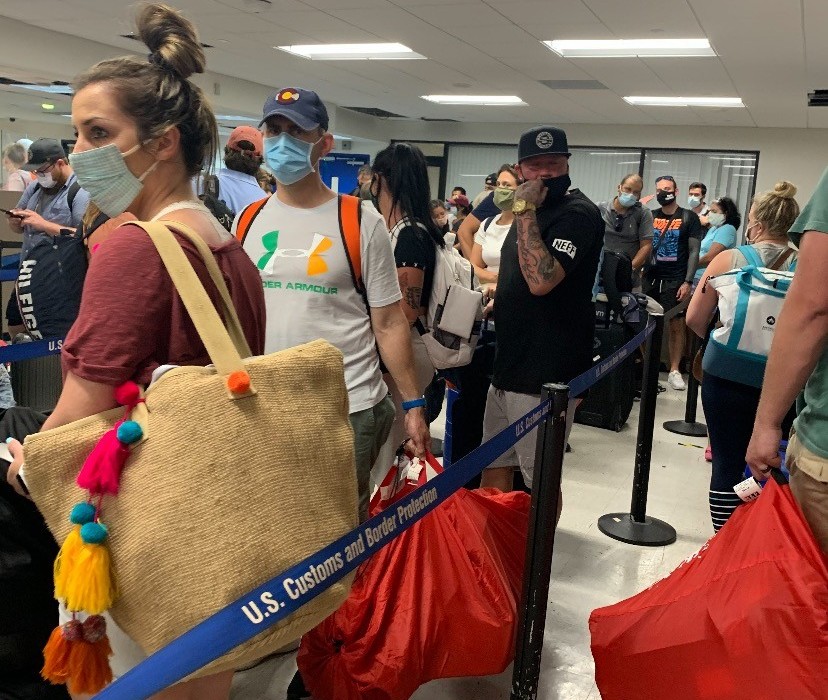
Travelers cram together in the line at the Cyril E. King Airport during last month’s Spring Break.
(Photo by Harleigh Stoltz)

Travel into the U.S. Virgin Islands during the COVID-19 pandemic is increasing, and Port Authority Executive Director Carlton Dowe said Cyril E. King Airport is running at three times the capacity its facilities were originally built to handle.

During Wednesday’s monthly Port Authority board meeting, held at the authority’s administrative offices adjacent to the airport, Dowe glanced out the window at the tarmac and said, “In a minute jets will start landing and it’s like J’ouvert morning at the airport.”

While Dowe acknowledged the influx of travelers into the territory is “not a bad problem to have,” he said the situation demands attention from both local and federal instrumentalities, and investments are needed in the aging airport to keep up with heavy demand from vacation-starved visitors.

“That’s why it is important for all the government entities, counsel, the federal government, everybody to recognize and understand that this airport was designed to accommodate 300,000 passengers when it was constructed many years ago,” Dowe said. “Today we are seeing close to 900,000 people going through the very same footprint that was designed to only accommodate 300,000 people.”
Advertising (skip)

While additional funding may be needed, the Port Authority has begun spending the $27 million it received last year as a grant from the U.S. Department of Commerce’s Economic Development Administration to begin new construction on the Cyril E. King airport. Nearly all the funding, $20 million, is being used for a parking and transportation center that will provide nearly 700 parking spots, in addition to a designated location for ground transportation and a location allocated solely for rental cars.

Port Authority Assistant Executive Director and Director of Engineering Damian Cartwright has previously told the Legislature that Cyril E. King Airport renovations alone will cost an estimated $250 million.

But the airport on St. Thomas is not the only one bustling with visitors.

“It’s interesting what you see at St. Croix,” Dowe said while directing meeting attendees to a photograph taken at the Henry E. Rohlsen Airport. “You can see what the line looks like and it makes the expansion very critical.”

“We’re seeing an uptick on the [airlift] and an uptick on activity at the St. Croix airport itself … we don’t see that too often,” Dowe said.

While board members seemed encouraged by the arrival of tourists flooding into the territory, Dowe said the authority must confront the need for funding head-on.

“The challenges are real, and they will be there,” Dowe said. “But we just have to make the best, but we definitely have to get that kind of funding, that investment. That investment must come not just from local government, but the federal government must play a critical role to help us expand.”

Posted in Fun | Comments Off on A Story I’ve Missed Totally . . .

Washington Post: Investigation suppressed by Trump administration reveals obstacles to hurricane aid for Puerto Rico

PLEASE READ: From the Thursday, 22 April 2021, Washington Post:

https://www.washingtonpost.com/business/2021/04/22/puerto-rico-hurricane-trump-hud/

The Trump machinations to subvert all forms of governance, including humanitarian assistance, is at least disgusting.

Business
Investigation suppressed by Trump administration reveals obstacles to hurricane aid for Puerto Rico
A watchdog report uncovers bureaucratic hurdles the administration erected for the island to receive aid after Hurricanes Irma and Maria

A Puerto Rican flag flies on an empty beach at Ocean Park in San Juan last May. (Carlos Giusti/AP)
By. Tracy Jan and Lisa Rein April 22, 2021 at 6:00 a.m. EDT

The Trump administration put up bureaucratic obstacles that stalled approximately $20 billion in hurricane relief for Puerto Rico and then obstructed an investigation into the holdup, according to an inspector general report obtained by The Washington Post.

Congress requested the investigation into the delays to recovery aid for Puerto Rico after Hurricanes Irma and Maria in 2017 left residents of the U.S. territory without power and clean water for months. But, the report said, former Housing and Urban Development secretary Ben Carson and another former HUD official declined to be interviewed by investigators during the course of the 2019 examination.

Access to HUD information was delayed or denied on several occasions. Several former senior administration officials in the Office of Management and Budget refused to provide requested information about decision-making related to the Puerto Rico relief funds.

“Delays and denials of access and refusals to cooperate negatively affected the ability of the [Office of Inspector General] to conduct this review,” the report said.

The 46-page report presents an incomplete picture of the political influence of the Trump White House on delaying disaster relief for the struggling island.

Still, Inspector General Rae Oliver Davis, appointed by Trump as top HUD watchdog, found unprecedented procedural hurdles set by the White House budget office — in addition to an extended partial federal government shutdown that also produced delays.

The OMB required HUD’s notice of grant funds to go through an interagency review process before approval, preventing HUD from publishing its draft notice of funding by its target date. The OMB had never before required such a review process for a notice allocating disaster-recovery funds, according to the inspector general’s report, and there had been no previous discussion about requiring the extra step.

One senior HUD official, Stan Gimont, then the deputy assistant secretary for grant programs, bemoaned the tedious review process imposed by the White House budget office as “kind of like Groundhog Day, just keeps coming back. And that’s … where your frustration will set in. … It’s almost like we’re going to keep bringing this back to you until you just eat it,” the report said.

While investigators interviewed 20 current and former HUD officials and two Puerto Rico housing officials, they had no access to Carson. Several senior political appointees at HUD withheld answers to questions, and White House budget office officials involved in delaying the timing of the aid also refused to cooperate.

The report said Carson and then-HUD Deputy Secretary Brian Montgomery had expressed “mounting concerns and frustrations” to then-acting OMB director Russell Vought about “HUD’s inability to make progress” on disbursing the funds. At one point, Montgomery told Vought that the White House’s actions were tantamount to holding disaster-relief funds “hostage,” the report said.

But the inspector general said given the lack of cooperation, investigators were unable to determine why the extra layer of review was required.

Trump officials hindered at least nine key oversight probes, watchdogs said. Some may finally be released in coming months.

HUD had initially intended to publish a funding notice that would have applied to all 16 jurisdictions receiving hurricane relief, but OMB urged the agency to issue separate notices for Puerto Rico and the U.S. Virgin Islands, the report said. Carson reluctantly agreed on the grounds that the agency was concerned over alleged corruption and fiscal mismanagement on the island.

The Post had previously reported that President Donald Trump repeatedly told aides that disaster relief allocated for Puerto Rico must be closely monitored because he believed the territory’s government is corrupt and the economy was in poor shape before the hurricanes devastated the island. Trump had also told then-White House Chief of Staff John F. Kelly and then-OMB Director Mick Mulvaney that he did not want a single dollar going to Puerto Rico, and instead, he wanted more of the money to go to Texas and Florida.

The White House budget office also insisted on overhauls to Puerto Rico’s property-management records, suspension of its minimum wage on federal contracts, and other prerequisites to access relief funds, prompting Montgomery to question whether HUD had the legal authority to enforce such requirements, the report said.

“How many poison pills are in here?” Montgomery wrote in an email to other senior HUD officials, according to the report.

“Montgomery said he did not believe that HUD could coerce Puerto Rico to fix its property-tax system to receive mitigation funding because the property-tax system was not related to mitigation activities,” the report said. “He also indicated that HUD did not put these types of conditions on other disaster-recovery grantees.”

The report, expected to be released publicly as early as Thursday, comes five months after Trump’s reelection defeat.

It is one of numerous politically sensitive investigations by federal watchdogs who are mandated by Congress to monitor agencies for waste, fraud and misconduct that was impeded by the last administration.

Damaging disclosures about former transportation secretary Elaine Chao, former White House physician Ronny Jackson, former secretary of state Mike Pompeo and other Trump officials were made public months after they left office.

At least a dozen other investigations have yet to be completed, in part because of unprecedented delays to inquiries by inspectors general.

Other overdue reports include an inquiry by the Commerce Department watchdog into the administration’s controversial decision to add a question on citizenship to the U.S. Census; two long-running ethics probes of Ryan Zinke, Trump’s first Interior secretary; and an audit of a $400 million contract to build the border wall that was awarded at Trump’s urging to a North Dakota construction firm whose top executive was a prominent GOP donor.

After butting heads with Trump administration, top HUD official departs agency

Davis took the unusual step of laying out the administration’s obstruction at the top of the HUD report. The report also notes that Trump administration officials delayed investigators’ access to emails and other electronic documents, invoking the privilege claimed by the president, known as executive privilege, of withholding information in the public interest.
Advertisement

HUD demanded that agency attorneys sit in on investigators’ interviews with Carson and other political appointees, the report said, a tactic widely used during the Trump administration that watchdogs worried could unduly shape testimony. Davis had previously expressed concern to congressional staffers about HUD attorneys’ desire to be present for witness testimonies.

While Carson was never interviewed, other former political appointees eventually agreed to be interviewed without an agency lawyer, but then refused to answer certain questions, the report said.

HUD did not immediately respond to a request for comment about the inspector general’s findings.

The Biden administration this week removed what it called “onerous restrictions unique to Puerto Rico that limited the island’s access” to disaster recovery funds and announced the obligation of $8.2 billion in federal mitigation funds.

Among the eliminated restrictions are the incremental grant obligations and review by a federal financial monitor to oversee the aid, as well as additional oversight by the U.S. territory’s federally mandated fiscal control board beyond what is already required by law, HUD said in its announcement.

“Since its first days, the Biden-Harris Administration has prioritized action to enable stronger recovery for Puerto Rico,” said HUD Secretary Marcia L. Fudge in a statement, adding that the new administration’s actions would “unlock access to funds Puerto Rico needs to recover from past disasters and build resilience to future storms, while ensuring transparency and accountability.”
– – – – – – – – – – – – – – – – – – –
Tracy Jan
Tracy Jan covers the intersection of race and the economy for The Washington Post, a beat she launched in December 2016. She previously was a national political reporter at the Boston Globe.

Lisa Rein
Lisa Rein covers federal agencies and the management of government in the Trump administration. At The Washington Post, she has written about the federal workforce; state politics and government in Annapolis, and in Richmond; local government in Fairfax County, Va.; and the redevelopment of Washington and its neighborhoods.

Posted in Fun | Comments Off on Washington Post: Investigation suppressed by Trump administration reveals obstacles to hurricane aid for Puerto Rico

The Romance of Corporate Tax Rates: US Tax Rates One-third of Other Industrial Nations

Dozens of America’s biggest businesses
paid no federal income tax — again
55 corporations had zero federal tax liability in 2020, including household names like Nike, FedEx and Dish Network, analysis finds

White House press secretary Jen Psaki points to a corporate tax rate chart last week during a news briefing. Last year, 55 of the nation’s largest corporations paid no federal income tax on more than $40 billion in profits, research shows. (Demetrius Freeman/The Washington Post)

By Christopher Ingraham April 5, 2021 at 6:00 a.m. EDT

Fifty-five of the nation’s largest corporations paid no federal income tax on more than $40 billion in profits last year, according to an analysis by the Institute on Taxation and Economic Policy, a progressive think tank.

In fact, they received a combined federal rebate of more than $3 billion, for an effective tax rate of about negative 9 percent.

“Their total corporate tax breaks for 2020, including $8.5 billion in tax avoidance and $3.5 billion in rebates, comes to $12 billion,” according to the study’s authors, Matthew Gardner and Steve Wamhoff.

The findings also underscore the favorable tax environment for big businesses in the wake of the 2017 Trump tax cuts. Twenty-six corporations have paid no federal income taxes since 2017, according to the report, including such household names as Nike, FedEx and Dish Network. Combined, the 26 companies have booked more than $77 billion in profits since 2018, while receiving nearly $5 billion in rebates, for an effective three-year tax rate of negative 6 percent.

A FedEx spokesman shared a statement from the company noting that “FedEx pays all of its taxes owed to local, state, federal, and foreign governments,” and that “through the third quarter of fiscal year 2021, FedEx has paid nearly $2 billion in U.S. federal income tax in the last 10 years.”

Representatives from Dish Network declined to comment, while Nike did not respond to a request for comment.

“By all appearances, the companies described in this report appear to be using entirely legal means to reduce their tax bills,” Gardner, the study’s lead author, said via email. But that doesn’t mean the companies are “blameless,” he added. “Many of the tax provisions these companies are using exist because they themselves have lobbied heavily for their creation.”

Those provisions include tax breaks for stock options given to chief executives as part of their pay packages, credits for research and experimentation, and write-offs for renewable energy and capital investments. The 2017 Tax Cuts and Jobs Act’s dramatic cut to the corporate income tax rate, from 35 to 21 percent, also plays a role in the limited tax liabilities facing many major corporations.

But Gardner says the generous carve-outs, not the baseline rate itself, are driving much of the phenomenon.

“We all want to see businesses investing more in the U.S., whether it’s creating productive capacity or just creating jobs,” he said. “Similarly, all Americans want to see businesses engaging in more research and development, and the R&D tax credit is another prominent factor driving the tax avoidance we see here.”

But there’s little evidence demonstrating that these provisions actually boost investment or R&D, Gardner says. Following the Trump tax cuts, for instance, many businesses opted to send cash to their shareholders and lay off employees rather than make long-term investments.

Speaking last month before the Senate Finance Committee, Kimberly A. Clausing, a deputy assistant secretary for tax analysis at the U.S. Treasury, said the Trump tax cuts roughly halved corporate tax revenue as a share of gross domestic product. While other wealthy nations typically raise roughly 3 percent of GDP through corporate taxes, in the United States that share fell to just 1 percent following the 2017 changes to the tax code.

She also noted that before the pandemic, corporate profits as a share of GDP were running roughly twice as high as in the period from 1980 to 2000.

Nearly 7 in 10 Americans say corporations are paying too little in taxes, according to Gallup polling.

President Biden has called for a higher corporate tax rate to fund his package of infrastructure investments, as well as a higher minimum tax on income earned by American companies overseas. Speaking to reporters Friday, Biden said “we are asking corporate America to pay their fair share.”

His proposal “wouldn’t directly repeal any tax breaks,” Gardner said, “but would reduce the cost of many existing breaks. If this is what’s politically doable, it’s certainly better than doing nothing at all.”

Biden’s proposal is already generating opposition among business groups. “By significantly increasing taxes on corporations, the proposal would be counterproductive to the goal of increasing economic growth and job creation,” said Business Roundtable chief executive Joshua Bolten in a statement.

However, progressive groups have been supportive of the plan. In a statement, a group of left-leaning think tanks wrote that “robust taxation of corporations and the wealthy can directly counter damaging inequality, rebalance power in our economy, and increase the competitiveness of American workers.”

Christopher Ingraham

Christopher Ingraham writes about all things data. He previously worked at the Brookings Institution and the Pew Research Center. Follow

—————————————————

Posted in Fun | Comments Off on The Romance of Corporate Tax Rates: US Tax Rates One-third of Other Industrial Nations

Church Membership in US Continues to Slip

From the Washington Post: <https://www.washingtonpost.com/religion/2021/03/29/church-membership-fallen-below-majority/ >

Religion
Church membership in the U.S. has fallen
below the majority for the first time in nearly a century

By Sarah Pulliam Bailey March 29, 2021 at 6:03 p.m. EDT

The proportion of Americans who consider themselves members of a church, synagogue or mosque has dropped below 50 percent, according to a poll from Gallup released Monday. It is the first time that has happened since Gallup first asked the question in 1937, when church membership was 73 percent.

In recent years, research data has shown a seismic shift in the U.S. population away from religious institutions and toward general disaffiliation, a trend that analysts say could have major implications for politics, business and how Americans group themselves. In 2020, 47 percent of Americans said they belonged to a church, synagogue or mosque. The polling firm also found that the number of people who said religion was very important to them has fallen to 48 percent, a new low point in the polling since 2000.

For some Americans, religious membership is seen as a relic of an older generation, said Ryan Burge, an assistant professor of political science at Eastern Illinois University and a pastor in the American Baptist Church. Gallup’s data finds that church membership is strongly correlated with age: 66 percent of American adults born before 1946 belong to a church, compared with 58 percent of baby boomers, 50 percent of Generation X and 36 percent of millennials.

Burge said many Christians still attend church but do not consider membership to be important, especially those who attend nondenominational churches. But no matter how researchers measure people’s faith — such as attendance, giving, self-identification — Americans’ attachment to institutional religion is on the decline.
Image without a caption

Burge, who recently published a book about disaffiliating Americans called “The Nones: Where They Came From, Who They Are, and Where They Are Going,” predicts that in the next 30 years, the United States will not have one dominant religion.

“We have to start thinking about what the world looks like in terms of politics, policy, social service,” Burge said. “How do we feed the hungry, clothe the naked when Christians are half of what it was. Who picks up the slack, especially if the government isn’t going to?”

Christianity is declining at a rapid pace, but Americans still hold positive views about religion’s role in society

The coronavirus pandemic, which forced most churches to close in March 2020, has caused a major disruption to American religious life, with most people unable to join weekly mass gatherings. But polls have not found a dramatic impact on Americans’ religiosity in the past year. Americans are more likely than people in other countries to say that their religious faith has become stronger during the pandemic, according to the Pew Research Center.

Tara Isabella Burton, author of “Strange Rites: New Religions for a Godless World,” attributes the national decline in religious affiliation to two major trends among younger Americans. First, she points to broader shifts suggesting a larger distrust of institutions, including police and pharmaceutical companies. Some Americans are disillusioned by the behavior of religious leaders, including the Roman Catholic Church’s sexual abuse scandal and the strong White evangelical alignment with former president Donald Trump.

Southern Baptists see historic drop in membership

The other major trend Burton describes is how people are mixing and matching from various religious traditions to create their own. Many people who don’t identify with a particular religious institution still say they believe in God, pray or do things that tend to be associated with faith.

“Why shouldn’t I pray or meditate or attend a liturgy, or perhaps I feel closer to the divine when I can do something privately rather than something that’s prescribed for me,” she said. “It’s my own spin on it.”

Younger generations that grew up with the Internet have a different kind of relationship with information, texts and hierarchy, Burton said.

“Existing trends in American religious life were exacerbated by generations that grew up in Internet culture that celebrates ownership — the idea that you can re-create a meme or narrative,” she said. “You have ownership over curating your own experience.”

Shadi Hamid, a senior fellow at the Brookings Institution, argued in a recent essay for the Atlantic that what was once religious belief has been replaced by political belief in many communities.

On the political right, he said in an interview, conservative Christians focused on Trump as a political savior rather than focusing on their traditional questions of morality. Christians in the Republican Party, he said, are being less defined by their faith than by a set of more narrow concerns.

And on the political left, Hamid said, strains of “wokeism” have taken up religious notions like sin and excommunication and repurposed them for secular ends. Hamid said that because there aren’t clear leaders, such as priests or imams, or a transcendent source that defines belief, the standards for what is considered “woke” continues to change.

“The vacuum [of religion] can’t just remain a vacuum,” Hamid said. “Americans are believers in some sense, and there has to be structures of belief and belonging. The question is, what takes the place of that religious affiliation?”

Scott Clement contributed to this report.
Sarah Pulliam Bailey

Sarah Pulliam Bailey is a religion reporter, covering how faith intersects with politics and culture. She runs The Washington Post’s religion vertical. Before joining The Post, she was a national correspondent for Religion News Service.

Posted in Fun | Comments Off on Church Membership in US Continues to Slip

Atlantic Article on Effectiveness of New Technologies in Combating Covid-19

from The Atlantic, on-line at <https://www.theatlantic.com/health/archive/2021/03/three-ways-pandemic-has-bettered-world/618320/?utm_source=newsletter&utm_medium=email&utm_campaign=atlantic-daily-newsletter&utm_content=20210318&silverid=NDA2NzU4MTkyMTkwS0 >

Health
3 Ways the Pandemic Has Made the World Better

COVID-19 has inflicted devastating losses. It has also delivered certain blessings.
Zeynep Tufekci March 18, 2021

This has been a year of terrible loss. People have lost loved ones to the pandemic. Many have gotten sick, and some are still suffering. Children have lost a year of school. Millions have lost a steady paycheck. Some have lost small businesses that they’d built for decades. Almost all of us have lost hugs and visits and travel and the joy of gathering together at a favorite restaurant and more.

And yet, this year has also taught us much. Strange as it may sound, the coronavirus pandemic has delivered blessings, and it does not diminish our ongoing suffering to acknowledge them. In fact, recognizing them increases the chance that our society may emerge from this ordeal more capable, more agile, and more prepared for the future.

Here are three ways the world has changed for the better during this awful year.

1. We Now Know How to Code for Our Vaccines

Perhaps the development that will have the most profound implications for future generations is the incredible advances in synthetic messenger RNA (mRNA) biotechnologies.

We got our vaccines very fast—the previous record for vaccine development was four years, and that was set in the 1960s. This time, we developed multiple good COVID-19 vaccines in less than a year. Luck bought us some of that speed. For example, the HIV retrovirus is notoriously difficult to vaccinate against, and we still don’t have a vaccine for it. COVID-19 was much more susceptible, and billions of dollars in public money and a global sense of urgency pushed things along. Tragedy also sped things up: Because the pandemic was raging—more cases to test against—it was easier to get results from vaccine trials.
Recommended Reading

But amid all this came historic developments. The new mRNA technology, on which several vaccines—notably Pfizer-BioNTech’s and Moderna’s—are based, is an epochal scientific and technical breakthrough. We are now coding for vaccines, and thanks to advances in science and industrial production, we can mass-produce them and figure out how to deliver them into our cells in a matter of months.

This is all new. Neither Moderna nor BioNTech had a single approved product on the market before 2020. Each company essentially designed its vaccine on a computer over a weekend in January 2020—BioNTech’s took just a few hours, really. Both companies had vaccine candidates designed at least four weeks before the first confirmed U.S. COVID-19 fatality was announced, and Moderna was producing vaccine batches to be used for its trials more than a month before the World Health Organization declared a pandemic. In 2021, the companies together aim to produce billions of stunningly efficacious vaccine doses,

We know the principle behind vaccination: Once our immune system encounters a virus, it can learn how to fight it and remember how to do it the next time. Vaccines give our immune system the practice it needs, but it’s deliberately structured as an unfair fight. Until now, most of our current vaccines have been either weakened or completely deactivated viruses or, more recently, protein subunits: just a few fragments from the virus, called antigens. We’ve achieved extraordinary levels of effectiveness and safety with these techniques, but they still have downsides. In 1955, a botched batch of weakened polio vaccine killed 10 children and caused paralysis in hundreds. We’ve since made sure to never repeat that tragic failure, but producing vaccines from the actual pathogen still means handling the virus in the manufacturing process. The newer subunit vaccines hold a lot of promise, but come with their own challenges. Identifying the right subunit (or antigen) can be difficult, and these vaccines tend to produce weaker immune responses. Plus, it’s not like antigens are hanging out on a supermarket shelf. We grow them in cell systems like yeast or in E. coli—essentially hijacking their genetics to produce the antigens we want, and then harvesting the yield. It works, but it’s slower than the mRNA process.

The mRNA vaccines work differently. For these, scientists look at the genetic sequence of a virus, identify a crucial part—such as the spike protein, which it uses as a key to bind onto cells’ receptors in order to unlock and enter them—produce instructions to make just that part, and then send those instructions into our cells. After all, that’s what a virus does: It takes over our cells’ machinery to make more of itself. Except in this case, we instruct our cells to make only the spike portion to give our immune system practice with something that cannot infect us—the rest of the virus isn’t there!

Until this year, that was the dream behind the synthetic mRNA technologies: a dream with few, scattered adherents, uphill battles, and nothing to show for it but promise. This year, it became a reality.

Our cells have a remarkable kind of software—wetware—that uses the instructions in the DNA in our cells’ nuclei to produce proteins. If you imagine the assembled proteins as a Lego structure, the DNA is like the instruction booklet. But someone has to look at those instructions and put the blocks together in the right way. In the cell, a key part of this process is the messenger RNA: a short-lived, single-strand molecule that carries the instructions from the DNA in the nucleus to the protein-making factory outside it.

In 2020, we figured out how to make messenger RNA with precision, by programming the exact code we wanted, producing it at scale (a printing press for messenger RNA!), and figuring out a way to inject it into people so the fragile mRNA makes it into our cells. The first step was pure programming: Uğur Şahin, the CEO of BioNTech, sat at his computer and entered the genetic code of the spike protein of the mysterious virus that had emerged in Wuhan. Moderna employees had done the same thing the weekend after the genomic sequence was released on January 10. The Moderna vaccine candidate was called mRNA-1273 because it encoded all of the 1,273 amino acids in the SARS-CoV-2 spike protein—the code was so small that it could all be represented with little less than half the number of characters that fit on a single-spaced page.

The rest of the process relied on key scientific and industrial innovations that are quite recent. Messenger RNA are fragile—they disintegrate easily, as they are supposed to. The lipid nanoparticles we envelop them in to use as delivery systems were approved only in 2018. Plus, the viral spike protein is a notorious shape-shifter. It takes one form before it fuses with our cells and another one afterward. The latter, postfusion form did not work well at all for developing vaccines, and scientists only recently figured out how to stabilize a virus’ spike in its prefusion form.

Now that this process is in place, a host of possibilities have opened up. We may soon have vaccines for many other diseases that have eluded our grasp. Efforts are already under way, for example, for an mRNA vaccine for malaria—a parasite that each year kills hundreds of thousands of people, mostly children, and is notoriously hard to vaccinate against.

We may also finally get a new set of tools to better fight cancer. (Both Moderna and BioNTech were working on cancer treatments before pivoting to coronavirus vaccines.) The challenge with cancer is that it is our own cells gone awry. It is really difficult to find a way to kill just a patient’s cancer cells thoroughly without also killing healthy cells—and thus the patient. But synthetic mRNA can be encoded with only the specific mutation in one patient’s cancer cells—and if the cancer cells further mutate, those can be targeted as well.

This may allow us, finally, to transition from a broadcast-only model of medicine, wherein drugs are meant to be identical for everyone in a particular group, to targeted, individualized therapies. Plus, these technologies are suitable for small-scale but cheap-enough production: a development that can help us treat rare diseases that afflict only a few thousand people each year, and are thus usually ignored by mass-market-oriented medical technologies.

It’s also no coincidence that these two mRNA vaccines were the fastest to market. They can be manufactured rapidly and, crucially, updated blazingly fast. Şahin, the BioNTech CEO, estimates that six weeks is enough time for the company to start producing new boosters for whenever a new COVID-19 variant emerges. Pfizer and Moderna are both already working on boosters that better target the new variants we’ve seen so far, and the FDA has said it can approve these tweaks quickly.

2. We Actually Learned How to Use Our Digital Infrastructure

The internet, widespread digital connectivity, our many apps—it’s easy to forget how new most of this is. Zoom, the ubiquitous video service that became synonymous with pandemic work, and that so many of us are understandably a little sick of, is less than 10 years old. Same with the kind of broadband access that allowed billions to stream entertainment at home and keep in touch with family members and colleagues. Internet connectivity is far from perfect or equally distributed, but it has gotten faster and more expansive over the past decade; without it, the pandemic would have been much more miserable and costly.

Technology also showed how we could make our society function better in normal times.

Consider, for example, the advent of telehealth during the pandemic. Last summer, while a few hours away from home, I developed the same debilitating neck pain that I had experienced once before, about five years ago, on a different trip. It was instantly recognizable: sharp, relentless pain that radiated from where my neck joined my left shoulder; even a slight movement felt as if an army of tiny, poisonous spears were hitting that area.

Read: What a doctor learns from watching you on video chat

The previous time, I was told nothing could be done before I could see my doctor in person, many days later. Not so now: My doctor and I connected immediately through a new patient portal, which had a videochat option that had become available because of the pandemic. I described the problem and demonstrated my limited range of motion. He signed off by saying he’d send a prescription for oral corticosteroids to a nearby pharmacy. Just an hour later, and less than a full day after the onset of my symptoms, I was sitting in my car in the pharmacy’s parking lot, staring at the box of medicine in wonder. Previously, I had suffered through severe pain for multiple days, to the degree that I had started hallucinating from lack of sleep. This time, relief was right there in my hand.

According to the CDC, telehealth visits increased by 50 percent in the first quarter of 2020, compared with the same period in 2019. Such visits are clearly not appropriate for every condition, but when warranted, they can make it much easier for people to access medical help without worrying about transportation, child care, or excessive time away from work. Remote access to medical help has long been a request from people with disabilities and people in rural areas, for whom traveling to clinics can be an extra burden.

Work, too, has been transformed. Suddenly, hundreds of millions of people around the world had to figure out how to get things done without going into the office. It turns out that for many white-collar jobs, this is not just possible; it comes with a variety of upsides.

Commutes, to take one example, are unhealthy—they waste time and potentially increase our sedentary time, which is associated with many adverse health outcomes, and perhaps worst of all, driving is among the most dangerous activities we undertake each day. The competition to try to avoid long commutes distorts property values and can worsen inequality, as those with money pay extra to live near centers of work, while other residents can no longer afford to live there.

Unsurprisingly, many of my luckier friends—those able to work from home and who did not suffer directly from COVID-19—have been whispering about how much better their lives have gotten without commutes and with more flexibility.

Many events have become a lot more inclusive too. Throughout the past year, I’ve been able to attend conferences and talks I’d otherwise have no chance to participate in without extensive time and travel costs. I’ve also given talks during which I’ve interacted with folks from around the world, who might never have been in that “room” otherwise. And I’ve noticed that a broader range of experts can appear on TV, now that we’ve normalized calling in from one’s home office, living room, or even bedroom. In a world divided by visas, income inequalities, time constraints, and opportunity, why didn’t we just incorporate videoconferencing into more of our events before? Why didn’t we take questions from the audience not in the room? We should keep doing that after the pandemic as well.

I certainly miss some of the serendipitous conversations that conferences and other in-person events provided: not just during the talks, but in the corridors, or at breakfast before a panel. And it’s true, such events are a form of livelihood for many, and I’m not advocating for eliminating that income. It’s also not that we should never go back to the office, nor ignore all the issues that can stem from working outside of the office—especially the threat to work-life balance. Being in the same office also allows for conversations that go beyond strict work discussions, and the connections they foster. We might never be able to fully replicate those positives digitally, but we should still provide some remote access to those who would otherwise be completely left out.

3. We’ve Unleashed the True Spirit of Peer Review and Open Science

On January 10, 2020, an Australian virologist, Edward Holmes, published a modest tweet: “All, an initial genome sequence of the coronavirus associated with the Wuhan outbreak is now available at Virological.org here.” A microbiologist responded with “And so it begins!” and added a GIF of planes taking off. And so it did indeed begin: a remarkable year of open, rapid, collaborative, dynamic—and, yes, messy—scientific activity, which included ways of collaborating that would have been unthinkable even a few decades ago.

Holmes was announcing that a scientist in China, Zhang Yongzhen, had rushed to sequence the genome of the mystery virus from Wuhan—his team had worked practically nonstop, completing the sequencing a mere 40 hours after a virus sample had arrived in a box of dry ice at his Shanghai office. Without waiting for approval or official permission, Zhang also promptly shared the result with a consortium of researchers in Australia, giving them the go-ahead to post it online in an open depository.

Peer review—review by one’s fellow scientists—remains the cornerstone of the scientific process, and rightly so: Good science happens when members of a community dedicated to advancing our knowledge can examine findings, replicate results, test theories, and challenge one another.

However, peer review as a formal process—as it happens right now—is different from the idea and spirit of peer view. We have “peer reviewed” scientific journals in which scientists can publish their findings. But in a hard-to-believe-but-true twist, many of those journals—especially the highly prestigious ones that can help a scientist’s career—are privately owned by for-profit companies, even though the peer reviews are done for free, on a volunteer basis, on articles that are submitted by scientists who also don’t get paid by the journals.

Worse, after they go through the formal process at these for-profit journals, these papers are then put behind paywalls, meaning these companies then charge outrageous sums to academic libraries in universities—whose scientists have freely contributed the paper and the peer review. The companies block the general public from accessing them too, unless they also pay for them. These companies will even charge scientists for the privilege of making these papers “open access”—again, papers written by the very scientists who receive no financial benefit from charging the public!

It’s little wonder that these companies remain highly profitable while many academics are up in arms over this terrible process that impedes the dissemination of science! Unfortunately, scientists—especially those who are early in their career—feel compelled to keep participating in this system, because getting published is the coin of the realm for hiring, promotions, and prestige.

Well, no more. When the pandemic hit, it simply wasn’t tenable to keep playing the old, slow, closed game, and the scientific community let loose. Peer review—the real thing, not just the formal version locked up by for-profit companies—broke out of its constraints. A good deal of the research community started publishing its findings as “preprints”—basically, papers before they get approved by formal publications—placing them in nonprofit scientific depositories that had no paywalls. The preprints were then fiercely and openly debated—often on social media, which is not necessarily the ideal place for it, but that’s what we had. Sometimes, the release of data was even faster: Some of the most important initial data about the immune response to the worrisome U.K. variant came from a Twitter thread by a tired but generous researcher in Texas. It showed true scientific spirit: The researcher’s lab was eschewing the prestige of being first to publish results in a manuscript by allowing others to get to work as fast as possible. The papers often also went through the formal peer review as well, eventually getting published in a journal, but the pandemic has forced many of these companies to drop their paywalls—besides, the preprints on which the final papers are based remain available to everyone.

Working together, too, has expanded in ways that were hard to imagine without the new digital tools that allow for rapid sharing and collaboration, and also the sense of urgency that broke through disciplinary silos.

For example, in early 2020, after I started writing about the necessity of wearing a mask, it became clear that we also needed detailed scientific articles looking at the science of the efficacy of masks for dampening community transmission. The questions the topic touched on involved many disciplines, including infectious diseases, aerosol science, and sociology. So I teamed up with a group of scientists, doctors, researchers, and data analysts across the globe to co-write an academic paper, and from start to finish, it was like nothing I had done before. A lot of scientific work involves international teams, but this time we had assembled practically on the fly: the co-authors lived in cities as varied as Cape Town, South Africa; Beijing, China; Chapel Hill, North Carolina (me!); Stanford, California; and Oxford, England. We would eventually publish in the most highly cited scientific outlet in the world, the Proceedings of the National Academy of Sciences of the United States of America, which is more than 100 years old. Most of the tools we used, however—shared editing of scientific papers, videochat and other forms of meetings—weren’t widely available or as easy to use even just a few years ago.

Like many others, we didn’t wait for formal peer review to end before sharing our findings. We quickly put our paper onto a preprint server so that it could receive both open peer review from the scientific community and questions and comments from other relevant stakeholders, including policy makers and even ordinary people trying to puzzle through a confusing time. And feedback came in quickly: We received thoughtful and lengthy emails and Twitter corrections and comments, which were extremely useful—as well as much less useful contributions, which sometimes involved random people getting mad at us. I started categorizing the feedback on the sections I’d worked on, as did many of my collaborators. Even before the first round of formal peer reviews were in, we used that feedback to generate a new, stronger version, which we added to the preprint server. We then got our initial round of formal peer review—which we also found quite useful. We updated the paper again, resubmitted the new version to PNAS, and waited for a second round of peer review (which took many months, but was also very useful). Finally, about a year later: acceptance and formal publication.

I have to admit, the final published paper looks great on my CV, but our preprint had already been downloaded more than any other paper on that server. It has been cited hundreds of times, including in the highest-ranked medical and scientific journals in the world; contributed to the global scientific discourse; and played a crucial role in the adoption of mask mandates. We even had a celebratory happy hour—chatting about our lives; challenges; and new, shared friendship.

This process of open peer review is fast, dynamic, and, admittedly, messy; it’s not without its downsides. Too many sensationalist headlines have resulted from journalists rushing to write about not yet sufficiently evaluated preprints, without waiting for the process of open review and feedback to do its work. This can be confusing to the broader public. However, the explosion of preprints is sometimes portrayed as the downfall of formal peer review. It’s the opposite. No process that allows more insight into how the sausage gets made can avoid a glimpse of its less tasteful elements, but what we need to change is how we relate to science, not try to go back to the stilted, slow pre-pandemic world. We should embrace the extraordinary and robust process of open science and more peer review, as well as its dynamism, even as we establish new guardrails to contain its energy.

The pandemic happened at a moment of convergence for medical and digital technology and social dynamics, which revealed enormous positive potential for people. Nothing will erase the losses we experienced. But this awful year has nudged us toward dramatic improvements in human life, thanks to new biotechnologies, greater experience with the positive aspects of digital connectivity, and a more dynamic scientific process.

Still, let’s never do it again.

Zeynep Tufekci is a contributing writer at The Atlantic and an associate professor at the University of North Carolina. She studies the interaction between digital technology, artificial intelligence, and society.

Posted in Fun | Comments Off on Atlantic Article on Effectiveness of New Technologies in Combating Covid-19

Sint Maarten Accuses the Netherlands of Neo-colonial Paternalism in Covid-19 Assistance.

The Americas — this appeared in the 14 March, 2021, print edition of the Washington Post and at <https://www.washingtonpost.com/world/the_americas/coronavirus-sint-maarten-netherlands/2021/03/10/d2f58bea-80e9-11eb-81db-b02f0398f49a_story.html >

Racial reckoning in the Caribbean: Former colony confronts the Netherlands over coronavirus aid conditions

Sint Maarten Prime Minister Silveria Jacobs and Curaçao Prime Minister Eugene Rhuggenaath speak to reporters after the weekly council of ministers in The Hague in July as the Caribbean former colonies sought a coronavirus aid package. (Bart Maat/ANP/AFP via Getty Images)
By Anthony Faiola and Ana Vanessa Herrero
March 10, 2021 at 12:39 p.m. EST

Inside the prime minister’s office in the Caribbean nation of Sint Maarten, the walls of paradise were closing in.

In the former Dutch colony renowned for fish stews and rum cocktails on Great Bay Beach, the coronavirus pandemic had ground tourism to a halt, sparking a financial crisis akin to the aftermath of a hurricane. By December, Prime Minister Silveria Jacobs said, public coffers were so low that she didn’t know how she could continue to cover the government payroll.

She needed a financial lifeline. Four thousand miles away, Mother Holland was prepared to throw one — but with strings attached. What followed would be a racial reckoning in the Caribbean: a bitter dispute between Sint Maarten’s Dutch overseers in Europe and local politicians representing an island populated predominantly by Afro-Caribbeans and other people of color.

“This top-down approach definitely feels like reverting back to colonial times,” Jacobs said.

The pandemic has upended the economic fortunes of billions of people worldwide, exacerbating existing inequalities and ­creating new ones. In the case of Sint Maarten and the other Dutch autonomous islands in the Caribbean — Aruba and Curaçao — the economic upheaval has gone much further.

Broad demands from the Netherlands in exchange for millions of dollars’ worth of emergency aid are threatening to shift the balance of power between the former empire and its former colonies, reimposing the kind of oversight that the islanders thought they had left behind when they gained autonomy within the Kingdom of the Netherlands in 2010. Last week, Sint Maarten lawmakers filed a petition with a U.N. special rapporteur on racism accusing the Netherlands of “racial discrimination” and “violations of international rights.”
Image without a caption

Philipsburg, the capital of Sint Maarten, is pictured with Salt Pond in the foreground and Great Bay and the Caribbean Sea beyond. (Education Images/Universal Images Group via Getty Images)

The filing Tuesday, which seeks monitoring, documentation and action against alleged racist policies, comes two months after the Dutch government fell in a scandal involving the alleged racial profiling of benefits claimants in the Netherlands.

The fundamental claim now is that the Dutch government is using the pandemic to turn back the clock on colonial rule.

“They are trying to take full control of our democracy,” said Grisha Heyliger-Marten, the senior member of the Sint Maarten parliament who helped lead the petition effort. “They have for far too long ran with the narrative that our people are corrupt and incompetent.”

“It’s like Black Pete,” she said, referring to the blackface Christmas character still popular in the Netherlands. “They say that’s not racist, but it is. Just like what they’re trying to do to us now.”

The Dutch, however, see a problem that needs fixing, with the pandemic presenting an opportunity to overhaul islands that they say just don’t work. In exchange for millions of dollars in aid, they’re insisting on cuts to state salaries and benefits. They’re also demanding broad, long-term changes to local tax laws, labor codes, border controls and the education and health-care systems that could forever change the way of life in Sint Maarten, Curaçao and Aruba. All is to be done under the watchful eye of the new Caribbean Entity for Reform and Development, whose members will be appointed by the Dutch government in “consultation” with the islands.

Paul Blokhuis, the Dutch state secretary for health, welfare and sport, left, and KLM chief executive Pieter Elbers check an aircraft loaded with coronavirus vaccines leaving Amsterdam Airport Schiphol last month for the islands of Aruba and Bonaire. (Koen Van Weel/AFP/Getty Images)

Dutch officials say the pandemic has pulled back the curtain on years of mounting problems since autonomy was granted — including excessively high salaries for lawmakers and government ministers. In Sint Maarten, with a population of about 40,000, members of parliament earn upwards of $10,000 a month — amounts Dutch officials say are higher than comparable salaries in the Netherlands. (Officials in Sint Maarten say the claim does not take into account the extra benefits and allowances granted to their Dutch counterparts.)

For the Dutch, it feels like 2017, when Sint Maarten was devastated by Hurricane Irma. The country, which shares an island with the French overseas collectivity of St. Martin, needed hundreds of millions of dollars in aid. Dutch officials say taxpayers in the Netherlands are again being asked to open their pockets for islands that are meant to be self-sustaining. Since the pandemic reached the Caribbean, they say, they have been feeding thousands of islanders through food programs and offering medical equipment and coronavirus vaccines through grants, in addition to tens of millions of dollars’ worth of loans for fiscal support.
Image without a caption

A rescue plane lands at the Princess Juliana Airport in St. Martin on Sept. 12, 2017, days after Hurricane Irma devastated the island. (Jose Jimenez/Getty Images)

Dutch officials insist that Sint Maarten — whose politicians have been the most vocal among the former colonies in condemning the Dutch demands, and held out the longest before agreeing to them — has not managed to create a functioning and fair society. They say they’re trying to push it toward that goal now. They point to allegations of rampant political corruption and stubbornly high levels of poverty on an island that’s a haven for mega-yachts and the billionaires who love them.

“If they feel colonized by us still today, they could jump out of the kingdom — that’s totally up to them,” said Raymond Knops, the Dutch cabinet minister for kingdom affairs. He said the Dutch demands had to do with guilders and euros, not “racism or post-colonial action.”

“Because of this crisis . . . they weren’t autonomous at all and they had to ask for money somewhere else — in this case, the Dutch government,” Knops said. “That makes this relationship a little bit contentious.” He added that he hoped they could achieve “real autonomy” and that “all these things we’re doing will help them get stronger.”

Sint Maarten voted for autonomy in 2000. The three Dutch Caribbean islands that chose to remain as closer “municipalities” within the Netherlands — Bonaire, St. Eustatius and Saba — are not being targeted. Critics say the Netherlands is singling out for punishment the islands that chose greater freedom.

Sint Maarten maintains its own parliament and police force; its defense and the judicial system are still run by the Dutch. It rests on an island slightly larger than The Hague. The island was divided in the 17th century between the Netherlands and France, whose relationship with its territory has been markedly less adversarial.

Dutch soldiers return to the air base in Eindhoven, the Netherlands, on Sept. 30, 2017, after assisting emergency services after Hurricane Irma in Sint Maarten. (AFP Contributor/AFP via Getty Images)

Dutch officials in Sint Maarten blame hyperbolic politicians for the discord. They say island leaders have refused to recognize the sacrifices Dutch taxpayers have made to support them. Ordinary islanders, they say, understand those sacrifices far better, and crave an end to the inefficiencies and corruption that plague the former colony.

“If you listen to stuff in the newspapers, and the politicians, you’ll hear words like ‘neocolonialism,’ ” all kinds of accusations against the Dutch,” said Chris Johnson, the Dutch representative to Sint Maarten. “But what civil servants are telling me is that they’re excited they’ll be able to look at their institutions and find out ways where they can be more efficient.”

At least some business leaders on the island agree.

“When a country is putting down hundreds of millions in aid, it is going to set conditions,” said Ricardo Perez, secretary of the Sint Maarten Hospitality and Trade Association. “Are the conditions hard? Definitely. But the government has not generated the level of confidence for the Netherlands to say, ‘Take the money and spend it however you want.’ ”

Yet the U.N. petition makes far broader allegations, asserting that racism has stained Dutch policy in the Caribbean.
AD

“Take a look at what the Dutch [government] is doing with respect to its own citizens in Europe, who are overwhelmingly White, in terms of covid assistance, covid relief for small business and being part of a funding mechanism for all of Europe,” said Peter Choharis, the Washington lawyer who filed the petition on behalf of Sint Maarten’s parliament. “Compare that to what they’re doing on the islands, which is, ‘You need to accumulate more debt and agree to our demands.’ ”

Rolando Brison, the head of Sint Maarten’s parliament, said 12 of the 15 members of the chamber backed the petition. But Dutch officials questioned its legality, ­arguing that its specific language had never been approved in a public hearing. They also said past legal challenges to Dutch fiscal edicts and claims of neocolonialism have been struck down by local courts.

“At the end of the day, sides will always have opinions on who is right and who is wrong,” Johnson said, “but it is the people that should be allowed to make the final call, so maybe we’ve reached the time for a constitutional referendum that asks the question: Independence, yes or no?”

Sint Maarten officials say they tried to avoid asking the Netherlands for fiscal help, but had no choice after Dutch officials effectively blocked their attempt to float a private bond offering last year. Dutch officials say they frowned on that deal because it smacked of “self-interest” for the politicians involved, and would have saddled the island with worse financial terms than zero-interest Dutch loans.

“You cannot come and use your money as a whipping tool to recolonize my country because a pandemic has put us in need,” ­Heyliger-Marten said. “You took everything from us already during colonization, and you left us with nothing. You guys were the pirates, you guys were corrupt. Don’t blame us now.”

Her husband, a former politician, was jailed on corruption charges. He denies the charges and is appealing them.

Jacobs, the prime minister, said she was grateful for the pandemic aid provided by the Dutch. She declined to say whether their demands amounted to racism.

“What it feels like, though, is a lack of respect, whether it’s because of race or whether it’s because we’re a small island,” she said, adding, “Draw your own conclusions.”

Correction: Grisha Heyliger-Marten’s name was misspelled in an earlier version of this article.

Posted in Disaster Management, Governance, politics, Small Island | Comments Off on Sint Maarten Accuses the Netherlands of Neo-colonial Paternalism in Covid-19 Assistance.

A Cautionary Tale

From The Washington Post: < https://www.washingtonpost.com/dc-md-va/2021/03/02/dc-bald-eagles/ >

A new, younger ‘First Lady’ bald eagle moves in at the National Arboretum

Image without a caption

A new, young female bald eagle has shown up at the nest of a bald eagle couple, Mr. President and the First Lady, in a tree on the grounds of the U.S. National Arboretum in Northeast Washington. (Courtesy of American Eagle Foundation/Friends of the National Arboretum)
By Dana Hedgpeth March 2, 2021 at 8:13 a.m. EST

There’s a new ‘First Lady’ in town.

A drama has been playing out between two female bald eagles in a nest that sits about 80 feet high in a tulip poplar tree at the National Arboretum in Northeast Washington.

Wildlife experts said a new, young female bald eagle arrived a few weeks ago and has pushed out and displaced the previous female bird — named the First Lady — from the nest. And the male bald eagle, Mr. President, is smitten.

It began in mid-February when watchers of live cameras at naeaglecam.org saw the happenings at the eagle nest as some new visitors arrived.

Dan Rauch, the District’s wildlife biologist, said the newest female visitor was one of five bald eagles — both male and female — that had recently checked out the nest. Often, the First Lady would come into the nest and chase off “any female spending any amount of time in the nest.”

“She would come in at 50 to 60 mph with the talons out,” Rauch said.

Mr. President tweets: The First Lady has laid an egg

There was one “altercation” between the two females, said Rauch, who caught a glimpse of it on the cameras. After the interaction, he said, the other female eagle “returned and the First Lady didn’t.” Wildlife experts said they last saw First Lady around Feb. 15.

Since then, the new female bald eagle has been cozying up to Mr. President in the nest.

“This one seems to have settled in,” Rauch said. “She immediately started to nuzzle his neck. They were food sharing and she was helping him get together the nest.”

Image without a caption

The young female bald eagle (left, with her back to the camera) is seen with Mr. President, the male bald eagle. (Courtesy of American Eagle Foundation/Friends of the National Arboretum)

He said the new female eagle also has been making “herself rather comfortable in the ‘nest cup,’” where she may lay eggs.

Bald eagles typically mate for life unless there’s a problem, Rauch said.

“They will mate for life as long as they’re successful, and having and raising chicks together,” Rauch said. “If they’re not successful, they will switch up partners and find new ones.”

It’s here! A baby bald eagle has hatched at a nest in D.C.

Mr. President and the First Lady had been together at the arboretum nest since 2014. The pair has laid and hatched seven chicks there, Rauch said. Their last chick hatched in 2018 and was named DC7, but it succumbed to West Nile virus. In the last two years, the bald eagle couple has had troubles producing offspring.

Image without a caption

Experts said the new female bald eagle is about 4 years old. (Courtesy of American Eagle Foundation/Friends of the National Arboretum)

So, it seems, Mr. President welcomed a new bird to the nest.

Rauch said Mr. President does tend to favor young female eagles. He estimated the new eagle is about 4 years old, judging by the chocolate coloring that’s sprinkled in on her white head. Mature bald eagles have completely white heads and they usually begin to mate at between 4 and 5 years old.

The new female bald eagle could be on the young side for mating and she may not be “mature enough to lay viable eggs,” Rauch said.

If the couple does lay eggs, now is the time to do it. Early February to mid-March is the typical “egg-laying” season, with the incubation period for bald eagles about 34 to 36 days.

Wildlife experts say they wouldn’t be surprised if Mr. President and his new, young female partner become parents.

Watch live: ‘Mr. President’ and ‘The First Lady’ nest at National Arboretum

The First Lady surprised wildlife experts in 2015 when she, as a young eagle, laid viable eggs. Rauch said that when those eggs hatched, Mr. President was the older, more mature bald eagle and knew what to do in feeding the chicks. Mr. President is between 11 and 12 years old.

“The First Lady was a younger eagle at the time and she didn’t know how to feed them,” Rauch said. “He kind of showed her.”

So far, Mr. President and his new female eagle appear to be hitting it off.

“They are constantly perched together, copulating and nest-building,” Rauch said.

Mr. President and the First Lady aren’t the only bald eagles in Washington to have a lover’s quarrel.

Two years ago, another bald eagle couple — Liberty and Justice — that live in a nest at the D.C. police training academy in Southwest Washington had been together for 14 years before trouble brewed. Justice, the male, went missing and two other male suitors — including one nicknamed “Aaron Burrd” by eagle watchers — showed up at the nest.

‘It’s a lot of drama at the nest this year’ for bald eagles in Washington

The bald eagle duo eventually got back together but moved their nest to a spot at Oxon Cove, off Interstate 295, according to Rauch. Last year, they had one chick.

As for the whereabouts of First Lady, no one is sure where she went. Experts said they plan to look for her during a helicopter flyover as they search for eggs along waterways in the Washington region.

Rauch said it’s possible she “moved off, looking for a new territory or mate.”
—————————————————

Posted in Fun | Comments Off on A Cautionary Tale