From the Outlook Section of the Sunday Washington Post

Building 5 residents —

I think we’re lucky at Severn House to have a talented and hard-working Condo Board, but many other associations in the Annapolis area are not so lucky. And we need to keep in mind that older developments require larger investments in major maintenance and renovation projects.

From the July 4th, Washington Post — < https://www.washingtonpost.com/outlook/surfside-condo-climate-change-cost/2021/07/01/b6699a98-da76-11eb-9bbb-37c30dcf9363_story.html >

OutlookPerspective

Climate change could cost condo boards billions. They aren’t ready for it.

The Surfside, Fla., building collapse is just one example of a bigger looming problem

Investigators are trying to figure out why Champlain Towers South in Surfside, Fla., collapsed. Climate change could leave other condo buildings around the country facing expensive repairs and upgrades to avoid disasters. (Octavio Jones/For The Washington Post)

The collapse of the Champlain Towers South condominium building in Surfside, Fla., is a terrible tragedy. Besides the stories of the victims and their grieving loved ones, early attention has focused on the causes of the collapse, such as how the building was constructed, the effects of saltwater on reinforced concrete and whether the condominium association was properly maintaining the high-rise.

Those are important matters, but the disaster exemplifies a bigger problem, one that will still loom once we have answers about what went wrong in Surfside: The untrained, unpaid and unsupervised volunteer directors of the nation’s more than 350,000 condo and homeowners’ associations, armed with limited financial resources, are expected to deal with the unprecedented infrastructure challenges that climate change poses to their communities. And there is no reason to believe that they are up to that task.

More than 20 percent of the U.S. population lives in property administered by condominium and homeowners’ associations, nonprofits run by volunteers elected by the owners. These directors and officers are responsible for an estimated $7 trillion worth of private property and infrastructure, including high-rise buildings, private streets, parks, pools, sewer and water systems, lakes, garages, and many other building systems and amenities

As condos and HOAs blossomed across the country in the last 50 years, little or no thought was given to the eventual effects of climate change, in terms of location or construction quality. The common-interest housing sector emerged in the 1960s as a way to put more people on less land, increasing developer profits and local property tax revenue. The model spread rapidly, and condos and HOAs are now the default options for new construction in many states, not just across the Sun Belt where they originated but in older metro areas as well.

Many locations are problematic from the outset. Developers often build in places that appeal to buyers but pose environmental challenges — such as on reclaimed wetlands or beaches next to rising seas, as in Surfside. Other developers place subdivisions at the top of artificial slopes that turn into mudslides in hundred-year storms, which now occur more often than they used to. Terrible disasters have struck neighborhoods built in areas that are prone to drought-induced wildfires. Local governments may approve these location decisions because they are great for sales and the property tax base, but they drop environmental issues right in the laps of condo and HOA boards.

Condo and homeowners’ associations were never designed or empowered to handle such conditions. These associations are essentially on their own, with virtually no support from any level of government. Although most of them operate well most of the time, paying for routine maintenance and repair has always been a challenge, long before climate change made things worse. For years, industry insiders have pointed out that although directors and officers are responsible for maintaining the property, most unit owners are notoriously unwilling to see their housing costs go up now to sock away funds for repairs in the future. Why, they ask, should they pay today so someone else can have a new roof long after they’ve moved out? Yet that is precisely what they are expected to do. Somehow, dozens, hundreds or even thousands of owners are supposed to overcome their self-interest and collective-action problems and commit to maintaining their private infrastructure in perpetuity.

Climate change made Arizona’s heat wave worse. And it won’t be the last one.

Now the maintenance and repair responsibilities that condo boards struggle with every day, with varying degrees of success, are being amplified by the effects of global climate change. It is increasingly clear that owner resources and volunteer expertise are inadequate to meet the challenge of maintaining buildings, preventing and mitigating climate-related damage, and restoring property that is severely harmed or even destroyed.

The Surfside disaster is an instructive example of an association faced with environmental challenges beyond its means. The 12-story condo tower with 136 units was built 40 years ago on reclaimed beachfront wetlands, where the proximity of a rising ocean, saltwater and gradual land subsidence have been constant threats to structural integrity. A few years ago, engineers told the condo board that they had an expensive problem on their hands with deteriorating reinforced concrete. After much internal back-and-forth, the board recently assessed a total repair cost on the owners of $15 million. That averages out to more than $110,000 per unit for this midsize association, an eye-popping figure for any homeowner and one that would undoubtedly put many into foreclosure for failure to pay. Repairs were set to begin soon; residents were initially supposed to decide whether to pay their share of the assessment at once or in monthly installments by this past Thursday.

Some are claiming that the collapse could have been avoided if better maintenance had been done earlier. Maybe. But there are thousands of beachfront condos on the Atlantic, Pacific and Gulf coasts. We cannot expect all of them to be maintained consistently to industry standards with sea level rise, storm surge, land subsidence and a host of other coastal climate issues in mind. We know there will always be some that risk skipping maintenance, thinking the worst won’t happen there.

Sea level rise is not the only climate-related problem that places owners in harm’s way and that local governments and developers never anticipated. It is clear by now that climate change produces heavy rainfall, including hurricanes and so-called 100-year storms, that can cause major flooding, landslides and other stormwater-related disasters. Condo and homeowners’ associations have been severely affected by such events, and developers have been sued from coast to coast over their failure to anticipate them and build accordingly. Expensive litigation after the fact is no substitute for prevention, but it is unrealistic to expect condominium and homeowner associations to undertake costly anticipatory measures. They have neither the expertise nor the resources to do so. In most cases, they don’t even know where to begin.

Many other communities have been built near places prone to wildfires, which have taken on new ferocity in drought conditions fueled by global warming. The costs of safeguarding neighborhoods against these fires are daunting for owners and associations, and prevention is almost entirely out of their hands. In 2003, wildfires destroyed 331 homes in Scripps Ranch, an upscale San Diego-area neighborhood where developer-created HOA requirements for wooden “shake” shingle roofs accelerated the destruction. The San Diego City Council banned these roofs in new construction, including for people who wanted to rebuild their homes. Yet they faced intense resistance from Scripps Ranch owners over proposed building code changes intended to protect their homes against future wildfires, because implementing those changes would have been expensive. Owners in a fire-prone area might be understandably angry if their association required them to pay for new roofs, elaborate sprinkler systems, doors and windows with heat-resistant double-glazed material, and special fire-retardant house paint. If local governments encounter pushback when they require such measures, it seems unlikely that condo and homeowners’ associations would adopt them voluntarily.

In effect, condo and HOA developments are a huge experiment in privatization of local government functions, and sometimes the offloading of government responsibilities goes too far. We can expect a condo or HOA board to handle garbage collection, get the leaves and snow removed from private streets, and broadly live up to its responsibilities to residents. But when private communities took off in the 1960s, we didn’t even know what climate change was. We cannot realistically expect condo boards to prevent damage from sea level rise, more-frequent severe storms, extreme heat and drought, and other major changes in the environment — especially not in buildings that weren’t built to withstand such conditions. If the proliferation of condos and HOAs is to continue in the time of climate change, federal, state and local governments must play a more supportive, directive and protective role. Otherwise, millions of owners and their volunteer community leaders will be swamped by forces beyond their control.

Image without a caption

By Evan McKenzie

Evan McKenzie teaches in the political science department and the law school at the University of Illinois at Chicago. He is the author of two books about condominium and homeowner associations.

—————————————————
Bruce Potter
764 Fairview Avenue
Annapolis, MD 21403

Bruce’s iPhone: 443/454-9044
” Blog: PottersWeal.com
See also: Kincey.org

E-mail: <bpotter@irf.org>
– – – – – – – – – – – – – – – – – – – – – – – – –

Posted in Fun | Comments Off on From the Outlook Section of the Sunday Washington Post

The Washington Post Officials worked secretly to clear Bob Baffert’s Justify amid 2018 Triple Crow n run, records show

Posted in Fun | Comments Off on The Washington Post Officials worked secretly to clear Bob Baffert’s Justify amid 2018 Triple Crow n run, records show

ISISA Today’s WorldView: A warning sign from the world’s most vaccinated country

Dear Huei-Min et al.

Thanks for sharing those and, yes, we were saddened to see the outbreak in Taiwan and hope that you get it back under control. We have had a recent outbreak again in Fiji stemming from poor quarantine management and security in relation to repatriated Fiji citizens from India. Had a four-day lockdown, 4 new cases yesterday, but were allowed out for part of today. Gain, hope we get through this.

Sincerely

Randy

Dr. Randolph R. Thaman
Emeritus Professor of Pacific Islands Biogeography
The University of the South Pacific
Suva, Fiji
thaman_r@usp.ac.fj

Posted in Fun | Comments Off on ISISA Today’s WorldView: A warning sign from the world’s most vaccinated country

ISISA Today’s WorldView: A warning sign from the world’s most vaccinated country

Thank you for sharing, Godfrey and Bruce.

I also share the case of Taiwan:

Taiwan is now under “the first wave” of community outbreak after the weekend of Mother’s Day (May 8-9) .

I happened has a webinar on April 29 that talked about how small islands in Taiwan keep no confirmed case but blooming tourism (with some figures), however it has been rapidly changed in Taiwan in the past weeks. More than 100 increased cases in Taipei and New Taipei city since May 15, while offshore islands fortunately still keep zero case so far. All offshore islands have announced restrictions of tourist from main island Taiwan two days ago. The attached is a brief update numbers, if you are interested.

For your information: https://edition.cnn.com/2021/05/17/asia/taiwan-covid-outbreak-intl-hnk/index.html

Today: https://focustaiwan.tw/society/202105190001

Hope it could be contained soon (I hope and believe so)

Best wishes to all,

Huei-Min

****

Huei-Min Tsai, Ph.D.

Professor, Graduate Institute of Environmental Education

National Taiwan Normal University

Taipei, Taiwan

Email: hmtsai

Phone: +886-2-77496565 Fax: +886-2-29325570

From: ISISA@groups.io [mailto:ISISA@groups.io] On Behalf Of Godfrey Baldacchino
Sent: Tuesday, May 18, 2021 2:20 PM
To: ISISA@groups.io
Cc: Iain Orr; PottersWeal.com; Chile8
Subject: Re: [ISISA] Today’s WorldView: A warning sign from the world’s most vaccinated country

Thank you for sharing Bruce.

Malta also has a very high rate of vaccination; meanwhile, reported daily infection rates have gone down into the single digits. (A far cry from the record 510 cases of Covid-19 recorded in 24 hours on March 10.)

Tourism is picking up and restaurants will be able to serve dinner soon; though bars remain closed so far; and no mass gatherings are permitted.

Godfrey

On Mon, 17 May 2021 at 21:26, Bruce Potter <bpotter> wrote:

This effect (runaway COVID-19 infections) has also been seen in the tabulations of coronavirus infections among many global islands in addition to the Seychelles, that Iain Orr has been tabulating every few days since March 21, 2020, and which Godfrey Baldacchinno has been posting and updating on the ISISA.ORG website.

Bruce

Begin forwarded message:

From: The Washington Post <email>

Subject: Today’s WorldView: A warning sign from the world’s most vaccinated country

Date: May 10, 2021 at 12:00:06 AM EDT

To: bpotter

The Washington Post
Today's WorldView
Adam Taylor By Adam Taylor
with Claire Parker
f64e26ef3b53afcd222ecc49f65aa958-envelope_byline-40-32-70-8.png Email

A warning sign from the world’s most vaccinated country

Shoppers wearing masks are seen in Victoria, Seychelles on April 2. (The Yomiuri Shimbun via AP Images)

Shoppers wearing masks are seen in Victoria, Seychelles on April 2. (The Yomiuri Shimbun via AP Images)

As the Seychelles began to offer free coronavirus vaccinations early this year, President Wavel Ramkalawan told reporters that the country was planning to reach herd immunity within weeks.

It was an ambitious target for a small, geographically isolated island nation in the Indian Ocean. But with its economy heavily reliant on tourism, the country called in favors to attain a vaccine supply from regional allies, including India and the United Arab Emirates.

The effort initially seemed to be a success. The Seychelles stands as the most vaccinated nation on Earth, with more than 60 percent of its population fully vaccinated, more than other vaccine giants such as Israel and Britain, and almost twice the United States’ rate of vaccination. But that success was undermined last week as the Seychelles found itself with the world’s largest number of new coronavirus cases per capita and was forced to reinstate some restrictions.

imp?s=220945&li=todayworld&m=93426bbcac10f9a828619f1c469f2f5e&p=6098aeb79d2fdae3024a3ac5
imp?s=220948&li=todayworld&m=93426bbcac10f9a828619f1c469f2f5e&p=6098aeb79d2fdae3024a3ac5 imp?s=627513&li=todayworld&m=93426bbcac10f9a828619f1c469f2f5e&p=6098aeb79d2fdae3024a3ac5

Though the number of new cases is relatively low — peaking at an average of just under 150 new cases a day — they are a big deal in a country with a population of less than 100,000. On a per capita basis, the Seychelles outbreak is worse than India’s raging surge. In a small country, even a small number of cases can be overwhelming. “A spike in cases places an enormous burden on an already strained public health system,” said Malshini Senaratne, director of Eco-Sol, an environmental consultancy firm in the Seychelles.

With the country’s main treatment center for covid-19 patients nearing capacity and doctors and nurses among the sick, the Seychelles announced the return of coronavirus restrictions, school closures and limited opening hours for shops and restaurants. “These are an upward trend,” said Public Health Commissioner Jude Gedeon at a media briefing last week. “We do not know how long it will last, but this will depend on what measures are taken and how the new measures are respected.”

President of Seychelles Wavel Ramkalawan receives a dose of the Chinese covid-19 vaccine produced by Sinopharm at the Seychelles Hospital in Victoria in January. (Photo by Rassin Vannier/AFP via Getty Images)

President of Seychelles Wavel Ramkalawan receives a dose of the Chinese covid-19 vaccine produced by Sinopharm at the Seychelles Hospital in Victoria in January. (Photo by Rassin Vannier/AFP via Getty Images)

The Seychelles situation is being watched all over the world. “It is providing a critical case to consider the effectiveness of some vaccines and what range we have to reach to meet herd immunity,” said Yanzhong Huang, a senior fellow for global health at the Council on Foreign Relations.

Huang noted that other nations that had vaccinated large proportions of their populations, including Israel and Britain, had seen significant drops in new daily cases. Sherin Francis, chief executive of the Seychelles tourism board, said that while much of the population was vaccinated, there were pockets that were not.

imp?s=220950&li=todayworld&m=93426bbcac10f9a828619f1c469f2f5e&p=6098aeb79d2fdae3024a3ac5
imp?s=220953&li=todayworld&m=93426bbcac10f9a828619f1c469f2f5e&p=6098aeb79d2fdae3024a3ac5 imp?s=627512&li=todayworld&m=93426bbcac10f9a828619f1c469f2f5e&p=6098aeb79d2fdae3024a3ac5

Government data released lastweek found that of 1,068 active cases, around 65 percent involved residents who were either completely unvaccinated or had received only one dose. Francis emphasized that even people who have been vaccinated can get infected. “Vaccines are very effective at preventing serious illness and death; they are less good at preventing infection,” Francis said.

So far, the number of deaths in the Seychelles attributed to the virus is relatively low — 28 out of more than 6,000 cases, as of last week. Most of those infected have only mild symptoms, Tourism and Foreign Affairs Minister Sylvestre Radegonde told the Seychelles News Agency over the weekend.But the surge in new cases may also confirm that the vaccines being used in the country have comparatively low effectiveness.

Roughly 60 percent of the doses administered in Seychelles are vaccines made by the Chinese company Sinopharm that were donated to the Seychelles by the United Arab Emirates. The remaining doses are of the vaccine developed by AstraZeneca and produced by the Serum Institute of India.

In many ways, Seychelles government negotiations for vaccine supplies were savvy and speedy. But the country has ended up using two vaccines that appear to be less effective against symptomatic covid-19. The World Health Organization recently estimated the efficacy of the Sinopharm vaccine at just over 78 percent for adults under 60, with little data on its success with older patients. The UAE has asked some who received the Sinopharm vaccine to return for third doses, citing low immune responses, though officials said only a “very small number” need to do so.

Meanwhile, U.S. trials of AstraZeneca have found that the vaccine is 79 percent effective overall. Both vaccines are considerably lower in effectiveness than the vaccines developed by Pfizer and Moderna, which use mRNA technology and have reported effectiveness rates of around 95 percent.

Jennifer Huang Bouey, an epidemiologist who works with the Rand Corp., estimated that given what was known about the Seychelles’ vaccine rollout and the vaccines used, less than 49 percent of the population could be assumed to have immunity conferred by vaccines. “It is still far below the community-level protection requirement,” she said.

“It’s not surprising that they are not seeing a significant decline in cases,” CFR’s Huang said. “But what is surprising to me is that they’ve seen a significant increase in cases since late April.”

Footprints dot the sand on the beach on Mahe island, Seychelles in March 2019. (AP Photo/David Keyton)

Footprints dot the sand on the beach on Mahe island, Seychelles in March 2019. (AP Photo/David Keyton)

That rise in cases arrived after something else: the return of tourists to the Seychelles. But so far, the evidence linking the two is unclear.

After almost a year of strict border controls, the Seychelles announced early this year that it was opening back up to tourists beginning March 25. The government said there would be no quarantine requirements and that visitors would not need to be vaccinated, though they would need to show negative PCR tests taken less than 72 hours before travel. It was an important move for the Seychelles, which relies on tourism for about a quarter of its economy. Economic output declined by 13.5 percent in 2020, largely because of steep drops in tourism revenue, according to the World Bank.

While the number of new daily coronavirus cases has more than doubled since tourism restrictions were removed, only 10 percent of positive cases are among visitors to the island, according to Francis. Even so, the rise in new cases threatens to upend the country’s reopening to tourism. In one recent dispute, vaccinated Israeli travelers publicly complained of “false positive” coronavirus tests that disrupted their stay. The Seychelles Tourism Board refuted that claim on Friday.

“While applying restrictions, care has been taken to ensure that the visitor experience is not affected and that our visitors are still able to enjoy an uninterrupted holiday in Seychelles,” said Francis, adding that the country was able to guarantee PCR tests with results within 24 hours.

Huang Bouey said that while vaccines can help prevent deaths, there was increasing agreement among medical professionals that they alone could not stop new cases or outbreaks. “Quarantine, mask-wearing and crowd-avoiding should be part of the public health strategy,” she said.

Senaratne said it was possible that the Seychelles’ ongoing outbreak could drive away tourists and that the government was undertaking a “delicate balancing act between health and wealth management.”

“Covid-19 has starkly outlined the vulnerabilities of an island nation that remains highly dependent on tourism,” she said, adding that the country would need to diversify its economy. “While we hope the spread of the virus will be curbed in the short term, we cannot help but look uneasily towards the future.”

—————————————————
Bruce Potter
764C Fairview Avenue
Severn House Condominium
Annapolis, MD 21403

Bruce’s iPhone: 443/454-9044
" Blog: PottersWeal.com
See also: Kincey.org

E-mail: <bpotter>
– – – – – – – – – – – – – – – – – – – – – – – – –

Covid-19 & Islands (Tsai)-19 May 2021 Taiwan (1).pdf

Posted in Fun | Comments Off on ISISA Today’s WorldView: A warning sign from the world’s most vaccinated country

ISISA Today’s WorldView: A warning sign from the world’s most vaccinated country

Thank you for sharing Bruce.

Malta also has a very high rate of vaccination; meanwhile, reported daily infection rates have gone down into the single digits. (A far cry from the record 510 cases of Covid-19 recorded in 24 hours on March 10.)

Tourism is picking up and restaurants will be able to serve dinner soon; though bars remain closed so far; and no mass gatherings are permitted.

Godfrey

On Mon, 17 May 2021 at 21:26, Bruce Potter <bpotter> wrote:

This effect (runaway COVID-19 infections) has also been seen in the tabulations of coronavirus infections among many global islands in addition to the Seychelles, that Iain Orr has been tabulating every few days since March 21, 2020, and which Godfrey Baldacchinno has been posting and updating on the ISISA.ORG website.

Bruce

Begin forwarded message:

From: The Washington Post <email>

Subject: Today’s WorldView: A warning sign from the world’s most vaccinated country

Date: May 10, 2021 at 12:00:06 AM EDT

To: bpotter

The Washington Post
Today's WorldView
Adam Taylor By Adam Taylor
with Claire Parker
f64e26ef3b53afcd222ecc49f65aa958-envelope_byline-40-32-70-8.png Email

A warning sign from the world’s most vaccinated country

Shoppers wearing masks are seen in Victoria, Seychelles on April 2. (The Yomiuri Shimbun via AP Images)Shoppers wearing masks are seen in Victoria, Seychelles on April 2. (The Yomiuri Shimbun via AP Images)

As the Seychelles began to offer free coronavirus vaccinations early this year, President Wavel Ramkalawan told reporters that the country was planning to reach herd immunity within weeks.

It was an ambitious target for a small, geographically isolated island nation in the Indian Ocean. But with its economy heavily reliant on tourism, the country called in favors to attain a vaccine supply from regional allies, including India and the United Arab Emirates.

The effort initially seemed to be a success. The Seychelles stands as the most vaccinated nation on Earth, with more than 60 percent of its population fully vaccinated, more than other vaccine giants such as Israel and Britain, and almost twice the United States’ rate of vaccination. But that success was undermined last week as the Seychelles found itself with the world’s largest number of new coronavirus cases per capita and was forced to reinstate some restrictions.

imp?s=220945&li=todayworld&m=93426bbcac10f9a828619f1c469f2f5e&p=6098aeb79d2fdae3024a3ac5
imp?s=220948&li=todayworld&m=93426bbcac10f9a828619f1c469f2f5e&p=6098aeb79d2fdae3024a3ac5 imp?s=627513&li=todayworld&m=93426bbcac10f9a828619f1c469f2f5e&p=6098aeb79d2fdae3024a3ac5

Though the number of new cases is relatively low — peaking at an average of just under 150 new cases a day — they are a big deal in a country with a population of less than 100,000. On a per capita basis, the Seychelles outbreak is worse than India’s raging surge. In a small country, even a small number of cases can be overwhelming. “A spike in cases places an enormous burden on an already strained public health system,” said Malshini Senaratne, director of Eco-Sol, an environmental consultancy firm in the Seychelles.

With the country’s main treatment center for covid-19 patients nearing capacity and doctors and nurses among the sick, the Seychelles announced the return of coronavirus restrictions, school closures and limited opening hours for shops and restaurants. “These are an upward trend,” said Public Health Commissioner Jude Gedeon at a media briefing last week. “We do not know how long it will last, but this will depend on what measures are taken and how the new measures are respected.”

President of Seychelles Wavel Ramkalawan receives a dose of the Chinese covid-19 vaccine produced by Sinopharm at the Seychelles Hospital in Victoria in January. (Photo by Rassin Vannier/AFP via Getty Images)President of Seychelles Wavel Ramkalawan receives a dose of the Chinese covid-19 vaccine produced by Sinopharm at the Seychelles Hospital in Victoria in January. (Photo by Rassin Vannier/AFP via Getty Images)

The Seychelles situation is being watched all over the world. “It is providing a critical case to consider the effectiveness of some vaccines and what range we have to reach to meet herd immunity,” said Yanzhong Huang, a senior fellow for global health at the Council on Foreign Relations.

Huang noted that other nations that had vaccinated large proportions of their populations, including Israel and Britain, had seen significant drops in new daily cases. Sherin Francis, chief executive of the Seychelles tourism board, said that while much of the population was vaccinated, there were pockets that were not.

imp?s=220950&li=todayworld&m=93426bbcac10f9a828619f1c469f2f5e&p=6098aeb79d2fdae3024a3ac5
imp?s=220953&li=todayworld&m=93426bbcac10f9a828619f1c469f2f5e&p=6098aeb79d2fdae3024a3ac5 imp?s=627512&li=todayworld&m=93426bbcac10f9a828619f1c469f2f5e&p=6098aeb79d2fdae3024a3ac5

Government data released lastweek found that of 1,068 active cases, around 65 percent involved residents who were either completely unvaccinated or had received only one dose. Francis emphasized that even people who have been vaccinated can get infected. “Vaccines are very effective at preventing serious illness and death; they are less good at preventing infection,” Francis said.

So far, the number of deaths in the Seychelles attributed to the virus is relatively low — 28 out of more than 6,000 cases, as of last week. Most of those infected have only mild symptoms, Tourism and Foreign Affairs Minister Sylvestre Radegonde told the Seychelles News Agency over the weekend.But the surge in new cases may also confirm that the vaccines being used in the country have comparatively low effectiveness.

Roughly 60 percent of the doses administered in Seychelles are vaccines made by the Chinese company Sinopharm that were donated to the Seychelles by the United Arab Emirates. The remaining doses are of the vaccine developed by AstraZeneca and produced by the Serum Institute of India.

In many ways, Seychelles government negotiations for vaccine supplies were savvy and speedy. But the country has ended up using two vaccines that appear to be less effective against symptomatic covid-19. The World Health Organization recently estimated the efficacy of the Sinopharm vaccine at just over 78 percent for adults under 60, with little data on its success with older patients. The UAE has asked some who received the Sinopharm vaccine to return for third doses, citing low immune responses, though officials said only a “very small number” need to do so.

Meanwhile, U.S. trials of AstraZeneca have found that the vaccine is 79 percent effective overall. Both vaccines are considerably lower in effectiveness than the vaccines developed by Pfizer and Moderna, which use mRNA technology and have reported effectiveness rates of around 95 percent.

Jennifer Huang Bouey, an epidemiologist who works with the Rand Corp., estimated that given what was known about the Seychelles’ vaccine rollout and the vaccines used, less than 49 percent of the population could be assumed to have immunity conferred by vaccines. “It is still far below the community-level protection requirement,” she said.

“It’s not surprising that they are not seeing a significant decline in cases,” CFR’s Huang said. “But what is surprising to me is that they’ve seen a significant increase in cases since late April.”

Footprints dot the sand on the beach on Mahe island, Seychelles in March 2019. (AP Photo/David Keyton)Footprints dot the sand on the beach on Mahe island, Seychelles in March 2019. (AP Photo/David Keyton)

That rise in cases arrived after something else: the return of tourists to the Seychelles. But so far, the evidence linking the two is unclear.

After almost a year of strict border controls, the Seychelles announced early this year that it was opening back up to tourists beginning March 25. The government said there would be no quarantine requirements and that visitors would not need to be vaccinated, though they would need to show negative PCR tests taken less than 72 hours before travel. It was an important move for the Seychelles, which relies on tourism for about a quarter of its economy. Economic output declined by 13.5 percent in 2020, largely because of steep drops in tourism revenue, according to the World Bank.

While the number of new daily coronavirus cases has more than doubled since tourism restrictions were removed, only 10 percent of positive cases are among visitors to the island, according to Francis. Even so, the rise in new cases threatens to upend the country’s reopening to tourism. In one recent dispute, vaccinated Israeli travelers publicly complained of “false positive” coronavirus tests that disrupted their stay. The Seychelles Tourism Board refuted that claim on Friday.

“While applying restrictions, care has been taken to ensure that the visitor experience is not affected and that our visitors are still able to enjoy an uninterrupted holiday in Seychelles,” said Francis, adding that the country was able to guarantee PCR tests with results within 24 hours.

Huang Bouey said that while vaccines can help prevent deaths, there was increasing agreement among medical professionals that they alone could not stop new cases or outbreaks. “Quarantine, mask-wearing and crowd-avoiding should be part of the public health strategy,” she said.

Senaratne said it was possible that the Seychelles’ ongoing outbreak could drive away tourists and that the government was undertaking a “delicate balancing act between health and wealth management.”

“Covid-19 has starkly outlined the vulnerabilities of an island nation that remains highly dependent on tourism,” she said, adding that the country would need to diversify its economy. “While we hope the spread of the virus will be curbed in the short term, we cannot help but look uneasily towards the future.”

—————————————————
Bruce Potter
764C Fairview Avenue
Severn House Condominium
Annapolis, MD 21403

Bruce’s iPhone: 443/454-9044
" Blog: PottersWeal.com
See also: Kincey.org

E-mail: <bpotter>
– – – – – – – – – – – – – – – – – – – – – – – – –

_._,_._,_

Posted in Fun | Comments Off on ISISA Today’s WorldView: A warning sign from the world’s most vaccinated country

Today’s WorldView: A warning sign from the world’s most vaccinated country

This effect (runaway COVID-19 infections) has also been seen in the tabulations of coronavirus infections among many global islands in addition to the Seychelles, that Iain Orr has been tabulating every few days since March 21, 2020, and which Godfrey Baldacchinno has been posting and updating on the ISISA.ORG website.

Bruce

Begin forwarded message:

From: The Washington Post <email>

Subject: Today’s WorldView: A warning sign from the world’s most vaccinated country

Date: May 10, 2021 at 12:00:06 AM EDT

To: bpotter

The Washington Post
Today's WorldView
Adam Taylor By Adam Taylor
with Claire Parker
f64e26ef3b53afcd222ecc49f65aa958-envelope_byline-40-32-70-8.png Email

A warning sign from the world’s most vaccinated country

Shoppers wearing masks are seen in Victoria, Seychelles on April 2. (The Yomiuri Shimbun via AP Images)Shoppers wearing masks are seen in Victoria, Seychelles on April 2. (The Yomiuri Shimbun via AP Images)

As the Seychelles began to offer free coronavirus vaccinations early this year, President Wavel Ramkalawan told reporters that the country was planning to reach herd immunity within weeks.

It was an ambitious target for a small, geographically isolated island nation in the Indian Ocean. But with its economy heavily reliant on tourism, the country called in favors to attain a vaccine supply from regional allies, including India and the United Arab Emirates.

The effort initially seemed to be a success. The Seychelles stands as the most vaccinated nation on Earth, with more than 60 percent of its population fully vaccinated, more than other vaccine giants such as Israel and Britain, and almost twice the United States’ rate of vaccination. But that success was undermined last week as the Seychelles found itself with the world’s largest number of new coronavirus cases per capita and was forced to reinstate some restrictions.

imp?s=220945&li=todayworld&m=93426bbcac10f9a828619f1c469f2f5e&p=6098aeb79d2fdae3024a3ac5
imp?s=220948&li=todayworld&m=93426bbcac10f9a828619f1c469f2f5e&p=6098aeb79d2fdae3024a3ac5 imp?s=627513&li=todayworld&m=93426bbcac10f9a828619f1c469f2f5e&p=6098aeb79d2fdae3024a3ac5

Though the number of new cases is relatively low — peaking at an average of just under 150 new cases a day — they are a big deal in a country with a population of less than 100,000. On a per capita basis, the Seychelles outbreak is worse than India’s raging surge. In a small country, even a small number of cases can be overwhelming. “A spike in cases places an enormous burden on an already strained public health system,” said Malshini Senaratne, director of Eco-Sol, an environmental consultancy firm in the Seychelles.

With the country’s main treatment center for covid-19 patients nearing capacity and doctors and nurses among the sick, the Seychelles announced the return of coronavirus restrictions, school closures and limited opening hours for shops and restaurants. “These are an upward trend,” said Public Health Commissioner Jude Gedeon at a media briefing last week. “We do not know how long it will last, but this will depend on what measures are taken and how the new measures are respected.”

President of Seychelles Wavel Ramkalawan receives a dose of the Chinese covid-19 vaccine produced by Sinopharm at the Seychelles Hospital in Victoria in January. (Photo by Rassin Vannier/AFP via Getty Images)President of Seychelles Wavel Ramkalawan receives a dose of the Chinese covid-19 vaccine produced by Sinopharm at the Seychelles Hospital in Victoria in January. (Photo by Rassin Vannier/AFP via Getty Images)

The Seychelles situation is being watched all over the world. “It is providing a critical case to consider the effectiveness of some vaccines and what range we have to reach to meet herd immunity,” said Yanzhong Huang, a senior fellow for global health at the Council on Foreign Relations.

Huang noted that other nations that had vaccinated large proportions of their populations, including Israel and Britain, had seen significant drops in new daily cases. Sherin Francis, chief executive of the Seychelles tourism board, said that while much of the population was vaccinated, there were pockets that were not.

imp?s=220950&li=todayworld&m=93426bbcac10f9a828619f1c469f2f5e&p=6098aeb79d2fdae3024a3ac5
imp?s=220953&li=todayworld&m=93426bbcac10f9a828619f1c469f2f5e&p=6098aeb79d2fdae3024a3ac5 imp?s=627512&li=todayworld&m=93426bbcac10f9a828619f1c469f2f5e&p=6098aeb79d2fdae3024a3ac5

Government data released lastweek found that of 1,068 active cases, around 65 percent involved residents who were either completely unvaccinated or had received only one dose. Francis emphasized that even people who have been vaccinated can get infected. “Vaccines are very effective at preventing serious illness and death; they are less good at preventing infection,” Francis said.

So far, the number of deaths in the Seychelles attributed to the virus is relatively low — 28 out of more than 6,000 cases, as of last week. Most of those infected have only mild symptoms, Tourism and Foreign Affairs Minister Sylvestre Radegonde told the Seychelles News Agency over the weekend.But the surge in new cases may also confirm that the vaccines being used in the country have comparatively low effectiveness.

Roughly 60 percent of the doses administered in Seychelles are vaccines made by the Chinese company Sinopharm that were donated to the Seychelles by the United Arab Emirates. The remaining doses are of the vaccine developed by AstraZeneca and produced by the Serum Institute of India.

In many ways, Seychelles government negotiations for vaccine supplies were savvy and speedy. But the country has ended up using two vaccines that appear to be less effective against symptomatic covid-19. The World Health Organization recently estimated the efficacy of the Sinopharm vaccine at just over 78 percent for adults under 60, with little data on its success with older patients. The UAE has asked some who received the Sinopharm vaccine to return for third doses, citing low immune responses, though officials said only a “very small number” need to do so.

Meanwhile, U.S. trials of AstraZeneca have found that the vaccine is 79 percent effective overall. Both vaccines are considerably lower in effectiveness than the vaccines developed by Pfizer and Moderna, which use mRNA technology and have reported effectiveness rates of around 95 percent.

Jennifer Huang Bouey, an epidemiologist who works with the Rand Corp., estimated that given what was known about the Seychelles’ vaccine rollout and the vaccines used, less than 49 percent of the population could be assumed to have immunity conferred by vaccines. “It is still far below the community-level protection requirement,” she said.

“It’s not surprising that they are not seeing a significant decline in cases,” CFR’s Huang said. “But what is surprising to me is that they’ve seen a significant increase in cases since late April.”

Footprints dot the sand on the beach on Mahe island, Seychelles in March 2019. (AP Photo/David Keyton)Footprints dot the sand on the beach on Mahe island, Seychelles in March 2019. (AP Photo/David Keyton)

That rise in cases arrived after something else: the return of tourists to the Seychelles. But so far, the evidence linking the two is unclear.

After almost a year of strict border controls, the Seychelles announced early this year that it was opening back up to tourists beginning March 25. The government said there would be no quarantine requirements and that visitors would not need to be vaccinated, though they would need to show negative PCR tests taken less than 72 hours before travel. It was an important move for the Seychelles, which relies on tourism for about a quarter of its economy. Economic output declined by 13.5 percent in 2020, largely because of steep drops in tourism revenue, according to the World Bank.

While the number of new daily coronavirus cases has more than doubled since tourism restrictions were removed, only 10 percent of positive cases are among visitors to the island, according to Francis. Even so, the rise in new cases threatens to upend the country’s reopening to tourism. In one recent dispute, vaccinated Israeli travelers publicly complained of “false positive” coronavirus tests that disrupted their stay. The Seychelles Tourism Board refuted that claim on Friday.

“While applying restrictions, care has been taken to ensure that the visitor experience is not affected and that our visitors are still able to enjoy an uninterrupted holiday in Seychelles,” said Francis, adding that the country was able to guarantee PCR tests with results within 24 hours.

Huang Bouey said that while vaccines can help prevent deaths, there was increasing agreement among medical professionals that they alone could not stop new cases or outbreaks. “Quarantine, mask-wearing and crowd-avoiding should be part of the public health strategy,” she said.

Senaratne said it was possible that the Seychelles’ ongoing outbreak could drive away tourists and that the government was undertaking a “delicate balancing act between health and wealth management.”

“Covid-19 has starkly outlined the vulnerabilities of an island nation that remains highly dependent on tourism,” she said, adding that the country would need to diversify its economy. “While we hope the spread of the virus will be curbed in the short term, we cannot help but look uneasily towards the future.”

—————————————————
Bruce Potter
764C Fairview Avenue
Severn House Condominium
Annapolis, MD 21403

Bruce’s iPhone: 443/454-9044
” Blog: PottersWeal.com
See also: Kincey.org

E-mail: <bpotter@irf.org>
– – – – – – – – – – – – – – – – – – – – – – – – –

Posted in Fun | Comments Off on Today’s WorldView: A warning sign from the world’s most vaccinated country

IRF-News Fourth fail in Limetree Bay Refinery (ex-Hovic) since February

Let’s hope it’s shut down for good. ☹

Sent from Mail for Windows 10

From: Bruce Potter
Sent: Friday, May 14, 2021 8:33 AM
To: Friends of the Sunsetted IRF
Cc: Potters Weal Blog; <a href="mailto:CaribEnvMgmt
Subject: [IRF-News] Fourth fail in Limetree Bay Refinery (ex-Hovic) since February

From Juliet Eilperin of the Washington PostL <https://www.washingtonpost.com/climate-environment/2021/05/12/limetree-bay-refinery/ >

Who knew that the Hess Oil Virgin Island Refinery would be the “good old days??"

Climate and Environment

St. Croix refinery halts operations after raining oil on local residents once again

Limetree Bay, which received a key permit under Donald Trump, has had several accidents since starting operations on Feb. 1

The Limetree Bay refinery in St. Croix is under investigation by the Environmental Protection Agency because of a Feb. 4 flare that spewed oil droplets over nearby homes, contaminating at least 63 cisterns with petroleum. (Salwan Georges/The Washington Post)

By

Juliet Eilperin

May 13, 2021 at 9:30 a.m. EDT

A troubled refinery in St. Croix announced Wednesday evening that it would temporarily halt operations after raining oil on local residents for the second time in just over three months.

Limetree Bay Refining, which showered a fine mist of oil over houses more than two miles away just three days after restarting operations on Feb. 1, spewed oil and sulfur dioxide into the air Wednesday afternoon. The accident triggered an alert from the Virgin Islands Territorial Emergency Management Agency, which warned residents about a “gaseous odor” and urged those with respiratory illnesses to stay inside.

The company acknowledged in a statement that Wednesday’s “incident resulted in a release of oil droplets which traveled directly west,” affecting the neighborhood of Enfield Green, an affluent, gated community, “as well as some industrial sites.”

Advertisement

“In response to today’s incident, Limetree Bay has decided to temporarily suspend production activities until further notice,” it added.

The island where it showered oil

Environmental Protection Agency Administrator Michael Regan tweeted Wednesday night, “The repeated incidents at the refinery are unacceptable. EPA has a team on St. Croix and is committed to taking all necessary action to ensure people’s health and safety is protected.”

The plant, which received approval to operate under the Trump administration, has come under close scrutiny since President Biden came into office. In March, the EPA revoked one of the permits the last administration granted the refinery just before Trump stepped down, and it is now investigating whether it poses “an imminent risk to people’s health.”

The refinery has experienced multiple accidents over the past three months that have sickened local residents and forced schools, as well as local government offices, to close. The fire occurred at the same unit that caused the Feb. 4 accident, which contaminated dozens of open cisterns — from which many residents get water they use to drink, cook and bathe — and coated more than 200 cars as well as rooftops and gardens.

Advertisement

Although the refinery ranks as one of the U.S. Virgin Islands’ largest private employers and sources of tax revenue, many on St. Croix have begun to question its impact on their health.

The company warned residents in the affected community Wednesday “to disconnect downspouts to cisterns if accessible” and not drink the water. It promised to deliver bottled water to those homes.

U.S. Virgin Islands Gov. Albert Bryan Jr. (D) called the latest incident “totally unacceptable” in a statement, but expressed hope that the plant will reopen after making improvements.

“Lieutenant Governor Roach and I both have been in contact with the executive team at Limetree Bay and have expressed our concern and frustration with the recent releases that have threatened the health and safety of the residents downwind of the refinery and urged Limetree to step up its efforts to guarantee the safety of its employees and the residents downwind from the refinery," Bryan said. "It is my sincere hope that they can rectify whatever the issues are and resume operations in a manner that protects the health and well-being of its employees and the residents of our community.”

Advertisement

Jennifer Valiulis, who directs the St. Croix Environmental Association, said in an email that the time had come for officials to take stronger action against the plant.

“Lately we are seeing incidents happening nearly daily with this refinery: Fires, flares, spills, noxious emissions, oil raining down into neighborhoods,” she said. “Each one of these events has impacted our community and disastrous ways — severe illness, loss of food, loss of drinking water. At some point, we need to say that enough is enough and demand accountability from Limetree.”

_._,_._,_

Groups.io Links:

You receive all messages sent to this group.

Reply To Group | <a href="mailto:bpotter | Mute This Topic | New Topic
Your Subscription | Contact Group Owner | Unsubscribe [recyclegal@hotmail.com]

_._,_._,_

Posted in Fun | Comments Off on IRF-News Fourth fail in Limetree Bay Refinery (ex-Hovic) since February

Fourth fail in Limetree Bay Refinery (ex-Hovic) since February

From Juliet Eilperin of the Washington PostL <https://www.washingtonpost.com/climate-environment/2021/05/12/limetree-bay-refinery/ >

Who knew that the Hess Oil Virgin Island Refinery would be the “good old days??”

Climate and Environment

St. Croix refinery halts operations after raining oil on local residents once again

Limetree Bay, which received a key permit under Donald Trump, has had several accidents since starting operations on Feb. 1

The Limetree Bay refinery in St. Croix is under investigation by the Environmental Protection Agency because of a Feb. 4 flare that spewed oil droplets over nearby homes, contaminating at least 63 cisterns with petroleum. (Salwan Georges/The Washington Post)
By Juliet Eilperin

May 13, 2021 at 9:30 a.m. EDT

A troubled refinery in St. Croix announced Wednesday evening that it would temporarily halt operations after raining oil on local residents for the second time in just over three months.

Limetree Bay Refining, which showered a fine mist of oil over houses more than two miles away just three days after restarting operations on Feb. 1, spewed oil and sulfur dioxide into the air Wednesday afternoon. The accident triggered an alert from the Virgin Islands Territorial Emergency Management Agency, which warned residents about a “gaseous odor” and urged those with respiratory illnesses to stay inside.

The company acknowledged in a statement that Wednesday’s “incident resulted in a release of oil droplets which traveled directly west,” affecting the neighborhood of Enfield Green, an affluent, gated community, “as well as some industrial sites.”

Advertisement

“In response to today’s incident, Limetree Bay has decided to temporarily suspend production activities until further notice,” it added.

The island where it showered oil

Environmental Protection Agency Administrator Michael Regan tweeted Wednesday night, “The repeated incidents at the refinery are unacceptable. EPA has a team on St. Croix and is committed to taking all necessary action to ensure people’s health and safety is protected.”

The plant, which received approval to operate under the Trump administration, has come under close scrutiny since President Biden came into office. In March, the EPA revoked one of the permits the last administration granted the refinery just before Trump stepped down, and it is now investigating whether it poses “an imminent risk to people’s health.”

The refinery has experienced multiple accidents over the past three months that have sickened local residents and forced schools, as well as local government offices, to close. The fire occurred at the same unit that caused the Feb. 4 accident, which contaminated dozens of open cisterns — from which many residents get water they use to drink, cook and bathe — and coated more than 200 cars as well as rooftops and gardens.

Advertisement

Although the refinery ranks as one of the U.S. Virgin Islands’ largest private employers and sources of tax revenue, many on St. Croix have begun to question its impact on their health.

The company warned residents in the affected community Wednesday “to disconnect downspouts to cisterns if accessible” and not drink the water. It promised to deliver bottled water to those homes.

U.S. Virgin Islands Gov. Albert Bryan Jr. (D) called the latest incident “totally unacceptable” in a statement, but expressed hope that the plant will reopen after making improvements.

“Lieutenant Governor Roach and I both have been in contact with the executive team at Limetree Bay and have expressed our concern and frustration with the recent releases that have threatened the health and safety of the residents downwind of the refinery and urged Limetree to step up its efforts to guarantee the safety of its employees and the residents downwind from the refinery,” Bryan said. “It is my sincere hope that they can rectify whatever the issues are and resume operations in a manner that protects the health and well-being of its employees and the residents of our community.”

Advertisement

Jennifer Valiulis, who directs the St. Croix Environmental Association, said in an email that the time had come for officials to take stronger action against the plant.

“Lately we are seeing incidents happening nearly daily with this refinery: Fires, flares, spills, noxious emissions, oil raining down into neighborhoods,” she said. “Each one of these events has impacted our community and disastrous ways — severe illness, loss of food, loss of drinking water. At some point, we need to say that enough is enough and demand accountability from Limetree.”

Posted in Fun | Comments Off on Fourth fail in Limetree Bay Refinery (ex-Hovic) since February

A Story I’ve Missed Totally . . .

From the VI Source < https://stthomassource.com/content/2021/04/21/tourism-boom-forces-port-authority-to-seek-additional-funds-for-airport-projects/ >

Except for the fact that the Source is totally reliable, if this article was datelined April 1st I would never believe it.

Would love to see the monthly arrivals data for both airports for the past 18 months — well really, since 2017. It’s clear I have no understanding of how the Territory has really been impacted by the several disasters that have passed over the previous three-and-a-half years.

Tourism Boom Forces Port Authority to Seek Additional Funds for Airport Projects
By Bethaney Lee April 21, 2021


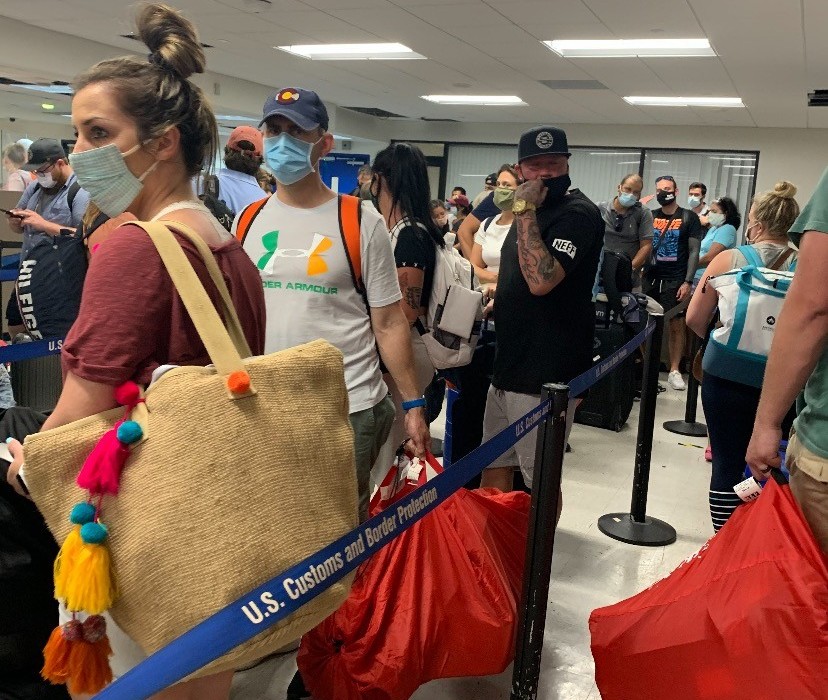
Travelers cram together in the line at the Cyril E. King Airport during last month’s Spring Break.
(Photo by Harleigh Stoltz)

Travel into the U.S. Virgin Islands during the COVID-19 pandemic is increasing, and Port Authority Executive Director Carlton Dowe said Cyril E. King Airport is running at three times the capacity its facilities were originally built to handle.

During Wednesday’s monthly Port Authority board meeting, held at the authority’s administrative offices adjacent to the airport, Dowe glanced out the window at the tarmac and said, “In a minute jets will start landing and it’s like J’ouvert morning at the airport.”

While Dowe acknowledged the influx of travelers into the territory is “not a bad problem to have,” he said the situation demands attention from both local and federal instrumentalities, and investments are needed in the aging airport to keep up with heavy demand from vacation-starved visitors.

“That’s why it is important for all the government entities, counsel, the federal government, everybody to recognize and understand that this airport was designed to accommodate 300,000 passengers when it was constructed many years ago,” Dowe said. “Today we are seeing close to 900,000 people going through the very same footprint that was designed to only accommodate 300,000 people.”
Advertising (skip)

While additional funding may be needed, the Port Authority has begun spending the $27 million it received last year as a grant from the U.S. Department of Commerce’s Economic Development Administration to begin new construction on the Cyril E. King airport. Nearly all the funding, $20 million, is being used for a parking and transportation center that will provide nearly 700 parking spots, in addition to a designated location for ground transportation and a location allocated solely for rental cars.

Port Authority Assistant Executive Director and Director of Engineering Damian Cartwright has previously told the Legislature that Cyril E. King Airport renovations alone will cost an estimated $250 million.

But the airport on St. Thomas is not the only one bustling with visitors.

“It’s interesting what you see at St. Croix,” Dowe said while directing meeting attendees to a photograph taken at the Henry E. Rohlsen Airport. “You can see what the line looks like and it makes the expansion very critical.”

“We’re seeing an uptick on the [airlift] and an uptick on activity at the St. Croix airport itself … we don’t see that too often,” Dowe said.

While board members seemed encouraged by the arrival of tourists flooding into the territory, Dowe said the authority must confront the need for funding head-on.

“The challenges are real, and they will be there,” Dowe said. “But we just have to make the best, but we definitely have to get that kind of funding, that investment. That investment must come not just from local government, but the federal government must play a critical role to help us expand.”

Posted in Fun | Comments Off on A Story I’ve Missed Totally . . .

Washington Post: Investigation suppressed by Trump administration reveals obstacles to hurricane aid for Puerto Rico

PLEASE READ: From the Thursday, 22 April 2021, Washington Post:

https://www.washingtonpost.com/business/2021/04/22/puerto-rico-hurricane-trump-hud/

The Trump machinations to subvert all forms of governance, including humanitarian assistance, is at least disgusting.

Business
Investigation suppressed by Trump administration reveals obstacles to hurricane aid for Puerto Rico
A watchdog report uncovers bureaucratic hurdles the administration erected for the island to receive aid after Hurricanes Irma and Maria

A Puerto Rican flag flies on an empty beach at Ocean Park in San Juan last May. (Carlos Giusti/AP)
By. Tracy Jan and Lisa Rein April 22, 2021 at 6:00 a.m. EDT

The Trump administration put up bureaucratic obstacles that stalled approximately $20 billion in hurricane relief for Puerto Rico and then obstructed an investigation into the holdup, according to an inspector general report obtained by The Washington Post.

Congress requested the investigation into the delays to recovery aid for Puerto Rico after Hurricanes Irma and Maria in 2017 left residents of the U.S. territory without power and clean water for months. But, the report said, former Housing and Urban Development secretary Ben Carson and another former HUD official declined to be interviewed by investigators during the course of the 2019 examination.

Access to HUD information was delayed or denied on several occasions. Several former senior administration officials in the Office of Management and Budget refused to provide requested information about decision-making related to the Puerto Rico relief funds.

“Delays and denials of access and refusals to cooperate negatively affected the ability of the [Office of Inspector General] to conduct this review,” the report said.

The 46-page report presents an incomplete picture of the political influence of the Trump White House on delaying disaster relief for the struggling island.

Still, Inspector General Rae Oliver Davis, appointed by Trump as top HUD watchdog, found unprecedented procedural hurdles set by the White House budget office — in addition to an extended partial federal government shutdown that also produced delays.

The OMB required HUD’s notice of grant funds to go through an interagency review process before approval, preventing HUD from publishing its draft notice of funding by its target date. The OMB had never before required such a review process for a notice allocating disaster-recovery funds, according to the inspector general’s report, and there had been no previous discussion about requiring the extra step.

One senior HUD official, Stan Gimont, then the deputy assistant secretary for grant programs, bemoaned the tedious review process imposed by the White House budget office as “kind of like Groundhog Day, just keeps coming back. And that’s … where your frustration will set in. … It’s almost like we’re going to keep bringing this back to you until you just eat it,” the report said.

While investigators interviewed 20 current and former HUD officials and two Puerto Rico housing officials, they had no access to Carson. Several senior political appointees at HUD withheld answers to questions, and White House budget office officials involved in delaying the timing of the aid also refused to cooperate.

The report said Carson and then-HUD Deputy Secretary Brian Montgomery had expressed “mounting concerns and frustrations” to then-acting OMB director Russell Vought about “HUD’s inability to make progress” on disbursing the funds. At one point, Montgomery told Vought that the White House’s actions were tantamount to holding disaster-relief funds “hostage,” the report said.

But the inspector general said given the lack of cooperation, investigators were unable to determine why the extra layer of review was required.

Trump officials hindered at least nine key oversight probes, watchdogs said. Some may finally be released in coming months.

HUD had initially intended to publish a funding notice that would have applied to all 16 jurisdictions receiving hurricane relief, but OMB urged the agency to issue separate notices for Puerto Rico and the U.S. Virgin Islands, the report said. Carson reluctantly agreed on the grounds that the agency was concerned over alleged corruption and fiscal mismanagement on the island.

The Post had previously reported that President Donald Trump repeatedly told aides that disaster relief allocated for Puerto Rico must be closely monitored because he believed the territory’s government is corrupt and the economy was in poor shape before the hurricanes devastated the island. Trump had also told then-White House Chief of Staff John F. Kelly and then-OMB Director Mick Mulvaney that he did not want a single dollar going to Puerto Rico, and instead, he wanted more of the money to go to Texas and Florida.

The White House budget office also insisted on overhauls to Puerto Rico’s property-management records, suspension of its minimum wage on federal contracts, and other prerequisites to access relief funds, prompting Montgomery to question whether HUD had the legal authority to enforce such requirements, the report said.

“How many poison pills are in here?” Montgomery wrote in an email to other senior HUD officials, according to the report.

“Montgomery said he did not believe that HUD could coerce Puerto Rico to fix its property-tax system to receive mitigation funding because the property-tax system was not related to mitigation activities,” the report said. “He also indicated that HUD did not put these types of conditions on other disaster-recovery grantees.”

The report, expected to be released publicly as early as Thursday, comes five months after Trump’s reelection defeat.

It is one of numerous politically sensitive investigations by federal watchdogs who are mandated by Congress to monitor agencies for waste, fraud and misconduct that was impeded by the last administration.

Damaging disclosures about former transportation secretary Elaine Chao, former White House physician Ronny Jackson, former secretary of state Mike Pompeo and other Trump officials were made public months after they left office.

At least a dozen other investigations have yet to be completed, in part because of unprecedented delays to inquiries by inspectors general.

Other overdue reports include an inquiry by the Commerce Department watchdog into the administration’s controversial decision to add a question on citizenship to the U.S. Census; two long-running ethics probes of Ryan Zinke, Trump’s first Interior secretary; and an audit of a $400 million contract to build the border wall that was awarded at Trump’s urging to a North Dakota construction firm whose top executive was a prominent GOP donor.

After butting heads with Trump administration, top HUD official departs agency

Davis took the unusual step of laying out the administration’s obstruction at the top of the HUD report. The report also notes that Trump administration officials delayed investigators’ access to emails and other electronic documents, invoking the privilege claimed by the president, known as executive privilege, of withholding information in the public interest.
Advertisement

HUD demanded that agency attorneys sit in on investigators’ interviews with Carson and other political appointees, the report said, a tactic widely used during the Trump administration that watchdogs worried could unduly shape testimony. Davis had previously expressed concern to congressional staffers about HUD attorneys’ desire to be present for witness testimonies.

While Carson was never interviewed, other former political appointees eventually agreed to be interviewed without an agency lawyer, but then refused to answer certain questions, the report said.

HUD did not immediately respond to a request for comment about the inspector general’s findings.

The Biden administration this week removed what it called “onerous restrictions unique to Puerto Rico that limited the island’s access” to disaster recovery funds and announced the obligation of $8.2 billion in federal mitigation funds.

Among the eliminated restrictions are the incremental grant obligations and review by a federal financial monitor to oversee the aid, as well as additional oversight by the U.S. territory’s federally mandated fiscal control board beyond what is already required by law, HUD said in its announcement.

“Since its first days, the Biden-Harris Administration has prioritized action to enable stronger recovery for Puerto Rico,” said HUD Secretary Marcia L. Fudge in a statement, adding that the new administration’s actions would “unlock access to funds Puerto Rico needs to recover from past disasters and build resilience to future storms, while ensuring transparency and accountability.”
– – – – – – – – – – – – – – – – – – –
Tracy Jan
Tracy Jan covers the intersection of race and the economy for The Washington Post, a beat she launched in December 2016. She previously was a national political reporter at the Boston Globe.

Lisa Rein
Lisa Rein covers federal agencies and the management of government in the Trump administration. At The Washington Post, she has written about the federal workforce; state politics and government in Annapolis, and in Richmond; local government in Fairfax County, Va.; and the redevelopment of Washington and its neighborhoods.

Posted in Fun | Comments Off on Washington Post: Investigation suppressed by Trump administration reveals obstacles to hurricane aid for Puerto Rico