Nevis Peak and Camps Watershed Project Management Plan…

Just an observation

 I like the attached as an example of “less land clearing to ensure slope stability and decrease erosion, etc.” (some irony involved here )


Media_httpfarm4static_tfocj

   
>Š The Department of Physical Planning through
>subdivision applications and individual lot residential development
>applications encourages larger lot sizes, less land coverage per
>lot,less land clearing to ensure slope stability and decrease erosion
>etc
>
>Š . . .

Posted in Uncategorized | Tagged | Leave a comment

Science News: Fraud in Medical Research

Science News: Fraud in MedicalResearch

[This blog is by Janet Raloff, one of the most respected sciencereporters in the US in Science News, published by theAmerican Academy for the Advancement of Science. The prospecthighlighted by her story and the apparently legitimate commentsappended by other researchers is literally on the order of “Whatif everybody lies?” The worse, of course, because this dealsdirectly with the most advanced levels of current medicalresearch.
        Comingon the heels of the financial meltdown, with its own version ofmultiple levels of lying and incompetence it begins to seem thatthere’s something that makes us — as humans — unable to live in acomplex, trust-based society.

Think I’ll go kayaking and look for our creekside kingfisher. . .. or see if the osprey has found his lady friend . . .  bp]

Home / Blogs /Science & the Public / Blog entry


OUCH! WAY WORSE THANPLAGIARISM
http://sn.im/ebx4z [www_sciencenews_org]
By JanetRaloff
Web edition : Tuesday, March 17th,2009

A little over aweek ago I wrote a two-parter on software that has uncovered hundredsof instances of apparent plagiarism in biomedical science. Copycatting someoneelse’s work is lazy at best; more likely it’s just amoral. But thecurrent issue of Anesthesiology News highlights an even moreegregious type of fraud: blatant fabrication of medical data.

In two investigative news stories, Adam Marcus describes the caseagainstanesthesiologist Scott S. Reuben. This prominent Massachusetts painresearcher is accused of faking data that served as the basis for aminimum of 21 published medical studies. At least plagiarists”borrow” data that are ostensibly real and therefore might have somemedical validity. Fabricated data benefit no one but the author who islooking to bolster his reputation by fattening his portfolio ofpublished studies.

Indeed, the potential for harm in seeding fake findings within themedical journals is substantial. They encourage an undue belief byclinicians that certain treatments will – or will not – helppatients.

In Reuben’s case, his publications focused on the purported benefitsin prescribing non-opiate painkillers, such ascelecoxib(sold as Celebrex), a drug that inhibits cyclooxygenase-2, an enzyme that triggersan inflammatory cascade of changes in the body. His studies claimed itworked well, particularly when paired with a neuropathicpainmedicinepregabalin(sold as Lyrica). But these Pfizer drugs are not the only ones thatReuben claimed performed well in place of more powerful old-linepainkillers.

Together, Reuben’s studies have served as the foundation of a fieldof medicine known as multi-modal analgesia. It recommendsadministering painkilling combos around the time of surgery, in someinstances as a form of “preemptive analgesia.”

Reports Marcus: “Due to the sheer scope of the misconduct Š thisfield now requires major bolstering to regain the confidence ofclinicians and researchers.” He quotes Paul F. White of theUniversity of Texas Southwestern Medical Center at Dallas as saying,”We are left with a large hole in our understanding of this field [ofmulti-modal analgesia].” White is the editor of Anesthesia andAnalgesia,which had to retract 10 of Dr. Reuben’s papers.

How did Reuben’s co-authors respond? At least two have apparentlycome forward and claimed that they had no knowledge they were listedas authors of the papers. If true, publishing forgery will be added tothe charges being leveled against the discredited Reuben.

Inklings of the academic misconduct, which Reuben has admitted to,came to light a year ago when the hospital he was working forperformed a routine audit of summaries for two of his studies. Marcusreports that this audit turned up no approval for the studies by thehospital’s institutional review board. “It turned out therewas not IRB approval because the data were partially or completelyfabricated,” the hospital’s chief academic officer toldAnesthesiology News.

This realization ultimately triggered a wholesale audit of Reuben’swork and a slew of retractions of his oft-cited papers. Reuben is nowon “medical leave” from his job as director of acute pain serviceat BaystateMedical Center.

Marcus quotes White as saying the scandal “compromises everymeta-analysis, editorial, systematic review of analgesic trials”or anything else that cited the fraudulent findings. The costs ofreviewing and undoing this fraud will just snowball in the comingmonths.

People always point to peer review as the gold standard for vettingresearch – confirming that it is not only important but also solid.As the Reuben incident points out, peer review is far from perfect.Reviewers assume their colleagues won’t cheat to get their name inprint. In this case, that’s proved to be a pervasive and dangerousassumption.

The big question: What change in policy could have routed thischeat’s bad deeds earlier? Now that it’s gotten a black eye from itstrust of Reuben, the medical-publishing field will have to reevaluateits policies.

Of course, there’s no reason to suspect such misconduct is undulyrepresented in medicine, although the ramifications of any cheatinghere could prove especially deadly. No, cheating can happen in anyfield. Which is why chemists, physicists, environmental scientists,nutritionists and others need to also reevaluate their practices inlight of the Reuben affair.

-=-=-=-=-=-=-=-=-=-=-=-=-=-=-=-

Comments  — 2

         “At least plagiarists borrow data that are ostensiblyreal and therefore might have some medical validity.” – Not eventhis is true. Plagiarists also falsify data, since if they directlycopy it, it never existed in their study, and most of them make it upto differentiate themselves. And the idea that these coauthors”didn’t know” they were on those seminal papers? Would youlike to buy a bridge?

My anecdotal experience says that medical research has the highestrate of fraud in sciences, bar none. No other field of sciencerequires the same level of obsequiousness toward big shots. In noother area do big shots retaliate as viciously against those who rockthe boat. In no other area is it as costly to reproduceexperiments/studies. In no other area is there so little that iscalculable, and so many practitioners who couldn’t calculate it evenif it was. In no other area are researchers allowed to supplementtheir salary out of grants so much. (There are a number of P.I.s whopay themselves an extra bonus out of their grant money that is largerthan the salaries of anybody who works for them.)
My random walk anecdotal sample says that 3 P.I.’s out of 9 in medicalresearch have committed or commissioned fraud. Commissioning frauddelivers plausible deniability over committing it, and brings theadded benefit of an ally upon whom the commissioner of the fraud has alarge lever to force their compliance. Science fraud in medicalresearch gets people into top positions, because those people bring inthe grant money. We are talking chair of department, etcetera. Thiscircle of fraud gives many of them outsize clout in getting furthergrants, and it is the huge grants that incentivize their universitiesto ignore what they know in order to keep the NIH gravy traingoing.
And the fraud has reached its cold fingers right into the heart of thefunding mechanism at NIH. There is a regulation now that sets a”statute of limitations” on investigating scientific fraudat 6 years. In today’s world the case of the midwife toad would nothave been solved!  John Toradze
Mar. 18, 2009 at 12:38pm

              After managing a 5-year, multi-center study of the situation,my team has concluded that fabrication rates for peer-reviewed medicalliterature dealing with pain killers range from 25.25% to 36.36%,placing them in the range of “high-rate forgery” for anyfield of study. Furthermore, approximately 42.42% of these frauds showno remorse.  Ralph Dratman

Mar. 18, 2009 at 4:10am
--
—————————————————

URL:          http://www.irf.org
              http://pottersweal.wordpress.com
              http://brucepotter.wordpress.com/
—————————————————————-
“Ignoranti quemportem petat, nullus suus ventas est”
“If one does notknow to which port one is sailing…..no wind isfavorable”
– Seneca the Younger(3BC-65AD)
—————————————————————-
Posted in Uncategorized | Leave a comment

Gallup Poll: More Old People, Republicans and Independents — “Climate Risk Exaggerated?”

Gallup Poll: More Old People, Republicans and Independents

US Public Opinion issue

Worth noting because US are often opinion leaders in the region:

March 11, 2009, 6:09 PM

Gallup: Rising View That Climate Risk Exaggerated?
By ANDREW C. REVKIN
The Gallup polling organization has come out with its annual survey on environmental issues

and marks some noteworthy trends, including rising concerns about how news accounts have portrayed the issue:
Although a majority of Americans believe that the seriousness of global warming is either correctly portrayed in the news or underestimated, a record-high of 41 percent now say that it is exaggerated.
That’s the highest percentage over more than a decade of relevant polling. The rise in what Gallup calls “cynicism” about descriptions of the problem has all occurred in people over 30, with respondents from 18 to 29 years old still the most likely group to say the problem is underestimated.
The polling group summarizes the full survey this way:
Importantly, Gallup’s annual March update on the environment shows a drop in public concern about global warming across several different measures, suggesting that the global warming message may have lost some footing with Americans over the past year. Gallup has documented declines in public concern about the environment at times when other issues, such as a major economic downturn or a national crisis like 9/11, absorbed Americans’ attention. To some extent that may be true today, given the troubling state of the U.S. economy. However, the solitary drop in concern this year about global warming, among the eight specific environmental issues Gallup tested, suggests that something unique may be happening with the issue.
Other surveys have
tracked related trends. What’s your take on what’s going on? There’s the economy, the rising debate over energy and climate legislation, the long-term nature of the projected warming, the flickers of natural climate variability, the pendulum-like nature of media focus, the inconsistent quality of media coverage, orŠ?
The Gallup survey was conducted from March 5-8, after the recent
flareup in the blogosphere over George Will’s columns challenging scientific and media accounts of impending climatic catastrophe.

--

      35 Years of Environmental Service to Small Tropical Islands


Posted in Uncategorized | Leave a comment

Map of Nevis

Map of Nevis

One of my favorite islands:

bp
Posted in Uncategorized | Leave a comment

In case retirement weighs too heavy on your hands . . .

http://www.wikihow.com/Crochet-a-Water-Bottle-Cozy

 How to Crochet a Water Bottle Cozy

 Reusable aluminum water bottles are better for the environment than purchasing bottled water or other drinks in plastic containers, but if you have one, you may have noticed how well aluminum conducts heat. With a bit of insulation, you can keep your beverage and your fingers at their own temperatures longer. This is a small project, so you could easily complete it using remnants of yarn from other projects.

 This article gives information on making the cozy to a custom size alongside numbers of stitches used to obtain the specific result pictured. Use whichever seems to work best for you. Working through parts about the custom size will teach you a lot about crocheting without a pattern; in fact, you could crochet any cylindrical object with confidence this way. The materials shown are listed under Things You’ll Need below.

Posted in Uncategorized | Leave a comment

Some serious science about diet — world energy/climate-wise

AAAS: Climate-friendly dining Š meats
The carbon footprints of raising livestock for food
By Janet Raloff

 THE FIRST OF TWO PARTS. Followup story is at: http://www.sciencenews.org/view/generic/id/40943/title/AAAS_Climate-Friendly_…

 For the good of the planet, we’re all being asked to reduce our carbon footprints – the quantities of greenhouse gases, aka GHGs, associated with our actions. Since some 30 percent of the global warming potential attributable to society’s GHG emissions stems from the production of foods and beverages, menu choices are critical, noted Ulf Sonesson of the Swedish Institute for Food and Biotechnology in Goteborg, today. From this climate perspective, meat eaters are the big hogs.

 Sonesson was one of the speakers on a panel titled “Food for Thought” at the American Association for the Advancement of Science annual meeting. This morning’s speakers shared data from largely new analyses on how foods, production techniques, and transportation affect the climate costs associated with our dining choices. And there were some big surprises.

 No longer a surprise is the relative energy intensity associated with meat, especially beef. For instance, roughly half of the GHG emissions due to human diets come from meat even though beef, pork and chicken together account for only about 14 percent of what people eat.

 From a climate perspective, beef is in a class by itself. It takes a lot of energy and other natural resources to produce cattle feed, manage the animals’ manure (a major emitter of methane, a potent GHG), get the livestock to market, slaughter the animals, process and package the meat, dispose of the greater part of the carcass that won’t be human food, market the retail cuts, transport them home from the store, refrigerate them until dinner time, and then cook the beef.

 Tally the GHG emissions associated with all of those activities, Sonesson says, and you’ll find it’s the global-warming equivalent to spewing 19 kilograms of carbon dioxide for every kg of beef served. Swine are more environmentally friendly. It only takes about 4.25 kg of CO2 to produce and fry each kg of pork. At the other end of the spectrum are veggies. The climate costs associated with growing, marketing, peeling and boiling up a kg of potatoes, by contrast, is just 280 grams, Sonesson reported.

 Another factor contributing to cattle’s particularly egregious carbon footprint is their relative fecundity, if you will, says Nathan Pelletier of Dalhousie University in Halifax, Nova Scotia. In her lifetime, a mother fish, particularly in protected aquaculture settings, may give birth to hundreds – if not thousands – of surviving offspring. A hen could certainly produce hundreds of chicks. Even a sow can give birth to eight piggies per litter. But a cow: She tends to issue a single calf every year for maybe 10. And while she’s in gestation and then waiting to become pregnant again, farmers have to care for her and perhaps a bull – which are both big, hungry manure factories.

 Many environmentalists have argued that finishing up the fattening of beef cattle on corn is worse for the environment than cattle that are raised solely on pasture grass. Pelletier says his team’s analysis finds that at least from a climate perspective, the opposite is true. “We do see significant differences in the GHG intensities [of grass vs grain finishing]. It’s roughly on the order of 50 percent higher in grass-finished systems.”

 When an audience member questioned whether he had heard that right, that grass-fed cattle have a higher carbon footprint, Pelletier reiterated, “higher. Yes.” The reason: “It’s related to the much higher volumes of feed throughput and associated methane and nitrous-oxide [GHG] emissions.” He added that most pastures were highly managed, and subject to “periodic renovations and also fertilization.” Finally, with grass-fed cattle “there is also a high [grass] trampling rate. So the actual land area that you need to maintain magnifies that [GHG] difference,” Pelletier said.

 But what really concerns his team about the bonus GHG emissions linked to beef is the planet’s growing numbers – and appetite for meat.

 Currently, although beef accounts for only about 30 percent of the world’s meat consumption, it contributes 78 percent of meat’s GHG emissions. Pork, at 38 percent of consumption, contributes only 14 percent of meat’s GHGs. Another 32 percent of the meat consumed worldwide comes from chicken, but getting these birds from farm to fork contributes only 8 percent of meat’s global carbon footprint. By shifting some share of beef and pork production to chicken over the next four decades, the increase in meat’s GHG emissions by 2050 might be held to just 6 percent higher than today, Pelletier said, even as the human population grows by another quarter-million each day.

 Although meat’s overall carbon footprint is projected to grow only a little over the next 40 years, the global goal is to cut emissions in every sector. Pelletier offered some suggestions on how to do that. Some were considerably more appetizing than others.

 For instance, substituting all beef production for chicken would cut meat’s projected carbon footprint by 70 percent, he said. Or perhaps per capita intake of meat could drop from a current average of 90 kilograms per year in the developed world to the 53 kg per person per year that’s been advocated as sufficient for human health by the U.S. Department of Agriculture. Under this scenario, Pelletier said, “I estimate that . . . we could reduce associated [carbon] emissions by roughly 44 percent.”

 Swap half of that protein now supplied by meat with soy by 2050, and “you could expect [projected] emissions to decrease on the order of 70 percent,” he said. Take the next big step – eliminating all meat in favor of soy – should drop the protein-associated carbon footprint of Western diets a whopping 96 percent.

 Pelletier described that the last scenario as “utopian.” Hmmm. Not for this carnivore. I’m willing to eat chicken much of the time and reserve beef as a big treat – maybe even to be downed only in small portions. But go solely soy? That’s no utopia to me.

 That said, would I consider such a sacrifice for survival of the planet? Of course – but I’m hoping someone can shoot me recipes that would made this legume taste like something other than soy. So far I only have one, but it’s dynamite: for chocolate mousse pie.

 Next up: What about fish?

  
-=-=-=-=-==-==-=-

  AAAS: Climate-Friendly Fish
By Janet Raloff

 SUSTENANCEI realized as I was writing this that the late lunch sitting beside my computer included salmon and other types of sushi.J. Raloff

 If eating meat in place of other proteins hogs natural resources and spews an overabundance of greenhouse gases into the atmosphere (see last blog), wouldn’t fish be a climate-friendlier menu selection? Usually, but not always. Or so panelists pointed out this morning at the American Association for the Advancement of Science annual meeting, here in Chicago. Focusing on salmon, they showed that fish consumption’s carbon footprint depends on what a fish has eaten, how it has been caught and stored, and how it’s transported to market.

 There were some real eye openers within these assessments.

 Peter Tyedmers of Dalhousie University in Halifax, Nova Scotia, focused on greenhouse gas – aka GHG – assessments of fish production downstream of food-processing plants. In other words, how fish are reared and caught.

 He started by focusing on the big North Atlantic and Chilean sources in Norway, Scotland, Canada and Chile. For every ton of fish harvested, there is a substantial GHG cost measured in terms of the amount of carbon dioxide that would produce equivalent warming. For production of Norwegian fish it’s 1,750 kilograms of CO2 equivalents, 2,250 kg for Chilean salmon, 2,500 kg for the Canadian fish, and 3,300 kg for Scottish farmed stock.

 The difference in the warming potential largely traces to what the finned populations have been fed, Tyedmers explains. Scottish farmers feed their salmon the highest proportion of fish meal – almost 70 percent, on average. Those fishy diets account for 85 percent of the greenhouse-gas emissions associated producing Scottish salmon, his team calculated. Elsewhere, fish farming operations tend to substitute plant-based meals and oil or meat byproducts for a share of that fish meal.

 Not surprisingly, the higher the proportion of plant sources in a farmed fish’s diet, the lower the climate impacts associated with its rearing.

 So why are Scottish salmon fed so much fish? Some markets – particularly France – put a premium on salmon that were reared on fish, arguing that it makes the farmed animals more “natural” than those fed rapeseed or other plant products. Yet clearly, Tyedmers said, if the goal is to reduce our food supply’s carbon footprint, rearing salmon on plant-based feed is a promising tactic.

 But just substituting any plant constituent for fish in a salmon’s diet will not always prove beneficial, he noted – at least from a climate standpoint. Some fish are fed fishmeal derived from capelin, which doesn’t have a large GHG contribution. If wheat gluten or even palm oil (which isn’t yet a normal ingredient in fishmeal) were substituted for the capelin, the carbon footprint of the salmon could jump substantially, Tyedmers team calculated.

 Data from another assessment, this one in wild fish, showed that fuel use associated with harvesting gear could greatly impact GHG emissions associated with salmon. Purse seining contributed 180 kilograms of CO2 equivalent to the carbon footprint associated with a ton of salmon, gillnetting about 380 kg, and trolling a whopping 1,700 kg. So, do you know how your fish was caught?

 Astrid Scholz, a food-production economist at Ecotrust in Portland, Ore., is part of an international consortium that is calculating GHG costs associated with getting salmon to market, independent of how they were raised. Again, there are some big eye openers here in the numbers that her team just crunched in the days leading up to this meeting.

 Three-quarters of the world’s harvested salmon comes from three major markets: the Northeast Pacific (including Alaska and British Columbia), the Northeast Atlantic (mostly Norway and Scotland) and Chile. It turns out, her team finds, that the big climate costs for these fish trace to how they reach their designated market – by air, by container ships, or by truck.

 And what determines the transport choice in most cases is whether the fish must arrive fresh (i.e. almost immediately), or whether it can arrive frozen at any point over many days or weeks.

 In practical terms, for Chicagoans wanting fresh salmon, farmed fish trucked in from British Columbia will always have a smaller carbon footprint than salmon caught anywhere else – because all other fresh salmon must be flown into to the lower 48 states, especially inland cities.

 If frozen salmon is acceptable, wild seine-caught Alaskan salmon will invariably prove the most climate-friendly choice at costs of 1 kg CO2 per kg of delivered fish, Scholz says. Although this fish has to travel nearly the same distance to market as will fish from Canada, the Alaskans’ wild foraging means there are no feed costs, which jack up the GHG costs associated with aquaculture.

 Where frozen wild, seined salmon is not available, a climate-friendly alternative will be frozen farm-raised Norwegian salmon. Its carbon footprint: just 1.8 kg CO2 per kg of fish.

 On a per dollar value, Chilean fish are usually the cheapest salmon in northern markets. But these monetary costs tend to disguise the high climate costs associated with moving South American salmon half-way round the world. There are 3 kg CO2 costs associated with each kg of frozen salmon brought to North America from Chile, and 5.5 times that GHG cost for fresh Chilean salmon flown into the Northern Hemisphere. Meanwhile, British Columbia salmon can be trucked in fresh or frozen for 3 kg of CO2 per kg of fish.

 The problem for consumers, all of this morning’s speakers conceded, is that they don’t know any better than to choose their fish on the basis of dollar-cost or fresh-vs-frozen considerations. They certainly have no way of knowing how their fish were pulled from the water or what they might have been fed.This could be remedied by labeling, several of the speakers noted. Indeed, this approach to identifying climate costs associated with our diets is already being explored in a few European countries.

 THIS WAS THE SECOND OF TWO PARTS: First part is at: http://www.sciencenews.org/view/generic/id/40934/title/AAAS_Climate-friendly_…

Posted in Uncategorized | Leave a comment

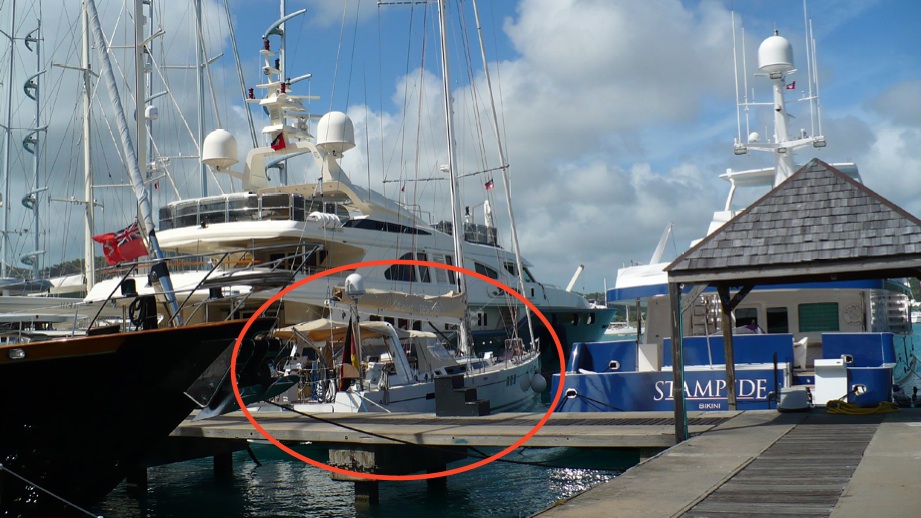
There are Yachts, and then there are YACHTS . . .

There are Yachts, and then there are YACHTS . ..

from a year old NY Times story:

P1010967
[Athena with Maltese Falcon in the background, in FalmouthHarbour, ANTIGUA]

Backdrop
Measuring Wealth by the Foot
Ted Aljibe/Agence France-Presse – Getty Images
The yacht owned by Microsoft co-founder Paul Allen, anchored offHong Kong in 2007. The yacht, named Octopus, is more than 414 feetlong. More Photos >
By PATRICIA KRANZ
Published: March 16, 2008
IN a shipyard in Germany, Blohm & Voss workers are building amammoth yacht called the Eclipse.
Like many things in the secretive world of superyachts, its exactlength is hard to pin down. So is the name of its owner, and the costof building it.

But according to the Web site of The Yacht Report, one of severalpublications that track yachting with the same intensity that gossipmagazines cover Hollywood hunks, the Eclipse is 531.5 feet long.

That’s six and a half feet longer than the Dubai, an 11,600-tonbehemoth that now holds the record as the world’s largest yacht. Itsowner is the ruler of Dubai, Sheik Mohammed bin Rashid al-Maktoum.

The extra length on the Eclipse isn’t an accident. Supersized yachtsare the latest examples of one-upmanship among billionaires, many ofwhom already own a private jet, a Rolls-Royce or two, and multiplemansions.

Despite fear of an economic recession and unrelenting job pressuresamong those who remain yachtless, there’s still a lot of moneyfloating around the world. And as the superrich get richer, the sizeof yachts grows bigger and bigger, too.

“When a yacht is over 328 feet, it’s so big that you lose theintimacy,” says Tork Buckley, editor of The Yacht Report. “On theother hand, you’ve got bragging rights. No question, that’s a verystrong part of the motivation.”

Who will be the one to wrest bragging rights from the sheik? Blohm &Voss, a leading shipbuilder, isn’t saying. According to an executiveat a different yacht company, who requested anonymity because he wasconcerned about losing clients, it is being built for RomanAbramovich, a Russian tycoon.

Mr. Abramovich already owns the 282-foot Ecstasea and the377-foot Pelorus, and Web sites that track yachts speculate that hemay be the owner of a new 394-foot yacht called Sigma thatresembles a battleship. A spokesman for Mr. Abramovich declined tocomment.

Just four years ago, when Lawrence J. Ellison, the chief executive ofthe Oracle Corporation, took possession of the 454-foot Rising Sun, hegained crowing rights over Paul Allen, the Microsoft co-founder. Mr.Allen’s yacht, the Octopus, is relatively minuscule at 417 feet.(Since then, David Geffen, the Hollywood mogul, has bought a 50percent share of the Rising Sun from Mr. Ellison.)

Many yacht owners are entrepreneurs or industrialists, rather thanroyalty or bold-faced names from Silicon Valley, according to yachtdesigners and builders. “One of my clients is a woman who startedher own business and ended up making cocktail-type quiches soldthrough Costco and Wal-Mart,” said Douglas Sharp, who owns a yachtdesign company in San Diego.

Like Mr. Abramovich, a growing number of yacht buyers are fromemerging markets. “There’s an incredible amount of disposablemoney in the world at the moment, and a lot of money is coming out ofnew markets like Russia and Ukraine, as well as India,” saysJonathan Beckett, chief executive of Burgess, a company that helpsowners build and charter yachts. “These people have made a lot ofmoney very quickly and have an appetite.”

According to ShowBoats International, a luxury yacht magazine,916 yachts measuring 80 feet or longer – the traditional definitionof a superyacht – were on order or under construction as of lastSept. 1, four times the number in 1997. The biggest gains were amongthe biggest yachts: 47 yachts were 200 to 249 feet long, up 68 percentfrom a year earlier, while 23 were 250 feet or longer, an increase of28 percent.

“When I started in the early 1970s, a 60-foot boat was consideredpretty large,” Mr. Sharp said. “A 150-foot boat was queen of theshow in Monaco in 1982. In 2008, you wouldn’t be able to find thatboat in the marina.”

Some new megayachts are so big that they have to dock in commercialports. The growth in the number and size of yachts is also making ithard to find qualified crew members.

Still, many yacht owners trade in their boats every few years forbigger models.

“People want more toys to play with. That’s something that drivesit,” says Wim Koersvelt, director of Icon Yachts in the Netherlands.”Gyms were unusual 20 years ago, and no yacht is being built nowwithout a gym. They’re buying two- to four-person submarines, havefour Jet Skis and little sailboats stored on board, as well ashelicopter landing pads.”

It takes two to four years to build a yacht, and prices are rising soquickly that some owners are selling their boats before they’re evenfinished – for a tidy profit. Mr. Beckett of Burgess says priceshave risen 10 percent to 20 percent in the past two years alone. Heestimates that a yacht 328 feet long would cost about $230 milliontoday, with prices rising to $650 million for a 500-foot yacht.

Some owners recoup part of their costs by chartering theiryachts. Want to sail the Maltese Falcon, the innovative clippership built by Tom Perkins, the Silicon Valley venture capitalist? Thatwill put you back around $539,000 to $555,000 a week, not countingexpenses for fuel, food or crew. Or the Mirabella V, theelegant sloop owned by Joe Vittoria, the former chief executive ofAvis Rent A Car System? That’s $325,000 to $375,000 a week,depending on the season.
There are no signs that demand will slacken. “There are2,000 superyachts in the world today” over 120 feet long, “andnearly 200,000 people who could afford to buy them,” Mr. Beckettsays.

The arms race in yachts echoes the competition among business titansin the last century to build the world’s tallest skyscraper. In hisbook “Mine’s Bigger,” David A. Kaplan describes the battlebetween Mr. Perkins and Jim Clark, the co-founder of three SiliconValley companies, including Netscape, as they competed to build theworld’s biggest sailing megayacht.

By the time Mr. Perkins completed his Maltese Falcon, measuring 288feet, in 2006, it was substantially longer than Mr. Clark’s Athenaif measured at the water line.

“Clark could console himself only with the fact that if you includedhis 33-foot stainless steel bowsprit as part of the length, then hiswas bigger than anybody else’s,” Mr. Kaplan writes.

Mr. Vittoria holds a different record. His 247-foot Mirabella Vhas a 292-foot mast – so tall that it can’t fit under the GoldenGate Bridge.

Grade_inflation-1

 . . . speaking of inflation — the “little” boatcircled here is SIXTY-FIVE feet long.

– = – = – = –

--

      35 Years of Environmental Service toSmall Tropical Islands
Posted in Uncategorized | Leave a comment

CNN Eliminates Science Reporting

from Andrew Revkin’s NY Times blog:

 >December 4, 2008, 10:34 am
>Science Journalism Implosion, CNN and Beyond
>By Andrew C. Revkin
>CNN is firing science correspondent Miles O’Brien and six producers. >(Credit: CNN)
>
>CNN is eliminating its seven-person unit covering science, the >environment, and technology, saying its “Planet in Peril” programs >do the trick. Curtis Brainard, who assesses environmental coverage >for the Columbia Journalism Review online, in a comprehensive piece >on the move, said: “[T]he decision to eliminate the positions seems >particularly misguided at a time when world events would seem to >warrant expanding science and environmental staff.”
>
>Of course, the situation at CNN is hardly isolated. Newspaper >coverage of science outside of health and wellness is steadily >eroding. Even here at The Times, where the Science Times section >celebrated its 25th anniversary in 2003 and management has always >supported strong science coverage, we (like everyone in print media) >are doing ever more with less.
>
>At CNN, among those leaving will be Peter Dykstra, a seasoned >producer focused on science and the environment, and Miles O’Brien, >a longtime CNN reporter and former morning news anchor, who I got to >know when he turned to climate coverage in a big way several years >ago. (See his spicy interview with Senator James Inhofe, the >Oklahoma Republican who challenges dire climate projections.)
>
>Just in case you think this is a new trend, consider this flashback >to the 1980’s, which shows how the public-service aspect of >journalism – sustaining coverage of important arenas even if it does >not “sell” – is a hard fit in a world focused on the bottom line:
>
>In the mid 1980’s, early in my science-writing career, I was hired >by the Los Angeles Times to be one of the first reporters for a >planned weekly science section like the established Science Times of >The New York Times. While things were getting set up, I was assigned >a slot in the San Fernando Valley, reporting on everything from >gasoline in the groundwater to a days-long hunt for Martina >Navratilova’s lost dogs. Before my first year was up, the section >was canceled.
>
>I was told by management that the paper’s business side made the >case that it was selling personal-computer ads in the sports >section, so why did it need a science section? I moved back east to >be an editor at Discover Magazine (and shortly afterward wrote my >first long story on global warming).
>
>It turns out that the Los Angeles Times’ move back then was just an >early-stages hint of the shrinkage of science journalism to come, in >all markets and media. My sense is that while it’s easy to blame >pencil-pushing accountants for all of this, it’s also worth >examining how we teach science and engineering (and new generations >of media consumers).
>
>One reason I aimed my third book on the environment (co-published by >The Times) at younger readers was in hopes that it might kindle a >bit of excitement in science as a journey and adventure, and not a >static set of facts. My guess is that until a new generation is >engaged in the importance and possibilities of science from the >bottom up, science journalists will remain a threatened, if not >endangered, species. What do you think?
>
> * Copyright 2008 The New York Times Company
> * NYTimes.com 620 Eighth Avenue New York, NY 10018

  
— —
  35 Years of Environmental Service to Small Tropical Islands

  Island Resources Foundation
Fone
202/265-9712 1718 “P” St NW, # T-4
fax
202/232-0748
  Washington, DC 20036
Potter cell: 1-443-454-9044
— — — — — — — — — — — — — — — — — — — — — — — — — — — –
Subscribe to environmental e-mail groups at
-=-=-=-=-=-=-=-=-=-=-=-=-=-=-=-=-=-=-=-=-=-=-=-=-=-=-=- Blogs at http://pottersweal.wordpress.com/; twitter: brucepotter
-=-=-=-=-=-=-=-=-=-=-=-=-=-=-=-=-=-=-=-=-=-=-=-=-=-=-=-

Posted in Uncategorized | Leave a comment

More on sediment in the Virgin Islands from construction. . .

More on sediment in the Virgin Islands from construction.

I just glanced over a new publication on CD that I got from

Jenny Waddell, the Technical lead for The State of Coral Reef Ecosystems of the United States and Pacific Freely Associated States: 2008
1305 East West Highway
SSMC-IV, N/SCI-1
Silver Spring, MD 20910
301-713-3028 x174  —

The State of Coral Reef Ecosystems of the US and Pacific Freely Associated States: 2008 — NOAA Technical Memorandum NOS NCCOS 73. — it’s 569 pages long

Theres a 71 page chapter on the USVI, and I happened to find this excerpt (JPEG attached) about Botany Bay sediment pollution on the north shore of STT.

You can get a free copy of the CD by following instructions at —

If you just want the chapter on the USVI, you can download any chapter of the document at

bruce

      35 Years of Environmental Service to Small Tropical Islands

      Island Resources Foundation    Fone  202/265-9712 
      1718 “P” St NW, # T-4          fax   202/232-0748
      Washington, DC 20036    Potter cell: 1-443-454-9044
— — — — — — — — — — — — — — — — — — — — — — — — — — — –
Subscribe to environmental e-mail groups at <http://www.irf.org/help/email.php >
-=-=-=-=-=-=-=-=-=-=-=-=-=-=-=-=-=-=-=-=-=-=-=-=-=-=-=- 

Botany_bay_sed_effects

Posted in Uncategorized | Leave a comment

Dan Janzen Vision: DNA Barcode Readers. . . .

Dan Janzen Vision: DNA Barcode Readers. . ..

Now Is The Time

Phil. Trans. R. Soc. Lond. B (2004) 359, 731–732 DOI10.1098/rstb.2003.1444

The spaceship lands. He steps out. He points it around. Itsays
‘friendly–unfriendly—edible–poisonous—safe–dangerous—living–inanimate’.
On the next sweep it says‘Quercus oleoides—Homosapiens—Spondias mombin—
Solanum nigrum—Crotalus durissus—Morphopeleides—serpentine’. This has
been in my head since reading science fiction in ninth grade halfa
century ago. I am sure it was in the heads of Linneaus, Alexanderthe
Great, and Timid the Mastodont Stomper. And it has been on thewish list
of every other human confronted with the bewildering blizzard ofwild
biodiversity at the edge, middle and focus of society.

Imagine a world where every child’s backpack, every farmer’spocket,
every doctor’s office and every biologist’s belt has a gadgetthe size
of a cell-phone. A free gadget.

Pop off a leg, pluck a tuft of hair, pinch a piece of leaf, swata
mosquito, and stick it in on a tuft of toilet tissue. One minutelater
the screen says Periplaneta americana, Canis familiaris,Quercus
virginiana, or West Nile virus in Culex pipiens. A chip the sizeof your
thumbnail could carry 30 million species-specific gene sequencesand
brief collaterals. Push the collateral information button onceand the
screen offers basic natural history and images for that species,or
species complex, for your point on the globe. Push it twice andyou are
in dialogue with central for more complex queries. Or, thegadget,
through your cell-phone uplink, says ‘this DNA sequence notpreviously
recorded for your zone, do you wish to provide collateralinformation in
return for 100 identification credits?’.

Imagine what maps of biodiversity would look like if they couldbe
generated from the sequence identification requests of millionsof
users. Such a gadget would allow access to true bioliteracyfor
all humanity. Such a gadget would be to biodiversity what theprinting
press was to literacy (and reading glasses, chairs, newspapers,the
Library of Congress and the computer). The blessing ofinformation
access through such a gadget is what the taxasphere—thecollective
intellectual might of taxonomists, museums, collections and
their centuries of literature—has within its power to offersociety,
global society, everyone. But will it? If it does not, wildbiodiversity
will continue its inexorable decline into the pit under the humanheel,
and the taxasphere will continue its accelerating slide into therealm
of quaint esoterica shared by a very few enthusiasts who lovetheir
bugs, ferns and birds.

The gadget requires two things and a third. Thing one is theeconomic
and social selective pressure to miniaturize what today occupiestwo
tabletops of machinery and a technician down to the size ofa
cell-phone; reusable and cheap. This miniaturization istechnically
feasible in any one of many industrial centres of the world. Itwould
take US$1 million and five bright people. This has not happenedin the
past decade because no one saw any particular reason to do it.However,
there is a reason. Real bioliteracy requires on-site real-timehand-held
cheap identification of hundreds of thousands of species, eventhough
any one person at any one time may care about only one organismin one
place.

Thing two is the global library of partial DNA sequences of afew
cleverly selected target genes that among them carryspecies-specific
combinations of nucleotides. Such a library can be constructed intwo
phases running concurrently. The world’s greatbiodiversity
collections—museums, herbaria and microbe depositories—haveon the
shelf, in some sort of order, easily half (if not more) of thespecies
of wild biodiversity encountered daily and consciously by 99% ofthe
world’s people.

One phase is to quite straightforwardly organize and fund SWATteams to
simultaneously polish the taxonomic organization and extract theDNA
samples for target gene species-level sequencing for theseshelves of
items. The other phase is to simultaneously reinforce theongoing
biodiversity inventory of the world and its taxonomic processing,so as
to sequence and characterize the as-yet uncollected wildbiodiversity.

Both the in-house taxonomic processing and outdoor inventory mustbe
congruent with the agendas of the taxon- and site-focused primaryusers,
so that as the sequence libraries emerge from the greatcollections,
these same collections are also receiving and taxonomicallyprocessing
the stream of new material (much of which may be sequencedas
collected). The cross-phase potential for mutual anditerative
reinforcement between the taxasphere and building thesequence
library—and populating its collaterals—is enormous. Icannot
over-emphasize the necessity for collaterals. A phone number isno good
if there is no one at the other end.

Thing three is the commercial–entrepreneurial process such thateach
time the gadget processes a sequence, a penny drops into a bucketthat
fuels the taxasphere to do what it does best and with such joy,and
fuels the conservation community to actually conserve that whichis
being sequenced in its wild home. Such a feedback system is
imperative to saving the present and future biodiversity Libraryof
Congress, so to speak. The goal is not to support yet anotherguild of
biodiversity administration and consultancies, but rather todeliver
bioliteracy to the world. And once people can read, ensure thatthere
still be books to be read.

Thing three is obviously the most difficult, given that Homosapiens is
notorious for not reinvesting its gains, ill-gotten or otherwise,in the
raw material source of those gains. Yes, start-up capital willbe
required, but rather than get this from classical venturecapitalism,
this is a time for the world’s philanthropic capitalists tofocus their
energy. Will the gadget user pay a penny per identification oncethe
system is in place? Yes, if it can deliver ‘one minute onesequence one
name’—and serious amounts of collaterals are available. Willthe users
feed new collaterals back into the information source toaccompany their
old or new sequence submitted? Yes, if they getidentification
credits, and as they see the value of retrieving their ownsubmissions
years down the road, to say nothing of the value of examiningeach
other’s submissions in real time and across geography.

The blending of these three things within their software glue andmatrix
is easily attainable in less than a decade with the technologicaland
sociological understanding already available, for a total budgetin the
range of US$1–5 billion. The process can be put in motion as aproof-of-
concept for a tiny fraction of this.

The viewpoint in this commentary was inspired by reading PaulHebert’s
enthusiasm and foresight in targeting just a part of the DNAsequence of
a single gene as a species’ ‘barcode’ (Hebert et al.2003a,b), by recent
planning efforts (Stoeckle 2003), and by witnessing the claritywith
which a portion of the CO1 gene sequence can discriminate amongmany
species of butterflies and moths, bees, birds and mammals.

Simultaneously, it has its roots in decades of attempting toprocess
millions of neotropical insects and plants through abiodiversity
inventory for a multiplicity of agendas. I am also frustrated byworking
for a half century in the field, nurtured and guided at longdistance by
the world’s best taxonomists, among hundreds of thousands ofspecies
of organisms, most of which are actually known to science yet canbe
identified in the field, at best, by only a select few. NeitherI, nor
the other millions of wild biodiversity users, can carry in theirpocket
the tens of thousands of pages of taxonomic descriptions, keysand
images, and their authors. Even if all were to be collapsed downinto
a single chip, I still could not connect the beast in hand toits
information as I stumble through the mud, rain and green of a 200000
species-rich patch of Costa Rican rain-forest. No one can learnthe
scientific language to read and hear the taxasphere’scollective wisdom
and facts for identification at the moment the bug is in the handor the
leaf in the mouth—even if we have the best access uplink toGoogle. If
each of us makes the long trek, which we will not, to the doorsof any
one of the great collections, in a matter of seconds thetotal
taxasphere will be over-whelmed. The gadget has huge potentialfor
relieving the taxasphere of the drudgery of routineidentifications at
those places where even today’s bioilliterate populace alreadyknows
that it needs to know what it is—the farmer’s field, ports ofentry,
doctor’s office, environmental monitoring, the kitchen, schoolscience
class, etc. Imagine what would happen if the environmentalmonitor could
know in a few minutes on-site the hundreds of species of insects,mites,
fungi and Protista in an environmental sample.

The answer does not lie in better keys, more keys, more images onthe
Web, more Web sites, species pages, more descriptions, morephylogenies,
more specimens, more anything. Those are necessary collaterals,but not
sufficient. The answer lies in a process that will, for the firsttime,
connect the collective species-level biodiversity knowledge ofthe world
to any and all users, on the spot, in real time, now. Fast, cheapand
on-site single (or very few) gene sequencing has the potentialto
deliver the species-specific linkage between the species and itshuman-
known collaterals. There is a huge opportunity for the taxasphereto
thrust itself into a position of friendly socialprominence—just as have
education, agriculture, medicine and communication.

We must move wild biodiversity from the category of something tobe
removed to make room for the extended human genome to a book tobe read,
and read, and read again. To illiterate people, a library is justneatly
stacked firewood. We must move the taxasphere from a ‘woe isus’ mode to
‘here is what we can offer at society’s negotiating table’.It is within
the technological power of the taxa-sphere to choose to move intoa
mutualism with directed molecular biology, miniaturizedengineering,
science writers and entrepreneurialism. Praise and supporttaxonomists
to be taxonomists, promote the emergence of those who enjoypackaging
species-level information for users, and enable us all to readwild
biodiversity. The time is ripe for a barcorder. Godfray (2002)noted ‘in
10 to 20 years’ time it will be simpler to take anindividual
organism and get enough sequence data to assign it to a“sequence
cluster” (equivalent to species) than to key it down usingtraditional
methods’. We do not have to wait one to two decades. Please doit now.

Daniel H. Janzen
Department of Biology, University of Pennsylvania,
Philadelphia, PA 19104, USA

REFERENCES

Godfray, H. C. J. 2002 Challenges for taxonomy. Nature 417,17–19.

Hebert, P. D. N., Cywinska, A., Ball, S. L. & deWaard, J. R.2003a Biological identifications through DNA barcodes. Proc. R.Soc. Lond. B 270, 313–321. (DOI 10.1098/rspb. 2002.2218.)

Hebert, P. D. N., Ratsingham, S. & deWaard, J. R. 2003bBarcoding animal life: cytochrome c oxidase subunit 1 divergencesamong closely related species. Proc. R. Soc. Lond. B270(Suppl.), S96–S99. (DOI 10.1098/rsbl.2003.0025.)

Stoeckle, M. 2003 Taxonomy, DNA, and the bar code of life.BioScience 53, 796–797.

--

      35 Years of Environmental Service toSmall Tropical Islands

      Island Resources Foundation   Fone  202/265-9712 
      1718 “P” St NW, #T-4         fax   202/232-0748
      Washington, DC 20036   Potter cell: 1-443-454-9044
— — — — — — — — — — — — — — — — — — — — — — —- — — — –
Subscribe to environmental e-mail groups at<http://www.irf.org/help/email.php >
-=-=-=-=-=-=-=-=-=-=-=-=-=-=-=-=-=-=-=-=-=-=-=-=-=-=-=- 
Blogs athttp://pottersweal.wordpress.com/; twitter: brucepotter
-=-=-=-=-=-=-=-=-=-=-=-=-=-=-=-=-=-=-=-=-=-=-=-=-=-=-=-
Posted in Uncategorized | Leave a comment