Potemkin Climate Change Adaptation

So Shankar Vedantam has it right in this article from the Washington Post, 17 May 2008. — read the excerpt below, or the whole story with illustrations at http://www.washingtonpost.com/wp-dyn/content/article/2008/05/16/AR2008051603612.html?hpid=moreheadlinesGo to that site to see comments posted about this issue.So if we make up the problem, in order to solve it with false actions like turning off the lights for an hour a year, we play directly into the fear mongers game.I admit that Kincey and I turned off our lights for the Earth Hour, and then looked around the neighborhood to see who else was virtuous, but I was afraid that I was only doing a census of the smart, not the virtuous.Now, if only they would make compact flourescent bulbs — or anything else — that worked, like dimming or coming on quickly or costing less than a car payment (yes, but it will still be burning 23 years after your life insurance is fully paid up!)from Grumpy Bruce

In Climate, Symbols Can Overshadow Substance

Lights-Out Event More Showy Than Practical

By Shankar VedantamWashington Post Staff WriterSaturday, May 17, 2008; A01In March of last year, the World Wildlife Fund in Australia teamed up with Leo Burnett, the multinational advertising agency that created the Marlboro Man, to come up with a new environmental campaign called Earth Hour. The idea was to get 2 million residents in Sydney to turn off all the lights in their homes for one hour. The campaign generated wide publicity, but the energy saved was small — the equivalent of taking about five cars off the city’s roads for a year.This year, Earth Hour expanded to dozens of cities around the world. The Golden Gate Bridge in San Francisco, the Sears Tower in Chicago and the Empire State Building in New York were among the U.S. landmarks that went dark. Many corporations signed on to burnish their green credentials. A bar in Phoenix served a drink called an ecotini — organic vodka, green tea and an edible orchid.But if everyone who participated in Earth Hour had left their lights on and instead switched to mundane, high-efficiency compact fluorescent bulbs, simple calculations show, it might have saved 1,368 times as much energy, because the bulbs would have saved energy all year.Such tension between substance and symbolism runs through the modern environmental movement. After years of conflict with climate-change deniers and a White House that has resisted mandatory efforts to address global warming, the movement has become a crusade that is partly moral statement and partly fashion statement. Earth Hour, Earth Day and the Miss Earth beauty pageant — “saving the planet, one pageant at a time” — generate lots of publicity, but they also tend to prompt people and companies to choose what looks good over what works.”There is a real problem in teaching people not to do something that appears to work, but that actually works,” said Severin Borenstein, director of the University of California’s Energy Institute, which studies ways to save energy and address climate change. Borenstein said it is hard to persuade people to do things that yield the biggest energy savings, and not necessarily the biggest returns in self-satisfaction.”It is very difficult to get people to invest in home insulation and energy efficiency, which are much more effective than putting solar panels on your roof,” he said. “Solar panels are popular because you can see you are doing something — and your neighbors can see it, too.”Leslie Aun, vice president for public relations at the World Wildlife Fund and the person with overall responsibility for running Earth Hour in the United States, agreed that getting people to turn off their lights for an hour has no discernible effect on the climate. What the event does, she said, is give neighbors an opportunity to share candlelit dinners, encourage churches to hold services about the environment and spur schoolchildren to start family conversations about what they have learned about climate change.Photos of darkened cities raise the visibility of environmental issues and make people feel empowered, Aun said. Campaigns that raise awareness through symbolic acts of personal sacrifice, she added, are not at odds with programs that produce tangible savings.”You are not going to get people to change what people do by engaging their heads; you have to engage their hearts,” she said. “You need symbols to spur action. You are not going to get people to take action unless you get them to care about the issue. You are not going to do that by pulling out the U.N. report on blah, blah, blah.”Aun stressed that the World Wildlife Fund wants to use the momentum generated by Earth Hour to advance its scientific and policy goals. And the organization handed out 1 million high-efficiency light bulbs during the event.Some 36 million Americans turned off their lights, according to the group’s publicity materials, which said that “Earth Hour inspires people all around the world to show their commitment and concern” and that the campaign is “about simple changes that will collectively make a difference.”While the idea that people who are emotionally committed can change their behavior in ways that help the planet seems appealing, a growing body of research suggests that this is not the way large-scale changes in behavior occur. The behavior of individuals, companies and nations is largely determined by structural factors, not personal choices.Once a person buys a house in the exurbs, for example (or once officials approve such a subdivision), asking people to think about the environmental costs of commuting isn’t very effective, because they are already locked into lengthy commutes. In the same way, installing motion sensors that automatically turn lights off at night produces far larger energy savings than depending on people to switch them off.”Depending on people to make a hard choice every day — don’t turn on the lights so much — is a less-promising solution than getting people to make a hard choice once,” by paying more for a high-efficiency bulb, “and thereafter having the ‘save energy’ decision be automatic,” said Travis Reynolds, a graduate student at the University of Washington in Seattle who studies how societies save energy.Reynolds’s argument is supported by the numbers: Let’s say people participating in Earth Hour have 10 100-watt light bulbs in their houses, on average. If you also assume that high-efficiency compact fluorescent bulbs last three years and use only 25 percent of the energy of conventional bulbs, you would have to persuade more than 400 people to turn off their lights for an hour to get the same energy savings as persuading one person to switch one conventional bulb to a high-efficiency bulb.Gary Flomenhoft, an economist at the University of Vermont, said his state’s decision to set up a public utility whose sole job is to reduce energy consumption produced huge savings in energy use, most of which had little to do with individual acts of virtue. The utility goes into businesses and homes and helps people figure out practical ways to save energy. As a result, Burlington today uses the same amount of energy it did in 1989.”Some people react to ethical and environmental concerns, but a vast majority of people react to price,” Flomenhoft said. “The biggest effect on people’s behavior is price. When gas reaches $4 a gallon, everyone talks about hybrids.”As gasoline prices have soared in recent months, the number of people using public transportation has risen sharply, as has interest in fuel-efficient cars. While the U.S. trends are a result of market-driven prices, many European countries have obtained the same results by raising the price of gas through taxes.The powerful role of structural factors also explains why some personal sacrifices count more than others. When it comes to turning off lights, for example, Earth Hour would have produced far more energy savings — although no cool photos of darkened cities — if it had asked people to save energy during the late afternoon, rather than at 8 p.m.That is because energy use fluctuates during the day. There are times when power companies bring more plants online, and times when plants are taken offline. In general, said Denny Ellerman, an energy and environmental economist at the Massachusetts Institute of Technology, large energy savings are produced when energy is generated and used in a steady manner.”The more a power plant operates steadily, the more efficient it will be,” he said. “To the extent you can shift the peaks toward the valleys, you are going to improve the efficiency.”Richard Kafka, manager of transmission policy at Pepco, said usage in the Washington area is highest between 4 p.m. and 8 p.m., and lowest between midnight and 4 a.m.”Which is smarter — running on level ground or running up and down a hill?” Kafka asked. “There is a characteristic of heat engines that they are most efficient at some point, and anytime I move off that I am less efficient.”Borenstein, at the University of California, said he recently decided to take his own advice about focusing on measurable outcomes. He bought a device called a Kill-o-watt, which can measure how much energy is used by appliances and electronics, and took it around his house to look for savings.“It turned out the TV and VCR in our guest room, which is almost never used unless I am exercising, uses 17 watts all the time when it is plugged in, and it does this 24 hours a day, seven days a week,” he said. By unplugging the devices when they are not used, Borenstein found he could save nearly 150 times the amount of energy that a household with 10 100-watt light bulbs would save by turning them off for an hour.”We are not going to solve this problem with voluntary measures — it is a problem of externalities,” he said. “It is true of pollution and the way we use oil. We address tailpipe emission problems by asking people to make sure they meet emission requirements — we actually check. We have found voluntary approaches don’t work when it comes to pollution.”

View all comments that have been posted about this article.
Posted in Uncategorized | Tagged , , | Leave a comment

Costs of Medical Practice

— but Should they “Practice” More?[from my friend Daniel, who is a lawyer, not a Doctor, or, gracias a Dios, a statistician]INTERESTING STATISTICS! Doctors(A) The number of physicians in the U.S. is 700,000.(B) Accidental deaths caused by Physicians per year are 120,000.(C) Accidental deaths per physician is 0.171.Statistics courtesy of U.S.Dept of Health & Human Services. >>>>>>>>>>>>>>>>>>>Now think about this: Guns(A) The number of gun owners in the U.S is 80,000,000.(Yes, that’s 80 million)(B) The number of accidental gun deaths per year, all age groups,is 1,500.(C) The number of accidental deaths per gun owner is .000188.Statistics courtesy of FBI >>>>>>>>>>>>>>>>>>>>>So, statistically, doctors are approximately 9,000 times more dangerous than gun owners.>>>>>>>>>>>>>>>>>>>>>>>>Remember, ‘Guns don’t kill people, doctors do.’>>>>>>>>>>>>>>>>>>>>>>>>>>>>> FACT: NOT EVERYONE HAS A GUN, BUT ALMOST EVERYONE HAS AT LEAST ONE DOCTOR.>>>>>>>>>>>>>>>>>>>>>>;>>>>>Please alert your friends to this alarming threat.We must ban doctors before this gets completely out of hand!!!!!>>>>>>>>>>>>>>>>>>>>>>>>>>Out of concern for the public at large, I withheld the statistics on lawyersfor fear the shock would cause people to panic and seek medical attention.

Posted in Uncategorized | Tagged | Leave a comment

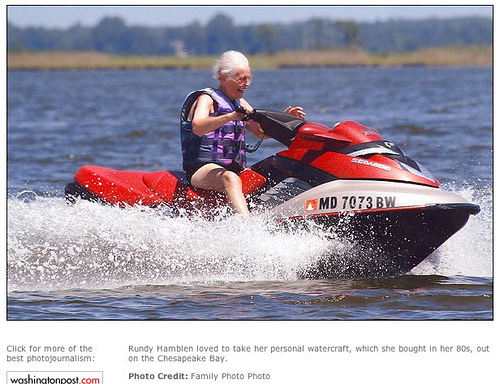
Rundy Hamblen, age 80+, in her Jet ski on the Chesapeake . .

Media_httpfarm4static_gavlm

This is definitely the kind of photo I want to have in my obituary — assuming it’s publishable in a family newspaper (assuming, I guess that there still are newspapers, too).

From the Post’s obituary at http://www.washingtonpost.com/wp-dyn/content/article/2008/03/01/AR2008030101706_2.html

With her oxygen tubes coiled around the handlebars, she skimmed over choppy waters, throttle wide open.

Bless Rundy Hamblen. . . .

Posted in Uncategorized | Tagged , , | Leave a comment

NOW What???

Media_httpfarm3static_cyhjf

Know How He Feels, originally uploaded by bpotter1942.


So there I was, walking over the veldt, minding my own business when they shot me in the fanny with this dart, threw me in a box, shipped me halfway around the world, and then locked me in a cell about half the size it should be . . .

Now what?? 

Now THIS!

Posted in Uncategorized | Leave a comment

New Spam: Carbon Credits

[Guess it would be just tooo pollyannish to say it’s proof that key environmental messages are now being “mainstreamed.”]To: <info@irf.org>Subject: Carbon Credit (CDM&JI)Sender: “Carbon Credits” <kind405@gmail.com>Date: Tue, 15 Jan 2008 15:16:39 +0530Carbon credit ˜ thrust for cleaner technologiesLearn about Carbon credit-CDM & JIWhat is Carbon Credit?How can I benefit from Carbon Credit?Double-edged benefit in carbon campaign … How?Learn in our E-Book”Carbon Credits for Landowners” highlights the fact that the United States forests sequester … how it works and if they might benefit from carbon credits. …Learn in our E-BookThe CDM allows the creation of new Carbon Credits by developing emission …..How?Learn in our E-BookHOW CAN AN INDIVIDUAL (NOT AN INDUSTRIALIST) BENEFIT FROM CARBON CREDITS??A buyer can bid for as low as 1000 carbon credits while a seller can submit a minimum of 5000 credits for sale…..Learn more in our E-Book

Posted in Uncategorized | Tagged , | Leave a comment

When is SPAM a New Year’s Card?

Check this out — I was about to delete this SPAM, and then I discovered it’s a message from a major program manager at CONSERVATION INTERNATIONAL — guess the old categories don’t hold up any more. . . . I’m getting a headache thinking about it . . . . I don’t think my management manual [DILBERT] has anything about “How to use your spouse’s corporate Xmas card list to market your new on-line distance learning course.”I can hardly wait for next year’s edition, when I’m sure I will have the opportunity to sign up for ice-skating lessons from the darling Ariana.——————Date: Wed, 9 Jan 2008 11:02:50 -0500 (EST)From: Neel Inamdar <inamdar1@gmail.com> To: bshrodinger@irf.org Subject: Have a Great 2008 !You’re receiving this email because of your relationship with Neel Inamdar. lease confirm your continued interest in receiving email from us.You may unsubscribe if you no longer wish to receive our emails.Neel Inamdar and Anne LoehrDear Bruce,Who would have thought 2007 would have passed so quickly? It was great to hear from all of you and/or see you in 2007. We’re hoping to be better about staying in touch in 2008, so please send us your news whenever you get a chance. We promise we’ll do the same!Something to Think About for 2008For a little perspective about the choices you want to make for 2008, we invite you to visit the Story of Stuff. It’s a powerful piece on the challenges we face in this new age. The video is very thought-provoking!An Update from NeelI’m still enjoying mywork as the Senior Advisor for Ecotourism with Conservation International (CI) in Washington, DC. My main role is identifying and working with hospitality companies interested in supporting conservation initiatives for a win-win solution. Madagascar is our current focus, but CI has active programs around the world.As many of you know, I like doing many things at once, so I recently became involved with a small startup company that advises hotels and resorts on how to improve their sustainability, save money and be more green. Feel free to visit www.sustainability-dna.com for more information.I’m still involved in various investment projects, most recently in New Hampshire, where we are building unique ski-on/ski-off condo’s next to the Mt. Sunappee Resort at Mountain Reach Who knows? Maybe I’ll even learn to ski someday and enjoy this resort!An Update from AnneMy first business book, “A Manager’s Guide to Coaching: Simple and Effective Ways to Get the Best Out of Your Employees” will be published in March 2008, which is also very exciting. Co-authored with Brian Emerson, this book will help managers and entrepreneurs successfully coach themselves and others to success. We’ve already received some great endorsements and I’m lining up book signing events for the spring, so feel free to contact me if you’d like a book signing in your area.Since so many people have asked me how we managed to get a book from idea to publisher in just six months, I decided to start a 10-week book publishing course, helping new and aspiring authors save time and money in their own publishing quest. If you know anyone who wants to be published, feel free to send them this newsletter. I’d be happy to help them in any way I can!An Update from ArianaAriana will be celebrating her 3rd birthday in January! Hard to believe! She loves ice skating, is learning to scooter on her new Christmas present, has a steel trap mind and does not hesitate to voice her opinion! She keeps us on our toes!If you no longer want to receive our news, please just select the appropriate “unsubscribe” mechanism below.We will be sorry to see you go, but totally understand your decision!All the best for 2008!Neel Inamdar & Anne LoehrThis email was sent to bpotter@irf.org, by inamdar1@gmail.comNeel Inamdar & Anne Loehr | 11654 Plaza America Drive | Suite 354 | Reston | VA | 20190

Posted in Uncategorized | Tagged , , , | Leave a comment

Web Semantics 3.0 for Web Users 0.9

This message started as an e-mail to Twine.com, a (still-in-restricted-beta Web 3.0 application) about a personal wish list for improved management of web information resources.

  1. Why am I writing this as an e-mail? That certainly seems awfully Web 1.0 in a discussion of Web 3.0 issues.  Guess I’ll eventually put it into a blog where many of my non-existent “followers” can look it up. [But fewer than  5% use RSS feeds for ANY purpose, and none have any kind of feed from this specific blog so how would they ever see it?? …]
  2. I run a half dozen different networks, trying to improve the use of environmental (scientific and technical) sustainability information in development activities on small islands, around the world. In that process, I maintain regular contact with maybe 250 people, about evenly split: half are residents of the USA and the European Community; the rest are in developing countries — mostly in islands where connectivity is less than optimal — around the world. Among the internet based tools I am using or have tried to use to support communications among these users since 1995 are e-mail discussion groups (30+ right now), forums, wikis, intensive e-mail messaging, web sites, blogs, and a couple of web 2.0 tools, such as TWITTER, FLICKR, and Leadln (but not MYSPACE or FACEBOOK).
  3. Progressing in time and complexity from plain text internet through the Web 2.0 applications listed above, I think there is an inverse relationship between the complexity of the applications and the willingness of potential users to actually sign-on to the technology.By way of examples:

a)    When I set up a simple e-mail group, between 10% and 20% of those who promise to participate will actually accept an invitation to subscribe. This is too low a rate for groups which need to reach most of the key opinion leaders in a subject matter area, so the lists are usually populated by “forcibly” subscribing  people into Yahoogroups (a pain, since they limit such a process to 10 additions per day).

b)    For three months I have been trying to get colleagues to sign up on Twitter because I see it as a neat tool to facilitate team efforts (see Adam Engst’s article on Twitter in Tidbits, “Confessions of a Twitter Convert“) on a major publication that we will be collaborating on for the UN Environment Programme by the end of 2008. There are about a dozen “core” members and another 100 or so less critical members, all of whom I have solicited to join Twitter two or more times. So far only my sister and brother have signed on (and they don’t work on the UNEP project!).

So, in light of these experiences I think the kinds of “Web 3.0” (or whatever) tools that would be most useful to me would be those that would provide a lot of the mapping and cross-indexing information described in  the video interview by Robert Scobel of Radar Networks’s CEO Nova Spivack, including some sort of version control for multiple editors and reviewers of written or graphic materials, without requiring the active engagement or positive participation by the bulk of the users.I don’t know if this makes sense to the designers and architects of the new types of web tools, but I thought it might be interesting for some to think about.

Posted in Uncategorized | Tagged , , | Leave a comment

Whatever you say, don’t use the “L” word. . .

[Stimulated by a holiday card from the Center for American Progress. . . ]Every once in a while you realize how contaminated the “L” word really is.Scratch a so-called “Progressive” deeply enough (you’ll have to ask MuKacy exactly how deeply, but I’m sure it’s not torture, exactly, as defined by US law and international treaty that we recognize, this week) and I’ll bet you find a — shudder — Liberal. . .

Posted in Uncategorized | Tagged , | Leave a comment

Michael Chertoff: The Grinch Who Stole [Canada’s] Christmas

For the three years past, my widely dispersed siblings and I have taken our respective families, and their families, etc., to Niagara-on-the-Lake for a family Christmas weekend. The tradition of a family get-together before Christmas goes back over twenty years, and has become an important part of the holiday celebrations for all of us.We have held these family sessions in a variety of sites, trying to find a place mutually accessible to all but not necessarily so close to anyone that they feel the need to serve as host to all of the relatives right in the middle of the hectic holiday seasons, especially after the passing of our parents in the 1990’s.We had settled on the village of Niagara-on-the-Lake (population about 15,000), just across the Niagara River from Western New York where we grew up in because of:o Its location;o The availability of affordable lodging for the multiple families involved;o The charm of this well preserved lakeside Victorian resort (summer home of a well-known George Bernard Shaw Festival);o Because of the large and somewhat quirky Christmas parade that coincided with our reunions; ando Don’t forget the ice wine, endemic to this part of southern Ontario.Well, this year we gave up on Niagara on the Lake and have gone someplace else, because crossing the Niagara River, from the USA to Canada (!) and return, has become so uncertain and so anxiety-provoking (members of the family have missed planes and other important appointments) because of delays of up to three hours at the Peace Bridge, or the other bridges in the area.We can live with Buffalo’s blizzards, but the Grinch has won this round, especially with passports being required after January 1st. We’re now meeting in a different, undisclosed site inside the continental boundaries of the United States of America.… and Canada even has a Conservative Government. Hey, Mikie, you’re doing a heck of a job, too. I know I sure feel a lot more secure.

Posted in Uncategorized | Tagged , , , , | Leave a comment

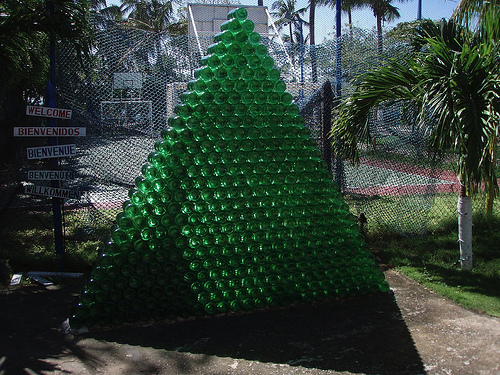
Xmas Tree in San Andres.JPG

Media_httpfarm3static_nchyk

PB300117.JPG, originally uploaded by bpotter1942.

Stack of green wine bottles outside of a beach bar just south of town on the small Western Caribbean island (belongs to Colombia, but about 500 miles from Cartagena) of San Andres.

Check the FLICKR site at http://tinyurl.com/2foj3e for other pictures of Xmas 2007 decorations on San Andres . . .

Posted in Uncategorized | Tagged , , | Leave a comment