Diplomatic Reform by Linda Thomas-Greenfield

From the November/December edition of Foreign Affairs
https://www.foreignaffairs.com/articles/united-states/2020-09-23/diplomacy-transformation

The Transformation of Diplomacy
How to Save the State Department
By William J. Burns and Linda Thomas-Greenfield
Foreign Affairs — November/December 2020

We joined the U.S. Foreign Service nearly 40 years ago in the same entering class, but we took very different paths to get there. One of us grew up amid hardship and segregation in the Deep South, the first in her family to graduate from high school, a Black woman joining a profession that was still very male and very pale. The other was the product of an itinerant military childhood that took his family from one end of the United States to the other, with a dozen moves and three high schools by the time he was 17.

There were 32 of us in the Foreign Service’s class of January 1982. It was an eclectic group that included former Peace Corps volunteers, military veterans, a failed rock musician, and an ex–Catholic priest. None of us retained much from the procession of enervating speakers describing their particular islands in the great archipelago of U.S. foreign policy. What we did learn early on, and what stayed true throughout our careers, is that smart and sustained investment in people is the key to good diplomacy. Well-intentioned reform efforts over the years were crippled by faddishness, budgetary pressures, the overmilitarization of foreign policy, the State Department’s lumbering bureaucracy, a fixation on structure, and—most of all—inattention to people.

The Trump administration also learned early on that people matter, and so it made them the primary target of what the White House aide Steve Bannon termed “the deconstruction of the administrative state.” That is what has made the administration’s demolition of the State Department and so many other government institutions so effective and ruinous. Tapping into popular distrust of expertise and public institutions, President Donald Trump has made career public servants—government meteorologists, public health specialists, law enforcement professionals, career diplomats—convenient targets in the culture wars. Taking aim at an imaginary “deep state,” he has instead created a weak state, an existential threat to the country’s democracy and the interests of its citizens.

The wreckage at the State Department runs deep. Career diplomats have been systematically sidelined and excluded from senior Washington jobs on an unprecedented scale. The picture overseas is just as grim, with the record quantity of political appointees serving as ambassadors matched by their often dismal quality. The most recent ambassador in Berlin, Richard Grenell, seemed intent on antagonizing as many Germans as he could—not only with ornery lectures but also through his support for far-right political parties. The ambassador in Budapest, David Cornstein, has developed a terminal case of “clientitis,” calling Hungary’s authoritarian, civil-liberties-bashing leader “the perfect partner.” And the U.S. ambassador to Iceland, Jeffrey Ross Gunter, has churned through career deputies at a stunning pace, going through no fewer than seven in less than two years at his post.

In Washington, career public servants who worked on controversial issues during the Obama administration, such as the Iran nuclear negotiations, have been smeared and attacked, their careers derailed. Colleagues who upheld their constitutional oaths during the Ukraine impeachment saga were maligned and abandoned by their own leadership. In May, the State Department’s independent inspector general, Steve Linick, was fired after doing what his job required him to do: opening an investigation into Secretary of State Mike Pompeo’s alleged personal use of government resources. Battered and belittled, too many career officials have been tempted to go along to get along. That undercuts not only morale but also a policy process that depends on apolitical experts airing contrary views, however inconvenient they may be to the politically appointed leadership.

Not surprisingly, the Foreign Service has experienced the biggest drop in applications in more than a decade. Painfully slow progress on recruiting a more diverse workforce has slid into reverse. It is a depressing fact that today only four of the 189 U.S. ambassadors abroad are Black—hardly a convincing recruiting pitch for woefully underrepresented communities.

No amount of empty rhetoric about ethos and swagger can conceal the institutional damage. After four years of relentless attacks by the Trump administration and decades of neglect, political paralysis, and organizational drift, U.S. diplomacy is badly broken. But it is not beyond repair, at least not yet. What is needed now is a great renewal of diplomatic capacity, an effort that balances ambition with the limits of the possible at a moment of growing difficulties at home and abroad. The aim should be not to restore the power and purpose of U.S. diplomacy as it once was but to reinvent it for a new era. Accomplishing that transformation demands a focused, disciplined reform effort—one that is rooted in the people who animate U.S. diplomacy.

REFORM AND RENEWAL

The State Department is capable of reform. The challenge has always been to link that reform to wise statecraft and adequate funding. After 9/11, with uncommon speed and few additional resources, the department managed to retrofit itself to help prosecute the war on terrorism and take on the new imperatives of stabilization and reconstruction in Afghanistan and Iraq, along with smaller but still complex missions from sub-Saharan Africa to Southeast Asia. New training and incentives were put into play, and a generation of career Foreign Service officers was shaped by tours in conflict zones. Diplomats quickly became secondary players to the military, preoccupied with the kind of nation-building activities that were beyond the capacity of Americans to accomplish. It was easy to lose sight of the distinctive role of the U.S. Foreign Service—the classic, head-banging work of persuading senior national leaders to bridge sectarian divides and pursue a more inclusive political order while standing up for human rights.

Although the transformation of the State Department into a more expeditionary and agile institution was healthy in many respects, it was also distorting. It was tethered to a fundamentally flawed strategy—one that was too narrowly focused on terrorism and too wrapped up in magical thinking about the United States’ supposed power to transform regions and societies. It paid too little attention to a rapidly changing international landscape in which geopolitical competition with a rising China and a resurgent Russia was accelerating and mammoth global challenges, such as climate change, were looming. It also neglected what was happening at home—the powerful storms of globalization that had left many communities and parts of the economy underwater and would soon overwhelm the United States’ political levees.

After four years of attacks by the Trump administration, U.S. diplomacy is badly broken.

The contours of a new agenda for diplomatic reform have to flow from a sensible reinvention of the United States’ role in the world. The restoration of American hegemony is not in the cards, given China’s rise and the diffusion of global power. Retrenchment is similarly illusory, since the United States cannot insulate itself from outside challenges that matter enormously to its domestic health and security.

Instead, U.S. diplomacy has to accept the country’s diminished, but still pivotal, role in global affairs. It has to apply greater restraint and discipline; it must develop a greater awareness of the United States’ position and more humility about the wilting power of the American example. It has to reflect the overriding priority of accelerating domestic renewal and strengthening the American middle class, at a time of heightened focus on racial injustice and economic inequality. And it has to take aim at other crucial priorities. One is to mobilize coalitions to deal with transnational challenges and ensure greater resilience in American society to the inevitable shocks of climate change, cyberthreats, and pandemics. Another is to organize wisely for geopolitical competition with China.

INVESTING IN PEOPLE

The ultimate measure of any reform effort is whether it attracts, unlocks, retains, and invests in talent. The last thing the State Department needs is another armada of consultants descending on Foggy Bottom with fancy slide decks full of new ideas about how the department should look. It’s time to focus on—and listen to—the people who drive U.S. diplomacy: the Foreign Service professionals who rotate through posts around the world, the civil service employees whose expertise anchors the department at home, and the foreign-national staff who drive so much of the work of U.S. embassies and consulates.

To start, the United States needs a top-to-bottom diplomatic surge. The Trump administration’s unilateral diplomatic disarmament is a reminder that it is much easier to break than to build. The country doesn’t have the luxury of waiting for a generational replenishment, marking time as new recruits slowly work their way up the ranks. Since 2017, nearly a quarter of the senior Foreign Service has left. That includes the departure of 60 percent of career ambassadors, the equivalent of four-star generals in the military. In the junior and midcareer ranks, the picture is also bleak. According to the Federal Employee Viewpoint Survey, as many as a third of current employees in some parts of the State Department are considering leaving—more than double the share in 2016.

The United States needs a top-to-bottom diplomatic surge.

A diplomatic surge will have to incorporate ideas that in the past have seemed heretical to the department and its career staff but that today are inescapable. These include bringing back select personnel with critical expertise who were forced out over the past four years; creating midcareer pathways into the Foreign Service, including lateral entry from the civil service; and offering opportunities for Americans with unique skills (in new technologies or global health, for example) to serve their country through fixed-term appointments. Another useful initiative would be to create a “diplomatic reserve corps” made up of former Foreign Service and civil service midlevel officers and spouses with professional experience who could take on shorter or fixed-term assignments abroad and in Washington. Still another idea would be to create an ROTC-like program for college students, an initiative that would broaden understanding of the diplomatic profession across society and provide financial support to those preparing for diplomatic careers.

All these ideas would have landed in the “too hard” pile when we were serving. But the reality today is that the State Department simply cannot afford to continue its bad habits of offering inflexible career tracks, imposing self-defeating hiring constraints, and encouraging tribal inbreeding among its cloistered ranks.

Another major priority is the need to treat the lack of diversity in the diplomatic corps as a national security crisis. It not only undermines the power of the United States’ example; it also suffocates the potential of the country’s diplomacy. Study after study has shown that more diverse organizations are more effective and innovative organizations. At the very moment when American diplomacy could benefit most from fresh perspectives and a closer connection to the American people, the diplomatic corps is becoming increasingly homogeneous and detached, undercutting the promotion of American interests and values.

Another priority is the need to treat the lack of diversity in the diplomatic corps as a national security crisis.

The top four ranks of the Foreign Service are whiter today than they were two decades ago; only ten percent are people of color. Just seven percent of the overall Foreign Service is made up of Black people, and just seven percent are Hispanic—well below each group’s representation in the U.S. labor force. Meanwhile, the Trump administration has reversed a more than quarter-century-long push to appoint more female ambassadors. Overall female representation in the Foreign Service remains roughly the same today as it was in 2000—still 25 percent below female representation in the wider U.S. labor force. These trends have effectively undone much of the progress made following the settlement of two class-action discrimination suits shortly after we entered the Foreign Service.

The State Department should make an unambiguous commitment that by 2030, America’s diplomats will, at long last, resemble the country they represent. Achieving this goal will require making diversity a key feature of the diplomatic surge at every point along the career pipeline. It will demand an unshakable commitment to diverse candidates and gender parity in senior appointments. And it will require the State Department’s leadership to hold itself accountable by not only getting departmental data in order and making the information accessible to the public but acting on it, as well, with clear annual benchmarks for progress. Lower promotion rates for racial and ethnic minorities and the precipitous drop-off in the number of women and minorities in the senior ranks are flashing red warning lights of structural discrimination.

The State Department ought to invest much more in mentorship, coaching, and diversity and inclusion training. It has to make its career track more responsive to the expectations of today’s workforce for a work-life balance rather than perpetuate the imbalance that has prevented too many talented Americans—disproportionally those from underrepresented groups—from serving their country. The department has to pay more attention to the particular hazards facing minorities serving overseas, including LGBTQ employees. And it has to revise its promotion criteria to require personnel to foster diverse, inclusive, and equitable workplaces.

The top four ranks of the Foreign Service are whiter today than they were two decades ago.

To succeed in both a serious diplomatic surge and a historic new campaign for diversity and inclusion, the department must commit to winning the war for talent. The entrance exams to the Foreign Service are designed to weed out candidates rather than recruit the most talented ones. Too much of a premium is placed on written and oral examinations and too little on a candidate’s résumé, academic performance, skills, expertise, and life experiences. The whole process can seem interminable—taking as long as two years from start to finish and inadvertently benefiting candidates who have the means to hold out. After hiring their diplomats, the most effective diplomatic services spend up to three years training them. The Foreign Service Institute still spends only six weeks testing the mettle of its recruits; the only real difference from our experience many years ago is that the tedious lectures now feature PowerPoint presentations.

Once on assignment, there is no rigorous, doctrinal approach to the art of diplomacy and no system for after-action reviews. The personnel evaluation process consumes three months of an officer’s time, with no commensurate accountability for, let alone improvement in, individual or collective performance. Opportunities for midcareer graduate or professional education are scarce and carry little weight with promotion panels. The effect is often to penalize employees who receive extra training or undertake assignments to other agencies or to Congress. They should be rewarded instead.

Senior leadership positions are increasingly out of reach for career personnel. Over the past few decades, the proportion of political appointees to career appointees at the State Department, reaching down to the deputy assistant secretary level, has grown far higher than at any other national security agency. That worrisome trend—like so many others during the Trump era—has worsened dramatically. Today, only one of the 28 positions at the assistant secretary level at the State Department is filled by an active-duty career officer confirmed by the U.S. Senate—the lowest number ever. A record share of ambassadors are also political appointees as opposed to professional diplomats, a significant blow to morale and to diplomatic effectiveness. In a reformed State Department, at least half the assistant secretary jobs and three-quarters of the ambassadorial appointments should be held by well-qualified career officers. The remaining political appointments should be driven by substantive qualifications and diversity considerations, not campaign donations.

Political appointments should be driven by qualifications and diversity considerations, not campaign donations.

To unlock its potential, the State Department must increase its staffing pipelines to deepen its officers’ command of core diplomatic skills and fluency in areas of growing importance, such as climate change, technology, public health, and humanitarian diplomacy. In the traditional area of economics, the State Department must strengthen its capabilities significantly—working closely with the Commerce and Treasury Departments—and promote the interests of American workers with the same zeal with which it has promoted the interests of corporate America.

The State Department also needs to rethink how and where it invests in language studies. One out of every four positions designated as requiring foreign-language skills is filled by an officer who does not in fact meet the minimum language requirements. The State Department trains nearly twice as many Portuguese speakers as it does Arabic or Chinese speakers. It should expand opportunities for midcareer graduate studies and incentivize continuous learning as a requirement for promotion. It should also streamline the evaluation process by determining personnel assignments on the basis of performance, expertise, and leadership development rather than through a process of competitive, careerist bidding built on connections and “corridor,” or word-of-mouth, reputations.

A NEW CULTURE

Part of investing in people means investing in the technology that allows them to realize their full potential. A more digital, agile, collaborative, and data-centric diplomatic corps depends on more robust and secure communications tools. Today, too many diplomats lack access to classified systems and technology, especially on the road. That leaves them more vulnerable to foreign intelligence and unable to keep up with other U.S. national security agencies. The COVID-19 pandemic has thrown into sharp relief the need to reimagine how to conduct diplomacy remotely or virtually.

Technology can no longer be seen as a luxury good for diplomacy. The last big technological push at the State Department came during Colin Powell’s tenure as secretary of state, nearly two decades ago, when the department began to set aside its mini-fridge-sized desktop computers and move cautiously into the modern age. It is long past time for another major effort. To enhance the department’s technological platforms, the State Department should appoint a chief technology officer reporting directly to the secretary of state. That official should work with the U.S. Digital Service—an information technology consulting group within the executive branch that was created in 2014—to make internal systems, foreign aid, and public diplomacy more effective. Just as the department’s chief economist helps diplomats understand the impact of global economic trends on U.S. interests, the chief technology officer should help diplomats grapple with disruptive technologies and leverage private-sector talent.

But technology is not the only—or the most important—aspect of the State Department’s culture that must change. A systemic reluctance to tolerate physical risk has led to the proliferation of fortress-style embassies that can trap personnel behind chancery walls and isolate them from the people they should be meeting, not only foreign officials but also members of civil society. This has also led to an ever-growing number of posts where officers can’t be joined by family members, shorter tours, misaligned assignment incentives, lower morale, and less effective diplomacy.

A torpid bureaucratic culture is no less significant. Policy information and recommendations often amass 15 or more sign-offs before reaching the secretary of state’s office, suffocating initiative and stifling debate. Unstaffed Foreign Service positions create an imbalance between Washington and the field that prevents decentralized decision-making. And a rigid promotion structure incentivizes careerism over political or moral bravery.

Technology can no longer be seen as a luxury good for diplomacy.

A seismic cultural shift is needed to create a more upstanding, courageous, and agile institution, with greater tolerance for risk and a simplified, decentralized decision-making process. The State Department must get out of its own way—delegating responsibility downward in Washington and outward to qualified chiefs of mission overseas and reducing the number of undersecretaries and top-level staff members to avoid duplicative authority and inefficiencies. Initiative should be prized, and the passive-aggressive habit of waiting for guidance from above should be discouraged.

The department ought to discard the current cumbersome process for clearing papers and policy recommendations and start from scratch. A new, more flexible framework would allow expertise in Washington and in the field to be quickly distilled into cogent policy proposals and would grant embassies in the field more autonomy to implement the resulting decisions. The State Department’s leaders must also offer political top cover for constructive dissent, supplanting the corrosive “keep your head down” culture with an “I have your back” mentality—in other words, the exact opposite of how the State Department treated its diplomats during the 2019 impeachment hearings.

CHANGE THAT LASTS

Any effort to reform the State Department should start from within. It should focus in the first year of a new administration or a new term on what can be accomplished under existing authorities and without significant new appropriations. That is the moment of greatest opportunity to set a new direction—and the moment of greatest vulnerability to the habitual traps of bureaucratic inertia, overly elaborate and time-consuming restructuring plans, partisan bickering, and distracting forays into the capillaries of reform rather than its arteries.

If the department can take the initiative and demonstrate progress on its own, that would be the best advertisement for sustained congressional support and White House backing for a new emphasis on diplomacy. It would be the best way to show that U.S. diplomats are ready to earn their way back to a more central role. It could help generate momentum for a rebalancing of national security budget priorities at a moment when U.S. rivals are not standing still; in recent years, the Chinese have doubled their spending on diplomacy and greatly expanded their presence overseas.

A rigid promotion structure incentivizes careerism over political or moral bravery.

With a sturdy foundation of reforms laid, the next step would be to codify them in the first major congressional legislation on U.S. diplomacy in 40 years. The last Foreign Service Act, passed in 1980, modernized the mission and structure of the State Department, building on acts from 1924 and 1946. A new act would be crucial to making reforms durable. It would also help shape a style of diplomacy that is fit for an increasingly competitive international landscape and better equipped to serve the priority of domestic renewal. Serious, lasting transformation of U.S. diplomacy will be very hard. But it matters enormously to the future of American democracy in an unforgiving world.

We both bear the professional scars, and have enjoyed the rewards, of many eventful years as career diplomats. We saw plenty of examples of skill and bravery among our colleagues in hard situations around the world—from the horrific genocidal violence of Rwanda and the epic turmoil of post-Soviet Russia in the 1990s to the later challenges of ambassadorial postings in Liberia after its civil war and in Jordan in the midst of a once-in-a-half-century royal succession. We saw how U.S. diplomats can produce tangible results, whether by holding secret talks with adversaries, mobilizing other countries to ease the plight of refugees, or promoting American jobs and economic opportunities.

Through it all, however, we still remember vividly the sense of possibility and shared commitment to public service that drew the two of us and 30 other proud Americans to our Foreign Service entering class all those years ago. Today, there is a new generation of diplomats capable of taking up that challenge—if only they are given a State Department and a mission worthy of their ambitions and of the country they will represent.

WILLIAM J. BURNS is President of the Carnegie Endowment for International Peace. He was U.S. Deputy Secretary of State from 2011 to 2014.

LINDA THOMAS-GREENFIELD is Senior Vice President at the Albright Stonebridge Group. She was U.S. Assistant Secretary of State for African Affairs from 2013 to 2017.

They served as Co-Chairs of the Advisory Committee for a Council on Foreign Relations Special Report, Revitalizing the State Department and American Diplomacy, authored by Jon Finer and Uzra Zeya. This essay draws on its recommendations.
Posted in Fun | Comments Off on Diplomatic Reform by Linda Thomas-Greenfield

Voting Record of Deb Haaland, Dept of Interior Secretary-Designate

It’s a crap shoot when a person’s main background is a legislator and then to become responsible to actually administer something. As several have quoted, "They debate and do nothing else, a debating club" That was Obama’s weakness. It’s always been Bernie Sanders problem. Biden should be much better for his years as Vice P. The key to being a successful administrator is to have staff that complement your skills and experience and not mirror them.

Surely her values are in the right place per protecting the environment, etc. She will have a lot of power within the agency and, hopefully knows the pressure points. First job, undo all of Trump’s horrible actions.

Thanks for the article, Bruce.

Andy

PS Groundhogs Day will be here before you know it.

On Tue, Dec 29, 2020 at 1:52 PM Bruce G. Potter <bpotter> wrote:

from the newsletter of the Congressional analytical site: "The GovTrack” < https://govtrackinsider.com/deb-haaland-is-joe-bidens-nominee-for-secretary-of-the-interior-how-has-she-voted-on-interior-37109a219769 >

Deb Haaland is Joe Biden’s nominee for Secretary of the Interior;
How has she voted on Interior issues in Congress?

GovTrack.us

Dec 28 · 7 min read — Rep. Deb Haaland (D-NM1)

A member of the Laguna Pueblo tribe, Rep. Deb Haaland (D-NM1) has been nominated as the first-ever Native American Cabinet secretary. The first-term congresswoman, previously chair of the New Mexico Democratic Party, currently serves as Vice Chair of the House Natural Resources Committee, including as Chair of the Subcommittee on National Parks, Forests, and Public Lands.

The $12.6 billion department she is poised to run, subject to Senate confirmation, controls about one-fifth of all U.S. land. It also houses such bureaus as the National Parks Service, the U.S. Fish and Wildlife Service, and the Bureau of Indian Affairs.

How has Rep. Haaland voted in Congress on such issues, and what legislation has she introduced or cosponsored on these subjects?

Works across the aisle

In 2019, among all House freshmen, Rep. Haaland introduced the most bills with at least one bipartisan cosponsor, with 13. (Reps. Anthony Brindisi [D-NY22] and Josh Harder [D-CA10] tied for second place, with 12 each.)

Curiously, that bipartisan outreach did not apply nearly as much in the opposite direction, when she was cosponsoring other legislators’ bills. Among all representatives, freshmen or otherwise, her rate of cosponsoring bills introduced by members across the aisle ranked 11th-least.

In 2019, she introduced more House bills that attracted a Senate companion than any other House member, freshman or otherwise, with 15. (Reps. Judy Chu [D-CA27] and Rosa DeLauro [D-CT3] tied for second place, with 14 each.) This reflects Haaland’s ability to work well with the upper chamber, possibly fortelling a relatively uncontroversial confirmation vote in January.

Three bills enacted

Rep. Haaland was the lead sponsor of three bills that were enacted into law so far during her first term. That’s a pretty good number for any member of Congress during these polarized times, but especially for a first-term representative who doesn’t serve in an official leadership role. All three laws dealt with Native American policy, which Haaland would also deal with at Interior.

Not Invisible Act

Native American rates of murder, rape, and violent crime are all higher than the national averages. The Not Invisible Act creates a new position within the Interior Department dealing specifically with murder, trafficking, and missing Native Americans, and forms a new joint advisory committee between the Interior and Justice Departments on those issues.

“Every woman deserves to feel safe, but women in Native communities are going missing without a trace,” Rep. Haaland said in a press release. “The congressional members of federally recognized tribes are stepping up for our communities by working to set up an advisory board that is specifically focused on finding solutions to address this silent crisis,” referring to the bill being cosponsored by Native American Reps. Tom Cole (R-OK4), Sharice Davids (D-KS3), and Markwayne Mullin (R-OK2).

The Senate passed it by voice vote on March 11, then the House followed suit on September 21, and President Trump signed it into law on October 10, 2020.

PROGRESS for Indian Tribes Act

Since 1975, the Indian Self-Determination and Education Assistance Act has allowed Native American tribes to self-govern through many programs and services that were previously administered federally. The PROGRESS for Indian Tribes Act, which stands for Practical Reforms and Other Goals to Reinforce the Effectiveness of Self-Governance and Self-Determination, makes some technical and bureaucratic tweaks and reforms to further expand tribes’ right to self-governance.

“Self-governance has been extraordinarily beneficial for Tribes to manage successful programs with the flexibility to utilize federal funds in a way that best fits the needs of their communities. Tribes are their own best stewards,” Rep. Haaland said in a press release. “However, serious gaps continue to exist that hinder the full exercise of Tribal self-governance.”

The Senate passed it by voice vote on June 27, 2019; the House did the same on September 21, 2020; and President Trump signed it into law on October 21, 2020.

Native American Business Incubators Program Act

Native Americans have the highest poverty rate of any racial group. The Native American Business Incubators Program Act creates a $5 million annual grant program within the Interior Department for tribal businesses, educational institutions, or other organizations.

When I was a young single mom trying to make ends meet, I started and ran a salsa company. That experience could have been so different if there was more access to resources,” Rep. Haaland said in a press release. “This bill will make sure future entrepreneurs in Indian Country can build businesses and break cycles of poverty in our communities.”

The Senate passed it by voice vote on June 27, 2019; the House did the same on September 21, 2020; and President Trump signed it into law on October 20, 2020.
Three bills introduced

Rep. Haaland has also introduced a number of bills dealing with issues she would tackle at the Interior Department. Here are three of them.

ANTIQUITIES Act

In December 2017, President Trump completed the largest rollback of national monument designations in U.S. history, reducing the size of the Bears Ears National Monument and Grand Staircase-Escalante National Monument — both in Utah — by a cumulative 2 million acres.

A month into her congressional tenure, the very first bill Rep. Haaland ever introduced was the ANTIQUITIES Act, which stands for “America’s Natural Treasures of Immeasurable Quality Unite, Inspire, and Together Improve the Economies of States.” The bill would clarify that Congress must officially declare any national monuments. It would also re-expand Bears Ears to 1.9 million acres and designate about 250,000 acres in Rep. Haaland’s home state of New Mexico as federally protected.

The name is a deliberate homage to the original Antiquities Act of 1906, which originally allowed the president to declare national monuments.

“We love our public lands, we love our open spaces, and we care about the future we’re going to leave for our children, but this administration has been illegally attacking our nation’s treasures so it can sell them off to oil companies and developers,” Rep. Haaland said in a press release. “As my first piece of legislation this bill expands on my efforts to fight climate change by protecting land from extraction, honor our sacred sites, and ensure our beautiful places are here for future generations. Our public lands are not for sale.”

Republicans contend not only that President Trump had the power to recede or rescind the monuments if he chose, but also that the bill may be unconstitutional. In the 1920 Supreme Court case Cameron v. United States, the Court unanimously upheld that President Theodore Roosevelt had the right to declare the Grand Canyon a national monument.

Despite receiving 113 cosponsors, all Democrats, the bill never received a vote in the Democratic-controlled House.

Climate Stewardship Act

From 1933 to 1942, during the Great Depression, the federal government ran the program Civilian Conservation Corps, employing hundreds of thousands of people to plant more than three billion trees and construct trails in more than 800 parks.

The Climate Stewardship Act would resurrect this program under the new name Stewardship Corps. The 84-page bill also contains provisions restoring 2+ million acres of coastal wetlands and investing in renewable energy.

“Climate change is an immediate threat our communities face that calls for bold solutions. However, deforestation and some current agricultural practices are making global warming worse,” Rep. Haaland said in a press release. The bill would “incentivize farming practices that reduce emissions and promote reforestation. These steps are important to reversing climate change impacts that threaten the health and safety of our communities and our planet.”

The bill has attracted 10 cosponsors, all Democrats, but has not received a vote in the Democratic-controlled House.

Reconciliation in Place Names Act

Part of the Interior Department, the U.S. Board on Geographic Names designates the official names of lands, mountains, rivers, and other geographic features. A 2015 study estimated there may be as many as 1,441 domestic geographic features which had potentially offensive official names, such as Dead Negro Spring.

The Reconciliation in Place Names Act would create a new 16-member Advisory Committee on Reconciliation in Place Names to advise the board. This committee would consist of four Native American tribe members, four people with expertise in civil rights or race relations, four people with expertise in anthropology or cultural studies, one person representing a tribal organization, with the last three intended to represent the general public at large.

“All visitors to public lands deserve to feel welcome and comfortable while enjoying all that nature has to offer them. However, offensive or racist place names are restricting access and prevent many from feeling welcome on lands that belong to all of us,” Rep. Haaland said in a press release. “It’s past time to change the offensive names of public lands, especially with input from groups who have been discriminated against.”

The bill has attracted 15 cosponsors, all Democrats, but has not received a vote in the Democratic-controlled House.

Presumably, President Donald Trump would oppose this bill. After President Obama’s Interior Secretary Sally Jewell changed the name of Alaska’s Mount McKinley to Mount Denali, reverting to the summit’s original name in the native language Koyukon, Trump tweeted, “Great insult to Ohio. I will change back!” referring to the namesake President William McKinley hailing from Ohio.

(However, Trump’s Interior Secretary Ryan Zinke ultimately kept the name Denali at the request of Alaska’s two U.S. senators.)

Posted in Fun | Comments Off on Voting Record of Deb Haaland, Dept of Interior Secretary-Designate

Voting Record of Deb Haaland, Dept of Interior Secretary-Designate

from the newsletter of the Congressional analytical site: “The GovTrack” < https://govtrackinsider.com/deb-haaland-is-joe-bidens-nominee-for-secretary-of-the-interior-how-has-she-voted-on-interior-37109a219769 >

Deb Haaland is Joe Biden’s nominee for Secretary of the Interior;
How has she voted on Interior issues in Congress?

GovTrack.us

Dec 28 · 7 min read — Rep. Deb Haaland (D-NM1)

A member of the Laguna Pueblo tribe, Rep. Deb Haaland (D-NM1) has been nominated as the first-ever Native American Cabinet secretary. The first-term congresswoman, previously chair of the New Mexico Democratic Party, currently serves as Vice Chair of the House Natural Resources Committee, including as Chair of the Subcommittee on National Parks, Forests, and Public Lands.

The $12.6 billion department she is poised to run, subject to Senate confirmation, controls about one-fifth of all U.S. land. It also houses such bureaus as the National Parks Service, the U.S. Fish and Wildlife Service, and the Bureau of Indian Affairs.

How has Rep. Haaland voted in Congress on such issues, and what legislation has she introduced or cosponsored on these subjects?

Works across the aisle

In 2019, among all House freshmen, Rep. Haaland introduced the most bills with at least one bipartisan cosponsor, with 13. (Reps. Anthony Brindisi [D-NY22] and Josh Harder [D-CA10] tied for second place, with 12 each.)

Curiously, that bipartisan outreach did not apply nearly as much in the opposite direction, when she was cosponsoring other legislators’ bills. Among all representatives, freshmen or otherwise, her rate of cosponsoring bills introduced by members across the aisle ranked 11th-least.

In 2019, she introduced more House bills that attracted a Senate companion than any other House member, freshman or otherwise, with 15. (Reps. Judy Chu [D-CA27] and Rosa DeLauro [D-CT3] tied for second place, with 14 each.) This reflects Haaland’s ability to work well with the upper chamber, possibly fortelling a relatively uncontroversial confirmation vote in January.

Three bills enacted

Rep. Haaland was the lead sponsor of three bills that were enacted into law so far during her first term. That’s a pretty good number for any member of Congress during these polarized times, but especially for a first-term representative who doesn’t serve in an official leadership role. All three laws dealt with Native American policy, which Haaland would also deal with at Interior.

Not Invisible Act

Native American rates of murder, rape, and violent crime are all higher than the national averages. The Not Invisible Act creates a new position within the Interior Department dealing specifically with murder, trafficking, and missing Native Americans, and forms a new joint advisory committee between the Interior and Justice Departments on those issues.

“Every woman deserves to feel safe, but women in Native communities are going missing without a trace,” Rep. Haaland said in a press release. “The congressional members of federally recognized tribes are stepping up for our communities by working to set up an advisory board that is specifically focused on finding solutions to address this silent crisis,” referring to the bill being cosponsored by Native American Reps. Tom Cole (R-OK4), Sharice Davids (D-KS3), and Markwayne Mullin (R-OK2).

The Senate passed it by voice vote on March 11, then the House followed suit on September 21, and President Trump signed it into law on October 10, 2020.

PROGRESS for Indian Tribes Act

Since 1975, the Indian Self-Determination and Education Assistance Act has allowed Native American tribes to self-govern through many programs and services that were previously administered federally. The PROGRESS for Indian Tribes Act, which stands for Practical Reforms and Other Goals to Reinforce the Effectiveness of Self-Governance and Self-Determination, makes some technical and bureaucratic tweaks and reforms to further expand tribes’ right to self-governance.

“Self-governance has been extraordinarily beneficial for Tribes to manage successful programs with the flexibility to utilize federal funds in a way that best fits the needs of their communities. Tribes are their own best stewards,” Rep. Haaland said in a press release. “However, serious gaps continue to exist that hinder the full exercise of Tribal self-governance.”

The Senate passed it by voice vote on June 27, 2019; the House did the same on September 21, 2020; and President Trump signed it into law on October 21, 2020.

Native American Business Incubators Program Act

Native Americans have the highest poverty rate of any racial group. The Native American Business Incubators Program Act creates a $5 million annual grant program within the Interior Department for tribal businesses, educational institutions, or other organizations.

When I was a young single mom trying to make ends meet, I started and ran a salsa company. That experience could have been so different if there was more access to resources,” Rep. Haaland said in a press release. “This bill will make sure future entrepreneurs in Indian Country can build businesses and break cycles of poverty in our communities.”

The Senate passed it by voice vote on June 27, 2019; the House did the same on September 21, 2020; and President Trump signed it into law on October 20, 2020.
Three bills introduced

Rep. Haaland has also introduced a number of bills dealing with issues she would tackle at the Interior Department. Here are three of them.

ANTIQUITIES Act

In December 2017, President Trump completed the largest rollback of national monument designations in U.S. history, reducing the size of the Bears Ears National Monument and Grand Staircase-Escalante National Monument — both in Utah — by a cumulative 2 million acres.

A month into her congressional tenure, the very first bill Rep. Haaland ever introduced was the ANTIQUITIES Act, which stands for “America’s Natural Treasures of Immeasurable Quality Unite, Inspire, and Together Improve the Economies of States.” The bill would clarify that Congress must officially declare any national monuments. It would also re-expand Bears Ears to 1.9 million acres and designate about 250,000 acres in Rep. Haaland’s home state of New Mexico as federally protected.

The name is a deliberate homage to the original Antiquities Act of 1906, which originally allowed the president to declare national monuments.

“We love our public lands, we love our open spaces, and we care about the future we’re going to leave for our children, but this administration has been illegally attacking our nation’s treasures so it can sell them off to oil companies and developers,” Rep. Haaland said in a press release. “As my first piece of legislation this bill expands on my efforts to fight climate change by protecting land from extraction, honor our sacred sites, and ensure our beautiful places are here for future generations. Our public lands are not for sale.”

Republicans contend not only that President Trump had the power to recede or rescind the monuments if he chose, but also that the bill may be unconstitutional. In the 1920 Supreme Court case Cameron v. United States, the Court unanimously upheld that President Theodore Roosevelt had the right to declare the Grand Canyon a national monument.

Despite receiving 113 cosponsors, all Democrats, the bill never received a vote in the Democratic-controlled House.

Climate Stewardship Act

From 1933 to 1942, during the Great Depression, the federal government ran the program Civilian Conservation Corps, employing hundreds of thousands of people to plant more than three billion trees and construct trails in more than 800 parks.

The Climate Stewardship Act would resurrect this program under the new name Stewardship Corps. The 84-page bill also contains provisions restoring 2+ million acres of coastal wetlands and investing in renewable energy.

“Climate change is an immediate threat our communities face that calls for bold solutions. However, deforestation and some current agricultural practices are making global warming worse,” Rep. Haaland said in a press release. The bill would “incentivize farming practices that reduce emissions and promote reforestation. These steps are important to reversing climate change impacts that threaten the health and safety of our communities and our planet.”

The bill has attracted 10 cosponsors, all Democrats, but has not received a vote in the Democratic-controlled House.

Reconciliation in Place Names Act

Part of the Interior Department, the U.S. Board on Geographic Names designates the official names of lands, mountains, rivers, and other geographic features. A 2015 study estimated there may be as many as 1,441 domestic geographic features which had potentially offensive official names, such as Dead Negro Spring.

The Reconciliation in Place Names Act would create a new 16-member Advisory Committee on Reconciliation in Place Names to advise the board. This committee would consist of four Native American tribe members, four people with expertise in civil rights or race relations, four people with expertise in anthropology or cultural studies, one person representing a tribal organization, with the last three intended to represent the general public at large.

“All visitors to public lands deserve to feel welcome and comfortable while enjoying all that nature has to offer them. However, offensive or racist place names are restricting access and prevent many from feeling welcome on lands that belong to all of us,” Rep. Haaland said in a press release. “It’s past time to change the offensive names of public lands, especially with input from groups who have been discriminated against.”

The bill has attracted 15 cosponsors, all Democrats, but has not received a vote in the Democratic-controlled House.

Presumably, President Donald Trump would oppose this bill. After President Obama’s Interior Secretary Sally Jewell changed the name of Alaska’s Mount McKinley to Mount Denali, reverting to the summit’s original name in the native language Koyukon, Trump tweeted, “Great insult to Ohio. I will change back!” referring to the namesake President William McKinley hailing from Ohio.

(However, Trump’s Interior Secretary Ryan Zinke ultimately kept the name Denali at the request of Alaska’s two U.S. senators.)

Posted in Fun | Comments Off on Voting Record of Deb Haaland, Dept of Interior Secretary-Designate

30 Tropical Storms in the Atlantic for Hurricane Season, 2020

From NASA https://earthobservatory.nasa.gov/images/147643/a-destructive-abundance?src=nha

A Destructive Abundance

2020

A Destructive Abundance

The 2020 Atlantic hurricane season will go down in history as a season of superlatives: the most named storms observed in a year (30); the most storms to make landfall in the continental United States (12); the most to hit Louisiana (5); and the most storms to form in September (10). The 2020 season was supercharged, and not just in the raw numbers.

“What really blew me away were the explosive intensification events,” said Jim Kossin, an atmospheric scientist with the National Oceanic and Atmospheric Administration (NOAA). “For instance, Hurricane Eta’s wind speeds increased around 80 miles (130 kilometers) per hour in one day. There’s rapid intensification, and then there’s really rapid intensification, which is what we saw often this year.”

For the past few decades, hurricanes have been rapidly intensifying more often, and their forward motion has been stalling more. 2020 continued both trends. A record-tying nine storms rapidly intensified, defined as wind speeds increasing at least 35 miles (56 kilometers) per hour within 24 hours. Two named storms stalled; one (Sally) moved at just 2 miles per hour for a period—slower than a walking pace.

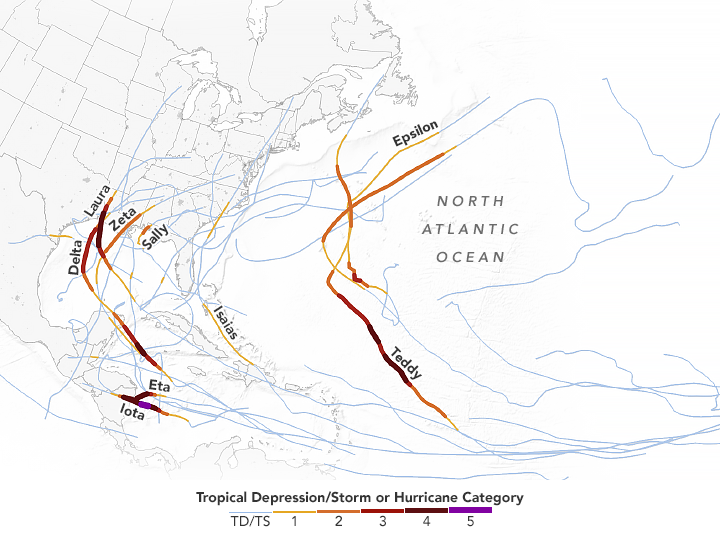
The map above shows the tracks of all 30 Atlantic storms in 2020, highlighting a few of the named storms. Three of them—Eta, Iota, and Delta—saw their winds intensify by at least 80 miles (130 kilometers) per hour in 24 hours. The data for the map come from the International Best Track Archive for Climate Stewardship (IBTrACS), the official archive used by the World Meteorological Organization.

During the 2020 season, nearly every mile of the U.S. Atlantic coast from Texas to Maine was under a tropical storm watch or warning at some point. It also marked the fifth year in a row with above-average hurricane activity.

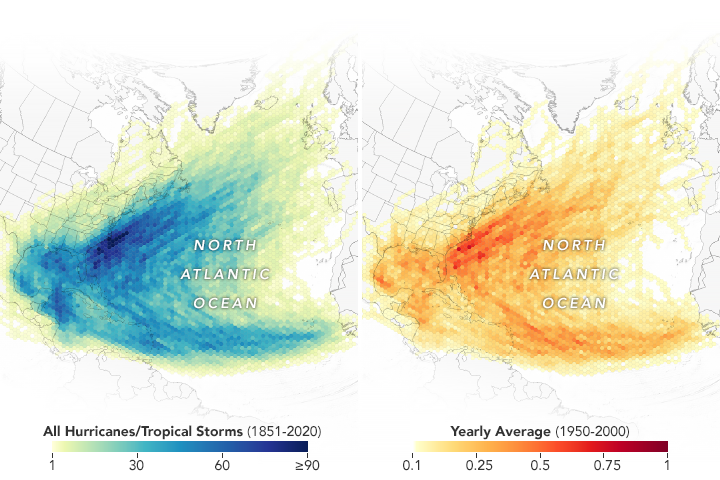
The maps below show historical storm tracks in the Atlantic basin, with each hexagon having a 100-kilometer (60-mile) diameter. The map on the left shows the total number of storms that crossed through each 100-kilometer parcel from 1851 to 2020. The map on the right shows the average number of storms that passed through each hexagon between 1950 and 2000. While the yearly average frequency barely approached one storm for any given parcel from 1950-2000, the active season of 2020 brought as many as four storms to some of these areas.

1851 – 2020

“This year, the U.S. got hit a lot and the storms did a lot of damage, but the damage certainly could have been worse had the storms tracked slightly differently,” said Phil Klotzbach, a meteorologist at Colorado State University. “For Hurricane Laura, the storm surge could have devastated Lake Charles if the storm had tracked 20 miles farther west.”

Category 4 Hurricane Laura was the strongest to make landfall in the U.S. this season, bringing sustained winds of 150 miles (240 kilometers) per hour and storm surges ranging from 9 to 15 feet (3 to 5 meters). It dropped 5 to 10 inches of rain across a swath of Louisiana, Texas, and Arkansas.

In Central America, category 4 hurricanes Eta and Iota made landfall within two weeks of one another in the same part of Nicaragua. Never have two Atlantic hurricanes hit the same area with such strength so close in time.

“Eta stood out as one of the most catastrophic storms of the season, as it stalled and rapidly intensified at the same time,” said Tim Hall, a hurricane researcher at NASA’s Goddard Institute for Space Studies. “It also occurred in November, well after the season typically peaks.”

September 14, 2020 JPEG

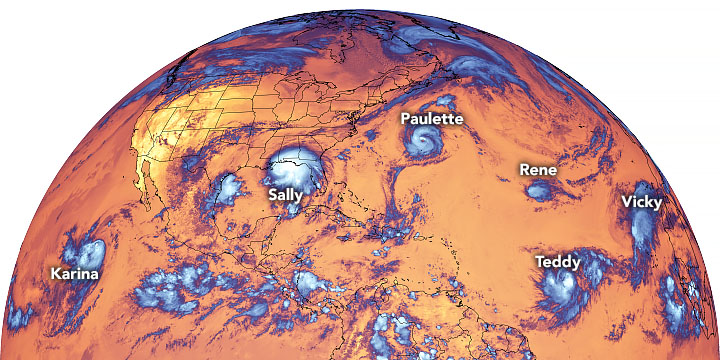
The image above shows a wide view of six storms on September 14, 2020. The data show brightness temperature of the cloud tops (infrared band 13) and were acquired on September 14 by the Geostationary Operational Environmental Satellite 16. GOES-16 is operated by NOAA; NASA develops and launches the GOES series of satellites.

A combination of environmental factors made the Atlantic basin favorable for storm development this year. Sea surface temperatures were abnormally warm at the beginning of the season—which led to a slew of early storms—and became warmer throughout the season. By August, a very active monsoon pattern took hold over northwestern Africa and helped produce the sort of robust atmospheric waves that can develop into storms. A moderate to strong La Niña also developed in the eastern Pacific Ocean and reduced the wind shear that can hinder hurricane formation and intensification across the tropical Atlantic.

Local atmospheric and oceanic conditions also helped intensify individual hurricanes, Klotzbach noted. Weak easterly trade winds prevented upwelling (the process of bringing deeper, colder water to the ocean surface) in the Caribbean, allowing a deep pool of extremely warm water to develop. This provided potent fuel for rapidly intensifying storms like Eta and Iota.

Though recent research suggests that warming seas may heighten hurricane activity in the future, the abundance of storms this year is not itself a signal of future storm trends. “There’s no observed trend globally on the frequency of storms. Some years and some ocean basins have more and then less,” said Hall. “But if you already have a hurricane formed, we have found that global warming signals are increasing a storm’s likelihood to stall, intensify into a major hurricane, and drop more rain.”

NASA Earth Observatory images by Joshua Stevens, using GOES 16 data from NOAA and the National Centers for Environmental Information (NCEI) and the International Best Track Archive for Climate Stewardship (IBTrACS). Story by Kasha Patel.

References & Resources

Bhatia, K. T. et al. (2019) Recent increases in tropical cyclone intensification rates. Nature Communications, 10 (635).
Colorado State University Tropical Weather & Climate Research (2020, November 30) Summary of 2020 Atlantic Tropical Cyclone Activity and Verification of Authors’ Seasonal and Two-Week Forecasts. Accessed December 9, 2020.
Hall, T. et al. (2020) US Tropical Cyclone Activity in the 2030s Based on Projected Changes in Tropical Sea-Surface Temperature. Journal of Climate.
National Hurricane Center (2020, December 1) Monthly Atlantic Tropical Weather Summary. Accessed December 9, 2020.
NOAA (2020, November 24) Record-breaking Atlantic hurricane season draws to an end. Accessed December 9, 2020.
Yale Climate Connections (2020, December 1) A look back at the horrific 2020 Atlantic hurricane season. Accessed December 9, 2020.

Posted in Fun | Comments Off on 30 Tropical Storms in the Atlantic for Hurricane Season, 2020

AP News: China testing blunders stemmed from secret deals with firms

wsj Drifting left of center lately and so is unlikely to be interested

by the way have you walked down past the house lately because all of the shrubbery is now gone as our two trees on the side of the house and everything in back as well the photos we are being sent show it looking quite barren — I think some preliminary grading may be underway soon and the inside work is scheduled we are told for January

Hope all is well and quiet on Burns Lane and I do miss our walks and talks

Posted in Fun | Comments Off on AP News: China testing blunders stemmed from secret deals with firms

AP News: China testing blunders stemmed from secret deals with firms

Looks as if some of these comments could be a ‘Letter to the Editor’ of the WSJ?

From: Beeman Hollow Farm <beemanhollowfarm@gmail.com>
Sent: Saturday, December 5, 2020 4:59 PM
To: Pete Crow <petermcrow@gmail.com>
Cc: Bruce G. Potter <bpotter@irf.org>; Carol Anne <Caswagler@aol.com>; GEORGE MORAN <gcmoran@me.com>; Liz Crow Turner <lizturner@swbell.net>; Potter Family <PotterFamily@groups.io>; Potters Weal Blog <>; Rick Stubblefield <grstub@hotmail.com>; Steven <stevencummings@cox.net>
Subject: Re: AP News: China testing blunders stemmed from secret deals with firms

Thank you for the kind words… it was my privilege to come full circle at those newspapers, I would’ve done it for free if I could afford it. There are now zero employees .. every reporter is a stringer.

Sigh.

On Sat, Dec 5, 2020 at 9:32 AM Pete Crow <petermcrow> wrote:

BG: Cheryl first came to work for me at age 19, and eventually became publisher of all of my newspapers for a number of years when she was recruited by a later owner following my sale of them to the Australians in 2007 — she was the best, finest publisher these newspapers ever had and (forget me) we had some giants over the 120 years of publishing — the chain that now owns my newspapers fired her in a cost savings endeavor about a year ago leaving, now, only one employee where once we had upwards to 60 … the end is near for all print publications, including Wapo and NYT whose readers are either in denial or woefully ignorant of the business realities of the industry

On Sat, Dec 5, 2020 at 8:28 AM Beeman Hollow Farm <beemanhollowfarm> wrote:

It’s indeed sad, the first thing I do before I read a story is look to see the source, I used to respect the AP but they are blatantly slanted these days. I’m not sure they would hire unbiased reporters these days anyway.

Hurts my soul!

On Fri, Dec 4, 2020 at 3:41 PM Pete Crow <petermcrow> wrote:

During my nearly 40 years of owning newspapers in Oklahoma the head of the Associated Press would come out to visit with me once or twice a year and we would spend the afternoon talking about the industry and other matters — Because the associated press is or at least was owned by the daily newspapers in the United States I was actually a tiny owner of the associated press

in those days my regard for them and for their staff could not have been higher and in fact the associated press recruited out of the news rooms of the daily newspapers in the United States including picking off several of my best reporters over the years and doing so with my full blessings because we wanted the very best reporters working for the associated press and they absolutely were

but about 20 years ago in the late 1990s during one of our meetings the fellow running the Associated Press in Oklahoma told me that he could no longer reliably find reporters who did not have an agenda and that reality made fair reporting increasingly difficult because it is not what the reporter places in the article that matters it is what they have left out and that is discovered only later after the story has been disseminated

which leads us to the sad situation we find ourselves in today where reliable accurate and full reporting no longer exists and readers and viewers are left to believe what they wish to believe or which they are maneuvered into believing by a selective leaving out of relevant information

One can choose to believe a glowing report from the associated press or from any of the media on the left or the right if one so chooses but the more effervescent the reporting becomes the more skeptical the consumer should become — with a near complete lack of editing a reporter can nearly always get their story disseminated before it’s veracity is challenged — This is made even more difficult because of the 24/7 news cycle and the desire to outcompete the competition but it has come at a terrible cost to the trust that the industry Once enjoyed with our readers and viewers

In the past year I have been sending out copies to friends and others of Orwell’s 1984 and recently a friend wrote back disputing that we were in 1984 saying “this is not 1984 we are now living in 1985 and beyond” in a world of rampant censorship and growing ignorance and a near complete inability to see all shades of gray. The head of the associated press saw it coming in the agenda-driven reporter cohort seeking jobs that began to present them selves more than 20 years ago and so did I

Posted in Fun | Comments Off on AP News: China testing blunders stemmed from secret deals with firms

AP News: China testing blunders stemmed from secret deals with firms

Thank you for the kind words… it was my privilege to come full circle at those newspapers, I would’ve done it for free if I could afford it. There are now zero employees .. every reporter is a stringer.
Sigh.

On Sat, Dec 5, 2020 at 9:32 AM Pete Crow <petermcrow> wrote:

BG: Cheryl first came to work for me at age 19, and eventually became publisher of all of my newspapers for a number of years when she was recruited by a later owner following my sale of them to the Australians in 2007 — she was the best, finest publisher these newspapers ever had and (forget me) we had some giants over the 120 years of publishing — the chain that now owns my newspapers fired her in a cost savings endeavor about a year ago leaving, now, only one employee where once we had upwards to 60 … the end is near for all print publications, including Wapo and NYT whose readers are either in denial or woefully ignorant of the business realities of the industry

On Sat, Dec 5, 2020 at 8:28 AM Beeman Hollow Farm <beemanhollowfarm> wrote:

It’s indeed sad, the first thing I do before I read a story is look to see the source, I used to respect the AP but they are blatantly slanted these days. I’m not sure they would hire unbiased reporters these days anyway.
Hurts my soul!

On Fri, Dec 4, 2020 at 3:41 PM Pete Crow <petermcrow> wrote:

During my nearly 40 years of owning newspapers in Oklahoma the head of the Associated Press would come out to visit with me once or twice a year and we would spend the afternoon talking about the industry and other matters — Because the associated press is or at least was owned by the daily newspapers in the United States I was actually a tiny owner of the associated press

in those days my regard for them and for their staff could not have been higher and in fact the associated press recruited out of the news rooms of the daily newspapers in the United States including picking off several of my best reporters over the years and doing so with my full blessings because we wanted the very best reporters working for the associated press and they absolutely were

but about 20 years ago in the late 1990s during one of our meetings the fellow running the Associated Press in Oklahoma told me that he could no longer reliably find reporters who did not have an agenda and that reality made fair reporting increasingly difficult because it is not what the reporter places in the article that matters it is what they have left out and that is discovered only later after the story has been disseminated

which leads us to the sad situation we find ourselves in today where reliable accurate and full reporting no longer exists and readers and viewers are left to believe what they wish to believe or which they are maneuvered into believing by a selective leaving out of relevant information

One can choose to believe a glowing report from the associated press or from any of the media on the left or the right if one so chooses but the more effervescent the reporting becomes the more skeptical the consumer should become — with a near complete lack of editing a reporter can nearly always get their story disseminated before it’s veracity is challenged — This is made even more difficult because of the 24/7 news cycle and the desire to outcompete the competition but it has come at a terrible cost to the trust that the industry Once enjoyed with our readers and viewers

In the past year I have been sending out copies to friends and others of Orwell’s 1984 and recently a friend wrote back disputing that we were in 1984 saying “this is not 1984 we are now living in 1985 and beyond” in a world of rampant censorship and growing ignorance and a near complete inability to see all shades of gray. The head of the associated press saw it coming in the agenda-driven reporter cohort seeking jobs that began to present them selves more than 20 years ago and so did I

Posted in Fun | Comments Off on AP News: China testing blunders stemmed from secret deals with firms

AP News: China testing blunders stemmed from secret deals with firms

BG: Cheryl first came to work for me at age 19, and eventually became publisher of all of my newspapers for a number of years when she was recruited by a later owner following my sale of them to the Australians in 2007 — she was the best, finest publisher these newspapers ever had and (forget me) we had some giants over the 120 years of publishing — the chain that now owns my newspapers fired her in a cost savings endeavor about a year ago leaving, now, only one employee where once we had upwards to 60 … the end is near for all print publications, including Wapo and NYT whose readers are either in denial or woefully ignorant of the business realities of the industry

On Sat, Dec 5, 2020 at 8:28 AM Beeman Hollow Farm <beemanhollowfarm> wrote:

It’s indeed sad, the first thing I do before I read a story is look to see the source, I used to respect the AP but they are blatantly slanted these days. I’m not sure they would hire unbiased reporters these days anyway.
Hurts my soul!

On Fri, Dec 4, 2020 at 3:41 PM Pete Crow <petermcrow> wrote:

During my nearly 40 years of owning newspapers in Oklahoma the head of the Associated Press would come out to visit with me once or twice a year and we would spend the afternoon talking about the industry and other matters — Because the associated press is or at least was owned by the daily newspapers in the United States I was actually a tiny owner of the associated press

in those days my regard for them and for their staff could not have been higher and in fact the associated press recruited out of the news rooms of the daily newspapers in the United States including picking off several of my best reporters over the years and doing so with my full blessings because we wanted the very best reporters working for the associated press and they absolutely were

but about 20 years ago in the late 1990s during one of our meetings the fellow running the Associated Press in Oklahoma told me that he could no longer reliably find reporters who did not have an agenda and that reality made fair reporting increasingly difficult because it is not what the reporter places in the article that matters it is what they have left out and that is discovered only later after the story has been disseminated

which leads us to the sad situation we find ourselves in today where reliable accurate and full reporting no longer exists and readers and viewers are left to believe what they wish to believe or which they are maneuvered into believing by a selective leaving out of relevant information

One can choose to believe a glowing report from the associated press or from any of the media on the left or the right if one so chooses but the more effervescent the reporting becomes the more skeptical the consumer should become — with a near complete lack of editing a reporter can nearly always get their story disseminated before it’s veracity is challenged — This is made even more difficult because of the 24/7 news cycle and the desire to outcompete the competition but it has come at a terrible cost to the trust that the industry Once enjoyed with our readers and viewers

In the past year I have been sending out copies to friends and others of Orwell’s 1984 and recently a friend wrote back disputing that we were in 1984 saying “this is not 1984 we are now living in 1985 and beyond” in a world of rampant censorship and growing ignorance and a near complete inability to see all shades of gray. The head of the associated press saw it coming in the agenda-driven reporter cohort seeking jobs that began to present them selves more than 20 years ago and so did I

Posted in Fun | Comments Off on AP News: China testing blunders stemmed from secret deals with firms

AP News: China testing blunders stemmed from secret deals with firms

It’s indeed sad, the first thing I do before I read a story is look to see the source, I used to respect the AP but they are blatantly slanted these days. I’m not sure they would hire unbiased reporters these days anyway.
Hurts my soul!

On Fri, Dec 4, 2020 at 3:41 PM Pete Crow <petermcrow> wrote:

During my nearly 40 years of owning newspapers in Oklahoma the head of the Associated Press would come out to visit with me once or twice a year and we would spend the afternoon talking about the industry and other matters — Because the associated press is or at least was owned by the daily newspapers in the United States I was actually a tiny owner of the associated press

in those days my regard for them and for their staff could not have been higher and in fact the associated press recruited out of the news rooms of the daily newspapers in the United States including picking off several of my best reporters over the years and doing so with my full blessings because we wanted the very best reporters working for the associated press and they absolutely were

but about 20 years ago in the late 1990s during one of our meetings the fellow running the Associated Press in Oklahoma told me that he could no longer reliably find reporters who did not have an agenda and that reality made fair reporting increasingly difficult because it is not what the reporter places in the article that matters it is what they have left out and that is discovered only later after the story has been disseminated

which leads us to the sad situation we find ourselves in today where reliable accurate and full reporting no longer exists and readers and viewers are left to believe what they wish to believe or which they are maneuvered into believing by a selective leaving out of relevant information

One can choose to believe a glowing report from the associated press or from any of the media on the left or the right if one so chooses but the more effervescent the reporting becomes the more skeptical the consumer should become — with a near complete lack of editing a reporter can nearly always get their story disseminated before it’s veracity is challenged — This is made even more difficult because of the 24/7 news cycle and the desire to outcompete the competition but it has come at a terrible cost to the trust that the industry Once enjoyed with our readers and viewers

In the past year I have been sending out copies to friends and others of Orwell’s 1984 and recently a friend wrote back disputing that we were in 1984 saying “this is not 1984 we are now living in 1985 and beyond” in a world of rampant censorship and growing ignorance and a near complete inability to see all shades of gray. The head of the associated press saw it coming in the agenda-driven reporter cohort seeking jobs that began to present them selves more than 20 years ago and so did I

Posted in Fun | Comments Off on AP News: China testing blunders stemmed from secret deals with firms

AP News: China testing blunders stemmed from secret deals with firms

During my nearly 40 years of owning newspapers in Oklahoma the head of the Associated Press would come out to visit with me once or twice a year and we would spend the afternoon talking about the industry and other matters — Because the associated press is or at least was owned by the daily newspapers in the United States I was actually a tiny owner of the associated press

in those days my regard for them and for their staff could not have been higher and in fact the associated press recruited out of the news rooms of the daily newspapers in the United States including picking off several of my best reporters over the years and doing so with my full blessings because we wanted the very best reporters working for the associated press and they absolutely were

but about 20 years ago in the late 1990s during one of our meetings the fellow running the Associated Press in Oklahoma told me that he could no longer reliably find reporters who did not have an agenda and that reality made fair reporting increasingly difficult because it is not what the reporter places in the article that matters it is what they have left out and that is discovered only later after the story has been disseminated

which leads us to the sad situation we find ourselves in today where reliable accurate and full reporting no longer exists and readers and viewers are left to believe what they wish to believe or which they are maneuvered into believing by a selective leaving out of relevant information

One can choose to believe a glowing report from the associated press or from any of the media on the left or the right if one so chooses but the more effervescent the reporting becomes the more skeptical the consumer should become — with a near complete lack of editing a reporter can nearly always get their story disseminated before it’s veracity is challenged — This is made even more difficult because of the 24/7 news cycle and the desire to outcompete the competition but it has come at a terrible cost to the trust that the industry Once enjoyed with our readers and viewers

In the past year I have been sending out copies to friends and others of Orwell’s 1984 and recently a friend wrote back disputing that we were in 1984 saying “this is not 1984 we are now living in 1985 and beyond” in a world of rampant censorship and growing ignorance and a near complete inability to see all shades of gray. The head of the associated press saw it coming in the agenda-driven reporter cohort seeking jobs that began to present them selves more than 20 years ago and so did I

Posted in Fun | Comments Off on AP News: China testing blunders stemmed from secret deals with firms