How has the coronavirus pandemic affected global poverty?

From The Washington Post — free from the paywall . . .

<https://www.washingtonpost.com/world/2020/07/03/how-has-coronavirus-pandemic-affected-global-poverty/ >

World

How has the coronavirus pandemic affected global poverty?

By
Siobhán O’Grady
July 3, 2020 at 8:00 a.m. EDT

The novel coronavirus pandemic has wreaked havoc on the global economy, upending entire industries and leaving scores of people around the world without work, child care and — in many places — enough food on their tables.

The economic upheaval has exposed and intensified deep-seated inequity, thrusting many of the world’s most vulnerable people into more precarious situations and pushing others into poverty. More than 10 million cases of the virus have been confirmed globally, but even in places where the official case count remains low, the ripple effects of the economic crisis have left many families on shaky financial footing.

Previous economic crises have taken devastating tolls. During the global financial crisis of 2007-2008, poverty increased in some countries and the rate of poverty reduction slowed in others. Countries suffered persistent losses in output. And researchers documented close associations between spikes in unemployment and excess mortality.

The pandemic is an external factor, not directly comparable to the problems within financial markets that led to the Great Recession. But regardless of cause, economic downturns affect human health and well-being, all the more so when a public health crisis is the cause of the downturn in the first place.

Here’s what we know about how international economic turmoil is playing out and what may come next.

What do economic forecasts tell us?

In April, the International Monetary Fund projected that the global economy would experience a 3 percent downturn in 2020, its sharpest contraction since the Great Depression. Last week, the IMF revised those forecasts, saying that the global recession will be far worse than originally thought. New projections suggest output will drop by 4.9 percent.

Justin Sandefur, senior fellow at the Center for Global Development, told The Washington Post that the projections can only tell part of the story.

“We are still mostly relying on forecasts of what’s happening, not actual numbers,” he said.

Some new data is trickling in via phone surveys, which allow interviewers to ask questions about how individual households are coping and can offer a better sense of how the economic crisis is playing out on the ground.

So far, evidence in some places suggests the impact has been “really severe,” Sandefur said. “But we don’t yet have a systematic picture of that. It’s still sort of just a collage of small pieces.”

It may take several years, he said, to gain a full understanding.

How is the economic turmoil affecting global hunger?

The World Food Program announced Monday that it will dramatically escalate its food assistance to serve up to 138 million people this year as more people go hungry due to lockdowns and job losses during the pandemic. That marks the highest number of people that WFP, the United Nations’ hunger relief arm, has ever served in a single year since its inception in 1961.

“It’s making the poorest poorer and the hungriest hungrier,” Steve Taravella, senior spokesman at WFP, said of the pandemic. “A lot of what we’re talking about really is the impact of the socioeconomic fallout from the virus more than the health impact.”

Hunger could be more deadly than coronavirus in poorer countries

For people facing food insecurity, the choice to stay home without money or food may feel more dangerous than the risk of the virus. David Beasley, WFP’s executive director, said in April that the world “could be facing multiple famines of biblical proportions within a short few months.”

Countries that were already facing food insecurity before the pandemic began are particularly at risk for being pushed over the brink.

WFP has not yet seen evidence that famine is happening, Taravella said this week, but he added that the organization fears “that if we don’t receive the resources to help meet this dramatic need very quickly, we could see famine in multiple countries.”

How does economic instability affect women and girls?

Experts have warned that globally, women and girls often bear the brunt of economic downturns, which can impact schooling, health and career opportunities.

By late March, more than 1.5 billion children had their schooling disrupted due to the pandemic, and a report in April from the Malala Fund projected that the pandemic will terminate or seriously delay secondary schooling for 10 million girls. Case studies from the 2014-2016 Ebola epidemic in West Africa found that during that deadly outbreak, large numbers of girls quit school and never returned.

When countries started to lock shut down, women’s health organizations warned that restrictions on movement could limit women’s ability to access lifesaving medical care and contraceptives, which could affect their ability to plan their families and control their finances. Some groups estimated that millions of women would experience unplanned pregnancy due to the effects of the shutdown.

Nahla Valji, who serves as senior gender adviser to António Guterres, the U.N. secretary general, told the New York Times in May that past crises show that although economic upheaval can affect anyone, it is women who are less likely to bounce back from fiscal damage wrought during a crisis. Globally, women perform most of the world’s unpaid labor. And when women and girls are forced out of school early or experience unplanned pregnancy, it can have long-term effects on their finances.

Globally, “women earn less, they save less, they’re more likely to be in precarious jobs with little security or protections if they do work, or in the informal sector, with no protections at all,” Valji told the Times. “And that means that they have less buffer to economic shocks, such as the ones we are experiencing.”

Stay safe and informed with our free Coronavirus Updates newsletter

How do travel restrictions and lockdowns affect the global economy?

In March, as the coronavirus spread, airlines started cutting flights and furloughing staff. Some shut down entirely. Border restrictions put in place to keep people from spreading the virus meant even travel between many neighboring countries became impossible.

Now, experts are trying to measure the full impact tourism losses will have on the global economy.

On Wednesday, the U.N. Conference on Trade and Development (UNCTD) warned that the global tourism industry is on track to lose at least $1.2 trillion due to pandemic-related disruptions. If travel continues to be affected for an entire year, the losses could reach $3.3 trillion.

Millions of jobs rely on tourism, which connects to sectors including food and entertainment. UNCTD warned that because so many women work within the tourism industry, many in informal jobs, as well as in service jobs tied to related industries, they are at particular risk of losing work due to the impact of shutdowns.

Countries that rely on tourism for crucial income are at serious risk of fiscal trouble. Jamaica, for example, looks set to lose 11 percent of its gross domestic product from losses in the tourism industry, even in the best-case scenario, UNCTD said in its report. Thailand would lose 9 percent.

“The global contraction in tourism arrivals could have devastating economic consequences as some developing countries are highly dependent on tourism,” the report said. “In some countries, such as several small island developing states, tourism accounts for more than half of the GDP.”

The jobs will affect workers in formal and informal sectors, and the lost wages could push workers who previously enjoyed steady work into dangerous financial uncertainty.

Lockdowns can also take a disproportionate toll on the most vulnerable. Strict shutdowns “carry a much higher human price in the developing world,” where the absence of social safety nets can make survival without work nearly impossible, economist Julian C. Jamison said in an essay published by The Washington Post.

Posted in Fun | Comments Off on How has the coronavirus pandemic affected global poverty?

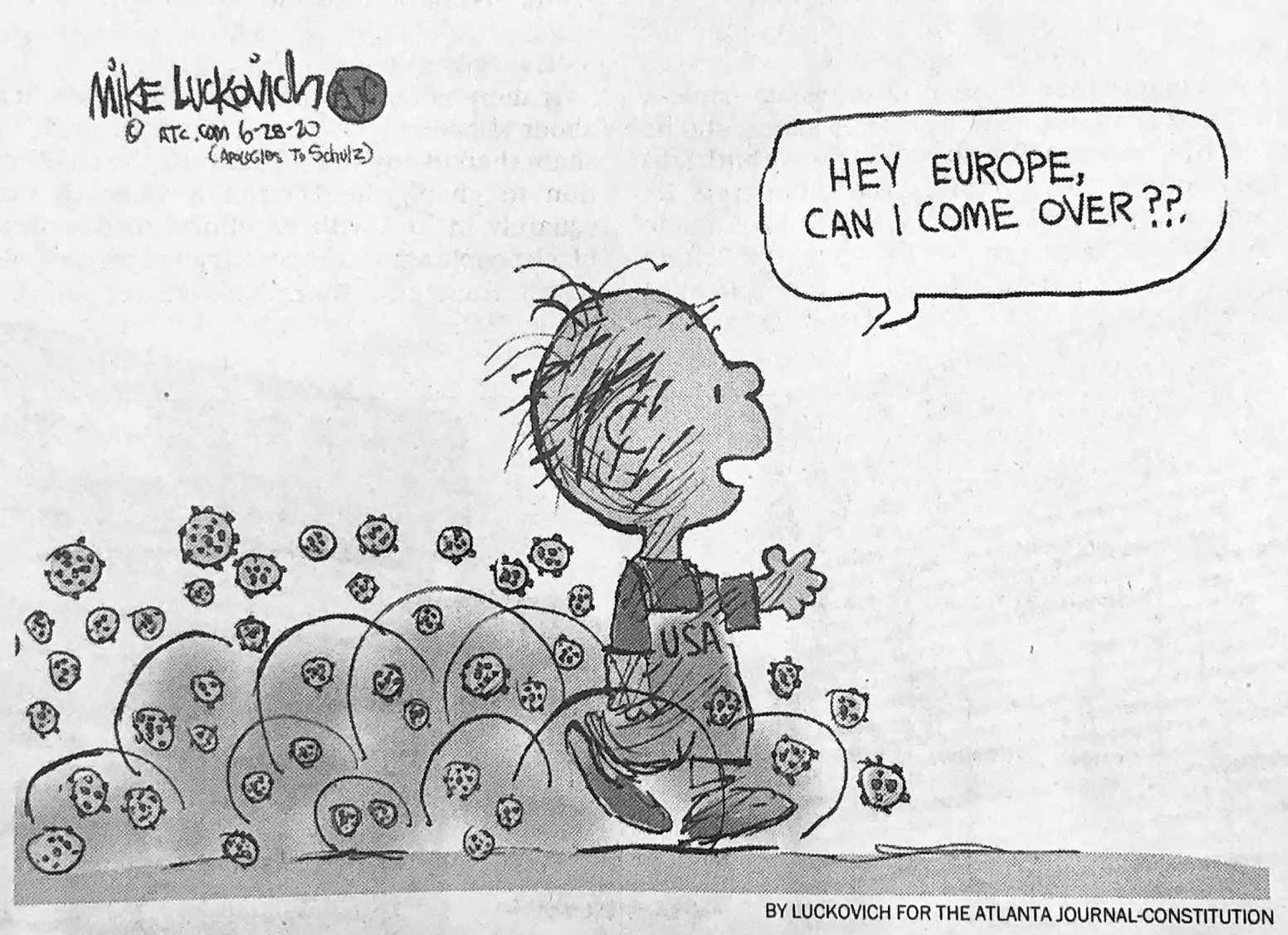
Welcome from Europe ?

Bruce Potter443-454-9044

Posted in Fun | Comments Off on Welcome from Europe ?

Why I Have Trouble Taking “Openers” Seriously.

From the Capital Gazette, p 1, 26 June 2020

Co-founder of ReOpen Maryland says he has COVID-19, but won’t help contact tracing efforts

Photo caption: Tim Walters, chair of Reopen Maryland, speaks at the Reopen Howard County rally beginning at the Howard County courthouse and ending at the bottom of Main Street in Ellicott City. Walters has said he has tested positive for coronavirus. (Kim Hairston/Baltimore Sun)

A co-founder of the ReOpen Maryland movement has said on social media that he tested positive for coronavirus this week but won’t work with public health officials trying to track the spread of the pandemic.

Tim Walters, a two-time Republican candidate for the General Assembly from Linthicum, said in a series of Facebook videos starting Tuesday that he has come down with COVID-19, the respiratory disease caused by the coronavirus.

“I was diagnosed yesterday at the ER with COVID-19 and here I am months after not wearing a mask at rallies, churches and so on and so it’s funny how capricious this thing is,” he said.

Walters helped organize ReOpen Maryland protests in Annapolis, on the Eastern Shore and elsewhere in Maryland to challenge state and local measures put in place by Gov. Larry Hogan to slow the spread of the virus.

The group describes itself as pursuing “peaceful, law-abiding advocacy for public health measures that respect Marylanders’ civil rights, economic well-being and educational access.”

In the first of what Walters described as a series of planned daily videos about his illness, he described himself as a 53-year-old man with diabetes who hasn’t maintained good health habits since he left the Navy.

He said he has had a dry cough since March, that in recent days has worsened and expanded to include a headache, fever and loss of focus in one eye.

Walters urged people who have come in contact with him in the past two weeks to pay attention to the symptoms he described but he said he would not provide any information to public health officials trying to trace the spread of the disease.

Anne Arundel County Health Office Nilesh Kalyanaraman has described contact tracing as the most effective tool public health officials have in slowing the spread of the virus.

By retracing the steps of people who are confirmed positive, contact tracing becomes key for containing the deadly coronavirus’ spread and lowering hospitalization rates. It’s a routine procedure that epidemiologists and infectious disease detectives have done for decades, but tracking coronavirus requires an unprecedented intensity compared with other infectious diseases.

The county did not see a spike in positive test results after protests Walters helped run in Annapolis this spring, in spite of state and local restrictions on the size of gatherings. Kalyanaraman said they were too small to have much of an impact on the spread of the virus.

Anne Arundel County was among the first counties in Maryland to establish a robust tracking system. The state of Maryland has also set up a contact tracing program.

Walters was having none of it.

“I will not share anybody’s information with the government. I will not do it,” he said.

In a second video posted Wednesday, Walters said he had been contacted by the state contact tracing team and decided to have his wife and members of his family tested.

Anne Arundel County added 29 coronavirus cases but no additional deaths Thursday, state health data shows, as the county continues to show a downward trend in cases. Maryland added 440 new coronavirus cases and 23 deaths.

Numbers released Thursday morning show the county now has 4,985 confirmed cases and 193 deaths. An additional nine people may have died from the disease, but a lab test was never performed.

Across Maryland, at least 603,597 tests have been conducted, an increase of more than 11,000 in the past 24 hours, bringing the statewide rate of positive cases to 5.05%. Anne Arundel’s rate of positive cases is 3.88%.

Statewide, 511 people are currently hospitalized, with 209 patients in the ICU and 302 patients in acute care.

Walters frequently posts videos on social media, often daily worship commentary based on his reading of the Bible.

Even though he said he would not work with state or county public health officials, he urged those who follow him to speak with their doctors if they have symptoms similar to his: a dry cough, severe headache and fever.

‘I just want to educate people,” Walters said. “Don’t live in fear, chances are that everyone is going to get this.”

Posted in Fun | Comments Off on Why I Have Trouble Taking “Openers” Seriously.

The Washington Post: Heath Freeman says he wants to save local news. Reporters call him a ‘vampire. ’

Another great example of how unbridled capitalism serves the public interest — thank you Mr Freeman for saving us.

Heath Freeman says he wants to save local news. Reporters call him a ‘vampire.’
How a former Duke place kicker took control of one of the biggest newspaper groups in America — and what it means for democracy.

https://www.washingtonpost.com/lifestyle/media/heath-freeman-is-the-hedge-fund-guy-who-says-he-wants-to-save-local-news-somehow-no-ones-buying-it/2020/06/11/9850a15c-884a-11ea-8ac1-bfb250876b7a_story.html

Posted in Fun | Comments Off on The Washington Post: Heath Freeman says he wants to save local news. Reporters call him a ‘vampire. ’

CEOs Must Be the Good Guys

. . . otherwise we wouldn’t pay them so much, would we?

Posted in Fun | Comments Off on CEOs Must Be the Good Guys

The Art of the Deal

Actually sounds like a great deal. From your Washington Post, March 18 2020: More lifesaving ventilators are available. Hospitals can’t afford them. Typically $25,000 to $50,000 each.

washingtonpost.png

More lifesaving ventilators are available. Hospitals can’t afford them.

America’s private health system was not set up to maintain backup supplies, leaving a gap that could cost lives …

On Friday, April 10, 2020, 11:43:58 AM EDT, Bruce G. Potter <bpotter@irf.org> wrote:

The Washington Post, 9 April 2020, page A19,

”U. S. to Pay GM $490 million for 30,000 Ventilators.”

So the World’s Greatest Negotiator was able to get the price down to $16,333.33 apiece???

My grand-niece Courtney could’ve gotten them delivered to your door for $16,000, with an extra SUP board thrown in for her.

And if niece Janie led the negotiation, the price would’ve been $12,000 with individualized paint jobs to order.

And Jennifer would have gotten the ventilators donated for free, as long as they had a Cadillac hood ornament.

The guy’s a piker.

Posted in Fun | Comments Off on The Art of the Deal

The Art of the Deal

The Washington Post, 9 April 2020, page A19,
”U. S. to Pay GM $490 million for 30,000 Ventilators.”

So the World’s Greatest Negotiator was able to get the price down to $16,333.33 apiece???

My grand-niece Courtney could’ve gotten them delivered to your door for $16,000, with an extra SUP board thrown in for her.

And if niece Janie led the negotiation, the price would’ve been $12,000 with individualized paint jobs to order.

And Jennifer would have gotten the ventilators donated for free, as long as they had a Cadillac hood ornament.

The guy’s a piker.

Posted in Fun | Comments Off on The Art of the Deal

Best Timeline for the Fouled Up USG Coronavirus Testing Process

from the Washington Post website – free – https://www.washingtonpost.com/politics/2020/03/30/11-100000-what-went-wrong-with-coronavirus-testing-us/

Graphics on-line are worth looking at.

Fact Checker

11 to 100,000: What went wrong with coronavirus testing in the U.S. |
The Fact Checker

Testing for the novel coronavirus is a crucial part of slowing the spread of the disease.
Here’s how the U.S. failed to provide tests that worked quickly.

By — Meg Kelly, Sarah Cahlan and Elyse Samuels
March 30, 2020 at 3:00 a.m. EDT

[Please Note: The Washington Post is providing this story for free so that all readers have access to this important information about the coronavirus. For more free stories, sign up for our daily Coronavirus Updates newsletter.]

“We have it totally under control.”
— President Trump, in an interview, on Jan. 22

“We’re in great shape in our country. We have 11, and the 11 are getting better. ”
— Trump, in remarks, on Feb. 10

“You may ask about the coronavirus, which is very well under control in our country.”
— Trump, in a news conference, on Feb. 25

“It’s going to disappear. One day — it’s like a miracle — it will disappear.”
— Trump, in remarks, on Feb. 27

“Anybody that needs a test, gets a test. They’re there. They have the tests. And the tests are beautiful.”
— Trump, in remarks at the Centers for Disease Control and Prevention in Atlanta, March 6

[This article has been updated with a response from the Food and Drug Administration.]

When the first U.S. case of the novel coronavirus was confirmed, President Trump assured the American people that the situation was “totally under control.” Cabinet officials, the vice president and the president repeated that refrain throughout February. By the end of that month, as global financial markets and the American public started to quiver, Trump held firm: “You may ask about the coronavirus, which is very well under control in our country.”

With the clarity of hindsight, it is obvious the situation was very much not under control. In reality, a lack of testing gave a false picture of how many people across the country were infected.

Through government documents, testimony, news reports and interviews, The Fact Checker video team has reconstructed events that left the government blind to the virus’s spread, and examined how those errors opened the door for 11 confirmed cases to balloon to more than 100,000 in less than six weeks.
The Facts

The novel coronavirus was first detected in early December in Wuhan, China. Chinese officials reported the pneumonia-like disease to the World Health Organization (WHO) at the end of December, but neglected to mention growing evidence that the virus could spread by human-to-human transmission through airborne droplets.
AD

Still, China’s previous failures to be forthcoming about public health crises meant that public health officials elsewhere already were wary of its government’s official statements. As reports of the mysterious virus increased, the Centers for Disease Control and Prevention (CDC) warned Americans against traveling to China and activated an emergency management tool used to direct operations, deliver resources and share information.

Despite the alarm bells and increased intelligence briefings, Health and Human Services Secretary Alex Azar struggled to get Trump’s attention for weeks.

January: Make the test

One of the first things that any government needs to track and manage any disease’s spread is the ability to test for it. Because covid-19 is a disease caused by a novel strain of coronavirus, that meant developing a new test.

China developed its own test. The WHO adopted a test from German researchers and published testing protocols in mid-January. Those protocols could be adopted by other countries to produce their own tests or countries could use tests provided by the WHO. The CDC publicly shared the details of the test it designed on Jan. 24 — three days after the first case of coronavirus was confirmed in Washington state.

The CDC’s decision to develop its own test is not unusual. “The CDC will develop their own test that is suited to an American health-care context and the regulations that exist here,” Jeremy Konyndyk, a senior policy fellow at the Center for Global Development, explained. “That’s how we normally would do things. A lot of countries don’t have the capabilities that we have here. And so they need to rely on the WHO to provide tests to them. We don’t have to do that in the United States.”

Even though the United States had cases in the single digits in late January, some public health officials were increasingly worried. Luciana Borio, the former head of medical and biodefense preparedness at the National Security Council, and Scott Gottlieb, who led the Food and Drug Administration (FDA) from May 2017 to April 2019, wrote a prescient op-ed in the Wall Street Journal, warning that if the virus is widespread, “the CDC will struggle to keep up with the volume of screening. Government should focus on working with private industry to develop easy-to-use, rapid diagnostic tests that can be made available to providers.” Borio told NPR on Jan. 30: “The most important and effective way to control epidemics is to identify patients who are infected, exposed to the virus, and isolate them.”

In other words, the government needed to prepare to test Americans on a large scale.

But the government did almost the exact opposite of what Borio and Gottlieb proposed. CDC issued narrow guidance on which patients qualified for a test — only those with recent travel to Wuhan or those who had come into contact with an infected person.

On Jan. 31, Azar declared a “public health emergency,” announcing travel restrictions — including barring noncitizens who had recently visited China from entering the United States — in an effort to curtail the virus’s spread inside the country. The declaration triggered emergency testing protocols, which increased restrictions on which labs could make a coronavirus test. Any lab would be required to acquire an Emergency Use Authorization (EUA) from the FDA to perform testing for covid-19. The FDA granted the CDC the first EUA.
AD

The overall plan was simple. The CDC would use the science it had developed for the test, do the bulk of the testing, and distribute test kits to qualified state labs. This would safeguard against potential bad results and ensure an accurate count.

The EUA requirement meant that other labs, including sophisticated labs that developed tests based on the genetic sequence available and that under normal circumstances could have begun testing, were not able to do so until they received special permission.

February: Distribute the Test

On Feb. 2, Gottlieb tweeted, “Since CDC and FDA haven’t authorized public health or hospital labs to run the tests, right now #CDC is the only place that can. So, screening has to be rationed. Our ability to detect secondary spread among people not directly tied to China travel is greatly limited.”
AD

The conundrum Gottlieb described quickly amplified. The CDC-manufactured kits were sent to state labs on Feb. 6 and Feb. 7. Some labs had problems with the test. By Feb. 12, the CDC announced that the test was providing inconclusive results. By then, the United States had reported 11 cases.

The low case count dampened concern among some in the administration. And Trump touted those comparatively low numbers on Feb. 10: “We’re doing great in our country. … We only have 11 cases, and they’re all getting better.”

By then, a self-perpetuating cycle had formed. Few people qualified to be tested, and even if they did qualify, the CDC was essentially the only place that could do those tests. (A total of 12 other labs received EUAs by late February.) That meant relatively few tests were performed, and thus few people tested positive for the virus.

By Feb. 16, the CDC and state public health labs tested nearly 1,600 specimens. As a rule of thumb, two specimens are required per person, meaning that in total, only about 800 people had been tested. That’s roughly 2.4 tests per million people in the United States. In contrast, South Korea, which found its first case on the same day as the United States, had tested nearly 8,000 people, or 154.7 tests per million.
COVID-19 tests per million residents

“The testing issue was not something that any single agency could resolve,” Konyndyk said. “CDC had their piece of it, which was their own test, but CDC didn’t have the authority to tell other private labs: Go ahead. You’ve got a green light. FDA had to do that.”

The New York Times reported that Azar was “unable” to get either the CDC or the FDA to “speed up or change course.” Moreover, he “had been at odds for months with the White House over other issues” and was communicating primarily with acting White House chief of staff Mick Mulvaney, who was in the process of being forced out.

Azar testified that he intended to implement a pilot program, adding coronavirus surveillance to the existing flu surveillance networks on Feb. 13. But it never came to fruition. There were not enough tests to make it happen.

By the following week, it became clear to local public health officials that the virus had spread in communities and become endemic in other countries. Public health labs, frustrated by their inability to test, became frantic. Still, the CDC warned labs not to test without emergency authorization from the FDA — regardless of whether protocols they planned to use came from the WHO or the CDC or had been developed in-house.

(Correction: An earlier version of this article incorrectly attributed this warning to the FDA.)

On Feb. 24, state public health labs made an unusual plea for the agency to open testing. That same day, Trump tweeted, “The Coronavirus is very much under control in the USA.”

The next day, Nancy Messonnier, director of the CDC’s National Center for Immunization and Respiratory Diseases, told reporters: “Ultimately, we expect we will see community spread in the United States. It’s not a question of if this will happen, but when this will happen, and how many people in this country will have severe illnesses.”

One section of Messonnier’s remarks was especially stark: “I had a conversation with my family over breakfast this morning, and I told my children that while I didn’t think that they were at risk right now, we as a family need to be preparing for significant disruption of our lives.”

According to news reports, Anthony S. Fauci, director of the National Institute of Allergy and Infectious Diseases, was growing concerned about the slow pace of testing. But Trump’s cheery assessments continued. On Feb. 27, he said, “It’s going to disappear. One day — it’s like a miracle — it will disappear.”

March: A new strategy

Two days later, on Feb. 29, the FDA lifted restrictions on labs, issuing a new set of significantly less restrictive protocols. On March 3, the restrictions on who qualified for a test were dissolved. At that point, 13 people in the United States were recorded as having died of covid-19.

Still, tests were hard to come by. Five days after both restrictions were removed, the United States reported 518 cases and had completed 3,099 tests, according to the Covid Tracking Project. That is roughly 9.5 tests per million people. South Korea had 7,314 cases after performing 188,518 tests, or 3,682 tests per million. Yet, Trump claimed on March 6 that “anybody that needs a test gets a test.”

As of March 28, exactly four weeks after the FDA loosened the rules for testing, the United States still performed only 2,250 tests per million — two-thirds of what South Korea did almost three weeks earlier. The death toll in the United States was 2,198 — and climbing rapidly.

South Korea’s death toll that day was 144, a rate of 3 per million people. The rate for the United States was more than double — 7 per million people.

Konyndyk put the failure simply: “The reason [the lack of testing] has been such a damaging shortcoming in the U.S. response is it basically left us blind to the spread of the virus in our country for about six or seven weeks.”

The White House, the CDC and other federal agencies did not respond to requests for comment.

Stephanie Caccomo, spokeswoman for the FDA sent this statement: “The FDA’s regulations have not hindered or been a roadblock to the rollout of tests during this pandemic. The FDA has been extremely proactive and supportive of test development by all comers—laboratories, and large and small commercial manufacturers—offering our expertise and support to speed development and to quickly authorize tests that the science supports.”

The Bottom Line

The president spent nearly two months issuing confusing and contradictory signals — leaving the bureaucratic machine of the U.S. government to chart the course for the coronavirus response.

The CDC designed its own test. The FDA picked a conservative testing strategy, allowing labs to use only the CDC test. When those tests failed, neither a new strategy nor a new test was available for more than two weeks. Azar failed to push the agencies to change direction, and the president didn’t intervene.

Even then, widespread testing was not immediately available. It’s not just the number of tests that are the problem — it’s getting the materials to do the tests and the personal protective medical equipment for providers to give those tests. That means we may never have a true count of how many Americans contracted the virus.

The missteps that went unmanaged were ignored by leaders at the highest level of government and allowed cases to go undetected, contributing to the spike in the virus’s spread.

2.2k Comments

Meg Kelly
Meg Kelly produces video and reports for the Fact Checker. She previously covered the 2016 election for NPR where she was a visual producer. Follow

Sarah Cahlan
Sarah Cahlan edits and produces videos for the Fact Checker at The Washington Post. Follow

Elyse Samuels
Elyse Samuels is a digital video editor focused on verifying viral video, reporting on misinformation and manipulated video that spreads online. She joined The Washington Post in October 2016 as a producer for the Facebook Live team. She then transitioned to the universal desk where she focused on editing breaking news content.

Posted in Fun | Comments Off on Best Timeline for the Fouled Up USG Coronavirus Testing Process

Walking Has Major Health Effects

This from Tuesday’s Health & Science section of The Washington Post. Bottom line is that 8,000 steps a day produces major benefits over a modest 4,000 steps.

Posted in Fun | Comments Off on Walking Has Major Health Effects

Washington Post: Judge challenges Barr’s credibility over handling of Mueller report

Another outburst by one of those subversive Republican-appointee judges who persist in characterizing Attorney General Barr as a lying piece . . . but I digress.

Judge challenges Barr’s credibility over handling of Mueller report
Judge Reggie Walton criticized the attorney general in a written opinion raising doubts about Barr’s credibility.

https://www.washingtonpost.com/national-security/mueller-report-attorney-general-william-barr/2020/03/05/3fa7afce-5f2c-11ea-b29b-9db42f7803a7

Posted in Fun | Comments Off on Washington Post: Judge challenges Barr’s credibility over handling of Mueller report