Ecobot App Raises $1M To Save Wetlands And Time

Thank you for the information, technology for protection and science through phones is a great way to get more information faster. Done are the days of slugging large instruments and equipment through the marsh and woods.

Diana L. Muller, Executive Director
Maritimas
443-534-2847

On Wed, Jan 15, 2020 at 1:31 PM Bruce G. Potter <bpotter> wrote:

This is the kind of resource planning tool that we’ve been waiting to see for many years. Moving the operation of the analytical and display issues directly to the resource policy managers.

From Forbes <https://www.forbes.com/sites/jeffkart/2019/12/17/ecobot-app-raises-1m-to-save-wetlands-and-time/#64d011b74ad2 > (See the website for graphics)

Dec 17, 2019, 06:14pm
Ecobot App Raises $1M To Save Wetlands And Time

Jeff Kart
Contributor
Science

Wetlands need protecting, for everything from filtering runoff to helping prevent flooding. But the job of environmental consultants, who examine properties to determine if they contain wetlands, consumes time. An app called Ecobot streamlines the process and has raised more than $1 million in venture funding. That means additional people who protect wetlands will be able to spend more of their time being scientists, says Lee Lance, cofounder and CEO.

The app from Ecobot, headquartered in Ashville, North Carolina, was in private beta release for a year before being released this month on the Apple App Store.

The recent influx of funding, via Cofounders Capital, will be used to bring on additional programmers and other staff, Lance says. Ecobot announced a partnership with mapping company Esri earlier this year, and also will be showing off its technology at upcoming conferences in 2020.

What does it mean for wetland protection?

Ecobot allows environmental consultants to work offline to identify Waters of the United States, as defined by the U.S. Environmental Protection Agency’s Clean Water Act.

“Waterway impacts must be assessed before any commercial construction companies can move dirt, before oil and gas companies can lay down pipelines, or before (Department of Transportation) or rail can do work on highways and railroads,” Lance explains.

Ecobot is used to generate U.S. Army Corps of Engineers wetland delineation reports. These are what a consultant is hired to prepare for a site that’s pending development.

The app provides lookup tools and automatic calculations that would otherwise have to be done by hand. The app even generates regulatory PDFs. One user has reported saving 2.5 hours per person, per day in the field.

“Wetlands don’t necessarily look like swamps,” Lance says. “Through the scientific observation, analysis and calculations of three key metrics, hydrology, vegetation and soil, a wetland scientist is able to make a recommendation on whether or not a property contains wetlands that would fall under the jurisdiction of the U.S. Army Corps of Engineers.

“Ecobot equips private industry to get this done faster, cheaper and more accurately.’’

The app is available under two subscription models, one with unlimited usage and another with unlimited team access, says Jeremy Schewe, Ecobot’s cofounder and chief scientific officer.

To date, more than 200 field scientists at more than 50 companies have access to Ecobot and have submitted more than 2,500 wetland delineations to the Corps, Schewe says.

Lance adds: “This app enables people that are protecting wetlands, and we help those scientists spend a greater percentage of their time being scientists. By reducing regulatory costs, facilitating greater accuracy and speeding decisions on land use, Ecobot helps us protect our wetlands.”

The company plans to move into mitigation banking monitoring, state wetland and stream forms next.

Jeff Kart: Follow me on Twitter or LinkedIn. Check out my website.

I focus on interesting, innovative and revolutionary U.S. stories about green startups and nongovernmental organizations as a Forbes contributor.

Posted in Fun | Comments Off on Ecobot App Raises $1M To Save Wetlands And Time

Ecobot App Raises $1M To Save Wetlands And Time

This is the kind of resource planning tool that we’ve been waiting to see for many years. Moving the operation of the analytical and display issues directly to the resource policy managers.

From Forbes <https://www.forbes.com/sites/jeffkart/2019/12/17/ecobot-app-raises-1m-to-save-wetlands-and-time/#64d011b74ad2 > (See the website for graphics)

Dec 17, 2019, 06:14pm
Ecobot App Raises $1M To Save Wetlands And Time

Jeff Kart
Contributor
Science

Wetlands need protecting, for everything from filtering runoff to helping prevent flooding. But the job of environmental consultants, who examine properties to determine if they contain wetlands, consumes time. An app called Ecobot streamlines the process and has raised more than $1 million in venture funding. That means additional people who protect wetlands will be able to spend more of their time being scientists, says Lee Lance, cofounder and CEO.

The app from Ecobot, headquartered in Ashville, North Carolina, was in private beta release for a year before being released this month on the Apple App Store.

The recent influx of funding, via Cofounders Capital, will be used to bring on additional programmers and other staff, Lance says. Ecobot announced a partnership with mapping company Esri earlier this year, and also will be showing off its technology at upcoming conferences in 2020.

What does it mean for wetland protection?

Ecobot allows environmental consultants to work offline to identify Waters of the United States, as defined by the U.S. Environmental Protection Agency’s Clean Water Act.

“Waterway impacts must be assessed before any commercial construction companies can move dirt, before oil and gas companies can lay down pipelines, or before (Department of Transportation) or rail can do work on highways and railroads,” Lance explains.

Ecobot is used to generate U.S. Army Corps of Engineers wetland delineation reports. These are what a consultant is hired to prepare for a site that’s pending development.

The app provides lookup tools and automatic calculations that would otherwise have to be done by hand. The app even generates regulatory PDFs. One user has reported saving 2.5 hours per person, per day in the field.

“Wetlands don’t necessarily look like swamps,” Lance says. “Through the scientific observation, analysis and calculations of three key metrics, hydrology, vegetation and soil, a wetland scientist is able to make a recommendation on whether or not a property contains wetlands that would fall under the jurisdiction of the U.S. Army Corps of Engineers.

“Ecobot equips private industry to get this done faster, cheaper and more accurately.’’

The app is available under two subscription models, one with unlimited usage and another with unlimited team access, says Jeremy Schewe, Ecobot’s cofounder and chief scientific officer.

To date, more than 200 field scientists at more than 50 companies have access to Ecobot and have submitted more than 2,500 wetland delineations to the Corps, Schewe says.

Lance adds: “This app enables people that are protecting wetlands, and we help those scientists spend a greater percentage of their time being scientists. By reducing regulatory costs, facilitating greater accuracy and speeding decisions on land use, Ecobot helps us protect our wetlands.”

The company plans to move into mitigation banking monitoring, state wetland and stream forms next.

Jeff Kart: Follow me on Twitter or LinkedIn. Check out my website.

I focus on interesting, innovative and revolutionary U.S. stories about green startups and nongovernmental organizations as a Forbes contributor.

Posted in Fun | Comments Off on Ecobot App Raises $1M To Save Wetlands And Time

Long Patch Article on Causes of Maryland Bad Air Quality

health & fitness

Maryland’s Dirty Air: Quality, Greenhouse Gas Recorded By UMD

Pollutants from smokestacks upwind, traffic, development density and proximity to water all contribute to Maryland’s air quality problems.

By Deb Belt, Patch Staff                                                   Dec 19, 2019 11:42 am ET

We import pollution and we grow our own

Air Quality in Baltimore

An aerial picture of Baltimore from June 2018, taken during a Regional Atmospheric Measurement Modeling and Prediction Program research flight.
(Photo courtesy of Sarah Benish)

By Greta Easthom, Capital News Service

ANNAPOLIS, MD — As soon as the Cessna twin-piston airplane touches down on the tarmac at Easton Airport, a graduate student runs out with an extension cord to repower the ozone monitoring equipment on board. The flight crew that just helped the University of Maryland research team land is slightly bemused at her urgency.

What they might not know is that her group — the Regional Atmospheric Measurement Modeling and Prediction Program or RAMMPP and comprised of 30 researchers and students — has helped the Maryland Department of the Environment improve regional air quality since 1999 by tracking how the ingredients for smog can originate from upwind states.

Due to Maryland’s geography and size, the state’s air quality is often affected by what is coming out of smokestacks upwind. Traffic, development density and proximity to water — particularly the Chesapeake Bay and Atlantic — also contribute to the state’s dirty air.

The costs can be staggering: hundreds of millions of dollars in health costs alone according to one regional study. And sometimes, not lowering one type of pollutant over another can cause environmental damage elsewhere in the atmosphere. The state has failed updated national standards for ground ozone, and the RAMMPP team is studying exactly why, where and ways to fix it.

The scientists gather data to understand how things are happening now, and then use that to predict how things are likely to go in the future.

Tad Aburn, director of the Maryland Department of the Environment’s Air and Radiation Administration, said over the years, through RAMMPP’s modeling and research, the agency has been able to design programs to reduce ground-based ozone and the cocktail of chemicals that create it.

Despite the team’s efforts, Maryland has been in violation of the EPA standard for ground-based ozone, largely because while air quality is slowly improving, the federal agency has lowered the standards. While having ozone high up in the atmosphere is good for human health because it forms a protective layer, ozone at lower levels — about 6 miles off the ground — is bad because it is one of the main ingredients for smog.

Measuring ozone in the lower levels through flights is important for determining how far away Maryland is from meeting national standards, what the main drivers of ozone pollution are and where they are located. Mired in this murky air pollution problem are judicial battles that result when upwind states are pinpointed as sources of ozone for downwind states, such as Maryland, at certain monitored sites.

“If one surface site (exceeds standards), that’s the whole state” that has failed federal standards, said Tim Canty, research professor at the University of Maryland who has been working with RAMMPP for almost a decade.

The EPA standard is based on a very specific average called the “design value” — the three-year average of the fourth-highest surface ozone readings in an eight-hour period for a given calendar date.”

And if that’s high(er than the standard), that’s pretty bad,” Canty said.

The reason why policy-makers average the fourth highest ozone day instead of the highest is because one day could just be an ozone outlier, and would skew the data too high. The EPA standard for the design value of surface ozone is now 70 parts per billion for an eight-hour average; this decreased in 2015 from 75 ppb, and it could become even more strict.If a site violates the standard over the three-year period, then Maryland must complete a state plan to compensate.

Six out of 20 monitored sites in Maryland have violated the standard this past summer. The preliminary design values for 2019 in Beltsville, Fair Hill and Essex are 72 ppb, Edgewood is at 75 ppb, Glen Burnie is 74 ppb, and Prince George’s Equestrian Center is at 71 ppb.

Ozone, while a big player, is not the only pollutant that is monitored. Sulfur dioxide, carbon monoxide, nitric oxide and nitrogen dioxide, lead, and particulate matter are all monitored and must meet national standards as well because they are six common pollutants under the Clean Air Act.

Particulate matter or aerosols are minuscule mixtures of solid and liquid droplets such as dust or soot, that can be easily accidentally inhaled.

Sulfur dioxide, which also comes from the combustion of fossil fuels, can form acid rain and particulate matter when it reacts with oxygen.

‘Not Your Typical Science’

While the national standard for ozone, and the pollutants that create it, is uniform across the board, the different ways to measure and model these pollutants is not.

The EPA, the Maryland Department of the Environment and the University of Maryland all keep records of their current estimates of certain pollutant and greenhouse gas emissions from ground-based monitors, aircraft measurements, and other recording equipment.

“It’s a challenge. It’s not your typical science,” said Canty. “Maryland Department of the Environment helps set up the strategies on the what-if, and then we run all the different scenarios (in the model).”In other words, the researchers collect data on current conditions and use it to predict future ozone levels, playing around with different scenarios.

“We work as a consortium with other states in the Mid-Atlantic region … and then we modify from there based on our science,” said Canty.

Sometimes, how to use the data and which scenarios to plug into the models create disagreements among scientists and government officials. A location can pass or fail air quality standards based on which models or parameters are used.

One of those disagreements happened recently with sulfur dioxide. The EPA modeling process designated three sites in Anne Arundel and Baltimore counties as having the potential to fail, but Aburn said these sites have not been observed as failing and are not projected to do so based off Maryland’s modeling.

A state implementation plan was made anyway.

Sulfur dioxide can become a particulate, known as a sulfate, which can turn into acid rain.

“What’s important,” said Hao He, a professor at Maryland and RAMMPP researcher, “what will kill you, is … sulfate.”

Figuring out how to eliminate particulate matter like sulfates, “that’s the problem of the lifetime,” He told Capital News Service.

‘Air pollution is not our own problem’

NOx, the catch-all term for nitrogen oxides — such as nitric oxide and nitrogen dioxide that can form ground-based ozone — comes from the combustion of fossil fuels and forest fires. Once released from tailpipes or tall smokestacks, it produces surface ozone and can form acid rain.

The University of Maryland research showed that decreasing nitric oxides high in the air helped abate ozone levels on the ground, Aburn said. The hot air masses rise from a couple-hundred feet high smokestack in Pennsylvania for instance, and a high pressure system can funnel these ozone-laden air masses in to Maryland.

The transport takes anywhere from one to a couple of days, He said.

“Air pollution is not (entirely) our own problem,” said He, “because Maryland is relatively small.”

The geography and heavy traffic of a densely populated and bustling Baltimore, along with other cities and towns near the Chesapeake Bay, can make them a hotbed for high levels of ground ozone, especially during the summer.

If NOx-rich, hot air rises, the air will circulate back over land as a bay breeze now thick with ozone-laden air.

Edgewood, Maryland, located northeast of Baltimore and along the Chesapeake Bay, has tipped 90 ppb as a design value in recent years due to its unique geography, squeezed between the city and the water.

Ground-based ozone also commonly tracks from southwest Washington, D.C., along the I-95 corridor, to northeast Baltimore, said Xinrong Ren, with the National Oceanic and Atmospheric Administration Air Resources Laboratory and RAMMPP lead researcher.

This setup combined with “Baltimore emitting (pollutants) itself,” said Ren, created the perfect storm for Baltimore to have an ozone concentration of 120 parts per billion per second during a June aircraft observation.

Though this is different than the EPA standard, which is averaged over eight hours, it is still not a great reading.

There are other factors, according to University of Maryland graduate student Sarah Benish.

“Generally air pollution is worse over water than land because it’s hotter, reaction rates are faster, (there is) less cloud coverage, (and) more direct solar radiation. We’re trying to fly under certain conditions and there’s not a lot of legroom,” said Benish.

The Maryland Department of the Environment’s air quality forecasters will often pinpoint the high pressure, sunny days to the team. The stagnant, warm air that can form from during these types of weather conditions have in the past been a good indicator of bad air quality days.

Why the Maryland Department of the Environment keeps pushing for “more and more” in terms of NOx reductions is that “about 70 percent of Maryland’s (ground-level) ozone originates from (states that are upwind and their emissions),” said Aburn.

Despite this, for a while air quality was starting to improve in Maryland, as more NOx scrubbers were installed and run in Maryland’s own power plants.

Now, “it looks like air quality (could be) getting worse and we might not be in attainment of the old standard soon (75 ppb),” said Canty.

The reasons are unclear: “This is an area of on-going research trying to figure out why that might be,” he said.

The researchers are trying to pinpoint whether this is a temporary anomaly.

In November 2016, Maryland Attorney General Brian Frosh filed a petition under the Clean Air Act — known as the Good Neighbor Act — requesting the EPA to require certain power plants in Indiana, Kentucky, Ohio, Pennsylvania and West Virginia to run their NOx controls, which would effectively lower their NOx emissions. In September 2017, Frosh sued the EPA for not responding to the petition by the required extended date of July 15, 2017.

The EPA denied the petition in October 2018, and Frosh is challenging the petition again in the United States Court of Appeals for the D.C. Circuit, scheduled for January.

On Oct. 1, the D.C. Circuit Court struck down an EPA ruling that required upwind states to employ only partial reductions on factory emissions. It’s a bit of a Catch-22: The concern is that the federal rule may not lower pollution levels of downwind states enough for them to meet federal guidelines.

The EPA had until Oct. 29 to challenge this decision and would not tell Capital News Service whether they challenged it or not. Nothing had been filed on Westlaw as of Dec. 4.

There are 36 power plants upwind in other states that could cut emissions of NOx with “scrubbers” and improve Maryland’s air quality, Canty said, but they are costly to run. If a private power plant is meeting its NOx emission standards set forth for it by the state, it does not have to run its controls all the time.

If a state is contributing more than 1 percent of ozone to downwind states, they have to help make improvements on downwind air quality.

“We did a lot of modeling to show that if these power plants ran their scrubbers, it would allow Maryland to attain the (ozone) standard,” said Canty.

Researchers in Delaware found that “because of these power plants not running their scrubbers, it’s causing (Maryland, Northern Virginia, D.C. and Delaware) three quarters of a billion dollars in health costs,” said Canty.

Perhaps most troubling is that, “they can turn off the scrubbers when it’s hot outside,” said Russ Dickerson, another lead researcher for RAMMPP and professor for Maryland, in order to offset increased demand for electricity.

But this is when ozone production has the potential to be at its worst.

For power plants, there are monitors in the stack, said Dickerson, and those are “pretty accurate, but we can test those by flying the aircraft through the plume,” of upwind and downwind states

“We fly a lot of Maryland, we’ve also flown in West Virginia, Virginia, New York — kinda the whole eastern side of things,” Benish said.

Taking flight:

When the researchers take flight, they take measurements called “whole air samples.”

“Think of an aluminum balloon that’s maybe this big,” said Benish, holding her hands as though around a large loaf of bread, holding about 3.2 liters, “and we fill them up for two minutes…and then send them to the Maryland Department of the Environment to be measured for hydrocarbons,” said Benish. “So I had to do those every two minutes for 20 minutes and I was getting super airsick.”

Benish said it was hard to look down on all the boating, camping, and hiking taking place at these sites, with the knowledge that bad air quality was affecting people’s health.

What to limit:

Air quality research can be tricky. Scientists must also determine whether decreasing certain chemicals — NOx or volatile organic compounds — will accelerate ground-level ozone production. Volatile organic compounds are any mixture of carbon, such as carbon monoxide, and can be emitted from smokestacks and tailpipes of cars, too. Twenty years ago, the general consensus in the air quality community was that volatile organic carbons were the main driver behind ozone production. RAMMPP’s research was crucial in determining that decreasing NOx was generally better for decreasing ground-level ozone.

“We all assumed organic driven,” said John Quinn, director of state affairs for Baltimore Gas and Electric. “We learned we had to reduce NOx a lot,” (from Dickerson’s research).

“However, as emissions and air quality has improved, it’s getting harder to predict ozone exceedance days,” said Canty. “It used to just be warm temperatures..now you can have not as warm temperatures with an air quality exceedance event (or vice versa).”

Canty’s graduate student, Allison Ring, also found that volatile organic carbons might be getting overlooked as everything else gets cleaner.

Sometimes, in localized areas when the NOx is high and volatile organize compounds are at low levels, NOx scrubbers can exacerbate ground-level ozone, another problem for scientists the study, Canty said. Cars an even harder problem, said Dickerson.

Dickerson’s graduate student, Dolly Hall, has helped implement a monitoring site at Savage, Maryland, to detect emissions from motor vehicles.

“Transportation is hard to model and harder to legislate,” said Canty.

Canty said that different factors such as the rules on the efficiency of after-market catalytic converters and gasoline formulations are all parameters that are hard to specify in a transportation emissions model, especially with changing legislation.

Methane measurements:

While air quality is generally a problem the researchers focus on in the summer, carbon dioxide and methane emissions — contributors to climate change — are measured in the winter.

While there is crossover between the groups, this research goes under an initiative the scientists call FLAGG-MD, which stands for Fluxes of Atmospheric Greenhouse Gases in Maryland.

It is funded by the National Institute of Standards and Technology, with support from the Maryland Department of the Environment.

The team flies around the East Coast for this research as well, employing what they call “a box method,” to get an accurate measure of the amount of methane in a given area at a given time.

The Marcellus Shale — a geological feature that is the source of much of the region’s natural gas — and Baltimore — with the state’s largest methane-producing landfill, are two big methane concern areas, Dickerson said.

Maryland Department of the Environment and the EPA keep inventories, or records, of greenhouse gas emissions.

Baltimore’s inventory definitely needs to be improved and there are lots of uncertainties surrounding the Marcellus Shale leak rates.

A leak rate is a percentage of the amount of methane lost to the atmosphere when it is pumped out of the ground at natural gas and oil wells. Older pipes will leak gas when transporting it as well.

Aburn said the Maryland Department of the Environment is working with the research team to adjust their inventory numbers for methane so that their estimates for landfill emissions are more aligned with University of Maryland’s estimates.

Methane levels at Brown Station Landfill in Baltimore were measured at 10 times higher than the EPA standards and five times higher than state standards.

“There is a gross difference in (our records ) of Brown Station Landfill,” said Salawitch, “which is the largest source of methane in Maryland.”

However, Salawitch acknowledged that the Maryland Department of the Environment and RAMMPP employ very different modeling approaches as Maryland’s is more observationally driven.

Salawitch said the EPA and the Maryland Department of the Environment are underestimating leaks of all landfills by a factor of around two.

Furthermore, “it doesn’t take much walking around Baltimore and Washington to know there is aged infrastructure,” and with aged natural gas pipes, which distribute into homes and businesses, come leaks, said Salawitch.

Methane is a potent greenhouse gas and has a great global warming potential on a 100-year time scale, but an even greater impact on a 20-year time scale. The impact is greater over a 20-year timescale because it is more concentrated.

Salawitch is hopeful that the state will soon implement a 20-year global warming potential in its evaluations but that doesn’t seem to be happening anytime soon.

Mike Tidwell, director of Chesapeake Climate Action Network, said at an October Maryland Commission on Climate Change meeting that the state’s draft Greenhouse Gas Emissions Reduction Act, increases “the attractiveness of natural gas,” by utilizing the 20-year timescale.

Salawitch is optimistic about Pennsylvania joining the Regional Greenhouse Gas Initiative, a market-based cap coalition on greenhouse gases.”

Having Pennsylvania be a part of RGGI..means that one day we could do our best to limit leaks from the point of extraction (when drilling for natural gas) to the point of combustion,” said Salawitch.

“I’m proud of what we did for the state of Maryland, but there is still a lot of work to be done,” said Dickerson. “We are still emitting too much carbon dioxide. I think methane may play a larger role than is indicated in there (the Greenhouse Gas Reduction Act),” Dickerson continued. “But at least we are looking at it.”

Posted in Chesapeake Bay, Climate Change, Close to Home, Health, Monitoring | Comments Off on Long Patch Article on Causes of Maryland Bad Air Quality

Greetings from the Philippines!

Hello Family!

Andy, George (his dad) and I made it to the Philippines after about 30 hours of travel. Luckily, it was 2:00 AM, so we had nothing to do but sleep. We were driven to McDonalds for a treat before bed.

George was here last when he served in the Air Force during the Vietnam conflict. He was lucky to be in a paymaster position after commercial services. He met his wife, Amelia, when in this second position as she was a Philippina in the Civilian Pay department. They met at a Christmas party on base and were married 10 months later in
Oct. of 68.

They lived in the de la Cruz family house until George’s term was up around Oct. of ‘69. That’s when George and “Mellie” left the Philippines for 6 mo. leave in St. Louis, George’s home city. That was his last time here!

Yesterday (Sat. here/Fri. there), George finally saw his third niece still living here in Manila. The 4th and oldest sister lives in VA, so he’s seen her most recently some 8 years ago at her oldest son’s wedding. George was amazed that he new them all despite not seeing them since they were under the age of 9 – he said their faces haven’t changed! One benefit of us being here in the beginning of January besides being the “dry season” (they have gotten some unseasonable typhoons/hurricanes), is that we will be celebrating Tito Tony’s 82 (Andy’s Uncle Tony) Birthday and George’s niece’s, Aileen’s, 60th! Tita Aida, the sister of Mellie, turned 80 in November – this was was the true reason for us wanting to take George on this reunion trip.

We’ve been living up the Philippine lifestyle, eating and conversation followed by more eating and conversation. “Priming the pump” and moderation is the key! Last night at the house of Ate. Annabelle ( she’s older than Andy and me so women get the title Ate. even though she is Andy’s cousin), we planned an adventure to Baguio where we will go hiking in the mountains and visiting the huge outdoor “Wet Market.” Don’t ask me! I have to still do the research. Baguio is the city that George is excited to visit as it is where he and Mellie spent their Honeymoon. Are. Annabelle, her son “Beto” (Alberto – one of 4 sons), and the three of us are going on the 13-15.

You all probably noticed that the family have nicknames (I think most people do here), but they also all have names beginning with “A.” Here are all the family members of Tita Aida and Tito Anthony (other husbands not included):

Annie (VA), Anton (son), Adrian (s)

Aileen (Manila), Alan (s), Angela (daughter), Abbey (d)

Agnes (Manila), Anele (d), Aisha (d), Ayan (d)

Annabelle (Manila), Alfonso (?) (s – again he’s always called by his nickname, which is “Pancho!”), Alejandro (s), Angelo (s), Alberto (s)

Anthony (Wales), Adrian (s – so far the only duplicated name in the entire de la Cruz family…they are actually spelled differently too, but I don’t know who is this spelling).

Well, I will write maybe a little more later after we have more experiences, but it’s time to get out for a walk around the neighborhood before we have to eat again!

Love,
Em and Andy

Posted in Fun | Comments Off on Greetings from the Philippines!

Dawn on Back Creek, 11 January 2020, temp 51°

Beautiful!

We’re opening a new IMAX movie at work called "Expedition Chesapeake". Documentary style look at the intersection of nature and human impacts through the watershed. Jeff Corwin narrates and "plays the part" of a guest researcher with various groups monitoring and preserving habitat all the way up to Lake Oswego in our old stomping gounds up the Susquehanna. Worth a look if folks get a chance.

Also shared a balmy morning with 72 degree overnight low in Houston as I picked Margaret up from the airport at 5:15am on 10 January. Climate change is a hoax.

Posted in Fun | Comments Off on Dawn on Back Creek, 11 January 2020, temp 51°

Dawn on Back Creek, 11 January 2020, temp 51°

Posted in Fun | Comments Off on Dawn on Back Creek, 11 January 2020, temp 51°

Significant Research: Min Wage Up, Suicide Down

From Wash Post 1/10/2020 — not online yet

Note Sen. Mike Lee’s comment to the effect that facts aren’t facts if we don’t make them up.

Bruce Potter443-454-9044

Posted in Fun | Comments Off on Significant Research: Min Wage Up, Suicide Down

Views on Same-Sex Marriage Illustrate Social Component of Partisan Divide

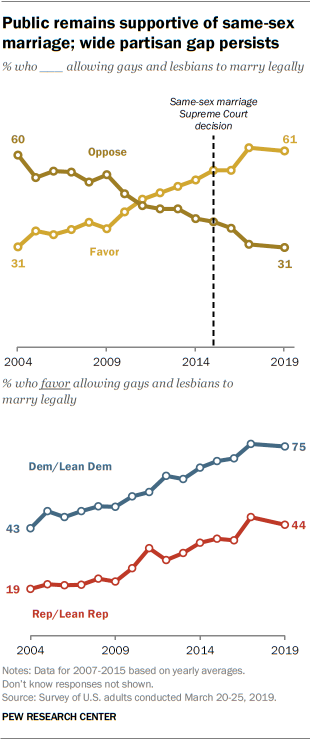
I often fall into the trap of believing that the class and political differences between Democrats and Republicans are driven primarily by economic self-interest, but these data from the Pew Research Center show the stark differences apparent on the relatively non-economic issue of same-sex marriage. The tribes really are different.

https://www.pewresearch.org/wp-content/uploads/2019/12/FT_19.12.17_DecadeChanges_same-sex-marriage.png?resize=310,740

Public remains supportive of same-sex marriage; wide partisan gap persists

Posted in Fun | Comments Off on Views on Same-Sex Marriage Illustrate Social Component of Partisan Divide

Ward Just Obituary

An early journalistic hero — obit on page C9 of the Sunday, 12/22/19, Washington Post, or at < https://www.washingtonpost.com/local/obituaries/ward-just-washington-post-reporter-and-acclaimed-political-novelist-dies-at-84/2019/12/20/803137a4-21b5-11ea-a153-dce4b94e4249_story.html >

Highlight:

“… unsigned editorial on Maryland Gov. Spiro Agnew’s selection as Richard M. Nixon’s running mate in 1968. It was, he said, “perhaps the most eccentric political appointment since the Roman emperor Caligula named his horse a consul.”

Ward Just, Washington Post reporter and
acclaimed political novelist, dies at 84

Ward Just, seen in 1988, was the “quintessential Washington reporter,” a former colleague once said, “except he’s doing it through fiction.”

By Harrison Smith Dec. 20, 2019 at 1:36 a.m. EST

Ward Just, a former journalist who helped rejuvenate an uninspiring Washington newspaper with his visceral dispatches from the Vietnam War, then gave up reporting to chronicle power, patriotism and moral corruption in a slew of celebrated short stories and novels, died Dec. 19 at a hospital in Plymouth, Mass. He was 84.

He had Lewy body dementia, said his wife, Sarah Catchpole.

A distinguished reporter for Newsweek and then The Washington Post, Mr. Just turned to fiction in 1970 and wrote 19 novels, including the National Book Award finalist “Echo House” (1997), about three generations of a Washington family, and the Pulitzer Prize finalist “An Unfinished Season” (2004), about an aspiring journalist in 1950s Chicago.

Heavily influenced by Ernest Hemingway, another onetime journalist who shared Mr. Just’s affection for Scotch, cigarettes and the ambiguities of war, Mr. Just acquired a reputation for crafting elegant, understated prose and psychologically complex characters. He often wrote of the fraught dynamics between fathers and sons and of the machinations of political insiders — “people,” he said, “who speak in low voices without using verbs.”

A distinguished reporter for Newsweek and then The Washington Post, Mr. Just turned to fiction in 1970 and wrote 19 novels. (Larry Morris/The Washington Post)

“He is not only the most literary chronicler of the daily lives and moral dilemmas of contemporary politicians, bureaucrats, intelligence agents, military officers, diplomats, lawyers and journalists, but one of the few novelists even interested in depicting such people realistically,” wrote syndicated columnist and author Judith Martin, reviewing Mr. Just’s novel “Jack Gance” (1989) for the New York Times.

Mr. Just seemed to have a long career in journalism ahead of him when he gave it up to write novels. The son and grandson of Midwestern newspaper publishers, he joined The Post in 1965 as one of the first hires made by Ben Bradlee, his former boss at Newsweek’s Washington bureau. At the time, the paper was generally regarded as a home for dull, stodgy writing and reporting that rarely commanded a national audience.

Its coverage of Vietnam in particular was far outpaced by competitors such as the New York Times and Associated Press. Mr. Just, seeking a change of pace after separating from his first wife, helped close that gap soon after arriving in Saigon in December 1965. He remained for 18 months, aside from a brief return home to recuperate from a grenade blast that left shrapnel lodged in his back.

“Perhaps no reporter working for a major daily paper wrote as well from Vietnam or with as much subtlety and grace as he did,” fellow Vietnam correspondent David Halberstam wrote in his book “The Powers That Be.” “His were stories of men at war, and they were wonderful, in the best sense timeless.”

Mr. Just, he added, “took exceptional risks in combat” and initially focused on the bravery of ordinary soldiers above broader issues of politics and strategy.

He “found drama everywhere he looked — the drama that turned details into truth and isolated events into history,” Brad­lee wrote in his memoir, “A Good Life.” “Sometimes Just would get a single quote that would tell an entire story. We spread one of those quotes, from a frightened GI surrounded by his enemies, eight columns over the top of the front page: ‘Ain’t Nobody Here but Charlie Cong,’ as in Viet Cong.”

Mr. Just grew increasingly critical of the war after June 1966, when he was wounded while accompanying a reconnaissance unit that was ambushed near Dak To. He had been handed a .45-caliber pistol that he didn’t know how to use when a grenade landed a few feet away, knocking him off his feet. When U.S. helicopters arrived two hours later, Mr. Just and 18 other wounded soldiers were lifted into the air by cable, amid continued gunfire from the North Vietnamese.

“You heard the bullets as you were rising and your body went stiff and you pulled out all the plugs,” he wrote in his book “To What End: Report From Vietnam” (1968). “You gripped the T-bar and made a number of very difficult promises if God got you safely into the helicopter. But when you got there, you said instinctively, I made it. And over and over again, Jesus Christ.”

After his tour ended in May 1967, Mr. Just wrote a scathing Post essay about the conflict, challenging the Johnson administration’s rosy assessments of its progress. “This war is not being won, and by any reasonable estimate, it is not going to be won in the foreseeable future,” he began. “It may be unwinnable.”

Mr. Just covered the 1968 presidential election and became an editorial writer, but he found that life in a newsroom paled in comparison to his work overseas. He took a leave of absence to write his first novel, “A Soldier of the Revolution” (1970), involving guerrillas in South America, and was said to have stunned Bradlee when he chose fiction over reporting.

In its strict reliance on the facts, Mr. Just said, journalism was limited in what it could reveal about the world or human nature. He chronicled the Vietnam era in novels such as “Stringer” (1974) and “In the City of Fear” (1982), and by the time he published “Jack Gance” — about the rise of a senator from Illinois — he was generally regarded as the finest “Washington novelist” since Allen Drury, who won the Pulitzer for his 1959 book “Advise and Consent.”

“He’s the quintessential Washington reporter,” author and former Post colleague Stanley Karnow told the Times in 1997, “except he’s doing it through fiction.”

Ward Swift Just was born in Michigan City, Ind., on Sept. 5, 1935, and grew up in the Chicago suburbs of Waukegan and Lake Forest, Ill. He said he struggled to make friends as a boy, throwing himself into books and eventually journalism. An early stint at his family’s newspaper, the Waukegan News-Sun, ended when he was fired for wearing shorts in the office.

Mr. Just graduated from the Cranbrook boarding school in Bloomfield Hills, Mich., and studied at Trinity College in Hartford, Conn., before leaving in 1957 without a degree. He spent two years at the News-Sun before landing a job at Newsweek, where he covered conflicts in Cyprus and the Dominican Republic and worked in Washington under Bradlee.

Mr. Just also worked for the Reporter news magazine before moving to The Post with Bradlee, who was hired in July 1965, as deputy managing editor, and soon rose to oversee the newsroom. He said he hired Mr. Just as part of a plan to recruit “the best horseflesh around” — an ace reporting team that included Karnow, David S. Broder, Richard Harwood, Nicholas von Hoffman and George C. Wilson.

As an editorial writer, Mr. Just was credited with penning one of The Post’s most biting pieces of political commentary, an unsigned editorial on Maryland Gov. Spiro Agnew’s selection as Richard M. Nixon’s running mate in 1968. It was, he said, “perhaps the most eccentric political appointment since the Roman emperor Caligula named his horse a consul.”

Mr. Just won National Magazine Awards for his 1970 Atlantic article “Soldiers” (adapted from his Vietnam book “Military Men,” also published that year) and for his 1980 short story “A Guide to the Geography of Vermont.”

His novels included “A Family Trust” (1978), which drew on his newspaper-family upbringing; “Forgetfulness” (2006), set after the 9/11 terrorist attacks; “Rodin’s Debutante” (2011), about a Midwesterner’s coming of age; and the Vietnam diplomacy tale “American Romantic” (2014), which Post book critic Jonathan Yardley called perhaps “the best of them all . . . opening our eyes to things we don’t know about worlds we think we know well and transporting us to worlds totally alien to us.”

Mr. Just also featured German characters and settings in much of his work — he was the descendant of 19th-century immigrants from Darmstadt — notably in “The American Ambassador” (1987), about a U.S. diplomat whose son joins a West German terrorist group, and “The Translator” (1991), about a German expatriate living in Paris.

His marriages to Jean Ramsay and Anne Burling ended in divorce. In 1983, he married Catchpole, with whom he lived for many years on Martha’s Vineyard and in Paris. In addition to his wife, survivors include two daughters from his first marriage, Jennifer Just of Woodbridge, Conn., and Julia Just of Brooklyn; a son from his second marriage, Ian Just of Arlington, Mass.; and six grandchildren.

Mr. Just dismissed suggestions that he might someday return to journalism, telling the Times in 1999, “Many of the things that make you a good journalist have to be discarded to make you a good writer. . . . In a novel, every fact is a rock thrown in the hull, and the boat sinks a bit.”

Nevertheless, as a reporter, Mr. Just repeatedly found ways to assemble facts into stories and scenes that resembled works of literature. In his 1967 Vietnam War essay, he analyzed the dismal state of the conflict before relating, in the essay’s final paragraphs, the death of a single soldier, 19-year-old Truman Schockley.

“Smoking a Lucky Strike and staring off into the mountains, Schockley died with a sniper’s bullet through the heart and stopped breathing before the cigarette stopped burning,” Mr. Just concluded. “The company commander sent a platoon into the underbrush to look for the sniper, but the sniper had left. Schockley was put in a green body bag and sent to Bongson for transport to Saigon and then home.”

Posted in Fun | Comments Off on Ward Just Obituary

The Washington Post: Former White House officials think Trump’s false Ukraine theory came from Putin

This story from The Washington Post 20 December, is such a great example of the insane world that Trump and those sycophants around have created.

Former White House officials think Trump’s false Ukraine theory came from Putin
One former senior White House official said Trump even stated so explicitly at one point, saying he knew Ukraine was the real culprit because “Putin told me.”

https://www.washingtonpost.com/national-security/former-white-house-officials-say-they-feared-putin-influenced-the-presidents-views-on-ukraine-and-2016-campaign/2019/12/19/af0fdbf6-20e9-11ea-bed5-880264cc91a9_story.html

Bruce Potter443-454-9044

Posted in Fun | Comments Off on The Washington Post: Former White House officials think Trump’s false Ukraine theory came from Putin