The Tormenting of Tillerson

from the October 7th edition of The Economist, page 32:

Crawling back to you

Mr Tillerson deserves only slight sympathy. He has shown little interest in representing American ideals, such as the promotion of human rights, while carrying out a botched reorganisation of the State Department that has left it hollowed out and dysfunctional. Many important posts remain unfilled—including those of assistant secretary of state for East Asia and ambassador to Seoul. He would not be much missed if he decided to quit. But on October 4th, Mr Tillerson declared that he would soldier on in his thankless job. That may not be a bad thing. Such is the damage being done to the effectiveness of American diplomacy at Mr Trump’s hands, it is doubtful whether anyone of stature would be willing to take his place.

Now to the Washington Post’s editorial of today, 13 November 2017 — 

Tillerson’s ‘redesign’ for State looks a lot like a retreat

November 12 at 7:47 PM

WHAT IS going on at the State Department? Secretary of State Rex Tillerson has begun a “redesign” and has spent much of this year working on it. There is not an agency in government that could not benefit from a fresh look, but the importance of the State Department’s mission should not be in doubt. Does Mr. Tillerson really intend to strengthen diplomacy as a tool for dealing with persistent global problems, or is this an exercise in slashing at the people and offices necessary to represent the United States abroad, defend its interests and keep a watch on the future?

In a forthcoming issue of the Foreign Service Journal, the monthly magazine of the American Foreign Service Association (which is the professional association and union of the Foreign Service), the group’s president, former ambassador Barbara Stephenson, raises a fresh alarm about the future of the U.S. diplomatic corps. This refrain has been heard all year, as many outside experts and foreign-service veterans criticize Mr. Tillerson’s proposals to slash the department’s budget by about 30 percent. Congress rejected the most draconian cuts of Mr. Tillerson’s reorganization process, which Sen. Benjamin L. Cardin of Maryland, ranking Democrat on the Senate Foreign Relations Committee, has called a “pre-cooked and ideologically driven exercise.”

Ms. Stephenson reports that the department has decided “to slash promotion numbers by more than half.” Usually, the number of promotions is aimed at matching available jobs at various grade levels. A multiyear smoothing algorithm is used to avoid big fluctuations from year to year. But now, she says, the number of officers at the rank of career minister has fallen from 33 to 19; the number of minister counselors from 431 to 369. Because of a hiring freeze, intake into the Foreign Service will drop from 366 last year to 100 this year, she says. “The rapid loss of so many senior officers has a serious, immediate, and tangible effect on the capacity of the United States to shape world events,” she wrote.

Posted in Fun | Comments Off on The Tormenting of Tillerson

US Climate Change Report — Weather Underground Summary w/ Graphics

This is an essay  produced by Bob Henson (bio at the bottom) for WeatherUnderground which nicely summarizes many of the most significant regional impacts of Climate Change in the USA (There is still something like this needed for islands under US jurisdiction.)
– – – – – – – – – – – – – – – – – – – – – – – – –
 – – – – – – – – – – – – – – – – – – – – – – – –

Blockbuster Assessment: Humans Likely Responsible For Virtually All Global Warming Since 1950s

November 3, 2017, 2:18 PM EDT

 temps-above-90-835px.jpeg
Above: Number of days per year with a high temperature above 90°F during the period 2036–2065 as compared to 1976–2005, under the highest of the emissions scenarios used by the IPCC (RCP8.5). The maps show the average (mean) from 32 climate model projections. Most parts of the U.S. are projected to get several dozen more 90°F days per year by the middle of this century. The results are statistically significant throughout the contiguous United States. Image credit: CICS-NC and NOAA NCEI, via Figure 6.9 of Chapter 6, Climate Science Special Report (CSSP).

Humans are likely responsible for 93 – 123% of Earth’s net global warming after 1950, says a blockbuster climate report issued on Friday. The Climate Science Special Report is the first product released by the Fourth National Climate Assessment (NCA); the core assessment itself, focusing on impacts, will be released in 2018. The NCA is an congressionally mandated quadrennial effort by hundreds of U.S. scientists to assess how the climate is changing in the United States. The project is carried out by the U.S. Global Change Research Program. Preparation of the report included workshops around the nation, a public-comment period on the draft, and a technical review spanning 13 agencies.
global-temp-rise-835px.png
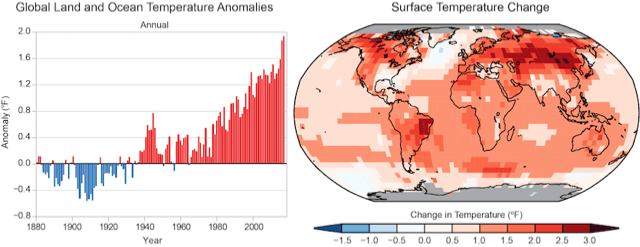
Figure 1. (left) Global annual average temperature has increased by more than 1.2°F (0.7°C) for the period 1986–2016 relative to 1901–1960. Red bars show temperatures that were above the 1901–1960 average, and blue bars indicate temperatures below the average. (right) Surface temperature change (in °F) for the period 1986–2016 relative to 1901–1960. Gray indicates missing data. Image credit: Figures 1.2. and 1.3 of Chapter 1, Climate Science Special Report.

A strong answer for climate-science-denying politicians

Ever since the Earth recorded three consecutive warmest years on record—2014, 2015, then 2016—the mantra of climate-science-denying politicians has shifted from “it hasn’t warmed since 1998” to “Earth’s climate has always changed, and we are not sure how much humans are to blame for the current warming.” At least three members of President Trump’s cabinet gave a variation of this message in their Congressional confirmation hearings. Well, we now have a new authoritative range on what the human contribution to global warming is: 93 – 123% of the warming since 1951. Chapter 3, Detection and Attribution of Climate Change (p.160) of the new report states:

“The likely range of the human contribution to the global mean temperature increase over the period 1951–2010 is 1.1° to 1.4°F (0.6° to 0.8°C), and the central estimate of the observed warming of 1.2°F (0.65°C) lies within this range (high confidence). This translates to a likely human contribution of 93%–123% of the observed 1951–2010 change.” 

In other words, Earth might well have cooled slightly during this period if it were not for human activity; this makes Earth’s recent record-high temperatures even more startling. The report adds:

“For the warming over the last century, there is no convincing alternative explanation supported by the extent of the observational evidence.”

It is worth noting that this new report is even stronger on the human-caused component of warming than the 2013 Intergovernmental Panel on Climate Change (IPCC) report, prepared once every six years. The 2013 IPCC report had this to say about the observed warming of Earth since 1950:

“The best estimate of the human-induced contribution to warming is similar to the observed warming over this period..”

us-regions-v2_0.jpeg
Figure 2.  The ten U.S. regions employed in the Climate Science Special Report and the upcoming Fourth National Climate Assessment. There are two new regions since the last assessment: the Caribbean has been broken off from the Southeast, and the Great Plains have been split into two regions. Image credit: Figure 1 of Guide to this Report, CSSR.

Major U.S. conclusions in the new report

Next year’s full assessment will dig deeper into national impacts, but the Climate Science Special Report has plenty of detail on how climate change is already affecting the United States and what the future may hold. As shown in Figure 1, the analysis is broken into 10 regions.  Here are just a few of the key findings:

Warmest in more than a thousand years. A major paleoclimate study has shown that for each of the world’s seven major continental regions, the average temperature for 1971-2000 was the highest in more than 1300 years. There is significant uncertainty around these estimates, but a separate study found that temperate North America as a whole (including most of the contiguous U.S.) is having its warmest 30-year periods in at least 1500 years.

It’s going to get a lot warmer in the coming decades. Temperatures across the contiguous U.S. have risen about 1.8°F (1.0°C) over the period 1901-2016. “Surface and satellite data are consistent in their depiction of rapid warming since 1979,” the report notes. By the period 2070-2100 (when today’s infants will be elders), U.S. temperatures may be 2.8 to 7.3°F warmer than the 1976-2005 average if greenhouse-gas emissions are reined in strongly—or 5.8 to 11.9°F warmer if emissions continue to grow at the pace of recent decades.

The U.S. temperature record still bears the imprint of the 1930s Dust Bowl.  The coldest single day of the year was higher in all U.S. regions during 1986-2016 as compared to 1901-1960:  from 1.13°F warmer in the Southeast to 4.78°F in the Northwest. Perhaps surprisingly, the warmest day of the year turned slightly cooler in all regions but the Southwest. One big reason: the 1930s Dust Bowl, exacerbated by poor land management, produced some extremely hot summer days. Warming in recent decades becomes much more evident when looking at daily record highs and lows. The ratio of hot to cold records has been more than 2 to 1 during the last two decades: in 2016 it was about 5 to 1, and for 2017 thus far, it’s running at more than 3 to 1. Continued warming in the 21st century should eventually transcend the Dust Bowl hangover, the report indicates: “the coldest and warmest daily temperatures of the year are expected to increase at least 5°F (2.8°C) in most areas by mid-century, rising to 10°F (5.5°C) or more by late-century.”

It’s getting wetter, but not everywhere. Average precipitation for the nation as a whole has increased by about 4% since 1901. This is mainly due to large increases in autumn (see Figure 4). Overall, precipitation has decreased over much of the West, Southwest, and Southeast, and increased over most of the Great Plains, Midwest, and Northeast.

fig-7.1-rev.jpeg
Figure 3.  Seasonal changes in precipitation, comparing the period 1986-2015 to the period 1901-1960 for the contiguous U.S. and to 1925-1960 for Alaska and Hawaii. Image credit: NOAA/NCEI, via Figure 7.1 of Chapter 7, CSSR.

The biggest precipitation events are getting bigger. Between 1901 and 2016, the amount of moisture one would get on the wettest day across a five-year period has increased by anywhere from 1% in the Southwest to 27% in the Northeast. The jumps are even larger for the period 1958 – 2016, when considering the amount of moisture falling in the top 1% of all wet days: from a 9% increase in the Northwest to 55% in the Northeast (although Hawaii and the Caribbean saw drops of 11% and 12%, respectively).

Heat is making U.S. drought worse. The new report finds little evidence for a human influence on observed precipitation deficits—i.e., meteorological drought. Importantly, the study did find ample evidence that the impact of drought on soil moisture is increasing, because of warmer temperatures drawing more moisture out of plants and soil. This is exactly the process implicated in California’s destructive drought of 2011-2016.

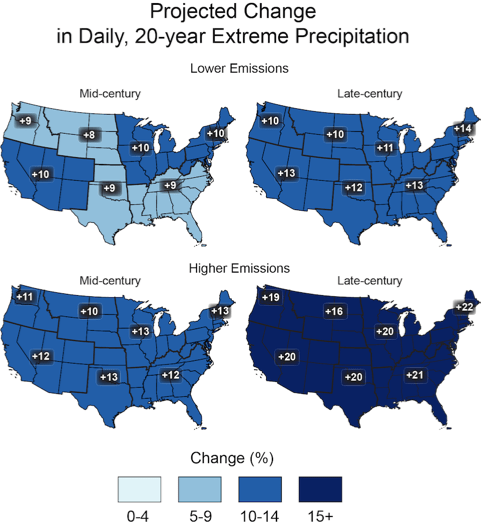
Wetter north, drier south? Winter and spring are projected to get wetter on average in the northern U.S., including Alaska. However, parts of the Southwest may see a decrease in winter and spring moisture. As the century rolls on, we’re likely to see a continued increase in the frequency and intensity of heavy precipitation events (see Figure 4 below).                
change-20-yr-prcp.png
Figure 4. Projected change in the amount of precipitation one would expect on the wettest day in a 20-year period for the mid-21stcentury (left maps) and late-21st century (right maps). Results are shown for a lower-emission scenario (top maps; RCP4.5) and for a higher-emission scenario (bottom maps, RCP8.5). Image credit: CICS-NC and NOAA NCEI, via Figure 7.7 of Chapter 7, CSSR.        

Big regional differences in sea level rise along U.S. coastline

For vast numbers of people living along or near the U.S. coast, no aspect of climate change will be more wrenching than sea level rise. One of the biggest advances in the ongoing National Climate Assessment is its treatment of sea level rise. This week’s report incorporates some of the latest findings on global mean sea level and how it could climb far more than earlier expected. The main reason: ice sheets in Antarctica may melt more quickly than once thought, especially if the ice cliffs and shelves along the Antarctic Ice Sheet become unstable and prone to fracturing.

Global mean sea level rose about 4-5 inches (11-14 cm) from 1901 to 1990, and about 3 inches (7 cm) in the comparatively brief period since 1990. The rate could accelerate much more this century based on six scenarios identified by the U.S. Interagency Sea Level Rise Task Force. The task force estimates (shown below) are similar to those now being used by the U.S. Department of Defense for planning all coastal facilities worldwide. The low end is comparable to a linear extension of the recent rate (about 0.12 in/year), while the high end is a very-bad-case scenario, including rapid ice loss in Antarctica.

Projected rises in global mean sea level from 2000 to the year shown:
Low:                    0.2’ by 2020,   0.5’  by 2050,   1.0’ by 2100
Intermediate:      0.3’ by 2020,   1.1’  by 2050,   3.3’ by 2100
High:                   0.4’ by 2020,   1.8’ by 2050,    2.1’ by 2100
Extreme:             0.4’ by 2020,   2.1’ by 2050,    8.2’ by 2100
(with further rises expected after 2100)                                                                         

Each of these numbers is a global average, but there’s actually a surprising amount of variation in the height of the sea from one place to another. At either end of the tropical Pacific, for example, El Niño and La Niña can drive sea level up or down by a few inches for months by altering the surface winds that push water across the region. Long-term climate change will bring its own set of region-by-region differences to sea level rise (see Figure 5).
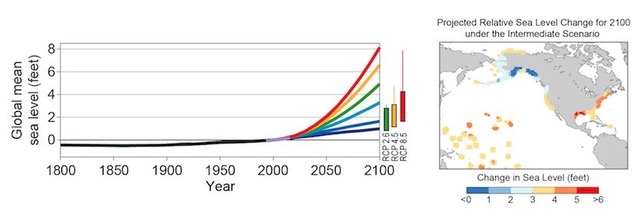
fig-12.4.jpeg
Figure 5. Left: Global mean sea level (GMSL) rise from 1800 to 2100, based on six scenarios from the U.S. Interagency Sea Level Rise Task Force (navy blue, royal blue, cyan, green, orange, and red curves). Also shown are the very likely ranges in 2100 for different RCPs (colored boxes), and lines augmenting the very likely ranges by the difference between the median Antarctic contribution of Kopp et al. and the various median Antarctic projections of DeConto and Pollard. Right:  Relative sea level (RSL) rise (feet) in 2100 projected for the Interagency Intermediate Scenario (a rise of 1 meter [3.3 feet] in global mean sea level by 2100). Image credit: Sweet et al. 2017, via Figure 12.4 of Chapter 12, CSSR.

For the first time, the U.S. National Assessment is analyzing and projecting regional differences in sea level rise along the nation’s coasts, as shown in Figure 5 above. A few of the factors involved:

U.S. coasts will experience more than the global average sea level rise from Antarctica Ice Sheet melt, and less than the global average from Greenland Ice Sheet melt. These results are both produced by what’s called static-equilibrium effects—basically, how the planet’s gravity and rotation are affected by moving huge volumes of water from polar ice sheets into the global oceans.

The Northeast U.S. coast is expected to see additional sea level rise because of a gradually weakening Atlantic meridional overturning circulation, which helps power the Gulf Stream. Much as the polar jet stream separates air masses of different densities, the Gulf Stream separates warmer, less-dense water and higher sea levels on its southwest side from denser, cooler water and a lower sea level on its northwest side, toward the Northeast U.S. coast. Any long-term weakening of the Gulf Stream would be associated with a reduced sea-level gradient, and that would mean a drop in sea level toward the southeast and a rise toward the northwest (on top of any global-scale changes, of course).

Regional sea level rise is being exacerbated by withdrawals of groundwater off the Atlantic coast, and withdrawals of both fossil fuels and groundwater off the Gulf Coast. If these continue, so will the regional effects.

Sea level could rise at a pace below the global average along the coasts of Alaska and the Pacific Northwest. As the glaciers of Alaska melt, the land beneath them will rebound; this will also cut back on sea level rise over the Pacific Northwest due to the static-equilibrium effects noted above.

Coastal storms such as hurricanes and nor’easters will complicate the effects of sea level rise, as they bring their surges atop an ever-rising foundation of mean sea level. “A projected increase in the intensity of hurricanes in the North Atlantic could increase the probability of extreme flooding along most of the U.S. Atlantic and Gulf Coast States beyond what would be projected based solely on [regional sea level] rise,” the report notes. On top of this, there are nonlinear effects that could increasingly exacerbate storm surge heights in areas where the near-coast topography is shallow.

fig-12.5a-b.jpeg
Figure 6. (a) Tidal floods (days per year) exceeding NOAA thresholds for minor impacts at 28 NOAA tide gauges through 2015. (b) Historical exceedances (orange), future projections through 2100 based upon the continuation of the historical trend (blue), and future projections under median conditions for low, medium, and high emission scenarios, for two of the locations: Charleston, SC and San Francisco, CA. Image credit: (a) adapted from Sweet and Marra 2016, (b) adapted from Sweet and Park 2014; via Fig. 12.5 of Chapter 12, CSSR.

Sea level rise is already having an effect on the U.S.

The impacts of sea level rise are not limited to future decades—they’re happening right in front of us, right now. “Nuisance” flooding has become a growing problem in places ranging from Miami Beach to San Francisco. In Maryland, both Annapolis and Baltimore now get more than nine times the number of flood days they experienced in the 1960s. For another example, see weather.com’s powerful report on Naval Station Norfolk (Virginia), a massive base that now experiences routine floods at high tide. Naval Station Norfolk could eventually flood on 200 days a year, based on current trends. However, efforts to keep up with the rising tide are mainly worked into ongoing projects rather than handled as priorities of their own.

The Norfolk report is part of weather.com’s “United States of Climate Change” series, which is examining major climate-change impacts in each of the 50 U.S. states—a very fitting complement to the new NOAA report.

Dr. Jeff Masters co-wrote this post.

The views of the author are his/her own and do not necessarily represent the position of The Weather Company or its parent, IBM.

Bob Henson

WU meteorologist Bob Henson, co-editor of Category 6, is the author of “Meteorology Today” and “The Thinking Person’s Guide to Climate Change.” Before joining WU, he was a longtime writer and editor at the University Corporation for Atmospheric Research in Boulder, CO.

Posted in Chesapeake Bay, Climate Change | Comments Off on US Climate Change Report — Weather Underground Summary w/ Graphics

Unhealthy Politics in Congress

The Unhealthy Politics of Pork: How It Increases Your Medical Costs

The term pork barrel spending has been around for well over 100 years. It means using government funds on local projects that are primarily used to bring more money to a specific representative’s district. 
CreditMatt Cardy/Getty Images

No industry in America spends more on lobbying than health care.

In 2016, the health care industry spent half a billion dollars on lobbying, with pharmaceutical companies, hospitals and health professionals making the largest contributions. In 2009, the year the Affordable Care Act was debated, health care lobbying exceeded $550 million. (Last year, by comparison, defense lobbying totaled $129 million, and the gun lobby spent just $10.5 million.)

Closely related to industry lobbying is the political maneuvering that congressional leaders use in an effort to pass legislation — specifically, targeted provisions known as earmarks, “sweeteners” or pork barrel spending.

The final version of the Graham-Cassidy health bill, for example, would have sent extra money to Alaska and Maine for the crucial votes of senators from those states, Lisa Murkowski and Susan Collins. In 2010, Democrats hoping to secure votes from reluctant rural state senators added the “Frontier States” provision to the A.C.A., which increased Medicare payments to five states with low population densities.

We all know earmarks and lobbying influence policymakers and policy. In health care, this has critical implications: who gets care, how much they get, how we pay for it. But there’s little hard data on exactly who benefits and how large the effects can be. A new study illuminates the ways these political dynamics can change congressional and hospital behavior — and how they can increase health care costs for the rest of us.

Research by Zack Cooper, Amanda Kowalski and Jennifer Wu at Yale and by Eleanor Powell at the University of Wisconsin-Madison analyzed a provision in the Medicare Modernization Act of 2003 (M.M.A.), known as Section 508, that helped secure Republican votes for the law’s passage.
The M.M.A., which created Medicare Part D and provided prescription drug coverage for seniors, was a political priority for President George W. Bush ahead of his 2004 re-election campaign. But fiscally conservative Republicans were hesitant to sign on to what amounted to the largest expansion of Medicare in its history, and the bill seemed unlikely to pass.

That’s when Section 508 was added.

The rate at which Medicare pays individual hospitals is determined largely by a hospital’s location and the labor costs, or wage index, in its area. Hospitals can, however, request to be reclassified into a different wage index area to raise their payments. Sometimes there are good reasons for this: Two hospitals might be competing in the same region, and because they’re separated by an arbitrary bureaucratic line, one gets paid more than the other.

But Section 508 waivers created new, more ambiguous ways that hospitals in specific districts could appeal their assigned wage index, and gave the executive branch considerable discretion about which requests would be granted and how big the pay increases would be.

The Section 508 waivers had large effects on how both politicians and hospitals operated. About 400 hospitals applied for a Medicare pay increase, and 120 waivers were granted. Hospitals in districts represented by a Republican member of Congress who voted for the M.M.A. were seven times more likely to receive a waiver compared with those in districts of members who voted against it. On average, these hospitals saw a 6.5 percent increase in Medicare payments, but the 29 hospitals with the biggest payment increases — “high 508 recipient hospitals” — received a 10 percent boost.

How did hospitals spend the extra money? Perhaps unsurprisingly, they started treating more Medicare patients — about 8 percent more per year. They also expanded nursing staffing by roughly a third, and invested in new technologies. But extra cash also meant big raises for hospital C.E.O.s: nearly half a million dollars per year at each hospital. Over all, “high 508 recipient hospitals” had $1.25 billion in additional spending from 2005 to 2010 — about 25 percent more than they otherwise would have. There was no evidence of improved quality or outcomes.

“If you told me in advance that we’d find this tight a link between Congress and hospitals, I would have been very surprised,” Mr. Cooper said. “We knew there was some connection, of course, but the more we kept digging, the stronger and more precise the link became.”

Section 508 payment changes were supposed to expire after three years. But hospitals with lucrative waivers had considerable interest in seeing the program extended, and worked together to form the Section 508 Hospital Coalition.

Pork, it seems, is as bad for budgets as it is for waistlines.

“Every time you pass legislation, big or small, these elements are added in,” Mr. Cooper said. “It’s not that any single one is hugely offensive. It’s their accumulation and continuation over time.”

Although Mr. Cooper’s research offers perhaps the clearest empirical glimpse of the links between lobbying, earmarks and medical spending, this political maneuvering is not new — and Medicare hospital payment seems to be a particularly susceptible target.

Both Democrats and Republicans have won pay increases for hospitals they represent. In the 1999 budget, the House Republican whip, Tom DeLay, and House Speaker Dennis Hastert reclassified hospitals in their districts into other regions, leading to hundreds of thousands of dollars of extra funding per year.

About a dozen years later, in what was called the Bay State Boondoggle, John Kerry, then a senator, succeeded in lobbying for Medicare to pay Massachusetts’ urban hospitals at the same rate it paid the state’s rural hospitals. The catch: There was only one hospital that qualified as “rural” in Massachusetts — on the wealthy island of Nantucket.

None of this is surprising. A primary motive of elected representatives is getting re-elected. Passing expansive legislation — like Medicare Part D or the A.C.A. — is hard, especially when legislators can’t point to specific benefits for their constituents. But a critical flaw in our current system is that payments are hugely influenced by politicians who have every incentive to increase them for their own districts.

“You can’t get upset at a snake for having fangs,” Mr. Cooper told me. “We need to design a system that takes payment decisions out of the hands of elected representatives. We think of interest rates as so important and complicated that we’ve tried to remove politics and give the responsibility to the Fed. The same argument holds for health care. When the government spends a trillion dollars on health care, it’s too easy for members to direct funds to their districts.”

We’ve been close to a possible solution. The A.C.A. called for establishing an Independent Payment Advisory Board, a 15-member panel charged with making changes to Medicare to control costs. The proposed reforms would have been put into effect unless Congress introduced alternate policies to achieve the same savings. But the advisory board faced fierce bipartisan opposition and was never created.

Often these costs are borne by all of us, while the benefits — if any — go to a favored few. Excess medical spending, then, is driven not only by inefficiencies in our health system, but also by those in our political system. Our solutions, it seems, must confront that uncomfortable reality.

Dhruv Khullar, M.D., M.P.P., is a physician at NewYork-Presbyterian Hospital and a researcher at the Weill Cornell Department of Healthcare Policy and Research. Follow him on Twitter at @DhruvKhullar.

The Upshot provides news, analysis and graphics about politics, policy and everyday life. Follow us on Facebook and Twitter. Sign up for our newsletter.

Posted in Fun, Governance, Health | Comments Off on Unhealthy Politics in Congress

Fresno Resurgent: Progress in Surprising Places

from the Non-Profit Quarterly

Posted in Development, Fun, Governance | Comments Off on Fresno Resurgent: Progress in Surprising Places

Another Study Showing Economic Disadvantage Inflicted by Racism

from the Business Section of the Sunday New York Times, 8 October 2017

Credit:  Dani Pendergast

A team of economists has uncovered persuasive evidence that local government officials throughout the United States are less responsive to African-Americans than they are to whites.

The researchers sent roughly 20,000 emails to local government employees in nearly every county. The emails posed commonplace questions, like “Could you please tell me what your opening hours are?”

The emails were identical except that half appeared to come from a DeShawn Jackson or a Tyrone Washington, names that have been shown to be associated with African-Americans. The other half used names that have been shown to be associated with whites: Greg Walsh and Jake Mueller. The email sent to each local officeholder was determined by chance.

Most inquiries yielded a timely and polite response. But emails with black-sounding names were 13 percent more likely to go unanswered than those with white-sounding names. This difference, which appeared in all regions of the country, was large enough that it was statistically unlikely to have been a matter of mere chance.

These troubling results were documented in the paper, “Racial Discrimination in Local Public Services: A Field Experiment in the US,” by Corrado Giulietti of the University of Southampton in Britain, Mirco Tonin of the Free University of Bozen-Bolzano in Italy, and Michael Vlassopoulos, also of the University of Southampton. The study is to be published in the Journal of the European Economic Association.

The findings appeared to be a striking indication of racial discrimination in seemingly benign and mundane interactions. The tendency to ignore emails sent by African-Americans was particularly pronounced in sheriffs’ offices, but it was also evident in school districts and libraries.

In a clever twist, the authors analyzed whether the replies were polite, counting responses that included either the sender’s name or words like “hi,” “Mr.,” “dear,” “good” (which captures “good morning,” “good afternoon” and “have a good day”) or “thank” (which captures both “thanks” and “thank you”). By this measure, those with apparently African-American names received 8 percent fewer polite responses than those with white names.

While many studies have found differences in treatment for African-Americans and whites in employment, housing and the criminal justice system, it hasn’t always been clear whether these differences reflect discrimination or other factors.

The usual difficulty is that it’s impossible to find, say, job seekers who are absolutely identical in every respect except race. As a result, it is difficult to conclude whether a white job seeker succeeded — and a black one didn’t — because of discrimination. While statistical techniques can adjust for some of these factors — education, geography and the like — no analysis can account for all of them.

But the new research allows for a clearer conclusion: It appears to have documented straightforward discrimination.

As a real-world experiment, it built on earlier “audit experiments,” as they are known in social science. Perhaps the most famous is a study by Marianne Bertrand of the University of Chicago and Sendhil Mullainathanof Harvard (who is a regular contributor to this column). In that earlier experiment, Ms. Bertrand and Mr. Mullainathan sent fictitious résumés to employers, finding that people with white-sounding names were more likely to receive a positive response than those with black-sounding names.

The new findings provide further indication of the many ways in which discrimination shapes the lives of African-Americans. What’s more, when it’s harder to get your neighborhood librarian to respond to a simple email about opening hours, it’s not much of a leap to imagine other interactions — dealing with a computer help desk, the front office at a school or just the dry cleaner — that go less smoothly.

Economists tend to group explanations of discriminatory behavior into two buckets: taste-based and statistical. If a librarian chooses not to respond because a person is black, that’s taste-based discrimination. In common speech, there’s a simpler label: racism.

Statistical discrimination, on the other hand, occurs when a librarian uses a person’s name or race as a marker for other characteristics. Perhaps an African-American-sounding name signals that a person is more likely to be poor. The librarian happens to be biased against poor people. In this case, race is being used as a statistic for inferring poverty, and it’s the perception of poverty that causes the discriminatory behavior.

But two pieces of suggestive evidence in this study point to the problem here as being straightforward, taste-based discrimination.

First, the authors repeated the exercise — sending an additional 20,000 emails to the same recipients — although this time with a twist. They added a signature line, identifying the sender as a real estate agent. This extra information made the sender’s name — whether it seemed to be African-American or white — less relevant for inferring income or socioeconomic status. If statistical discrimination had driven behavior in the first round, this extra information should have led to less discrimination in the follow-up. It did not.

Second, the pattern of evidence was consistent with taste-based discrimination. While the researchers didn’t determine the race of the people who responded to their emails, they did have data on the racial breakdown of the municipal work forces. The racial gap in email response rates was greater in counties where the proportion of whites was higher.

Taste-based discrimination — basically, racism — isn’t necessarily the result of conscious thought. In an email, Mr. Tonin, one of the study’s authors, said that it’s possible “this behavior is due to some sort of unconscious bias” and, therefore, that “making people aware of the problem may contribute to the solution.”

If awareness really is the first step toward a fix, then the study may be helpful in refining our understanding of racial discrimination in America. It occurs not only in the labor market and the criminal justice system, but also in countless small frictions every day.

The culprit may not be a hate-spewing white nationalist, but rather a librarian or a school administrator or a county clerk, unaware that she’s helping some clients more than others.

Posted in Fun | Comments Off on Another Study Showing Economic Disadvantage Inflicted by Racism

The New Gilded Age

from the on-line Washington Post: The 202

The Daily 202: Why a Republican strategist thinks we’re in a new Gilded Age

October 4


With Breanne Deppisch and Joanie Greve

THE BIG IDEA: Everywhere he looks, Republican strategist and lobbyist Bruce Mehlman sees “eerie” parallels between the Gilded Age and today.

Mehlman produces quarterly reports about the political climate. In his latest, which he’s distributing to his clients today, he argues that “data is the new oil.” He likens Facebook’s Mark Zuckerberg, Google’s Larry Page and Amazon’s Jeff Bezos (who also owns The Washington Post) to captains of industry like Andrew Carnegie, John D. Rockefeller and Cornelius Vanderbilt.

“Back then you had iconic innovators who built these dominant companies and amassed great fortunes. You’ve got that again today,” Mehlman explained in an interview. “You saw income inequality spike. The last time it was as high for the top 10 percent as it is today was the Gilded Age. … In politics, you saw a rich few increasingly dominating spending to impact elections similar to today.

Mehlman, who was the assistant secretary of commerce for technology policy under George W. Bush and the policy director for the House Republican Conference before that, outlines additional similarities — and the lessons that might be learned from them — over 36 PowerPoint slides:

  • The economy shifted dramatically away from agriculture toward manufacturing from 1870 to 1920, just as it has moved away from manufacturing toward service over the past half century.
  • The last time immigrants made up as large a share of the population as they do right now was also during the Gilded Age.
  • President Trump’s win should be viewed partly as an aftershock of the Great Recession, just as the fear that lingered after market crashes in 1873 and 1893 affected the outcome of multiple elections.
  • The country was intensely divided politically. In 2016 and 2000, the candidate who lost the popular vote won the presidency. The last time that happened was 1888 and 1876.

— Fear of disruption, backlash to change and frustration with inequality, immigrants and global trade all contributed back then to the sort of populist backlash we saw with Trump’s victory last November. The Republican Party, which dominated national politics in the decades after the Civil War, splintered. An aggressive press exposed corruption and the excesses of unfettered capitalism, which ratcheted up public pressure for reforms. The industrial age created new public policy problems and generated new alliances. William Jennings Bryan never became president, despite being the Democratic nominee three times, but he helped transform the country’s politics.

— The passions of the populist movement eventually gave way to the Progressive Era. The federal government busted trusts, banned corporate political contributions, imposed food safety regulations and restricted child labor. Four amendments to the Constitution were enacted, including women’s suffrage and the direct election of senators, as well as the imposition of an income tax and the prohibition of alcohol.

Global trade powered tremendous economic growth at the dawn of the 20th century. While there were a lot of winners, there were also a lot of losers. Mehlman believes that now, as then, “the winner’s circle is too small.” Success in modern America is closely correlated to where you live, how much education you received, and which sector you work in.

— Technology companies are coming under growing pressure because of the rising tides of populism, protectionism, nationalism and nativism. Mehlman, who was the policy lead at Cisco Systems during the collapse of the first tech bubble, believes industry behemoths need to worry about antitrust problems, strengthened consumer protection laws, security concerns, trade policy and new regulations that increase intermediary liability. Headaches are coming from lots of places, from Brussels to Beijing and Washington to Sacramento.

— Against this backdrop, Mehlman thinks American politics has become less left vs. right and more insider vs. outsider. The globalist consensus that dominated through the Obama era is crumbling. “On issues like race and on immigration, we’re now finding the culture war is competing with a class war,” Mehlman said. “You used to hear it from the Pat Buchanans of the world and some of the Democrats like Bernie Sanders, but it’s now becoming mainstream in, for sure, the Democratic Party and, increasingly, the Republican Party. … The president campaigned and said we need to increase taxes on the rich. The class war has joined the culture war — both in the Progressive Era and potentially today. It could realign the political parties.”

— In this environment, he believes that it will be very hard to get any marquee legislation enacted. “Almost every Republican and almost every Democratic rank-and-file member wants to get more done,” said Mehlman, a partner at the firm Mehlman Castagnetti. “The politics that we have, and at the top, the leadership, makes it difficult, less because there are not compromises and more because to stay on top of the tiger you have to keep feeding it. So it’s very difficult to get the really big ticket things done.”

Mehlman does expect Congress to get something done on taxes. “It will probably not be 1986-style comprehensive, permanent reform,” he predicted. “It will probably be smaller. Maybe just tax cuts. It’s always easier to cut taxes than to pay for it. The climate is different today than it was in 1986.”

I asked what worries his clients most: “Around the world, the greatest concern is opacity,” he said. “They don’t know how to read the United States anymore. Once upon a time you could predict Republicans and you could predict Democrats and you kind of knew where policies and politics were going. These days, it’s unclear whether the president is going to build a new Republican Party that’s fundamentally economic nationalism, or whether he’s going to be a more traditional right-of-center Republican.”

Go to the original WaPo article for video,
Trump: I could ‘shoot somebody and I wouldn’t lose voters’
Republican presidential candidate Donald Trump jokes that he wouldn’t lose support for his campaign even if he shot people “in the middle of Fifth Avenue.” (Reuters)

— In his previous powerpoint, Mehlman made the case that Trump is to politics what Uber is to the technology industry. He highlighted parallels between the cycle of disruption that’s churned through Silicon Valley and what’s now wreaking havoc on Washington. (Read my July Big Idea on this theme: “Trump is the disrupter-in-chief in an age of disruption.”)

Since then, Trump’s culture wars have further inflamed his opposition and limited the potential upside of his economic nationalist message. Mehlman refers to the president’s most loyal supporters as “Fifth Avenue Republicans.” This is a reference to when Trump boasted last year that he could shoot someone in the middle of Fifth Avenue, and his supporters would still stick with him.

“The core challenge for the president politically is to try to grow his base,” Mehlman said yesterday. “There’s 98 percent support for the president among people who voted for him in the primary. And that’s great, but it’s not going to be sufficient in 2020. … As long as the culture war is concurrently raging, it’s going to be very hard to gain the support of registered Democrats and independents.”

See Mehlman’s full slide deck here.

— Listen to a 10-minute excerpt of my conversation with him at the end of today’s Big Idea audio briefing:
Subscribe to The Daily 202’s Big Idea on
Amazon Echo, Google Home, Apple Podcasts and other podcast players.

— Go deep: If you really want to bone up on the Gilded Age, I recommend Stanford professor Richard White’s “The Republic for Which It Stands,” a sweeping history of the United States from 1865 to 1896 that just published last month. It’s 941 pages but beautifully written and a gripping narrative of a tumultuous era. (White was one of my favorite professors at Stanford. I took two of his classes.)

Posted in Fun | Comments Off on The New Gilded Age

Semi-Free Speech; or maybe Hemi-Semi Free …

The civil rights and Vietnam protests changed America. Today, they might be illegal.

 
In this scene from the PBS documentary “The Vietnam War,” college students protest in Boston on Oct. 16, 1965. (Frank C. Curtin/AP)

Media Columnist September 24
What’s the state of free speech in America?Sanford Ungar, who teaches about it at Harvard and Georgetown, has a simple, depressing answer.

“It’s a mess,” he says.

It’s not just the problems on college campuses where high-profile speakers haven’t been allowed to talk. It’s not just what happened in Charlottesville, where a counterprotester was run over and killed. It’s not just President Trump’s insistent call for the firings or suspensions of NFL players who take a knee during the national anthem to protest police violence.

An insidious problem also is developing in dozens of states where legislatures are considering — and sometimes approving — new laws that restrict free speech.

 “They are criminalizing things that are pretty routine,” Ungar told me. “Much of the activism of the Vietnam and civil rights era would be completely illegal” under the new laws.

The lunch-counter sit-ins that were a staple of civil rights protests in the ’60s would, under some new legislation, be punishable because they “disrupt commerce.” And the demonstrations that brought thousands into the streets of major cities to protest the Vietnam War would be a crime because they blocked traffic.

Twenty-seven states have considered such legislation, he said. Twelve bills have become law, and many others remain under consideration.

Some of the bills sound perfectly acceptable at first because their purported aim is tranquility.

But here’s the problem: Meaningful protest isn’t always as mild as milk. The new laws have little tolerance for the tumultuous reality of dissent.

In Iowa, for example, the legislature considered a bill to punish protesters who block highway traffic with up to five years in prison.

In North Dakota, the governor signed a bill that would punish masked individuals in any public forum who are trying to conceal their identity.

In Arizona, the state Senate approved a bill that would add “rioting” to organized crime statutes, making participation in a protest that turns into a riot a possible criminal racketeering offense.

Florida even considered a bill that, in some cases, would exempt drivers from liability if they struck a protester.

Traci Yoder, National Lawyers Guild director of research and education, predicts that whether this wave of bills ends up passing or not, the effect may be the same — to tamp down dissent.

“Few people would be as willing to protest if they thought they could easily be arrested, fined, imprisoned or even killed,” Yoder wrote. And most regular citizens aren’t keeping track of the details, she said, but may know that the penalties have been vastly toughened.

It amounts to a nationwide movement to chill speech.

And while it might be convenient to blame it on Trump’s hard-line views on law enforcement, much of this movement predates the Trump administration. A substantial amount of the proposed legislation stems from protests over the Dakota Access pipeline and from the Black Lives Matter movement.

While countering this trend won’t be easy, Ungar is making a start with the Free Speech Project, based at Georgetown, with funding from the university and the Miami-based John S. and James L. Knight Foundation. (The former president of Goucher College in Baltimore, Ungar is a journalist, a former host of “All Things Considered,” and the author of an acclaimed book on the Pentagon Papers.)

One element is a Free Speech Tracker, which has more than 50 entries for troubling incidents or legislation around the country. That’s likely to grow dramatically over the next few months, he said.

A journalistic reality is part of the problem: There are far fewer state-government reporters around the nation than there were a decade ago. A Pew Research study showed a 35 percent decline from 2003 to 2014; it’s undoubtedly worse now.

That means that some state legislatures are freer to act at will without the watchdog function — and the public reaction to it — that once was routine.

At the root of these laws, Ungar believes, is a false narrative: “Spoiled students and liberal faculty shutting down speech because they don’t want to hear and confront the truth.” And, at the same time, the idea that protests of various kinds are “getting out of hand.”

So conservative lawmakers are stepping in to, in their view, fix it.

It’s not so simple, he says, and the stereotypes translate quickly into a political diatribe about free speech in which nobody wins. 

Protecting this basic American right sounds like it should be simple enough, but it’s often a minefield. (Or, at the moment, a football field.)

“Everybody believes in free speech,” Ungar notes, “until you get to the topic on which they don’t.”

For more by Margaret Sullivan visit wapo.st/sullivan


Posted in Fun | Comments Off on Semi-Free Speech; or maybe Hemi-Semi Free …

The Bozos Strike Again — EPA Breaks Contract with Bay Journal

In the Pruitt EPA, even when they might do important, good things, like Bay restoration, they don’t want us to know about it. The Bay Journal is THE BEST reporting there is on Bay restoration.

from the Newport News Daily Press 

EPA yanks funding for Bay Journal

The nonprofit Bay Journal is set to lose about a third of its funding after the U.S. Environmental Protection Agency announced it’s terminating a six-year grant it awarded the magazine just two years ago.

The EPA notice came without warning in a “very terse” email Wednesday that attributed the decision to a “shift in priorities,” said managing editor Timothy Wheeler in a phone interview Friday.

The termination is effective February 2018, when the journal was supposed to receive an annual installment of $325,000 to help support a staff of 11 and 100,000 free print and online subscriptions.

“It doesn’t completely defund us, but it does knock us back, there’s no question about that,” said Wheeler. “If we can’t replace that money, we’re going to have to make cuts. It’s a rather big drop.

“It’s not as if we didn’t realize we were vulnerable. We had been working to reduce our share coming from federal funds even before this. But we had no reason to suspect that a grant that had already been approved would be yanked like this.”

In a statement, journal editor Karl Blankenship called it an “unprecedented decision” in the history of the nonprofit monthly magazine, whose mission since 1991 has been to cover the Chesapeake Bay watershed, particularly pollution, water quality, habitat and fishery issues.

“For 27 years,” Blankenship said, “the Bay Journal has been an important source of news and information for those who care deeply about the Chesapeake.”

The EPA has funded the journal since it began. EPA funding comes through the Chesapeake Bay Program, a regional partnership of federal, state and local governments, and academic, conservation and citizens groups, all dedicated to restoring the bay.

President Donald Trump wants to zero out federal funds for the CBP in a stated effort to shrink government bloat. His chosen EPA administrator, Scott Pruitt, had voiced support for cleanup efforts during his confirmation hearings earlier this year, but since then has come under fire from conservation groups for failing to live up to those words.

At the nonprofit Chesapeake Bay Foundation, president William Baker said the funding cut shows Pruitt’s “true anti-environmental colors” in a “transparent attempt to shut down the free exchange of scientifically validated bay information.”

The bay watershed is the largest on the continent, stretching over portions of six states and the District of Columbia.

The bay deteriorated over decades of pollution and overfishing, and the EPA has been at the forefront of efforts to restore it, pushing bay states into a so-called pollution diet in 2010 that recent scientific surveys indicate are starting to work.

The Bay Journal also receives funds from the Campbell Foundation for the Environment, the Town Creek Foundation, the National Oceanic and Atmospheric Administration Chesapeake Bay Office, the Chesapeake Bay Trust and individual donations.

Posted in Chesapeake Bay, Resource Management | Comments Off on The Bozos Strike Again — EPA Breaks Contract with Bay Journal

States’ Rights: Not Federal Rights, Not Local Rights

from the NY Times, 6 July 2017. . . 

Photo

Hundreds of protesters lined the balconies of the Texas state Capitol rotunda in Austin on May 29, the last day of the legislative session, to protest a new state law banning sanctuary cities.
Credit: Ricardo Brazziell/Austin American-Statesman, via Associated Press

At a time when Democrats are locked out of power from the White House, both chambers of Congress, the majority of governor’s offices and three-fifths of the country’s state houses, their ideas at least have one reliable outlet. Democrats still control most of the country’s biggest cities.

Even that power center, though, is increasingly under attack.

In the last few years, Republican-controlled state legislatures have intensified the use of what are known as pre-emption laws, to block towns and cities from adopting measures favored by the left. The states aren’t merely overruling local laws; they’ve walled off whole new realms where local governments aren’t allowed to govern at all.

The pattern has worsened a different kind of partisan war beyond Washington, where the political divide cuts not just across the aisle, but across different levels of government. As standoffs between red states and blue cities grow more rancorous, the tactics of pre-emption laws have become personal and punitive: Several states are now threatening to withhold resources from communities that defy them and to hold their elected officials legally and financially liable.

“There are all sorts of legitimate ways we can divide power,” said Nestor Davidson, a law professor at Fordham. But if local officials risk personal fines, lawsuits and lost wealth for their communities over policy disagreements, he said, that changes the rules of the game. “That has the potential to change what it means to be a government official, to change what it means to elect people.”

States have banned local ordinances on minimum wage increases, paid sick days and lesbian, gay, bisexual and transgender rights. They’ve banned sanctuary cities.” They’ve even banned a number of bans (it’s now illegal for Michigan cities to ban plastic bags, for Texas towns to ban fracking).

A law passed in Arizona last year threatens to withhold shared state revenuefrom local governments that adopt ordinances in conflict with state policy. Texas’ new sanctuary city law imposes civil fines as high as $25,500 a day on local governments and officials who block cooperation with federal immigration requests. And it threatens officials who flout the law with removal from office and misdemeanor charges.

Texas’ four largest cities are now suing the state in response. Gov. Greg Abbott of Texas, a Republican, has been a vocal advocate for state laws that he says are necessary to protect individual liberty from local government overreach. When cities overstep their bounds, he said this year, they “should have to pay a price for it.”

Where States Curb Local Control

Go to the linked article to see graphics that show “Policies in these states block or limit local laws.”

These new pre-emption laws echo 19th-century “ripper bills,” legal scholars say, state laws that ripped control from cities over their finances, utilities, police forces and local charters. The backlash against them helped spur the movement for local control in the United States. Now home rule is under a “troubling nationwide assault,” warn municipal lawyers and law professors, including Mr. Davidson, in an amicus brief supporting another legal fight, in Cleveland.

There, Ohio passed a law blocking a longstanding requirement that city construction contracts hire some local workers. Cleveland, in other words, was trying to ensure that local projects created local jobs, alleviating local poverty.

Both state legislators and municipal groups agree that pre-emption laws have proliferated in the last few years in number and in the breadth of issues they touch. They disagree on who started the fight: states in stripping municipal power, or cities in seizing new roles that weren’t theirs to begin with.

“It is about power, and I think it’s about wielding power at any cost. That’s it,” said Andrew Gillum, the Democratic mayor of Tallahassee, Fla., who formed a national group to fight pre-emption laws this year. Now that Republicans control both legislative chambers in 32 states and the governor’s office on top of that in 25, he said, their slogans lionizing local government ring hollow. “They only mean that,” Mr. Gillum said, “to the extent that they’re in control.”

The contrast between what’s happening in cities and the decentralized philosophy Republicans have championed from Washington is striking. The supremacy of local control is central to Republican plans for undoing Obamacare, rolling back regulations and leaving the federal minimum wage unchanged (wages, the party said in its platform last year, should be handled at the state and local level).

As House Speaker Paul Ryan has put it: “Government closest to the people governs best.”

That government, many local legislators clarify now, is the state.

“We’re the United States of America. We are not the United Towns of Florida. We’re not the United Counties of Florida,” said Randy Fine, a Republican state representative there who sponsored a bill this year that would have broadly blocked local laws regulating “businesses, professions and occupations.”

He said: “The state is the nexus of government in this country. The states created the federal government, and the states created local government.”

The timing and language of many pre-emptions, though, suggest that while they’re cast as broad state standards, they’re often aimed at specific cities.

North Carolina’s so-called bathroom bill sought to squash a local ordinance in Charlotte adding gender identity to the city’s nondiscrimination policy. The repeal passed by the state this year still bars local communities from adopting such protections until at least 2020.

Photo

Gov. Eric Greitens of Missouri taking questions after an anti-abortion rally at the Statehouse in Jefferson City on June 14. Lawmakers were called back to special session by the governor with the intent of modifying abortion laws in Missouri. CreditDavid Carson/St. Louis Post-Dispatch, via Associated Press

St. Louis this year passed an ordinance banning employer and housing discrimination against women who use contraception or have abortions. Gov. Eric Greitens of Missouri, a Republican, called the state legislature back into special session in June in part to undo that law (it would turn St. Louis, he said, into an “abortion sanctuary city”).

In Alabama, Birmingham is fighting a law banning cities from setting their own minimum wages. Civil-rights groups say the pre-emption — enacted last year by a predominantly white state legislature the same week the city passed its ordinance — violates the voting rights of residents in a majority-black city.

In Texas, Mr. Abbott has called a special session for this month. On the agenda: proposals that would block cities from regulating trees on private land, restricting cellphone use in cars, and allowing transgender residents to use the bathroom matching their identity.

“It’s like quick-fire,” said Lisa Graves, executive director of the Center for Media and Democracy, which tracks pre-emption bills. “Once it passes some place, other legislatures go, ‘Oh, we could just pre-empt all of this.’ ”

Lori Riverstone-Newell, a political scientist at Illinois State University, traces modern escalation of pre-emptions to the 1980s — when the tobacco industry began to back state laws barring antismoking ordinances.

In the 1990s, the National Rifle Association followed the same state strategy with gun-control laws. More recently, the industry-backed American Legislative Exchange Council, which advocates free-market state policies, has promoted model state legislation preventing local governments from adopting what it considers a patchwork of regulatory burdens on businesses.

Then after the 2010 elections that swept Republicans to power in many states, Dr. Riverstone-Newell says the pace of such laws accelerated.

But where opponents point to industry influence at state houses, backers of pre-emption make a similar argument: Environmental and labor lobbies are pushing local bag taxes or minimum wages, they say, not voters engaged in some pure form of local democracy.

“It’s not illegal, but we should also not think it’s organic,” said Jon Russell, a councilman in Culpeper, Va., who leads a group of local-government officials within the American Legislative Exchange Council. “I’ve been a city councilman for almost 10 years, and I can tell you those kinds of issues are not organic. You don’t have a group of ladies sitting around in their living room wringing their hands about plastic bags or about fracking.”

He also accuses Democrats of their own hypocrisy: When blue states raise the minimum wage statewide, Democrats cheer those laws as progress.

Photo

A coalition of groups rallied at the Minnesota State Capitol in May to encourage Gov. Mark Dayton, a Democrat, to fend off new state laws that would block cities from setting their own minimum wage and paid sick leave policies.
Credit:  Glen Stubbe/Star Tribune, via Associated Press

The new punitive nature of pre-emptions, though, has escalated the fight beyond the usual partisan bickering. “It’s intended to send a chilling effect,” said Mr. Gillum, the Tallahassee mayor.

In Florida, local officials who run afoul of the state’s pre-emption on gun control are personally liable in court. Mr. Gillum and other city commissioners were sued by gun-rights groups over an old ordinance the city never repealed — but that no longer had effect — making it illegal to shoot guns in public parks. An appellate court rejected the lawsuit, but Mr. Gillum and other local officials had to defend themselves without public money (they were able to get pro bono legal help).

“It is intended to put everyone across this state and across this country where these efforts are taking place on notice: Don’t come near it,” Mr. Gillum said of issues like gun control and immigration. “And if you do, we’ll come after you personally, we’ll come after your government, we’ll come after the very survivability of your community by cutting off resources to you.”

Posted in Fun | Comments Off on States’ Rights: Not Federal Rights, Not Local Rights

If You Can Count More Than Three: Nine Obamacare Reforms Worth Doing

[This article is by Steven Brill, whose biography is more interesting than the squib on this excerpt from Sunday’s Washington Post. Most pertinent new information is that over the course of about three years in the early 2000’s, Brill flipped from being a strong supporter of charter schools in NY City (in part because of his observations of the Harlem Academy) and opponent of teachers’ unions to supporting reforms of public education and cooperation with the teachers unions. Details in a short bio in Wikipedia.] 

Nine ways to really fix Obamacare

 mcconnell_c.jpeg
 June 30 at 7:46 PM

[Steven Brill is the author of “America’s Bitter Pill: Money, Politics, Backroom Deals, And The Fight to Fix Our Broken Healthcare System.” He has received consulting fees for work on a consumer information and ombudsman program for New York-based Oscar Health Insurance. ]

If Senate Majority Leader Mitch McConnell cannot salvage his party’s effort to repeal and replace the Affordable Care Act, there is still a way forward if he and his Democratic colleagues truly want to fix Obamacare. All they have to do is be willing to compromise — and to acknowledge some history. 

The failure of the Republicans to agree, so far, on an alternative to Obamacare should not be surprising — because Obamacare was, in fact, the long-standing Republican alternative to the more radical health-care reforms, such as a single-payer system, that Democrats have proposed since the Truman era. What President Barack Obama and his party pushed through Congress in 2010 was more conservative — and more pro-private sector — than what Richard M. Nixon proposed in the 1970s, or what Republican Gov. Mitt Romney implemented in Massachusetts in 2006. Put simply, Obama dared Republicans to take yes for an answer. In a polarized America, they still said no. 

Obamacare did little to deal with the problem of health-care costs. There would be no cost-control interference with the only-in-America profits of drug companies, medical device makers or hospitals. Instead, the law subsidized Americans who could not otherwise afford health insurance, allowing them to become paying customers in the same overpriced private-sector system. 

True, there would be a provision aimed at making the insurance pool big enough to keep costs lower than they would be if people could just buy insurance when they got sick. Everyone would have to buy insurance (with subsidies where necessary) or pay a penalty. But that big-government mandate was first suggested by the conservative Heritage Foundation in 1989 under the banner of a classic conservative principle: “individual responsibility.” Romneycare included the same mandate. 

However, the Republicans’ answer would fix nothing related to health-care costs, while eliminating access to care for millions of poor people in order to cut taxes for the wealthy. They have proposed lowering premiums not by reining in costs, but by allowing insurers to sell shoddy insurance that pays for less health care. That will not work in any event, because the healthiest people would buy the cheaper products, leaving those who need full protection in a less healthy insurance pool facing sky-high prices. (“Consumer choice” may sound like an unassailable virtue, but in insurance it can be self-defeating.)

So, here are nine ways that Democrats and Republicans could come together — if they really wanted to — to fix Obamacare by truly tackling the problem of high premiums caused by high costs. 

1. The Republicans were right that a 3-to-1 ratio — heavily lobbied for by the Democrats’ friends at AARP — between the rates charged for older people and those for the youngest adults does not match the relative actuarial costs of insuring the two groups and discourages the young from enrolling. The ratio should be moved to 5 to 1, as was originally contemplated by those drafting Obamacare until AARP got to them.

2. However, much more generous subsidies should then be given to older Americans to make insurance more affordable to them. 

3. Those increased subsidies could be paid for by new controls on the price of prescription drugs, either by allowing Medicare to negotiate prices or by other mechanisms used by every other developed country, where prices are 30 to 60 percent lower than here. Taking just 15 percent off the price of prescription drugs would produce more than $600 billion in health-care savings over the next decade, which would lower private premiums while saving taxpayers billions on Medicare costs. 

4. As an additional lure to get younger, healthier people into the insurance pool, insurance companies should be allowed to offer them an introductory 50 percent off for their first year of coverage. 

5. Five percent of Obamacare’s 2.3 percent excise tax on medical devices (which was suspended in 2015 and should be reinstated) should be used for a massive marketing program aimed at enticing younger people into the pool. The ad campaign should also tout the mandate to buy insurance (which must be kept) as, in the Heritage Foundation’s words, a matter of “individual responsibility.” The more young people who enroll, the lower the premiums will be for everyone.

6. Medicare should finally be allowed to fully implement competitive bidding for medical equipment and devices. Believe it or not, Congress has restricted Medicare’s ability even to negotiate the price of diabetes test strips to selected “pilot project” regions. Competitive bidding could save the government at least $50 billion over the next decade, which could be used to increase premium support for older Obamacare enrollees. 

7. Antitrust reform needs to be part of the new package, too. Hospitals are merging with abandon. Every study says that although they say they are doing it to save money by consolidating services, prices always go up instead. How are insurers supposed to keep premiums under control if they can negotiate with only one hospital system that controls all the area’s hospital beds and most of the doctors and clinics?

8. The experiments in bundled payments (as opposed to paying for every episode of care) for knee and hip replacements or cardiac surgery, which Health and Human Services Secretary Tom Price has sharply curtailed, need to be restored and intensified.

9. Finally, tort reform should be included. Abuse of malpractice suits is not as costly as Republicans claim, but it is a real issue because it provides a reason — and an excuse — for hospitals to over-treat and over-test. If tort reform shaved just half of one percent off of health-care costs, that would yield close to $200 billion over a decade. Democrats need to stand up to their trial lawyer patrons on this one. 

Posted in Fun | Comments Off on If You Can Count More Than Three: Nine Obamacare Reforms Worth Doing