Politico: How’d THAT Work Out?

from Politico Magazine

LETTER FROM COLORADO SPRINGS

The Short, Unhappy Life of a Libertarian Paradise

The residents of Colorado Springs undertook a radical experiment in government.
Here’s what they got.


Colorado Springs has always leaned hard on
itsreputation for natural beauty. An hour’s drive south of Denver, it sits at the base of the Rocky Mountains’ southern range and features two of the state’s top tourist destinations: the ancient sandstone rock formations known as Garden of the Gods, and Pikes Peak, the 14,000-foot summit visible from nearly every street corner. It’s also a staunchly Republican city—headquarters of the politically active Christian group Focus on the Family (Colorado Springs is nicknamed “the Evangelical Vatican”) and the fourth most conservative city in America, according to a recent study. It’s a right-wing counterweight to liberal Boulder, just a couple of hours north, along the Front Range.

It was its jut-jawed conservatism that not that long ago made the city’s local government a brief national fixation. During the recession, like nearly every other city in America, Colorado Springs’ revenue—heavily dependent on sales tax—plunged. Faced with massive shortfalls, the city’s leaders began slashing. Gone were weekend bus service and nine buses.

Out went some police officers along with three of the department’s helicopters, which were auctioned online. Trash cans vanished from city parks, because when you cut 75 percent of the parks’ budget, one of the things you lose is someone to empty the garbage. For a city that was founded when a wealthy industrialist planted 10,000 trees on a shadeless prairie, the suddenly sparse watering of the city’s grassy lawns was a profound and dire statement of retreat.

To fill a $28 million budget hole, Colorado Springs’ political leaders—who until that point might have been described by most voters as fiscal conservatives—proposed tripling property taxes. Nearly two-thirds of voters said no. In response, city officials (some would say almost petulantly) turned off one out of every three street lights. That’s when people started paying attention to a city that seemed to be conducting a real-time experiment in fiscal self-starvation. But that was just the prelude. The city wasn’t content simply to reject a tax increase. Voters wanted something genuinely different, so a little more than a year later, they elected a real estate entrepreneur as mayor who promised a radical break from politics as usual.

For a city, like the country at large, that was hurting economically, Steve Bach seemed like a man with an answer. What he promised sounded radically simple: Wasteful government is the root of the pain, and if you just run government like the best businesses, the pain will go away. Easy. Because he had never held office and because he actually had been a successful entrepreneur, people were inclined to believe he really could reinvent the way a city was governed.

The city’s experiment was fascinating because it offered a chance to observe some of the most extreme conservative principles in action in a real-world laboratory. Producers from “60 Minutes” flew out to talk withthe town’s leaders. The New York Times found a woman in a dark trailer park pawning her flat screen TV to buy a shotgun for protection. “This American Life” did a segment portraying Springs citizens as the ultimate anti-tax zealots, willing to pay $125 in a new “Adopt a Streetlight” program to illuminate their own neighborhoods, but not willing to spend the same to do so for the entire city. “I’ll take care of mine” was the gist of what one council member heard from a resident when she confronted him with this fact.

That’s where Colorado Springs was frozen in the consciousness of the country—a city determined to redefine the role of government, led by a sharp-elbowed businessman who didn’t care whom he offended along the way (not unlike a certain president). But it has been five years since “This American Life” packed up its mics. A lot has changed in that time, not least of which is that the local economy, which nearly drowned the city like a concrete block tied around its balance sheet, is buoyant once again. Sales tax revenue has made the books plump with surplus. Enough to turn those famous streetlights back on. Seven years after the experiment began, the verdict is in—and it’s not at all what its architects planned.

One of the lessons: There’s a real cost to saving money.

Take the streetlights. Turning them off had saved the city about $1.25 million. What had not made the national news stories was what had happened while those lights were off. Copper thieves, emboldened by the opportunity to work without fear of electrocution, had worked overtime scavenging wire. Some, the City Council learned, had even dressed up as utility workers and pried open the boxes at the base of streetlights in broad daylight. Keeping the lights off might have saved some money in the short term, but the cost to fix what had been stolen ran to some $5 million.

“Sometimes the best-laid plans don’t work out the way you’d hope,” says Merv Bennett, who served on the City Council at the time and asked officials at the utilities about whether the savings were real.

There has been a lot of this kind of reckoning over the past half-decade. From crisis came a desire for disruption. From disruption came, well, too much disruption. And from that came a full-circle return to professional politicians. Including one—a beloved mayor and respected bureaucrat who was short-listed to replace James Comey as FBI director—who is so persuasive he has gotten Colorado Springs residents to do something the outside world assumed they were not capable of: Five years after its moment in the spotlight, revenue is so high that the same voters who refused to keep the lights on have overwhelmingly approved ballot measures allowing the city to not only keep some of its extra tax money, but impose new taxes as well.

In the process, many residents of Colorado Springs, but especially the men and women most committed to making the city thrive, have learned a few other lessons:

  • That perpetual chaos can be exhausting.
  • That the value of the status quo rises with the budget’s bottom line.
  • And that it helps when the people responsible for running the city are actually talking with one another.

All it took was a few years running an experiment that everyone involved seems happy is over.

***

Like many revolutions, the one in Colorado Springs began with a manifesto.

It was an email that was intended to be private, sent from Steve Bartolin, then CEO of luxury hotel The Broadmoor, to the mayor and City Council. The Broadmoor is a city unto itself—a century-old resort whose three golf courses, 779 rooms and skating rink sprawl over 3,000 acres around a lake in the foothills on the city’s western boundary. In a tourist-dependent region with an unusually large reliance on sales taxes, The Broadmoor is an economic powerhouse. In 2009, at the height of the impasse over the worsening budget, Bartolin had made a comparison between Colorado Springs’ budget and the budget of his resort. Observations like the fact that the city had a computer department with 81 people, while The Broadmoor employed only nine. The email didn’t stay private for long. It quickly went viral, was published in full in the newspaper, and so energized the business community that it inspired a dozen locals to start their own shadow council, which they called the City Committee. One of the members of the committee was Bach, a private real-estate broker who had gotten his first corporate job by the audacious move of cold-calling—collect—the CEO of Procter & Gamble. Soon, the committee members prevailed upon Bach to run for mayor, to bring their principles to City Hall.

Bach’s mantra on the campaign trail was one that voters nationwide would recognize from last year’s presidential cycle: Run the government more like a business. He said he was intent on“transforming city government so it works for everyone—and without tax increases.” In fact, he wanted to do away with the personal property tax for businesses and expedite how long it takes developers to get permits, all in service of promoting job growth, which he later vowed would hit 6,000 a year. Bach considered himself an outsider fighting the city’s “regulatory agency mind-set.”

“The only difference I can see between me and Donald Trump,” he told Politico Magazine recently, “is that I don’t tweet.”

In 2011, Bach was swept into City Hall with nearly 60 percent of the vote. Not only did he win, but he arrived in office with powers no mayor of Colorado Springs had ever wielded. A ballot amendment approved by voters a year earlier had taken power away from the City Council and given it to the mayor. Now that mayor happened to be someone who felt that political compromise was a dirty word. Shortly after the election, two top council members asked Bach to give them a detailed weekly report just as the previous city manager had done. He said no. The mayor wouldn’t answer to anyone. The council, he indicated, would answer to him. And he showed that by taking on a major deal, the council was negotiating to rid itself of the local hospital.

Leaders at Memorial Health claimed the hospital was hemorrhaging money in the recession. But to Bach, the hospital was an incredible asset that was just being mismanaged—an argument he buttressed by pointing out that it was sitting on some $300 million in free cash. The council wanted to lease the hospital to a team of local leaders led by Memorial Health’s CEO for about $15 million over 20 years. Bach called it a giveaway. He demanded that the council open up the process to other bidders. Eventually, that process led to a very different financial arrangement with the massive University of Colorado Health System: a 40-year lease that, counting capital improvements, came out to nearly $2 billion. You don’t have to have an MBA to appreciate the benefits of Bach’s deal.

“I was really angry when I got on council and found out they just wanted to hand over the hospital,” Merv Bennett says. “Steve kept us from going down a terrible path.”

Bach also turned out to be right on another deal he said City Council had mismanaged before he was elected. The council had approved a generous contract to a physicist from the nearby U.S. Air Force Academy to develop and implement what he said would be a $20 million, coal-scrubbing technology on the city’s downtown power plant. “Just a terrible deal,” Bach says.

The city had pitched it as a way of making a profit—when the technology was licensed to other plants, Colorado Springs would share in the rewards. But the city was also on the hook to pay for the research and development it required, and costs quickly spiraled. Just last month, the business shut down without having made a single additional sale. The cost: some $150 million over budget. As with the hospital deal, in which the council chose to go with a local rather than open the bidding to all comers, Bach raked officials for their shortsighted provincialism that he and others felt wasn’t befitting America’s 40th-most populous city.

“This town is so easily scammed,” says John Hazlehurst, himself a former council member and now a columnist with the Colorado Springs Business Journal. “Why? Because we’re hicks. It’s really that simple.”

But there was a cost for all that head-butting in City Hall. Although the economy continued to improve, and although Bach’s outsourcing of jobs had done enough to repair the parks budget so that trees were being watered and the lights were back on, some business leaders were skittish about moving to town or expanding.

For those who opposed Bach, the political newcomer was doing damage by firing longstanding department heads without consulting anyone beforehand. Jan Martin, then the council’s pro-tem president, said she heard of Bach’s firing of the city’s police chief by word of mouth, rather than from Bach himself. “He was draining the city of all of this accumulated knowledge,” she says. Hazlehurst, watching from the sidelines, is more succinct. “Bach’s dysfunction and [the] council’s dysfunction were intimately related,” he says. “It was just a rookie government.”

There was a price to pay for Bach’s imperiousness and lack of diplomacy, and this is something about which he and his critics agree to some extent. Job creation, which had been a pillar of Bach’s campaign, never got up the steam that he had promised and, by his own admission, lagged other similarly sized cities in the region like Albuquerque, Omaha and Oklahoma City. He never managed to get the business tax repealed. And his signature plan to boost tourism with a multipronged project of museums and an outdoor stadium ran into headwinds from a council that said it wasn’t sufficiently involved in the planning.

By 2015, the final year of his term, Bach was no longer talking to any member of City Council, save for Bennett. Both sides were fighting proxy battles in the middle of council meetings, quibbling over the sorts of things—moving money from one government account to another to pay bills—that would normally be routine. People outside the council chambers were paying attention, and they didn’t care for what they were seeing—the city that was supposed to run like a business was actually scaring companies. The business leaders who had once supported him had even started their own, newer version of the City Committee—called Colorado Springs Forward—and were looking for a different candidate to back.

Mike Juran, CEO of a midsized company that “puts displays in anything that’s not a laptop or a phone,” had a choice to make in the last year of Bach’s administration. He believed his company, Altia, was poised for big growth—thanks to an automobile industry that wanted to put more gadgets in their cars. Juran wanted to stay put, but he wondered whether he would have trouble attracting young software engineers to Colorado Springs. “The city was in a weird funk and getting a bad national reputation,” he says. Juran knew that if any of his potential recruits googled the city, they would see that it had gone dark, a wildfire had recently destroyed 300 homes, and the city was home to disgraced pastorTed Haggard. Much of this had nothing to do with Bach’s administration, but Juran also knew that Bach’s belt-tightening had hidden effects that were going to erode the city’s quality of life. Colorado Springs had spent years putting off enormous infrastructure problems that would one day come due—one, an issue with stormwater, was so bad it would soon be the focus of a lawsuit from the Environmental Protection Agency. Juran began looking into offices in Denver or Silicon Valley.

Bach had made a campaign promise to serve only one term. But the promise wasn’t necessary—by 2015, he, along with everyone else, knew the then-71-year-old’s chances for reelection were close to zero. Even the business leaders who had helped get him elected knew Bach wasn’t the man for the job anymore. What was needed was a steady hand, and Colorado Springs ended up getting exactly what it needed.

“Finally,” Juran says, “we had grown up and decided we wanted to be a real city.”

***

If every election is a referendum on the politician who came before, John Suthers was as clear a renunciation of Steve Bach as could be found. Far from a political outsider, Suthers had spent his life working inside government, from student body president of his high school (“No others than Suthers”), to local district attorney, to head of the Department of Corrections, to state attorney and all the way up to attorney general of Colorado, where he served for 10 years.

“When Suthers came in it was as if Michael Jordan had joined your pickup basketball team,” says columnist Hazlehurst. “He’s a consummate politician. … He knows what he’s doing.”

Suthers was a Republican like Bach, and he shared Bach’s belief in keeping government budgets on a leash. But unlike Bach, he wasn’t going to try to strangle the city with it. Suthers believed there was a fundamental difference between business and government—no matter how strong the mayor’s office is, there are still a bunch of other elected officials who need a say. So Suthers’ first goal after getting elected was, he says, to improve his relationship with the City Council. He did that by scheduling two monthly catered lunch meetings, acquiescing to many of their requests for staff and resources and, in the minds of many, treating them like partners rather than combatants. “My predecessor sent over a budget on the day it was due and said, ‘Take it or leave it,’” Suthers says. “I’ve been doing this for a long time. … I didn’t wait until [the last minute] to tell [the council] what I was thinking.”

Suthers’ collaborative approach also led to something that might have been unthinkable in the dark, budget-strapped days of 2010.

Colorado Springs’ reputation as a Republican stronghold might seem overblown to a visitor walking downtown. Just minutes from the pricey liberal arts school Colorado College is a kombucha shop, a store that sells hour-and-a-half stays in sensory deprivation tanks, and a book seller that gives prominent shelf space to the latest Noam Chomsky and is owned by Richard Skorman, the current City Council president. Yet despite those superficial signs of changing demographics, Donald Trump still beatHillary Clinton by more than 22 points in Colorado Springs’ El Paso County. Even with that small-government mind-set still relatively intact, three times in his first two years as mayor, Suthers has gone to voters either proposing a new tax or asking to keep extra tax revenue. By overwhelming margins, he has now persuaded the supposedly anti-tax zealots of Colorado Springs to commit $250 million to new roads, $2 million to new park trails and as much as $12 million for new stormwater projects. “The ballot items were enormous statements of confidence,” says Chamber of Commerce Director Dirk Draper. “They showed that while the community is fiscally conservative, it’s not radically so. If you can find someone to explain it to where it makes sense, voters will allow it.”

Today, Suthers can point to a whole host of data points that suggest Colorado Springs has more than recovered. “We’re on a roll, big-time,” he says. The city’s unemployment is a vanishingly low 2.7 percent. Some 16,000 jobs have been created in the past 24 months—a pace that exceeds Bach’s lofty goals. Flights at the airport have increased nearly 50 percent from a year ago. And large projects have either opened recently—such as a National Cybersecurity Center that takes advantage of the defense ecosystem built up around the Air Force Academy—or will soon, like the U.S. Olympic Museum slated for 2018, a natural offshoot of the fact that Colorado Springs has been home to the U.S. Olympic Training Center for nearly 40 years.

The city’s experience as a political petri dish might not have produced any easy answers. But at least for Suthers, it has produced a verdict on the run-the-government-as-a-business mantra. “Some personalities in the business world don’t suffer fools very much,” he says. “You’ve got to suffer a lot of fools in politics.”

This is the larger lesson of Colorado Springs’ experiment: Ideas matter, but so do relationships. Colorado Springs remains fiscally conservative; on this score, there’s more agreement than not between elected officials and their constituents. But ideological consensus isn’t enough to overcome a lack of surrogates willing to advocate your policies when, even with the strongest mayor system, it’s not entirely up to you.

At a recent charity roast, the 180-degree change in attitude among the city’s political class was on full display. The emcee joked that while Suthers had agreed to come and endure good-natured jokes about his comb-over, the previous year Bach had been invited and offered a different response. “It was two words,” he said, “and the second one was ‘you.’”

Despite Bach’s sandpapery reputation, many who used to spar with him are willing to give the former mayor credit today. Suthers says Bach’s extreme focus on the budget helped right the city financially, and his efforts helped set the stage for a revival of the airport. But most of all, what the leaders of Colorado Springs seem most thankful for is that one man’s turmoil begat another man’s harmony.

“Steve was the ultimate change agent, and they usually have a short shelf life,” Bennett says. “If it weren’t for the lights going out, we might not have had Steve. And if it weren’t for Steve, we might not have John.”

Caleb Hannan is a writer in Denver.

Posted in Fun | Comments Off on Politico: How’d THAT Work Out?

For Fun: The Donald’s Big Moment(s) on the Cover(s) of TIME Magazine

[This could have been posted on our companion blog “Wake Me When We’re Great Again,” [I know, but it was more original when I started it], but I decided more than the politics of the moment, the irritating (to The Donald) investigative reporter David Fahrenthold has again found a somewhat obscure little corner of the Trump Empire that illuminates a whole lot about the way the President of the Free World operates.

Think I’ll Photoshop my own Time magazine cover and will use it for my avatar or icon or whatever we call those little labels in Facebook or Twitter — or WordPress for that matter.]

from the Washington Post, 28 June 2017 

A Time magazine with Trump on the cover hangs in his golf clubs. It’s fake.

 
  June 27 at 6:28 PM
Breaking down Trump’s fake TIME magazine cover
 
The Washington Post’s David A. Fahrenthold breaks down a fake TIME magazine cover that is displayed in at least two of President Trump’s golf resorts. (Peter Stevenson/The Washington Post) This article has been updated.


The framed copy of Time magazine was hung up in at least five of President Trump’s clubs, from South Florida to Scotland. Filling the entire cover was a photo of Donald Trump.

“Donald Trump: The ‘Apprentice’ is a television smash!” the big headline said. Above the Time nameplate, there was another headline in all caps: “TRUMP IS HITTING ON ALL FRONTS . . . EVEN TV!”

This cover — dated March 1, 2009 — looks like an impressive memento from Trump’s pre-presidential career. To club members eating lunch, or golfers waiting for a pro-shop purchase, it seemed to be a signal that Trump had always been a man who mattered. Even when he was just a reality TV star, Trump was the kind of star who got a cover story in Time.

But that wasn’t true.

The Time cover is a fake.

There was no March 1, 2009, issue of Time magazine. And there was no issue at all in 2009 that had Trump on the cover.

In fact, the cover on display at Trump’s clubs, observed recently by a reporter visiting one of the properties, contains several small but telling mistakes. Its red border is skinnier than that of a genuine Time cover, and, unlike the real thing, there is no thin white border next to the red. The Trump cover’s secondary headlines are stacked on the right side — on a real Time cover, they would go across the top.

And it has two exclamation points. Time headlines don’t yell.

“I can confirm that this is not a real TIME cover,” Kerri Chyka, a spokeswoman for Time Inc., wrote in an email to The Washington Post.

At 5 p.m. Tuesday, a spokeswoman for Time said that the magazine had asked the Trump Organization to remove the phony cover from the walls where it was on display.

So how did Trump — who spent an entire campaign and much of his presidency accusing the mainstream media of producing “fake news” — wind up decorating his properties with a literal piece of phony journalism?

The Trump Organization did not respond to questions this week about who made the cover and why it was displayed at Trump clubs. White House spokeswoman Sarah Huckabee Sanders declined to say whether Trump had known that the cover wasn’t real.

“We couldn’t comment on the decor at Trump Golf clubs one way or another,” Sanders wrote in an email.

The cover seems to fit a broader pattern for Trump, who has often boasted of his appearances on Time’s cover and adorned his Trump Tower office with images of himself from magazines and newspapers. Trump has made claims about himself — about his charitable giving, his business success, even the size of the crowd at his inauguration that are not supported by the facts.

In this case, Trump’s golf clubs might seem like places where he wouldn’t need to stretch the truth. Reality is flattering enough. The clubs are monuments to Trump’s success — they bear his name and are filled with his images. But, still, his staff added an extra trophy that was phony.

It is not clear who created this fake Time cover — or why.

Its date might be a clue: March 1, 2009, was the season debut of Trump’s show “The Celebrity Apprentice.” But a transcript of that show offers no answers. In that episode, various B-list celebrities competed to sell cupcakes, and Trump fired comedian Andrew Dice Clay for poor performance. Nobody mentioned Time magazine.

While it’s not difficult to mock up a fake cover using graphic-design software, whoever made this one sought out real Time headlines, to add to the fake.

There are secondary headlines on the Trump cover that tout stories on President Barack Obama, climate change and the financial crisis. Two of those are taken from a real March 2, 2009, issue of Time, which featured actress Kate Winslet on the cover. But the issue makes no mention of Trump.

Another possible clue to the fake cover’s origins: The fake bar code on the bottom right. An identical bar code shows up online in a graphic-design tutorial posted in 2010, in which a Peruvian designer laid out how to make a fake Time cover — complete with this bar code, for extra realism. The graphic designer did not immediately respond to questions from The Post.

The Post found that the fake cover had been hung in at least four of Trump’s 17 golf clubs.

At Trump’s resort in Doral, Fla., outside Miami, the fake image hangs in two prominent spots.

In the pro shop, it shares a wall with 11 other framed magazine pages — all of them highlighting Trump, another member of the Trump family or a Trump golf course.

Among the covers with Trump’s face on them, the Time cover looks like one of the most impressive. The others are old — such as a 1984 cover of GQ — or from less-prominent titles, such as Fairways + Greens magazine and TV Guide Canada. Those two publications are out of print.

A copy of the fake cover also hangs in Champions, the Doral resort’s sports bar. It faces a framed cover of Fortune magazine from 2004, showing Trump’s face with the headline “Trumped.” That one is real.

In Virginia, the phony Time cover hangs on the wall of the members’ dining room at the Trump golf course in suburban Loudoun County, near Washington. Trump has visited that club more frequently since moving into the White House. In early June, the president ate lunch in that dining room with football star Peyton Manning and Sen. Bob Corker (R-Tenn.).

A photo taken during their lunch shows that Trump’s chair faced the fake Time cover.

At the same club, Trump’s staff put up a historical marker declaring that there had been a Civil War battle on the site — and that the adjacent Potomac River became a “River of Blood.” Historians say this battle never happened. The marker was first reported by the New York Times.

In addition, the fake cover was hung up near the entrance of Trump’s Mar-a-Lago Club in Palm Beach, Fla., according to a photo taken in July 2016 by Scott Keeler, a photographer at the Tampa Bay Times. Keeler posted it Tuesday on Twitter.

The Time cover also appears to have been hung up at Trump’s golf resort in Doonbeg, in western Ireland. Trump bought the club in 2014. Photos posted on TripAdvisor show it on the wall of a dining room. But when a reporter visited the club this past weekend, it was gone.

A bartender later found it in the manager’s office. Officials at the clubcould not explain why it had been moved.

And at Trump’s Turnberry club in Scotland, employees said they recognized the cover. It had been added after Trump bought the course in 2014, said the employees, who spoke to The Post on the condition of anonymity because they were not authorized to comment to the media. One employee said the fake cover had previously hung in the resort’s pub, called the Duel in the Sun after a famous golf match played at Turnberry in 1977.

But, she said, the cover was taken down a few weeks ago.

“We used to have a Time magazine cover up — aye, it was there for ages and ages, as long as I’ve been here. I know the one you’re on about,” the employee said. “But they came and took it down a while back.”

In its place, the club had hung up an old-timey photo of the course.

Club officials did not respond to queries about why it was taken down. The employee said it was part of a general reduction in photos of Trump.

“We certainly have been hearing more grumbling about all the stuff like that up on the walls since his election,” the employee said. “From Americans, mostly, funny enough. That’s why we all assumed they started taking some of his photos off the walls.”

“But it was just a guess. I don’t actually have a scooby,” the employee added, using an expression that means, “I don’t have a clue.”

The Post also looked for the fake cover at two Trump courses in the United States that are open to the public, in the Bronx and in Rancho Palos Verdes, Calif. It was not on display at either. The rest of Trump’s courses are members-only, making it difficult to get inside to look at the decor.

The image does not appear to be among the many framed magazine covers that adorn Trump’s old office in Trump Tower, based on photos of the office.

One thing that is clear, from the president’s past statements, is that he views the cover of Time as a significant honor.

Trump has bragged that he’s been on more Time covers than anyone. “I think we have the all-time record in the history of Time magazine,” he said during a January speech at CIA headquarters.

That is wrong. Richard Nixon has appeared on far more than Trump.

“I think I was on the cover of Time magazine twice in my life and like six times in the last number of months. So you tell me, which is more important, real estate or politics, okay?” Trump said. “I have six for politics, and I have two for real estate or whatever they put me on for.”

But that count was wrong.

According to Time magazine’s tally, Trump had been on the cover only once before he got into politics. That was in January 1989.

Francisco Alvarado in Doral, Nash Riggins in Turnberry, Yvonne Gordon in Doonbeg, Philip Bump in New York, Rob Kuznia in Rancho Palos Verdes and Alice Crites in Washington contributed to this report.

 
4.1K
Comments
 
Posted in Fun | Comments Off on For Fun: The Donald’s Big Moment(s) on the Cover(s) of TIME Magazine

Kids Don’t Work. How Do They Learn to Work?

Guess this qualifies as an old fool’s rant. . .

From Bloomberg News

800x-1

Posted in Fun | Comments Off on Kids Don’t Work. How Do They Learn to Work?

‘An embarrassment’: U.S. health care far from the top in global study

Just to be clear — I’m not embarrassed, I’m MAD.

More controversial research from those scientists at the University of Washington,from the Washington Post <https://www.washingtonpost.com/news/to-your-health/wp/2017/05/18/an-embarrassment-u-s-health-care-far-from-the-top-in-global-study/?utm_term=.167e609e8339>

To Your Health:

US Ranks about 39th out of 195 Countries

                   May 18,2017

Americans grumble all the time about the quality of our health-care system, but when we’re dealing with serious issues, such as injuries from an auto accident or cancer, we often count our blessings that we live in a wealthy country that has well-trained doctors with access to the latest medical technology.

Yet those factors don’t always correlate with staying alive. That’s the distressing finding from a global study of what researchers call “amenable mortality,” or deaths that theoretically could have been avoided by timely and effective medical care.

Christopher Murray, a researcher at the University of Washington, and his collaborators looked at 32 causes of death in 195 countries from 1990 to 2015 to create a health-care quality index they used for rankings. Murray described the findings as “disturbing.”

“Having a strong economy does not guarantee good health care,” he said. “Having great medical technology doesn’t, either. We know this because people are not getting the care that should be expected for diseases with established treatments.”

The top country on their list is Andorra, the microstate in the Pyrenees mountains with a population of about 85,000 and an economy is based on tourism. The lowest is the Central African Republic, the landlocked country in the middle of the continent where violence by armed groups against the civilian population has broken out in recent days.

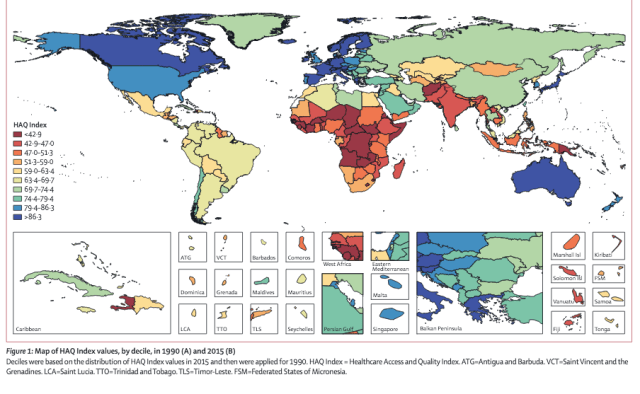
As might be expected, many highly developed nations, such as Norway, Australia and Canada, scored well. Those in more-remote areas in sub-Saharan Africa, South Asia, Latin America and the Caribbean scored poorly. In the map below, the higher the health-care quality index, or HAQ, the better the level of care, according to the study.

The world’s superpower doesn’t rank where you might expect it to. The United States scores an 80 on the index, which is at the bottom of the second decile and puts it on par with Estonia and Montenegro.

The United States measures well for diseases preventable by vaccines, such as diphtheria and measles, but it gets almost failing grades for nine other conditions that can lead to death. These are lower respiratory infections, neonatal disorders, non-melanoma skin cancer, Hodgkin’s lymphoma, ischemic heart disease, hypertensive heart disease, diabetes, chronic kidney disease and the adverse effects of medical treatment itself.

“America’s ranking is an embarrassment,” according to Murray, who noted that U.S. health spending per person — $9,000 annually — is more than that of any other country.

The study, published in the Lancet on Thursday evening, offers some models that the United States might want to consider to take steps to improve. It highlights a long list of countries, including Peru, South Korea, Niger and Jordan, that have had health-care quality climb since 1990, meeting or surpassing levels of other countries with similar development.

Read more:

Women with advanced breast cancer are surviving longer, study says

Blood tests significantly underestimated lead levels, FDA and CDC warn

‘Internet abortions’ may be safe option where procedure is restricted, study suggests

Posted in Fun, Governance, Health | Comments Off on ‘An embarrassment’: U.S. health care far from the top in global study

Commemoration of Bay Watermen in Chestertown

This from the Kent County News. If you like this, check the wonderful photo book Working the Water by Jay Fleming

http://www.myeasternshoremd.com/spotlight/article_b0f80978-dc76-59f1-9f10-b3ab8767a664.html

Reflecting on the golden age of watermen

By LEANN SCHENKE lschenke@thekentcountynews.com

 Ron Fithian on 'Those Were the Days'

After Hurricane Agnes hit in 1972, though, pollution levels led to a decrease in the Chesapeake Bay’s health and all but ended the “golden age” of the waterman.

In an effort to preserve details about the lifestyle of watermen, Tom McHugh, director emeritus of the Mainstay in Rock Hall, and Ron Fithian, Rock Hall town manager, Kent County Commissioner and former waterman, interviewed 18 watermen and women from Rock Hall and created a documentary.

 “For years, and I mean going back eight or nine years, Ron Fithian and I would sit and talk about the need to get somehow recorded these people who were in what we call the golden age of Rock Hall and working the water,” McHugh said.

McHugh and Fithian shared a few clips from their documentary “Those Were the Days: The Golden Age of Rock Hall Watermen” May 10 at the Chestertown branch of the Kent County Public Library.

“The intent is to get down what was different about that period of time compared to this period of time,” McHugh said. “And by watching even a few samples of these men and women talking, you get a sense of what those differences were.”

The full documentary features the 18 interviews conducted with men and women who worked on the water between 1945 and 1972. McHugh and Fithian originally had the idea to start the project after discussing the need to document the lifestyle of watermen before it disappears completely.

“I can remember at the height of the seafood business, that probably I wouldn’t be exaggerating if I said 75 to 80 percent of the people in Rock Hall made their living working on the water,” Fithian said.

McHugh produced the documentary with Fithian conducting the majority of the interviews and the late Clarence Hawkins conducting a few. Fithian’s experience on the water helped facilitate the flow of the interviews.

Their first attempt at obtaining a grant from Eastern Shore Heritage Inc. was unsuccessful, but on their second try, they received the grant and were able to hire a cinematographer and began conducting interviews.

“The story Tom is trying to tell is how much different it is than it was then and as to where it is now,” Fithian said.

In the documentary, those interviewed tell their stories of working on the water including what type of fishing they did and where. The stories vary from the work of oyster shuckers to chasing rockfish up the Bay.

During the presentation, Fithian and McHugh showed a few minutes of interviews with Larry Simns, James “Pork Chop” Manley, Glenwood Thomas, Syriva Johnson and Jean Sisco. Afterward, Fithian spoke about his time on the water and his outlook on if watermen, and the seafood industry on the Bay, can make a comeback.

“When I first got out of school, a lot of kids sit around and talk about how they don’t know what to do, I knew exactly what I was going to do. I was going to go work on the water,” Fithian said.

 Fithian reflected on the changes the seafood industry has gone through including losing the entirety of the soft shell clamming. Fithian said there was a time when the Bay supplied all of New England’s soft shell clams, but when they spontaneously died out in the mid 1980s the business disappeared.

He also spoke on the ups and downs of the oyster business and if the seafood business in the Bay can eventually return to what it was given conservation efforts.

“So there’s been some real big changes. Will we ever see it come back? I’m not sure about that. I have my doubts to be quite honest with you because it’s changed so much,” Fithian said.

He said it was damage from Hurricane Agnes and the subsequent flooding from the Conowingo Dam after the hurricane that effectively lead to the decline of watermen.

As to how to help the Bay, Fithian said people have a lot to gain from hearing the stories of those who worked on the water and made a living out of it.

“I think that sometimes a little more attention has to be paid to those who lived their life there,” Fithian said.

“Those Were the Days” was shown as part of “The Way We Worked,” the Smithsonian Institution’s traveling exhibit. It is available at all Kent County Public Library locations.

Posted in Chesapeake Bay, Close to Home | Comments Off on Commemoration of Bay Watermen in Chestertown

Key Medical Costs Issue: Indecipherable Medical Bills

Those Indecipherable Medical Bills? They’re One Reason
Health Care Costs So Much

Hospitals have learned to manipulate medical codes — often resulting in mind-boggling bills.

The catastrophe struck Wanda Wickizer on Christmas Day 2013. A generally healthy, energetic 51-year-old, she suddenly found herself vomiting all day, racked with debilitating headaches. When her alarmed teenage son called an ambulance, the paramedics thought that she had food poisoning and didn’t take her to the emergency room. Later, when she became confused and groggy at 3 a.m., her boyfriend raced her to Sentara Norfolk General Hospital in coastal Virginia, where a scan showed she was suffering from a subarachnoid hemorrhage. A vessel had burst, and blood was leaking into the narrow space between the skull and the brain.

During a subarachnoid hemorrhage, if the pressure in the head isn’t relieved, blood accumulates in that narrow space and can push the brain down toward the neck. Vital nerves that control breathing and vision are compressed. Death is imminent. Wickizer was whisked by helicopter ambulance to the University of Virginia Medical Center in Charlottesville, 160 miles away, for an emergency procedure to halt the bleeding.

After spending days in a semi-comatose state, Wickizer slowly recovered and left the hospital three weeks after the hemorrhage, grateful to be alive. But soon after she returned home to her two teenage children, she found herself confronted with a different kind of catastrophe. Wickizer had had health insurance for most of her adult life: Her husband, who died in 2006, worked for the city of Norfolk, which insured their family while he was alive and for three years beyond. After his death, Wickizer worked in a series of low-wage jobs, but none provided health insurance. A minor pre-existing condition — she was taking Lexapro, a common medicine for depression — meant that her only insurance option was to be funneled into the “high-risk pool” (a type of costly insurance option that was essentially rendered obsolete by the Affordable Care Act and now figures in some of the G.O.P. plans to replace it). She would need to pay more than $800 per month for a policy with a $5,000 deductible, and her medical procedures would then be reimbursed at 80 percent. She felt she couldn’t afford that. In 2011, she decided to temporarily stop working to tend to her children, which qualified them for Medicaid; with trepidation, she left herself uninsured.

And so in early 2014, without an insurer or employer or government agency to run interference between her and the hospital, she began receiving bills: $16,000 from Sentara Norfolk (not including the scan or the E.R. doctor), $50,000 for the air ambulance. By the end of January, there was also one for $24,000 from the University of Virginia Physicians’ Group: charges for some of the doctors at the medical center. “I thought, O.K., that’s not so bad,” Wickizer recalls. A month later, a bill for $54,000 arrived from the same physicians’ group, which included further charges and late fees. Then a separate bill came just for the hospital’s charges, containing a demand for $356,884.42 but little in the way of comprehensible explanation.

In other countries, when patients recover from a terrifying brain bleed — or, for that matter, when they battle cancer, or heal from a serious accident, or face down any other life-threatening health condition — they are allowed to spend their days focusing on getting better. Only in America do medical treatment and recovery coexist with a peculiar national dread: the struggle to figure out from the mounting pile of bills what portion of the fantastical charges you actually must pay. It is the sickness that eventually afflicts most every American.

What’s less understood is the extent to which our current medical-billing system itself is responsible for the high prices patients are charged. There are, of course, many factors that have led to the United States’ record-breaking $3 trillion health care bill: runaway drug prices, excessive testing and sky-high charges for even the most basic medical interventions. But all of those individual price increases have been enabled — indeed, aided and abetted — by the complex system of billing and coding that underlies bills like those sent to Wickizer. That system, with its lines of alphanumeric codes and arcane medical abbreviations, has given birth to a gigantic new industry of consultants, armies of back-room experts whom medical providers and insurance companies deploy against each other in an endless war over which medical procedures were undertaken and how much to pay for them. Caught in the crossfire are Americans like Wanda Wickizer, left with huge bills and indecipherable explanations in languages they cannot possibly understand.

Disease-classification systems originated during an outbreak of the bubonic plague in 17th-century London — epidemiologic constructs to classify and track causes of death and prevent the spread of infections among populations that spoke different languages. In the 1890s, the French physician and statistician Jacques Bertillon further systematized death reporting by introducing the Bertillon Classification of Causes of Death, the first medical-coding system, which was adopted and modified in many countries. It became an official global effort, which was periodically revised by an international commission. During the first half of the 20th century, the number of entries naturally increased with improved understanding of science, and many countries began tabulating not just causes of deaths but also the incidence of diseases.

In the 1940s, the World Health Organization took over stewardship of Bertillon’s system and renamed it to reflect a new, broader focus: the International Statistical Classification of Diseases, Injuries and Causes of Death (ICD). The codes became an invaluable tool, a common language for epidemiologists and statisticians to track the world’s afflictions. But over the last several decades in the United States, codes gradually took on a bedrock financial function as the basis for medical billing. In 1979, the government decided to use what by then were called ICD-9 codes — which specify the patient’s diagnosis — in adjudicating Medicare and Medicaid claims, with some modifications added specifically for that purpose; the United States version was called ICD-9-CM. (The country has recently moved to a new iteration, ICD-10-CM.) For its beneficiaries, Medicare pays a fixed fee for inpatient hospitalization based primarily on the ICD-CM code, which is translated into a DRG (diagnosis-related group) code — which is the immediate basis for reimbursement.

Other insurers followed in making codes the basis for billing. Coding systems begot new coding systems, because few hospitals wanted to be paid according to Medicare’s relatively low DRG standards. And because strategic coding meant increased payment, that begot coding specialists and coding courses and coding degrees. There are now different increasingly complex coding languages that define payment for different kinds of services: CPT codes, for office visits delivered by doctors, as well as HCPCS, ICD-PCS-CM and DRG, for charges that are incurred in the hospital. There are tens of thousands of codes in each lexicon that have become increasingly specific. For example, there are different codes for in-office earwax removal depending on the method used (irrigation or instruments), different codes for delivering different vaccinations and a code for each injection delivered in the hospital. Different insurers also use different coding systems. While Medicare would have most likely considered Wickizer’s brain bleed as DRG 021, if billed to a commercial insurer, it could result in more than a dozen ICD codes and hundreds of HCPCS entries.

Seemingly subtle choices about which code to use can have large financial consequences. If after reviewing a hospital chart of, say, a patient who has just had a problem with his heart, a hospital coder indicates the diagnosis code for “heart failure” (ICD-9-CM Code 428) instead of the one for “acute systolic heart failure” (Code 428.21), the difference could mean thousands of dollars. “In order to code for the more lucrative code, you have to know how it is defined and make sure the care described in the chart meets the criterion, the definition, for that higher number,” says one experienced coder in Florida, who helped with Wickizer’s case and declined to be identified because she works for another major hospital. In order to code for “acute systolic heart failure,” the patient’s chart ought to include supporting documentation, for example, that the heart was pumping out less than 25 percent of its blood with each beat and that he was given an echocardiogram and a diuretic to lower blood pressure. Submitting a bill using the higher code without meeting criteria could constitute fraud.

Each billing decision, then, can be seen as a battle of coder versus coder. The coders who work for hospitals and doctors strive to bring in as much revenue as possible from each service, while coders employed by insurers try to deny claims as overreaching. Coders who audit Medicare charts look for abuse to reclaim money or fraud that needs to be punished with fines. Hospital coders teach doctors — and doctors pay to take courses — to learn how they can “upcode” their charts to a more lucrative level with minimal effort. In a doctor’s office, a Level 3 visit (paid, say, at $175) might be legally transformed into a Level 4 (say, $225) by performing one extra maneuver, like weighing the patient or listening to the lungs, whether the patient’s illness required that or not.

While most hospitals and insurers set their own rates for each level of care, adding a step when interacting with a patient can also bring windfalls. E.R. doctors, for example, learned that insurers might accept a higher-reimbursed code for the examination and treatment of a patient with a finger fracture (usually 99282) if — in addition to needed interventions — a narcotic painkiller was also prescribed (a plausible bump up to 99283), indicating a more serious condition.

Toward the end of the 20th century and into the next, as strategic coding increased, a new industry thrived. For-profit colleges offered medical-coding degrees, and internships soon followed. Because alphanumeric coding languages are as distinct from one another as Chinese is from Russian, different degree tracks are necessary, along with distinct professional organizations that offer their own particular professional exams, certifications and licensing. Hospital systems and insurers — which have become huge, Hydra-like enterprises — now all employ roomfuls of coding-program graduates to perform these tasks. Membership in the American Academy of Professional Coders has risen to more than 170,000 today from roughly 70,000 in 2008.

Individual doctors have complained bitterly about the increasing complexity of coding and the expensive necessity of hiring their own professional coders and billers — or paying a billing consultant. But they have received little support from the medical establishment, which has largely ignored the protests. And perhaps for good reason: The American Medical Association owns the copyright to CPT, the code used by doctors. It publishes coding books and dictionaries. It also creates new codes when doctors want to charge for a new procedure. It levies a licensing fee on billing companies for using CPT codes on bills. Royalties for CPT codes, along with revenues from other products, are the association’s biggest single source of income.

Patients with good health insurance are often blissfully unaware and mostly unaffected by the jockeying that goes on over how to code their bills. But uninsured patients like Wickizer, or (increasingly) those with high deductibles, are stuck with no insurer to argue on their behalf. Her experience with the University of Virginia Medical Center is not unique: Studies have shown that hospitals charge patients who are uninsured or self-pay 2.5 times more than they charge those covered by health insurance (who are billed negotiated rates) and three times more than the amount allowed by Medicare. That gap has grown considerably since the 1980s.

Photo

Credit: Illustration by Paul Sahre

When Wickizer arrived home from the hospital in January 2014, she had trouble concentrating and finding words; she spoke deliberately, slowly. She remembers nothing before February, she says, but relied on help from her parents, who live nearby, and her boyfriend, who is retired from the Navy. She did her best to address the onslaught of bills that began appearing in her mailbox.

First, she took stock of her finances. She paid the rent for the Norfolk apartment that she and her children lived in by renting out a townhouse that she and her deceased husband had bought in Virginia Beach; after paying property tax, insurance and maintenance on the townhouse, she just broke even. She also received about $2,000 a month in Social Security survivor benefits because of her husband’s death. In addition, she had about $100,000 from her husband’s life insurance in a retirement account, which she was also hoping would help pay for her children’s college. With medical bills totaling nearly $500,000 and no health insurance, the numbers didn’t add up. “My dad said: ‘They’ll never expect you to pay that,’ ” Wickizer told me. “But they did.”

As a sign of good faith, she quickly paid $1,500 to the hospital and $1,000 to the doctors and sought to make sense of the bills. Patients today are told to be good medical consumers, but they are asked to write checks for thousands of dollars — in this case hundreds of thousands — with little explanation of what they’re for. Wickizer did what she would have done with a credit-card statement: She contacted the hospital and requested an itemized bill. Her idea was that if she could understand how much she was being charged for each procedure, she could compare the fees with the reimbursements that Medicare or another insurer would pay for those services and begin some kind of negotiation.

A month later, on March 19, the hospital finally sent a list of charges, using medical abbreviations and terminology but not revealing the all-important alphanumeric codes. Despite being 60 pages long, the tally seemed incomplete, leaving out doctor’s charges and including other fees that seemed incidental, like charges for catheters, wires and oxygen. Room charges were vastly different on different days.

Nearly simultaneously, she received a one-page bill for the hospital portion of her care, broken down only into the broadest categories, including $111,162 in room charges, $34,755.75 for pharmacy, $19,653 for labs, $8,640 for the operating room, $8,325 for anesthesia, $1,143 for the recovery room, $44,524 for medical supplies and $40,489 for radiology services, totaling $356,884.42. The bill informed her that the medical center was prepared to offer her its standard 20 percent discount for patients who are uninsured, leaving a “what you owe now” fee of $285,507.58. It noted that the hospital could offer some additional financial assistance, but only if her household of three had assets of less than $3,100 (“such as bank or retirement accounts”), which disqualified Wickizer and very likely most Americans who have ever held a job.

Next, she did her best to find out what Medicare or another insurer would have paid for her hospitalization, hoping to offer the hospital that amount from her retirement account. To understand the Medicare codes, she had to learn a bit of coding language. Would her hospitalization count as Medicare DRG 020 or 021? She estimated that in 2013, her subarachnoid hemorrhage (most likely coded, she determined, as “intracranial hemorrhage or cerebral infarction disorders, DRG 021, with procedures and major comorbidities or complications”), would have been reimbursed by Medicare for about $80,000. Had a member of the armed services experienced the same condition, Tricare, the military insurer, might have paid closer to $70,000. But to know how much a commercial insurer would have paid, she would have to figure out what HCPCS codes the hospital used to calculate her bill, and the hospital did not send those. Hospitals tend to treat their billing strategies — codes and their master price list, called a charge master — as trade secrets vital to their business. State laws and judges tend to respect that as proprietary information.

When the billers called insisting on payment of the full $285,507.58, Wickizer explained, “I don’t have this kind of money.” She offered the hospital and its doctors the $100,000 in her retirement account. They declined and suggested that she sign up for a payment plan of $5,000 a month to the hospital — and a second $5,000 plan for the physicians’ group. It was an untenable amount.

In October 2014, a sheriff affixed a summons to Wickizer’s front door, saying that the university was suing her for nonpayment. Eric Swensen, a spokesman for the University of Virginia, declined to answer questions about the case, citing patient privacy, as governed by HIPAA rules. But he noted that the university provides $270 million worth of free care to patients who meet its criterion for assistance and sets up interest-free payment plans for those who don’t.

After receiving the summons, Wickizer resorted to a technique followed by many a frustrated customer: She went on Facebook, posted her story and solicited advice. (The Facebook group Paying Till It Hurts, where she posted her story, was created in 2014 in connection with a New York Times seriesthat I wrote with the same name.) A handful of experts — patient advocates, billing professionals, lawyers and a coder — volunteered their help pro bono to try to get more information from the medical center and translate the coding that yielded the unaffordable figure. (One notable aspect of our commercialized health system is that for every person who is pushing to profit, there is another who is doing his or her best to protect patients.)

In vetting Wickizer’s bill, the experts encountered roadblocks from the medical center at every turn in a contentious battle that lasted for over a year. Multiple legal requests to review Wickizer’s chart and complete bill — with its coding elucidated — were refused. Nora Johnson, a retired hospital bill-compliance auditor from West Virginia who volunteered to help Wickizer, noted that not revealing the billing codes constituted a violation of federal law. No insurer would have paid the bills without seeing them, allowing at least a rational attempt at negotiation. As Wickizer’s team wrote to the University of Virginia in one of their letters: “No Codes = No Pay.” The University of Virginia Physicians’ Group, which independently charged Wickizer $54,000, eventually turned over its billing codes. Wickizer’s experts were able to use the bill fragments they had received in discovery, supplemented by those codes, to get a better idea of what medical procedures Wickizer received during her three-week hospitalization. From there, they tried to extrapolate how the hospital had, perhaps, coded her case. By examining the cost reports the University of Virginia hospital must file with Medicare, which indicate the amount it spends delivering certain types of care, Christine Kraft, another medical-billing expert, estimated that even by its own calculations, the medical center spent less than $60,000 treating Wickizer.

Photo

CreditIllustration by Paul Sahre

The stealth battle between hospitals and insurers over bills for each hospitalization, office visit, test, piece of equipment and procedure is costly for us all. Twenty-five percent of United States hospital spending — the single most expensive sector in our health care system — is related to administrative costs, “including salaries for staff who handle coding and billing,” according to a study by the Commonwealth Fund. That compares with 16 percent in England and 12 percent in Canada.

That discrepancy comes, in part, from the prolonged negotiations over payment and the huge number of coders, billers and collectors who have to be compensated: Their salaries and loans from those years of training in obscure languages are folded into those high charges and rising premiums. In addition, as is often the case in warfare, the big conventional army can be at a disadvantage: The insurance companies and government seem to be always one step behind the latest guerrilla tactics of providers’ coders.

For years, creative coding has been winning over what the government calls “correct coding,” meaning coding that gives providers their due, but without exaggeration. Indeed, each attempt by the government to control questionable coding to enhance providers’ revenue has seemed to only fuel more attempts. In 1996, for example, Medicare’s National Correct Coding Initiative made it clear that certain codes couldn’t appear on the same bill because they were inherently part of the same procedure. As a rule, an anesthesiologist could not, for example, separately bill for anesthesia and checking your oxygen level during your surgery. But the government created Modifier 59 — a code that could be appended to other codes to allow doctors to take exceptions to that rule in unusual cases. Modifier 59 could be used to allow for two payments in certain situations, such as when an oncology nurse needed to insert two separate IVs for two different purposes — one to administer chemotherapy, say, and another hours later because the patient seemed dehydrated. Such cases were expected to be exceedingly rare.

But just as entrepreneurial corporate tax lawyers search each new tax code for economic advantage, entrepreneurial coders and billers find loopholes to exploit at the edge of the law. An investigation by the Health and Human Services Office of the Inspector General in 2005 found many instances of Modifier 59 abuse. Forty percent of code pairs billed with Modifier 59 in 2003 were not legitimate, resulting in $59 million in overpayment. Similarly, when Medicare announced that it would pay only a set fee for the first hour and a half of a chemotherapy infusion — and a bonus for time thereafter — a raft of infusions clocked in at 91 minutes.

Like nearly every area of medicine, coding science has advanced — though not to the patient’s benefit. Commercial computer “encoder” programs maximize income from coding and make helpful suggestions (“That could be billed for Level 3,” or “Did you forget Code 54150,” indicating a circumcision on a bill for a male newborn). Today many medical centers have coders specializing in particular disciplines — joint replacement or ophthalmology or interventional radiology, for example. Advanced coding consultants advise lesser coders. The Business of Spine, a Texas-based consulting firm with a partner office in Long Island, advises spine surgeons’ billers about what coding Medicare and commercial insurers will tolerate, what’s legal and not, to maximize revenue. The evolution of this mammoth growth enterprise means bigger bills for everyone — whether through increasing premiums and deductibles on insurance policies or, as in Wickizer’s situation, depleting the savings earmarked for children’s college.

Like many medical centers, the University of Virginia Health System has turned at least some of its billing and debt collection over to professionals, third-party contractors who have no pretense of the charitable mission espoused by the University of Virginia, founded by Thomas Jefferson in 1819 to educate leaders in public service. The collectors are often paid a percentage of the money they recover. They tend not to care whether a procedure was coded well or poorly. Their task is usually to go after the total sum the hospital says it is owed.

In Wickizer’s case, the hospital brought in a law firm that specialized in debt collection, then called Daniel & Hetzel and based in Winchester, Va. For a year and a half, Wickizer’s team of experts dissected the bills and negotiated with the hospital and its representatives at the law firm over its charges and coding strategies — just as insurers do behind the scenes on patients’ behalf. The experts laid out their logic for what might constitute reasonable payment in a detailed report based on what they could discover about Wickizer’s care: how it could be coded and what other hospitals and insurers would have paid. They helped her local lawyer, Kelly Roberts, write motions for discovery and legal letters and made offers of payment between $65,000 and $80,000, which they calculated should provide the hospital a profit on the services rendered to Wickizer.

But the hospital did not accept any of the offers. In a letter, Peter Hetzel, an attorney at the firm, said his client would accept only just over $225,000, saying the University of Virginia Medical Center was “the victim here.” He noted, too, that the small rental property that Wickizer owned — appraised at $90,200 in 2014 — was considered fair game for the hospital to seize as payment. Swensen, the spokesman for the university, said that it decides on a case-by-case basis whether or not to report nonpayment to credit agencies or to pursue civil cases against patients in court. He added: “If we obtain a lien on real estate, we do not seek to sell the property if it is the patient’s primary residence.”

In February 2016, Wickizer received a letter from the state of Virginia saying that the medical center would be dunning money from any tax refund she might get. At one point, in exasperation, Wickizer wrote to her group of experts: “More than likely I am going to have to declare bankruptcy by the time this is all said and done, and I just would like to have everything settled. I want to pay them what I have and what is fair.”

968COMMENTS

By then, Wickizer was recovering physically and had married her boyfriend. But she was still struggling with stress from the uncertainty of the mammoth bills hanging over her. With court dates scheduled and postponed, motions filed and denied, she and her pro bono lawyer from Chicago, Tom Osran, along with her local lawyer were finally scheduled to face off in court with the University of Virginia Medical Center on April 29, 2016. The day before trial, after Osran was preparing to book his plane ticket to Virginia, and after I called the hospital inquiring about attending the court session, the case was dismissed. The terms of the settlement are sealed.

Nearly a year later, Wickizer remains exhausted by the ordeal. Her speech, which was hesitant when I first spoke with her more than two years ago, sounds fluid now, and she is funny and thoughtful, though she says she still occasionally needs to search to find the right word, a form of a condition known as aphasia. Now working part-time as a clerk in a small store, she would like to go back to her previous work as a bookkeeper, she told me when we spoke in March. But she has failed to secure a job; she worries that her barely noticeable speech problems make her job interviews less than optimal. Or perhaps, she frets, the problem is her credit rating, which (unknown to her at the time) dropped more than 200 points after the doctors who cared for her reported her unpaid bills to credit agencies. That black mark will remain until 2021, even though her legal case is resolved and she now has military health insurance through her husband. And, she notes with a sigh of resignation, “I’m the kind of person who’s always tried to do everything right.”

Posted in Fun | Comments Off on Key Medical Costs Issue: Indecipherable Medical Bills

From the Economist: Foreign AID Foodchain

Great-Barrier-Reef-Food-Web

So the little NGOs get eaten up by the mega-international NGOs like The Nature Conservancy, WWF, etc. . .  and THEY get displaced by the international consultants.

. . . . . and everything just keeps getting better and better. . . .

from the print edition of The Economist for May 6 to 12th, 2017: <http://www.economist.com/news/international/21721635-they-need-diversify-growing-share-aid-spent-private-firms-not-charities>

Doing good and doing well — A growing share of aid is spent by private firms, not charities

But they need to diversify

“THE gold rush is on!” That is how a cable from the American ambassador to Haiti described the descent of foreign firms upon Port-au-Prince in early 2010. An earthquake had flattened the city and killed hundreds of thousands. But a deluge of aid presented an opportunity. The message, released by WikiLeaks, noted that AshBritt, a Florida-based disaster-recovery firm, was trying to sell a scheme to restore government buildings, and that other firms were also pitching proposals in a “veritable free-for-all”.

During the following two years $6bn in aid flooded into a country of 10m people, for everything from rebuilding homes to supporting pro-American political parties. Of $500m or so in aid contracts from the American agency for international development (USAID), roughly 70% passed through the hands of private companies.

Haiti is one example of a trend. Though not all countries break down aid spending according to the type of contractor used, data from those that do suggest that a growing share of aid is funnelled, not through charities or non-profit foundations, but through consultancies and other private-sector contractors that profit from the work. Nearly a quarter of USAID spending in 2016 went to for-profit firms, a share that was two-thirds higher than in 2008. Britain’s Department for International Development (DfID) counts its spending slightly differently: in 2015-16, 22% of bilateral spending (as opposed to money that it paid to multilateral organisations such as the UN) went to contractors, most of them for-profit companies, up from 12% five years earlier.

Typically, firms win aid contracts at auction, rather than receiving grants, as charities do. Some have become global players. Chemonics, an American firm founded in 1975, is active in 70 countries. In 2015 it won a contract for health-care services with USAID worth up to $10.5bn over eight years. Cardno, an Australian firm, won 17% of the country’s contracts last year, worth A$945m ($709m).

One reason for the shift towards the private sector is the changing nature of aid. A smaller share now is made up of traditional projects, such as building schools or handing out food parcels, and more is “technical assistance”, for example to streamline a country’s tax code and strengthen tax collection, or to set up an insurance scheme to help farmers when crops fail. Private firms may be best-placed to advise on, or even run, these schemes.

Another reason is that even as aid budgets have grown, governments have sought to make aid departments smaller and more nimble. Both USAID and DfID have around the same number of employees now as they did when their budgets were just half as large in real terms. As aid agencies struggle to manage contracts, they have turned to the private sector.

Surprisingly little research has been done on the impact of this shift. That is partly because the oversight of aid is often poor. Think-tanks are still trying to work out where all the Haitian disaster-relief funding ended up, for example. And private-sector involvement can further obscure the picture, because the winners of bids may use a host of subcontractors, or insist that some information is kept confidential for commercial reasons.

What is known, though, is that for-profit and non-profit groups work differently. A non-profit body typically has large bureaus in the countries where it works, or forms long-standing partnerships with local charities that do. It will consider whether a proposed project fits with its charitable purpose, and whether it has suitable in-house expertise; only then will it decide whether to bid. Firms, by contrast, tend to have fewer staff, and to rely on subcontractors and freelance experts who can be flown in for as long as a project lasts. Tim Midgley of Saferworld, a charity, argues that this model means that firms may be less likely to understand local cultures, build relationships with governments and monitor long-term results. But it can also be more flexible, with firms matching expertise and staffing to each contract.

Cool aid

To shed light on the shift towards private-sector aid delivery, The Economist has analysed 4,500 subcontracts from USAID worth more than $25,000 each. (All were granted since 2010. Those for which data were not available were excluded.) A third went to for-profit firms, and the rest to charities, NGOs or other governments. For contracts where a firm was the primary contractor, on average 41% of subcontracts went to other firms; when the primary contractor was a non-profit organisation, just 27% did. Around two-fifths of all subcontractors were based in America, although most aid work is done abroad. And four-fifths of them worked with just one primary contractor, suggesting that aid work is carried out largely by stable consortia, rather than shifting alliances.

Not just aid budgets but contracts are growing bigger, says Raj Kumar of Devex, an aid-focused news organisation. One consequence is that only large bidders can stomach the risks. Together with the high cost of preparing bids—as much as $100,000—this has led to market concentration. In Britain ten firms snap up half of all contracts (or lead consortia that do). The top ten account for around the same share of USAID contracts, a much higher share than for other government departments. In Australia they account for 70%.

The sector is consolidating further, as firms seek to expand the number of countries where they have the expertise to bid for contracts, and to run them. Between 2007 and 2015 Tetra Tech, an American firm, bought ARD and DPK, two aid consultancies; Coffey International, an Australian engineering firm; and a handful of smaller Canadian consultancies. Australia’s GRM International merged with America’s Futures Group and later became part of Palladium International, a permanent consortium of six aid firms.

A smaller firm’s best chance to pick up some of this work is to join a consortium led by a larger firm. But it risks becoming mere “bid candy”, as a recent investigation by a British parliamentary committee into DfID’s use of contractors put it, with its expertise used to win a contract, after which the lead contractor keeps the work in-house. The committee also concluded that DfID focused too much on evaluating bids rather than results.

A specific concern is that, like many firms that rely on government contracts, private aid contractors may be prone to revolving-door hiring. Our analysis of data from LinkedIn, a social network, shows that, at six of America’s ten biggest aid contractors, about 5% of listed staff name USAID as their previous employer, a higher share than for any other former workplace. The agency was one of the most common ex-employers at the other four. No wrongdoing may have resulted. But the risks are evident at Adam Smith International, which turned out to have sought to win bids by using proprietary information shared by a former DfID employee who went on to work for the firm.

Another claim is that private firms may skim too much cream from their contracts. Without access to commercial information this is hard to evaluate; however, private firms do seem to pay higher salaries than charities to their top executives. We compared firms that won USAID contracts in the past eight years with data from USAspending, a state website that lists expenditures and the pay of senior staff at some government contractors. Information about wages was available for 135 for-profit firms. For comparison we looked at figures for 346 similar-sized American charities from CauseIQ, a data company. The bosses of the private firms earn on average more than $500,000 a year—more than twice as much as their non-profit peers.

A separate study published in 2014 by Marieke Huysentruyt, then at the London School of Economics, examined 457 DfID contracts from 1999 to 2003. She found that, when controlling for the type of contract, the total personnel costs proposed by non-profit firms were on average just two-fifths those proposed by private firms. What is more, the contracts won by for-profit outfits were more likely to bust their budgets and miss deadlines.

All this suggests that donor governments should improve their bidding procedures and contract management. In the meantime, aid contractors have responded to bad publicity by lobbying harder. In 2016 a group of British aid contractors set up the Centre for Development Results to represent their views and counter unfavourable headlines. In 2011 American contractors started the Council of International Development Companies, which joined forces with an older group dubbed the “Bombay Club” after the Indian restaurant where it first met. It lobbies federal politicians, arguing against aid dollars being given directly to foreign organisations and governments, which would risk cutting its members out.

A more immediate threat to the sector is that aid budgets might fall. President Donald Trump wants to reduce American aid by 28%. Australia’s government started cutting in 2011. Britain’s government has reaffirmed its commitment to spending 0.7% of gross national income on aid—a target long suggested by the UN which Britain is the first big country to meet. Nonetheless, calls to abandon it are growing ever louder.

How to be the change

One way to keep going during leaner times is to bid not only for contracts, but for grants—that is, to do some aid work at cost, without making a profit from it. When USAID funding reached a plateau in 2008, following years of fast growth, a few firms started bidding for more such grants. Take Abt Associates, a firm set up in 1965 that does research and implements aid programmes in nearly 50 countries. In 2008 17% of its revenue from USAID came in the form of grants; by 2016 that share was 31%.

Another opportunity, says Mr Kumar, is to work directly for the governments of countries that have long been aid recipients. Some have started to fund programmes similar to those paid for by donors, such as improving the way their health-care systems are administered. A third option is to expand into the fledgling “corporate-aid” sector. This strand of development work involves multinationals building capacity in poor countries, not principally for philanthropic reasons, but to benefit their businesses. Starbucks, for instance, is training coffee farmers in Rwanda and Ethiopia. Private aid contractors may be well placed to act as consultants to firms keen on such projects, or as brokers between them and local partners.

One estimate puts the total value to firms of such “aid-like” work in developing countries at around $20bn a year, a figure that is expected to rise. Having built their businesses on contracts with Western governments, private aid firms may need to diversify if they are to continue to thrive.

Posted in Fun | Comments Off on From the Economist: Foreign AID Foodchain

“Twitter Bots:” Recreation on-line that’s good for your brain

from the NY Times: <https://www.nytimes.com/2017/04/28/science/twitter-bots-science.html?smid=tw-nytimesscience&smtyp=cur&_r=0>

Photo

An image from the Twitter account @mothgenerator, a bot that generates intricate images of imaginary moths and names them.

Not all Twitter bots are trying to spam, hack or peddle you fake news. Some are works of creativity, programmed to tweet diagrams of imaginary bird migrations or haikus composed of words scavenged from surveys of marine mammals.

I follow Twitter bots for serendipitous notes that take me out of my day, if just fleetingly. There’s comfort in witnessing a narrative take form outside the direct control of humans and oblivious to the breakneck clip of the internet.

Science-themed Twitter bots come in various forms, doling out humor, factual information and galactic perspective. There’s @shark_girls, which casts two geotracked great white sharks as travel writers, quoting from the writings of Virginia Woolf and the poet Hilda Doolittle. There’s @the_ephemerides, which juxtaposes raw images taken by outer planet probes like the Cassini spacecraft with computer-generated poems. There are many more. Below are some of my favorites.

@grow_slow

Nicole He programmed this bot to tweet a photo of her fiddle-leaf fig, a common houseplant, at 10:17 every morning. Over time, you can see the plant birth new offshoots and shuffle its leaves ever so slightly.

“It’s striking how often people tweet encouraging, nice things at the plant about how shiny its leaves are or how fast it’s growing,” wrote Ms. He, a programmer and artist, in an email. “I think I’ve discovered that a humbly tweeting plant is actually the secret to world peace (or at least kindness on Twitter).”

@usinjuries

This bot tweets descriptions of emergency room visits from a government database that tracks about 100 hospitals across the United States.

Its parent, Keith Collins, a reporter at Quartz, emailed that he didn’t expect to laugh out loud when he first looked at the data. But most of the injuries are minor, he said, and there’s something about the way they’re written in the “pithy style of a rushed E.R. doctor.” Noticing a glut of entries about patients who punched walls, he charted the age distribution of wall-punchers and found that 15-year-olds were most prolific.

Many of the bot’s retweets come with comments like “same” or “it’s me,” he said. It “gives us a chance to laugh at ourselves.”

@birdcolourbot

Each tweet from @birdcolourbot is a bird name followed by a swath of colors resembling a paint chip. Each band’s width is determined by the probability of a given bird of that species being that hue.

“I’m red-green colorblind, so I’m interested in color perception and how different people see birds (or anything really),” emailed David L. Miller, the bot’s creator and a statistician with affiliations at the Woods Hole Oceanographic Institution in Massachusetts and the University of St. Andrews in Scotland.

@mothgenerator

Also dedicated to winged creatures, this bot tweets make-believe moths of all shapes, sizes, textures and iridescent colors. It’s programmed to generate variations in several anatomical structures of real moths, including antennas, wing shapes and wing markings.

Another program, which splices and recombines real Latin and English moth names, generates monikers for the moths. You can also reply to the account with name suggestions, and it will generate a corresponding moth.

Inspired by naturalist illustrations, such as those of Ernst Haeckel, the programmers designed their bot to create moths stroke by stroke, with each insect composed of tens of thousands of individual strokes. “At its core, the moth generator is a wildly byzantine drawing machine in the shape of a moth,” said Katie Rose Pipkin, an artist at Carnegie Mellon University who created the bot with Loren Schmidt.

@i_find_planets

“They have discovered a planet. A guinea pig-like creature lives there and creeps through the valleys. It is something of a mystery.” Such are the snapshots offered by Newfound Planets, a bot that tweets about fictional distant worlds.

The human behind it, Charles Bergquist, who directs the public radio program Science Friday, wrote via email that he thinks people enjoy the bot because they yearn to know what it’s like on another planet — “how big it is, might there be water or what might the sunrise look like.”

@unchartedatlas

This bot also tweets about fictional lands, but based on actual erosion science. Martin O’Leary, a glaciologist at Swansea University in Wales, programmed it as part of National Novel Generation Month, a spinoff of National Novel Writing Month that challenges people to write an algorithm that writes a novel (here’s his accompanying novel).

The bot starts with a random initial terrain, then simulates how water would flow over it to create channels, valleys and coastlines. Cities are placed away from each other and near running water, and Dr. O’Leary wrote another program to name the cities.

To him, Twitter bots are a piecemeal form of science outreach. He said a lot of publicly available information about science amounted to, “Look at this amazing thing right now!” But Twitter bots “worm their way into your life, sit there and slowly give you this drip of stuff. They’re gentle.”


Posted in Fun | Comments Off on “Twitter Bots:” Recreation on-line that’s good for your brain

Overseas and International NGO’s Being Handicapped by US-Imposed Restrictions

{The issues discussed in this article about obstacles faced by non-profits working in humanitarian fields in war zones is actually only one aspect of US-inspired and -enforced regulations that affect all manner of non-profit and non-governmental organizations, especially in developing countries, such as small islands in the Caribbean. For example, to comply with US Treasury Department international financial regulations* , non-profit groups in the British Virgin Islands have to comply with hundreds of pages of burdensome regulations and reports to satisfy requirements that the US imposes on the Government of the BVI. A bit much for the local garden club, but that’s where it’s happening these days. Sounds to me like financial bullying by the United States.   bp}

Scrutiny over terrorism funding hampers charitable work in ravaged countries

         April 19   2017
As the Syrian military began laying waste to the city of Aleppo in an offensive to vanquish rebel forces last year, a doctor was at his wit’s end.Anas Moughrabieh was trying to save civilian lives, treating patients remotely via teleconference from his office in Detroit. As people were rushed into the Syrian hospital with grave head injuries, doctors there had run out of hypertonic saline, which relieves pressure in the brain. That and other simple supply shortages led many to die, including children. He looked on helplessly from 6,000 miles away.

Although the hospital was run by the Syrian American Medical Society — a District-based charity that relies on donations — lack of funding wasn’t the issue. And in this case, the brutality of the Syrian regime wasn’t responsible for the supply shortage.

The problem was a U.S. bank.

During the bloody siege, the medical society had tried to wire $80,000 to a vendor in Turkey so its hospitals could stock up on medical supplies. But the U.S.-based bank, in its diligence to ensure the funds weren’t being funneled to overseas terrorists, was holding up the transfer. By the time the money went through six months later, the deadly siege was over.

“Patients on life support cannot be patient,” Moughrabieh said. “They either live or they die.”

The wire transfer delays during last summer’s bloody campaign in Aleppo reflect a broad pattern: At a time of historic humanitarian need, banks are increasingly hesitant to conduct business with charities that work in disaster zones for fear that they could be caught up in funding international terrorism.

Known in charity circles as “derisking,” because banks are seeking to avoid rather than manage risk, the issue has been brewing for about three years, largely as an unintended consequence of stepped-up efforts to counter terrorism financing, charity advocates and finance professionals say.

“The inability to get humanitarian assistance to refugees from political conflicts or natural disasters can result in death from starvation, exposure, and disease,” concluded a 2016 report from the World Bank. “The elderly and the young are particularly hurt by de-risking and are literally dying as a result.”

Two-thirds of all U.S. charities that work abroad are reporting difficulties accessing financial services because of the banking trend, according to one of two new studies that show for the first time the scope of the impact the banking trend has had on aid providers working in catastrophe zones.

“I was surprised,” said Kay Guinane, director of the D.C.-based Charity & Security Network, which represents nonprofit groups working in crisis regions and issued one of the new reports. “I don’t think any of us had any idea how big a problem this really is until we got this data.”

The other report, released last month by Duke Law’s International Human Rights Clinic and the Netherlands-based Women Peacemakers Program, found that institutional donors such as Western governments and large foundations — as well as banks — are increasingly neglecting human-rights organizations that focus their work on women’s issues and operate in areas such as Syria and Iraq.

One such grass-roots group provides secular education to children in Syria to counteract Islamic State schools.

“Women’s rights and their defenders are really often caught in the crosshairs of these very risk-averse banks and overzealous regulatory authorities,” said Jayne Huckerby, a Duke University law professor and an author of the study.

The world is facing its worst humanitarian crisis since World War II, with the United Nations estimating that 65 million people have been displaced by climate change and war and that 20 million are in danger of starvation.

Drought and famine are plaguing Somalia, Nigeria and South Sudan. A Saudi-led blockade of goods is starving innocents in Yemen. The Syrian government has been blocking aid deliveries to its own people and this month allegedly killed at least 80 civilians in a chemical attack.

The derisking trend also has prompted recent closures of orphanages in Lebanon and Sudan, has cut off relief for persecuted minorities in Burma and has terminated school programs for students in Afghanistan, according to the Charity & Security Network report.

Delays, fees, closures

Funded by the Bill and Melinda Gates Foundation, the Charity & Security Network report asserts that it is the first comprehensive empirical study on the impact that bank derisking has had on nonprofit organizations.

The 305 charities surveyed said they experienced delays in wire transfers, requests for unusual additional documentation, increased fees and account closures.

The issue stems from well-intended efforts to tighten controls on terrorism financing in the wake of the Sept. 11, 2001, attacks. Since then, the U.S. Treasury Department has labeled nine U.S. charities as supporters of terrorism and has designated 54 worldwide.

No U.S. charity has been put on a terrorist list since 2009, but the report contends that at least 5,875 of the roughly 8,665 U.S. charities that work overseas have been adversely affected by banking behavior aimed at disrupting terrorism. [But bear in mind that 10’s of thousands of overseas DOMESTIC NGOs — in developing countries — are now also being affected by FATF regulations enforced on them.]

One District-based charity, which works to promote gender equality in sub-Saharan Africa, Latin America, Lebanon and elsewhere, was hit when Citibank froze its accounts on March 10.

“Our checks have started to bounce,” said an executive, who asked that the charity not be publicly identified out of fear of retribution that could further stall its efforts. “We are working for the betterment of people’s lives in the world. We’re not doing arms trade, or something horrible like that. I am almost beside myself with frustration.”

Sue Eckert, lead author of the Charity & Security Network study and an expert on the intersection of economics and national security, said the fundamental nature of terrorist financing is changing in part because of the bank-led crackdown on traditional cash streams.

“It’s by and large not coming through the formal channels now,” she said, noting that Islamic State funds now often “derive from their physical control of territory — from oil, sale of antiquities, and taxation and extortion, including kidnapping for ransom.”

Bank associates acknowledge the problem. Rob Rowe, a vice president at the American Bankers Association, said the chaos wrought by civil war in Somalia, for example, has left bankers feeling blind.

“Unfortunately, banks just can’t send funds,” he said. “They look at it and say, ‘We can’t make the distinction between a charity that’s trying to get money to a starving family versus one that is ready to go out and buy a stockpile of Uzis to fire on civilians. We don’t have enough information, we can’t make that call, and if we make the wrong guess, we’re the ones that are in trouble.”

 The financial sector has been spooked by a spate of high-profile fines. HSBC — Britain’s biggest bank — was fined nearly $2 billion in 2012 after a U.S. Justice Department probe found its controls for money-laundering inadequate. Paris-based BNP Paribas bank was fined nearly $9 billion in 2014 for violating sanctions against Sudan, Cuba and Iran.

BNP, as one example, was accused among other things of stripping information from wire transfers so they could pass through the U.S. system without raising red flags.

‘We cannot continue’

On occasion, even established charities have had their accounts closed. It happened to the Syrian American Medical Society in early 2015, more than a year before its wire-transfer debacle during the Aleppo siege in summer 2016. In February 2015, Chase Bank closed the society’s account with little explanation. JPMorgan Chase’s media relations department declined to comment,

“During that period of freezing, we weren’t able to wire money; we weren’t able to pay our staff in the U.S.,” said Randa Loutfi, a pediatrician and the organization’s director of programs.

Society officials scrambled to find a new bank. Large financial institutions politely declined, Loutfi said. She believes the word “Syria” in the title of her organization immediately made banks wary.

“We show them the license that we work under from the government,” she said. “Still, many banks were scared. They start the process and then, ‘Sorry, we cannot continue.’ ”

It took months for the organization — which treated roughly 1.4 million Syrians in 2014 alone — to get its finances back in order. The charity wound up splitting its money among three smaller banks from the Midwest.

Another U.S.-based group, Syria Relief & Development, which runs about 30 hospitals in Syria and has a shelter program for Syrian refugees in Jordan, has had its accounts closed by five different banks since 2015. Mais Balkhi, the Kansas-based organization’s advocacy and outreach manager, said dealing with banks has been one of the group’s biggest challenges.

“We’re having more attacks, people are dying, but we are sometimes unable to help because banks are closing accounts and delaying transactions,” Balkhi said.

‘Particularly vulnerable’

Much of the focus on charities as potential fronts for terrorism centers on a simple phrase: “Particularly vulnerable.”

Helping to create the mistrust of charities after Sept. 11 was a highly influential but little-known intergovernmental organization called the Financial Action Task Force, an advisory panel that formed in 1989 to combat money laundering. Immediately after the attacks, the purview of the global task force expanded to terrorist-financing concerns and it deemed nonprofit organizations “particularly vulnerable” to terrorist abuse.

In June 2016, recognizing the harm to charities caused by that designation, the Financial Action Task Force removed it. But the manual used by state and federal bank examiners in the United States who investigate banks for ethical and legal lapses still reflects the old standard, charity advocates say.

Bank derisking isn’t always the most pressing problem plaguing aid givers in crisis-ravaged countries, where they are putting their lives on the line to help. In 2016, 14 doctors working with the Syrian American Medical Society were killed in combat zones, mostly when bombs fell on hospitals.

But the banking woes compound the problems.

“It’s silly to add the money issue to all the other challenges,” Loutfi said. “We already have enough challenges.”

-+-+-+-+-+-+-+-+-+-+-+-+-+-+-+-+-+-+-+-+-+-+-+-+-+-+-+
*As enforced through the Financial Action Task Force (on Money Laundering — FATF), also known by its French name, Groupe d’action financière (GAFI), is an intergovernmental organization founded in 1989 on the initiative of the G7 to develop policies to combat money laundering. In 2001 the purpose expanded to act on terrorism financing. It monitors countries’ progress in implementing the FATF Recommendations by ‘peer reviews’ (‘mutual evaluations’) of member countries. The FATF Secretariat is housed at the headquarters of the OECD in Paris — by Wikipedia]
Posted in Development, Finance Services, Governance, Small Island | Comments Off on Overseas and International NGO’s Being Handicapped by US-Imposed Restrictions

As Coral Reefs Die . . .

An important article from the Washington Post: <https://www.washingtonpost.com/news/energy-environment/wp/2017/04/20/as-coral-reefs-die-huge-swaths-of-the-ocean-floor-are-vanishing-with-them/?utm_term=.f5d3a0d92067>

As coral reefs die, huge swaths of the seafloor are deteriorating along with them

April 20 at 9:00 AM

U.S. government scientists have found a dramatic impact from the continuing decline of coral reefs: The seafloor around them is eroding and sinking, deepening coastal waters and exposing nearby communities to damaging waves that reefs used to weaken.

The new study, conducted by researchers with the U.S. Geological Survey, examined reefs in Hawaii, the Florida Keys and the U.S. Virgin Islands, finding seafloor drops in all three locations. Near Maui, where the largest changes were observed, the researchers found that the sea floor had lost so much sand that, by volume, it would be the equivalent of 81 Empire State Buildings.

“We knew that coral reefs were degrading, but we didn’t really know how much until we did this study,” said USGS oceanographer Kimberly Yates, the lead study author. “We didn’t really realize until now that they’re degrading enough that it’s actually affecting the rest of the seafloor as well.”

Yates conducted the study with two other geological survey researchers and a researcher with Cherokee Nation Technologies. The work was published Thursday in the journal Biogeosciences.

Coral reefs naturally generate sand as hard coral skeletons die, and their calcium carbonate bodies become the next layer of the seafloor. Meanwhile, the living tops of coral columns grow taller and taller, which allows them to keep pace in eras of rising seas.

But as corals are subjected to more and more assaults from a combination of global climate change, local pollution and direct human-caused damage, this natural dynamic appears to have been undermined, and seafloor accretion has swung to erosion.

When corals stop growing fast enough, and when they stop making those big skeletons, you also lose that supply of sand to the rest of the seafloor, and you lose that supply of sand to the beaches,” said Yates.

The exhaustive study started with old nautical charts, dating as far back as the 1930s in some cases, that listed seafloor depths in the vicinity of reefs. Then the scientists remeasured depths in the present.

And they found that averaged across the three areas they studied, the seafloor dropped from between 0.3 feet and 2.62 feet. At extremes, losses in specific places exceeded 13 feet.

These numbers are particularly striking when considered in the context of today’s rising seas. While the current rate of sea level rise is estimated at a little above 3 millimeters per year, the study calculated seafloor elevation loss rates that were sometimes double that — or even higher in Maui, which saw the greatest losses.

The upshot is that natural reef growth in these areas will not be able to keep up with sea level rise — rather, the reefs will fall well behind it, and coastal waters will grow deeper and deeper. In fact, they already have.

“Erosion of coral reefs and seafloor is happening much more and much faster than what was previously known or expected, enough so that it’s affecting those local sea level rises,” said Yates. “Enough so that it increases the risk to the coastlines from coastal hazards, storm waves, every day persistent waves, tsunamis and those kinds of things.”

The authors caution that these findings apply only to their study areas for U.S. coral reefs in Florida, Hawaii and the Virgin Islands. Globally, similar processes may well also be afoot — reefs across the world are generally threatened. But there could also be local processes that act very differently in other places.

They also warn that they can’t attribute seafloor changes to any one cause — or even to multiple ones. From hurricane wave action to coral collapses, many factors change the elevation of the seafloor.

Still, the researchers are convinced that the findings represent a risk to coastal communities in regions that experience major hurricane strikes.

“Think of the reefs as kind of natural speed bumps,” said David Zawada, one of the study’s co-authors and also an oceanographer with the U.S. Geological Survey. “Take that away, this wave energy, more of it is going to be able to migrate in closer to shore.”

“This is a critically important study, which shows that we are not only losing living corals but also that reefs are being eroded away around the world,” said Michael Beck, lead marine scientist at the Nature Conservancy, which has a program to study and protect Florida’s enormous reef tract, which is the third largest of its kind in the world. Beck was not involved in the study.

“Effectively, seas are not just rising but reefs are sinking and with them the many benefits they provide including flood protection to communities around the world. Their study points to why it is so urgent to act now to improve reef health through conservation and restoration.”

There is a recurrent motif that you can now detect in climate change studies when researchers are delivering weighty findings. They often invoke the “Anthropocene,” or the idea that we’re entering a new geologic epoch brought on by human alterations to the planet.

“The magnitude of reef volume lost due to erosion provides evidence for the onset of an Anthropocene reef crisis similar to ancient reef crises caused by climate change and marked in the geologic record by regional and global declines in reef volume,” the authors write.

[We urge you to check the latest comments on this article, AND the original article in Biogeosciences.]


Posted in Uncategorized | Leave a comment