Makes Me Feel Dumb(er)

This one short article has more words that are totally foreign to me than I usually encounter in a week:

Wordnik Word of the Day for August 29, 2016

vaticinate

To prophesy; to foretell; to practice prediction; to utter prophecies.

Paul, I vaticinate that the mansuetude of your response will bring out the best of my muliebrity.
Save the language! « Write Anything

You may see my attitude as defensive and oppugnant, but I vaticinate further derogation of our incomparable tongue should such complots be permitted to unfold without denunciation.
Archive 2008-10-01

Semblably Titus Livius writeth that, in the solemnization time of the Bacchanalian holidays at Rome, both men and women seemed to prophetize and vaticinate, because of an affected kind of wagging of the head, shrugging of the shoulders, and jectigation of the whole body, which they used then most punctually.
Five books of the lives, heroic deeds and sayings of Gargantua and his son Pantagruel

I am reassured, however, by the reflection that I am not expected to look into the future and vaticinate.
A Royalist Fiasco

But Gwyneth and I are not uncomfortably provided for, and I no longer contribute paragraphs of gossip to the Pimlico Postboy, nor yet do I vaticinate in the columns of the Tipster.
In the Wrong Paradise

The word ‘vaticinate’ comes from the Latin ‘vāticinātus’, from ‘vāticinor’ (“foretell, prophesy”).

Read this word of the day in your browser »
See this entry on Wordnik »
Forwarded this email by a friend? Subscribe for yourself here.

Posted in Uncategorized | Leave a comment

A Favorite Theme: They’re Killing the Non-Profits

from the Stanford Social Innovation Review <http://ssir.org/articles/entry/the_nonprofit_starvation_cycle&gt;

Philanthropy

The Nonprofit Starvation Cycle

A vicious cycle is leaving nonprofits so hungry for decent infrastructure that they can barely function as organizations—let alone serve their beneficiaries. The cycle starts with funders’ unrealistic expectations about how much running a nonprofit costs, and results in nonprofits’ misrepresenting their costs while skimping on vital systems—acts that feed funders’ skewed beliefs. To break the nonprofit starvation cycle, funders must take the lead.

Why do nonprofits and funders alike continue to shortchange overhead? To answer this question, we studied four national nonprofits that serve youth. Each organization has a mix of funding, including monies from government, foundation, and individual sources. We also interviewed the leaders and managers of a range of nonprofit organizations and funders, as well as synthesized existing research on overhead costs in the nonprofit sector.

Our research reveals that a vicious cycle fuels the persistent underfunding of overhead.1 The first step in the cycle is funders’ unrealistic expectations about how much it costs to run a nonprofit. At the second step, nonprofits feel pressure to conform to funders’ unrealistic expectations. At the third step, nonprofits respond to this pressure in two ways: They spend too little on overhead, and they underreport their expenditures on tax forms and in fundraising materials. This underspending and underreporting in turn perpetuates funders’ unrealistic expectations. Over time, funders expect grantees to do more and more with less and less—a cycle that slowly starves nonprofits.

Although several factors drive the cycle of nonprofit starvation, our research suggests that taking action at the first stage—funders’ unrealistic expectations—could be the best way to slow or even stop the cycle. Changing funders’ expectations, however, will require a coordinated, sector-wide effort. At a time when people need nonprofit services more than ever and when government is increasingly turning to nonprofits to solve social problems, this effort is necessary to keep nonprofits healthy and functioning.

Funders’ Unrealistic Expectations

The nonprofit starvation cycle is the result of deeply ingrained behaviors, with a chicken-and-egg-like quality that makes it hard to determine where the dysfunction really begins. Our sense, however, is that the most useful place to start analyzing this cycle is with funders’ unrealistic expectations. The power dynamics between funders and their grantees make it difficult, if not impossible, for nonprofits to stand up and address the cycle head-on; the downside to doing so could be catastrophic for the organization, especially if other organizations do not follow suit. Particularly in these tough economic times, an organization that decides—on its own—to buck the trend and report its true overhead costs could risk losing major funding. The organization’s reputation could also suffer. Resetting funder expectations would help pave the way for honest discussions with grantees.

Many funders know that nonprofit organizations report artificially low overhead figures, and that the donor literature often reflects grossly inaccurate program ratios (the proportion of program-related expenses to indirect expenses). Without accurate data, funders do not know what overhead rates should be. Although for-profit analogies are not perfect for nonprofits, they do provide some context for thinking about how realistic—or not—average overhead rates in the nonprofit sector are. Overhead rates across for-profit industries vary, with the average rate falling around 25 percent of total expenses. And among service industries— a closer analog to nonprofits—none report average overhead rates below 20 percent.

In the absence of clear, accurate data, funders must rely on the numbers their grantees report. But as we will later discuss, these data are riddled with errors. As a result, funders routinely require nonprofits to spend unhealthily small amounts on overhead. For instance, all four of the youth service organizations that we studied were managing government contracts from local, state, and federal sources, and none of the contracts allowed grantees to use more than 15 percent of the grant for indirect expenses (which include operations, finances, human resources, and fundraising).

Some foundations allot more money for indirect costs than do government agencies. Yet foundations are quite variable in their indirect cost allowances, with the average ranging from 10 percent to 15 percent of each grant. These rates hold true even for some of the largest, most influential U.S. foundations. And foundations can be just as rigid with their indirect cost policies as government funders.

Many times, the indirect allowances that grants do fund don’t even cover the costs of administering the grants themselves. For example, when one Bridgespan client added up the hours that staff members spent on reporting requirements for a particular government grant, the organization found that it was spending about 31 percent of the value of the grant on its administration. Yet the funder had specified that the nonprofit spend only 13 percent of the grant on indirect costs.

Most funders are aware that their indirect cost rates are indeed too low, finds a recent Grantmakers for Effective Organizations (GEO) study. In this national survey of 820 grantmaking foundations, only 20 percent of the respondents said that their grants include enough overhead allocation to cover the time that grantees spend on reporting.2

Individual donors’ expectations are also skewed. A 2001 survey conducted by the Better Business Bureau’s Wise Giving Alliance found that more than half of American adults felt that nonprofit organizations should have overhead rates of 20 percent or less, and nearly four out of five felt that overhead spending should be held at less than 30 percent. In fact, those surveyed ranked overhead ratio and financial transparency to be more important attributes in determining their willingness to give to an organization than the success of the organization’s programs.

Not only do funders and donors have unrealistic expectations, but the nonprofit sector itself also promotes unhealthy overhead levels. “The 20 percent norm is perpetuated by funders, individuals, and nonprofits themselves,” says the CFO of one of the organizations we studied. “When we benchmarked our reported financials, we looked at others, [and] we realized that others misreport as well. One of our peer organizations allocates 70 percent of its finance director’s time to programs. That’s preposterous!”

In this context, nonprofits are reluctant to break ranks and be honest in their fundraising literature, even if they know that they are fueling unrealistic expectations. They find it difficult to justify spending on infrastructure when nonprofits commonly tout their low overhead costs. For example, Smile Train, an organization that treats children born with cleft lip and palate conditions, has claimed that “100 percent of your donation will go toward programs … zero percent goes to overhead.” Nevertheless, the fine print goes on to say that this is not because the organization has no overhead; rather, it is because Smile Train uses contributions from “founding supporters” to cover its nonprogram costs.

This constellation of causes feeds the second stage in the nonprofit starvation cycle: pressure on nonprofits to conform to unrealistic expectations. This pressure comes from a variety of sources, finds the Nonprofit Overhead Cost Study. The survey found that 36 percent of respondents felt pressure from government agencies, 30 percent felt pressure from donors, and 24 percent felt pressure from foundations.3

Underfed Overhead 

In response to pressure from funders, nonprofits settle into a “low pay, make do, and do without” culture, as the Nonprofit Overhead Cost Study calls it. Every aspect of an organization feels the pinch of this culture. In our consulting work with nonprofits, for example, we often see clients who are unable to pay competitive salaries for qualified specialists, and so instead make do with hires who lack the necessary experience or expertise. Similarly, many organizations that limit their investment in staff training find it difficult to develop a strong pipeline of senior leaders.

These deficits can be especially damaging to youth-serving organizations, notes Ben Paul, president and CEO of After-School All-Stars, a Los Angeles-based nonprofit organization that provides after-school and summer camp programs for at-risk youth nationwide. “It is clear to anyone who has led an organization that the most important capital in a company is the human capital,” says Paul. “In after-school we have a saying: Kids come for the program, but stay for the staff. If we don’t hire the right people, we might as well not run after-school programs.”

Meanwhile, without strong tracking systems, nonprofits have a hard time diagnosing which actions truly drive their desired outcomes. “The catch-22 is that, while organizations need capacity-building funding in order to invest in solid performance tracking, many funders want to see strong program outcome data before they will provide such general operating support,” says Jamie McAuliffe, a portfolio manager at the New York-based Edna McConnell Clark Foundation.

Take the case of a well-respected network of youth development programs. To protect the identity of this organization, we will call it the Learning Goes On Network (LGON). Poised for a huge growth spurt, LGON realized that its data systems would be hopelessly inadequate to accommodate more clients. An analysis showed that program staff spent 25 percent of their time collecting data manually. One staff member spent 50 percent of her time typing results into an antiquated Microsoft Access database.

Staff members can become so accustomed to their strained circumstances that they have trouble justifying even much-needed investments in overhead, our interviews revealed. “We [had] known for a long time that a COO was vital to our growth but [hadn’t] been able to fund one,” relates the CEO of one of the four youth development organizations that we studied. But when his organization’s board finally created the COO position, the rest of the staff resisted. “They had lived so long in a starved organization that the idea of hiring a COO was shocking to them.”

Misleading Reporting

The final driver of the cycle that starves nonprofit infrastructure is nonprofits’ routine misrepresentation of how much they actually spend on overhead. The numbers that nonprofits report on their financial statements “[defy] plausibility,” finds the Nonprofit Overhead Cost Study. Upon examination of more than 220,000 nonprofit organizations, researchers found that more than a third of the organizations reported no fundraising costs whatsoever, while one in eight reported no management and general expenses. Further scrutiny found that 75 percent to 85 percent of these organizations were incorrectly reporting the costs associated with grants.

Our study of the four youth-serving nonprofits likewise reported discrepancies between what nonprofits spent on overhead and what they reported spending. Although they reported overhead rates ranging from 13 percent to 22 percent, their actual overhead rates ranged from 17 percent to 35 percent.

Many factors support this underreporting of nonprofit costs. According to a survey conducted by The Chronicle of Philanthropy in 2000, a majority of nonprofits say that their accountants advised them to report zero in the fundraising section of Form 990.4 Limited surveillance of nonprofits’ Form 990 tax reports only exacerbates the problem: The IRS rarely levies the $50,000 penalty for an incomplete or inaccurate return, and generally applies it only when an organization deliberately fails to file the form altogether. According to the Chronicle study, “Improperly reporting these expenses is likely to have few, if any, consequences.”

The IRS’ ambiguous instructions likewise lead to error, report several sources. For example, nowhere does the IRS explicitly address how to account for nonprofit marketing and communications. As a result, many organizations allocate all marketing and communications expenses to programs when, in most cases, these expenses should be reported as administrative or fundraising overhead.

Government agencies likewise have varying and ambiguous definitions of indirect costs. The White House Office of Management and Budget, for example, defines indirect costs as “those that have been incurred for common or joint objectives and cannot be readily identified with a particular final cost objective.” It then goes on to say that “because of the diverse characteristics and accounting practices of nonprofit organizations, it is not possible to specify the types of cost that may be classified as indirect cost in all situations.”5

There is some good news. Currently, the U.S. Government Accountability Office (GAO) is conducting a study of various federal grantors’ definitions of indirect costs. As Stan Czerwinski, the director of strategic issues for GAO, explains, “The goal is to achieve consistency, so that when nonprofits go in for funding, they have clarity (as do funders) about what they’re actually going to get reimbursed for.” The study is in the early stages, but as Czerwinski notes, the need is clear: “We don’t find anybody telling us that we’re barking up the wrong tree.”

Proper Care and Feeding

Although the vicious cycle of nonprofit starvation has many entry points and drivers, we believe that the best place to end it is where it starts: Funders’ unrealistic expectations. Foundations and government funders must take the lead because they have an enormous power advantage over their grantees. When funders change their expectations, nonprofits will feel less need to underreport their overhead. They will also feel empowered to invest in infrastructure.

The first step that funders should take is to shift their focus from costs to outcomes. In the nonprofit world, organizations are so diverse that they do not share a common indicator of program effectiveness. In the absence of this indicator, many funders try to understand an organization’s efficiency by monitoring overhead and other easily obtained yet faulty indicators. Funders need to refocus their attention on impact by asking “What are we trying to achieve?” and “What would define success?” In so doing, they will signal to their grantees that impact matters more than anything else. Even focusing on approximate or crude indicators (for example, “Are we getting an A or a C on our impact goals?”) is better than looking at cost efficiencies, as focusing on the latter may lead to narrow decisions that undermine program results.

Funders must also clearly communicate their program goals to their grantees. Having established that funder and grantee share the same goals, funders should then insist on honest answers to the question “What will it take to deliver these outcomes consistently, or to deliver these outcomes at an even higher level of quality or quantity?”

One of our study participants, for instance, worked closely with its major funder to think through this question, and ultimately determined it needed a sizable investment in technology to support its projected growth. The funder agreed that only by making such an investment would the organization be able to track outcomes uniformly and to make program improvements quickly.

When feasible, funders should help meet grantees’ identified infrastructure needs by making general operating support grants. Grantmakers and nonprofits agree that more operating support is very likely to improve an organization’s ability to achieve results, finds the 2008 Grantmakers for Effective Organizations study. And a 2006 CompassPoint Nonprofit Services study of nearly 2,000 nonprofit executives in eight metropolitan areas reveals that receiving general operating support played a major role in reducing burnout and stress among executive directors.6 Yet although 80 percent of the foundations in this study made some general operating grants, they dedicated a median of only 20 percent of their grant dollars to this kind of support.

Regardless of the type of support they provide, funders should encourage open, candid discussions with their grantees about what the latter need to be effective. Many funders’ grantmaking processes are not set up to consider the full scope of what grantees do, and why. As a result, their grants are not as flexible as they need to be. Yet when funders fully understand their grantees’ operations, they are more likely to meet their grantees’ needs.

Although changing their expectations will have the greatest impact on the nonprofit starvation cycle, funders can also intervene in other useful ways. When making use-restricted grants, funders should commit to paying a greater share of administrative and fundraising costs. Indeed, in 2004, the board of the Independent Sector encouraged funders to pay “the fair proportion of administrative and fundraising costs necessary to manage and sustain whatever is required by the organization to run that particular project.”

Likewise, rather than prescribing an indirect expense rate for all grants, government funders should allow nonprofits to define their true overhead needs in grant applications and, so long as these needs are justifiable, pay for them. For example, some federal funding contracts allow a nonprofit to justify an indirect cost rate (within guidelines), which the organization can then use for all its federal grant applications. Extending such a policy to all federal, state, and local government contracts would go a long way toward helping nonprofits deliver better programs while being able to pay for their grants’ management.

Finally, to foster transparent and accurate reporting, funders should encourage the development of a standard definition of the term overhead. Currently, organizations have to report their overhead differently for nearly every grant that they receive. Standardization would allow funders to compare apples with apples, as well as allow grantees to understand better their own overhead investments—or lack thereof. Having a dialogue about real overhead rates could also help shift the focus to the real target: outcomes.

What Grantees Can Do

The burden of breaking the cycle of nonprofit starvation does not rest solely with funders. Nonprofit leaders also play a role. As a baseline task, they should commit to understanding their real overhead costs and their real infrastructure needs. At LGON, for instance, senior managers spent several months digging into their costs, analyzing their current systems—including the organization’s subpar tracking process—and identifying gaps in capacity. After this strategic planning process, the organization could articulate a clear plan for a new tracking system and a 150 percent increase in nonprogram staff over three years.

Nonprofits must then speak truth to power, sharing their real numbers with their boards and then engaging their boards’ support in communicating with funders. Case studies of organizations that have successfully invested in their own infrastructure have repeatedly noted the need for a shared agenda between the leadership team and the board. The executive director of LGON, for example, communicated early and often with her board members throughout the strategic planning process. She also facilitated several meetings to address infrastructure needs.

For their part, board members should ask the tough questions before funders do, namely: “What does this organization really need to succeed?” “Where are we underinvesting?” and “What are the risks we’re taking by underinvesting in these areas?” Board members should encourage nonprofit leaders to develop strategies that explicitly recognize infrastructure needs. In developing plans for infrastructure, board members can help, notes Chris Brahm, chairman of the board of directors at Larkin Street Youth Services, a San Francisco nonprofit that serves homeless and runaway youth: “The people running agencies are often consumed with programs and raising money. Board members, whether businesspeople or otherwise, can bring external perspective on overhead services.”

At LGON, for example, the executive director identified a handful of board members who were fervent supporters of the emerging strategic vision. These board members then communicated to their colleagues how much overhead this vision would require.

During these discussions, both board members and managers should focus on how investments in infrastructure will benefit the organization’s beneficiaries, rather than reduce costs. Even within the confines of a “cost conversation,” they should emphasize how infrastructure investments may actually reduce the costs of serving beneficiaries over time. One organization in our study, for instance, determined that an investment in technological infrastructure yielded $350,000 per year by freeing up staff time and consolidating “scrappy” systems.

Finally, organizations must attempt to educate their donors. “Donors don’t want to pay for an organization’s rent, or phone bill, or stamps,” notes Paul, “but those are essential components of everyday work. You can’t run a high-performing organization from your car. And there are many ways to explain these types of expenses to donors.”

Both funders and grantees are feeling the sting of the current recession. But this economic downturn is no excuse to cut overhead funding. “If a nonprofit’s leaders are feeling as if they cannot raise money to support overhead, I think they’re confusing the issue,” says Brahm. “The real issue is that they can’t raise enough money, period. Either they do not have, or they have not been able to communicate, a results story that is compelling to funders.”

Rather than being the reason to reduce overhead spending, the recession is an excellent opportunity to redress decades-long underinvestment in nonprofit infrastructure. “There is real potential for change if all of the major stakeholders—government, private funders, and the nonprofits themselves—take steps to acknowledge that capacity building is critical to the health of an organization,” says McAuliffe. And although the forces that fuel the nonprofit starvation cycle are strong, the opportunity to achieve more for beneficiaries in the long term should compel funders and grantees alike to stop the cycle.

Former Bridgespan Group manager William Bedsworth contributed to this article. 

Notes

  1. See also Kennard Wing, Tom Pollak, and Patrick Rooney, How Not to Empower the Nonprofit Sector: Under-Resourcing and Misreporting Spending on Organizational Infrastructure, Washington, D.C.: Alliance for Nonprofit Management, 2004. Wing, Pollak, and Rooney are three of the lead researchers on the Nonprofit Overhead Cost Study.
  2. William H. Woodwell Jr. and Lori Bartczak, Is Grantmaking Getting Smarter? A National Study of Philanthropic Practice, Washington, D.C.: Grantmakers for Eff ective Organizations, 2008.
  3. Kennard Wing and Mark Hager, Who Feels Pressure to Contain Overhead Costs?, Paper presented at the ARNOVA Annual Conference, 2004.
  4. Holly Hall, Harvy Lipman, and Martha Voelz, “Charities’ Zero-Sum Filing Game,” The Chronicle of Philanthropy, May 18, 2000.
  5. White House Office of Management and Budget, Circular A-122 (Revised): Cost Principles for Nonprofit Organizations. 
  6. Jeanne Bell, Richard Moyers, and Timothy Wolfred, Daring to Lead 2006: A National Study of Nonprofit Executive Leadership, San Francisco: CompassPoint Nonprofit Services, 2006.

Ann Goggins Gregory is the director of knowledge management at the Bridgespan Group and a former consultant in Bridgespan’s strategy area. In her consulting work, Ann’s clients included education and youth development organizations, as well as foundations.

Don Howard is a partner at the Bridgespan Group, where he leads the San Francisco office. His clients have included foundations and nonprofits working to alleviate poverty, end homelessness, revitalize neighborhoods, end inequities in education, and improve the environment.

Tracker Pixel for Entry

Posted in Civil Society, Finance Services | Tagged | Leave a comment

Scary Account of Unknown Plague Affecting East Flower Garden Bank, offshore Texas.

Passed along by Wendy Ann Lee, based on this account in the NOAA Sanctuaries web site. . .

<http://sanctuaries.noaa.gov/news/jul16/noaa-scientists-report-mass-die-off-of-invertebrates-at-east-flower-garden-bank.html>

NOAA scientists report mass die-off of invertebrates at East Flower Garden Bank in Gulf of Mexico

Sanctuary recommends public avoid diving, fishing, boating activities in affected area

By Dr. Steve Gittings, steve.gittings
Chief Scientist, Office of National Marine Sanctuaries

July 2016

A white mat of unknown material coats a dying sponge at the East Flower Garden Bank during a large-scale mortality event. Image: FGBNMS/G.P. Schmahl

On Monday, sport divers on the M/V Fling, diving in the Gulf of Mexico 100 miles offshore of Texas and Louisiana, were stunned to find green, hazy water, huge patches of ugly white mats coating corals and sponges, and dead animals littering the bottom on the East Flower Garden Bank, a reef normally filled with color and marine life. The reef, which is part of Flower Garden Banks National Marine Sanctuary, is considered one of the healthiest anywhere in the region.

The charter captain alerted scientists from the National Oceanic and Atmospheric Administration(NOAA) and Bureau of Ocean Energy Management (BOEM), who were doing annual monitoring work a few hundred yards away on the same reef. The scientists are now reporting that a large-scale mortality event of unknown cause is underway on this bank.

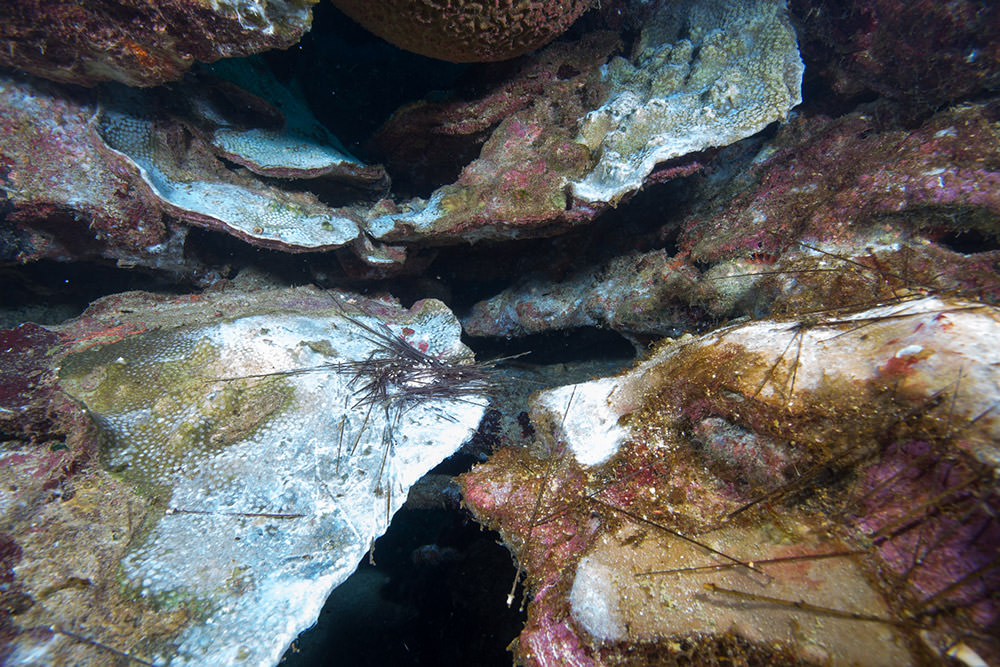
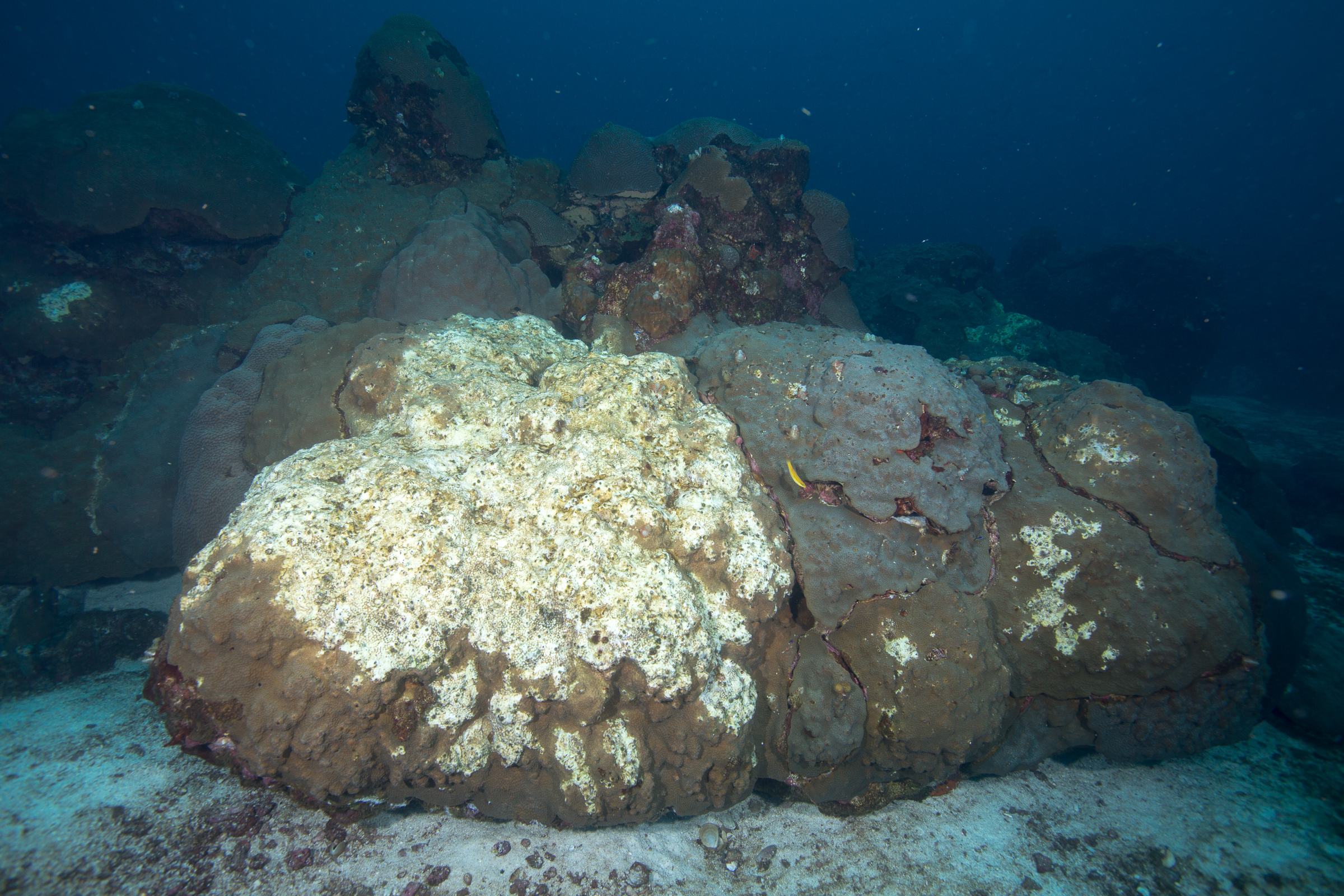
Coats of white mats covering dying star corals during a large-scale mortality event at the East Flower Garden Bank. Image credit: FGBNMS/G.P. SchmahlThe divers and researchers found unprecedented numbers of dying corals, sponges, sea urchins, brittle stars, clams and other invertebrates on large but separate patches of the reef. Sanctuary Research Coordinator Emma Hickerson reported extensive white mats covering corals and sponges, and estimates the mortality of corals to be nearly 50 percent in some of the affected areas. The spatial extent of the event is still being determined, but Hickerson says the die-off has so far been seen at three dive sites that charter boats typically use when they visit the bank.

Oddly, there was no evidence of the mass die-off at the site used for long-term monitoring of the bank since the late 1980s, where the scientists had been working when they first heard the news. Annual monitoring at the sanctuary is co-funded by NOAA, BOEM and the National Marine Sanctuary Foundation. Twelve miles away, the reefs of the West Flower Garden Bank remain vibrant, bathed in clear, blue water and free of the problem for now.

A massive star coral impacted by a large-scale mortality event at the East Flower Garden Bank. These corals are hundreds and hundreds of years old, and can be lost in a matter of days. Image credit: FGBNMS/G.P. SchmahlUntil the problem is sorted out, NOAA is recommending the public avoid diving, fishing, and boating activities on the East Flower Garden Bank. This is primarily to prevent the transmission of whatever is causing the mass mortality to unaffected locations, but also could protect divers from ingesting what could be harmful pathogens or toxins.

“At present, we are not aware of any specific risks to humans, but we are recommending this action as a precaution until more is known about the cause,” said G.P. Schmahl, Sanctuary Superintendent.

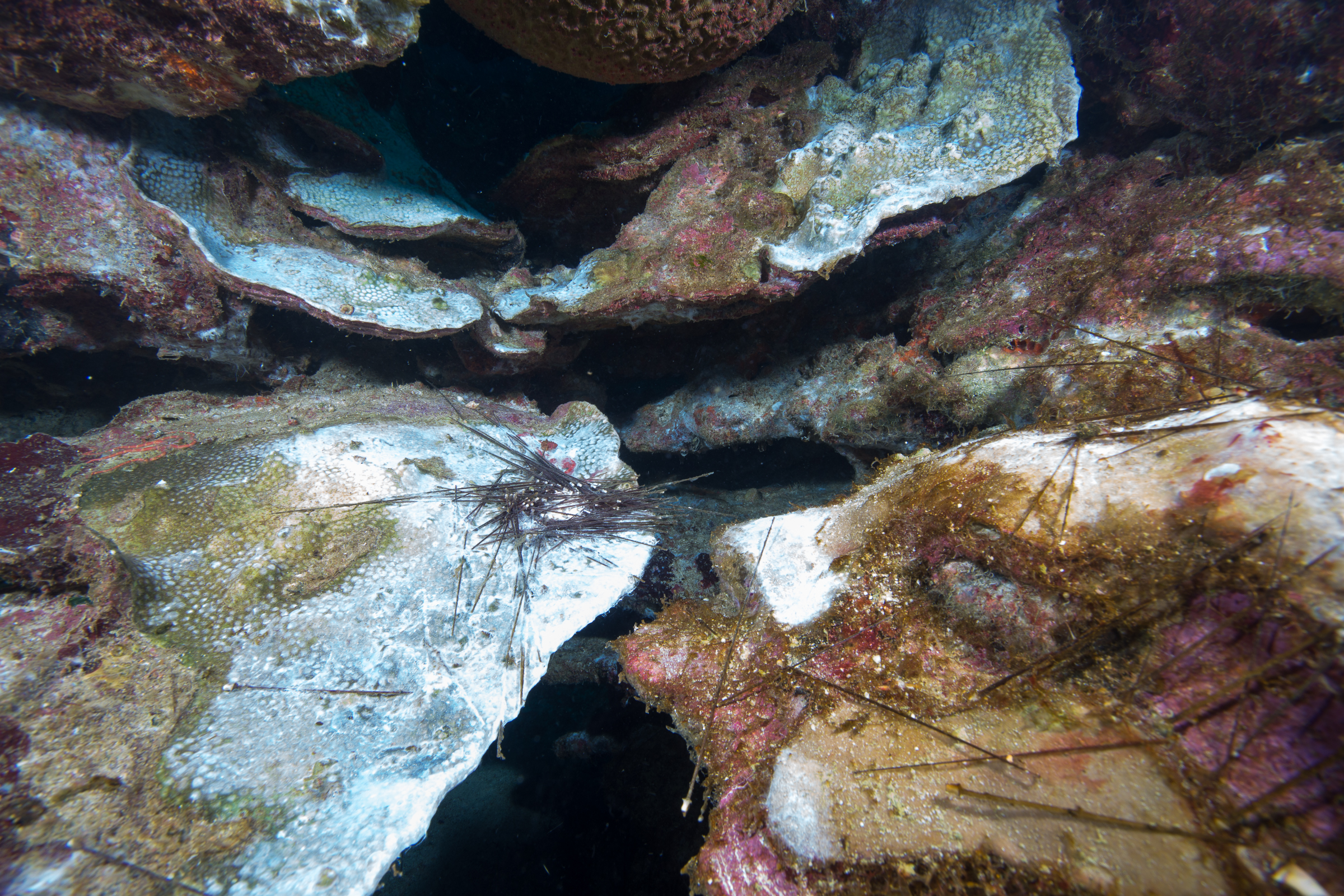
The remains of a sea urchin recently dead from a large-scale mortality event at the East Flower Garden Banks laying atop dying star coral colonies – these are coated with a white mat of unknown material. Image credit: FGBNMS/G.P. Schmahl Several potential causes of the outbreak will be investigated, including poor water quality, disease pathogens and chemical spills. Each alone could cause mortality in coral reef organisms, but more likely, a combination of stressors is at work.

“We know of no spills that have recently occurred near the Flower Garden Banks,” said Schmahl, “but water temperature over the banks is quite high, at 86 degrees.” In addition, large plumes of low-salinity coastal water have moved offshore following months of extreme rainfall in the region. That water is rich with plankton, nutrients and chemicals that arrive to the Gulf through runoff and river discharges. As the plumes decay, oxygen levels in the water can decrease.

Tissue sloughing off a recently dead brain coral succumbing to a large-scale mortality event at the East Flower Garden Bank. Image credit: FGBNMS/G.P. SchmahlCombined, these stressors could make coral reefs animals and plants more prone to disease outbreaks, or simply fuel the growth of bacterial or algae mats that smother the reefs. Scientists from around the world are offering advice and assistance in trying to help discover the cause.

Isolated bleaching events and unconfirmed cases of diseases have been reported at the Flower Garden Banks in the past. Overall, however, the health and stability of the sanctuary’s invertebrate and fish populations have been in stark contrast to coral reefs around the world that have degraded over the last four decades.

A deadly white mat coats a sponge between star and brain coral at the East Flower Garden Banks. Image credit: FGBNMS/G.P. Schmahl.Concern now is that the isolation of the banks, which many believe has been shielding them from human impacts, may not be enough to fully protect them anymore. But from what? The sanctuary and the science community are desperately trying to figure that out.

To learn more:
Flower Garden Banks National Marine Sanctuary
http://flowergarden.noaa.gov/

BOEM Science Notes – Flower Garden Banks National Marine Sanctuary
http://www.boem.gov/2014-03-Science-Notes/

Posted in Uncategorized | Leave a comment

Carib Journal Op Ed: Marine Pollution in the Caribbean

from the Carib Journal <http://www.caribjournal.com/2016/07/21/op-ed-marine-pollution-caribbean/?utm_source=Caribbean+Journal&utm_campaign=59065adaf4-Caribbean+Journal&utm_medium=email&utm_term=0_ea4e1e4090-59065adaf4-188909129>

[Ship-borne waste may be a contributor to marine pollution in the Caribbean, but I question whether it’s a major source, and whether addressing ship-borne waste issues (with their high capital costs as outlined in this discussion) are the most cost-effective tactics for reducing marine and coastal ecosystem impairments. My own bet would be that on-island investments in a variety of strategies to reduce forms of land-based run-off would do more to increase the productivity of the coastal and marine environment on a dollar-for-dollar basis than any ship-borne waste program. Furthermore, the capital-intensive nature of ship-borne waste management activities described here require a much higher proportion of imported products and technologies than increasing the competence and changing the land management activities of local farmers, developers and residents. bp]

Op-Ed: Marine Pollution in the Caribbean

July 21st, 2016 | 9:35 pm

Print

Exploring Marine Pollution and the Caribbean Maritime Transport Industry

By George Nicholson and Rachael Robinson
Op-Ed Contributors

Pollution of the world’s oceans is globally recognized as one of our highest environmental concerns. The oceans are regarded as the transportation highways for shipping, tourism and commerce, and with this abundance of ships, there is a significant amount of ship-generated waste that needs disposal. International conventions guide both states and masters of vessels on handling ship generated wastes and, depending on the nature of the waste, these regulations determine whether it may be discharged into the ocean or disposed of on land once the ships come into port. Given the scope and intensity of shipping in the Greater Caribbean, as well as the sensitive nature the Caribbean Sea itself, ship-generated waste presents a significant threat to regions’ marine ecosystems.

In light of this sensitivity and given that the region serves as a major hub for the global shipping industry, the capacity of ports or states to handle and dispose of ship-generated waste itself is a complex issue.

It is well recognised that marine pollution, including oil, chemicals, garbage, sewage, and food waste, which are all being dumped into the ocean, negatively affects industries related to the ocean such as fishing and tourism. In light of this recognition the international community developed the International Convention for the Prevention of Pollution from Ships, otherwise known as the MARPOL Convention, as the principal international treaty governing ship-generated waste.

The Convention, written in 1973 and modified in 1978 focuses on the regulation of ship-generated waste.

Under the provisions of MARPOL, waste is categorized into six annexes, allowing restrictions to be placed on groups of materials rather than on specific substances, and further defines separate requirements for the disposal of each. Annex I and II which cover the prevention of pollution by oil, and noxious liquids carried in bulk respectively, are subject to compulsory ratification by all parties while Annexes III to VI, which introduces requirements to control pollution of the sea by noxious substances and sewage from ships, are optional and must be ratified separately. Of all the annexes, oil (Annex I) and garbage (Annex V) are the most common and make up the majority of waste tonnage. Annex V which focuses on Prevention of Pollution by Garbage from Ships sets restrictions on the handling of garbage, including all food, domestic, and operational waste and completely prohibits the dumping of plastics at sea.

Due to its heavy maritime traffic, sensitive and fragile marine ecosystem, and the nature of the currents through the region, the Caribbean Sea was designated a Special Area with restrictions under MARPOL Annex V in 2011. This is of key importance to the region as special areas are provided with a higher level of protection than other areas, and strict rules apply for the disposal of garbage from ships. Within the Wider Caribbean Region, vessels operating are prohibited from discharging any garbage, with the exception of food waste which may be discharged subject to certain conditions, if the vessel is at least 12 nautical miles from the nearest land. Implementation of this special area status however is not without its own challenges.

The designation recognizes the ecological sensitivity of the region, but puts additional strain on the region’s port waste collection infrastructure. This is especially problematic in the context of the region’s Small Island Developing States (SIDS), which rely heavily on ships coming into their ports, but may lack the means to dispose of the additional waste they bring. Cruise ships, for instance, are critical to the economies of many SIDS, but they also produce significantly more waste than container ships. Although vessel traffic in the region is one of the primary contributors to the tourist-driven economy, limited financial resources curtail the ability of small states to construct appropriate facilities.

Given that ships must now offload all of their waste in ports, since the volume that was once dumped into the sea must now be processed at ports, there is the risk that region’s ports may become overburdened as they lack the infrastructure or reception facilities necessary to handle this increase. Whilst the majority of ports in the region have reported to have adequate port reception facilities, high costs of disposal, and other factors may lead some mariners to illegally discharge of their ship’s waste in the Caribbean’s waters.

With an average of five million barrels of crude oil being transported daily throughout the Wider Caribbean Region, together with an annual total of 70 million tons passing through the Panama Canal, it is estimated that approximately 250 major and minor oil spills will occur each year in the Caribbean Sea and the Gulf of Mexico.

However, studies show that of the sixty-plus Caribbean ports that handle oil and oil derivatives, oil/slop or ballast reception facilities are lacking. The International Maritime Organization (IMO) Global Integrated Shipping Information System further reveals a great need for the availability of data regarding port reception facilities (discharge restrictions, charges, availability of facilities, etc.), particularly in the Small Island Developing States (IMO, 2016). Port State Control inspectors in the territories are responsible for determining if vessels are adhering to international agreements, and have committed to inspecting a minimum of 15% of international ships calling at their ports, but given the vastness of the Caribbean Sea, and the lack of capacity of some member states, there is a significant probability that illegal dumping may go undetected.

Pollution already affects the marine environment and will continue to do so in the Special Area unless territories are able to provide ports with inexpensive and efficient waste disposal systems, either on the port itself or through offsite facilities. Unless disposal is desirable from the mariners’ point of view, pollution will continue in the face of such challenges; consequently compliance with the provisions of MARPOL may not be universal.

In spite of these challenges, through effective enforcement, Caribbean countries have a significant opportunity to improve the region’s marine ecological footprint. Ideally, there must be either an improvement to port infrastructure or other means of improving waste management in the Caribbean on a regional basis and given the difficulties in enforcement, any solution proposed must be both convenient and cost-effective to incentivise compliance.

While there have been improvements, the enactment of the relevant instruments into national legislation to further support the international regulatory framework would also assist the region in meeting its obligations. A successful solution will allow shipping and commerce to continue with minimal hindrance but also result in a significant reduction in the area’s marine pollution.

George Nicholson is the Director of Transport and Disaster Risk Reduction and Rachael Robinson is the Transport and Disaster Risk Reduction Research Assistant of the Association of Caribbean States. Any comments or feedback should be submitted to feedback

Posted in Uncategorized | Leave a comment

Home Town Heroes

It made me proud to learn that a hometown company, the Delaware North Companies, with offices above the new Westin Hotel in BUFFALO, NEW YORK, is listed by Forbes Magazine as one of the richest US privately held companies.

And my friend Joe tells me:

Well, it turns out that just about every name in Yosemite has been changed due to a trademarks dispute. Yosemite, like most national parks, uses private management companies to operate the hotels and campgrounds and provide food service. When the Park Service was not paying attention, the former private management company, Delaware North, proceeded to trademark under their name virtually every historic place in the park; and when they were replaced by Aramark, they offered to return the trademarks to the Park Service for a mere $52 million. (Does this sound like something Trump would do?) In fact, there is no such thing as Yosemite National Park anymore because Delaware North trademarked that name as well; so it is now just “Yosemite.”

And these guys aren’t even Big Pharma!

So the next time you happen to see them slithering around the lounge of the new Westin in Buffalo, give my regards to these scions of the Jacobs family of Buffalo — Chairman Jeremy actually lives in East Aurora, according to Wikipedia.

Current Delaware North Chairman Jeremy Jacobs, the son of founder Louis Jacobs, represents the second generation of the Jacobs family to own and lead the company. His three sons – Jerry, Lou and Charlie – are chief executive officers of Delaware North and are leading the company’s long-term business strategy.

We invite you to learn more about the Jacobs family.

  • JEREMY M. JACOBSChairman, Delaware North
    Owner/Governor, Boston Bruins

  • JERRY JACOBS JR.Co-Chief Executive Officer, Delaware North
    Alternate Governor, Boston Bruins

  • LOU JACOBSCo-Chief Executive Officer, Delaware North
    Alternate Governor, Boston Bruins

– See more at: https://www.delawarenorth.com/about/family-leadership#sthash.wN5l1yQW.dpuf

Would it surprise you to know that these fine fellows run a lot of gambling casinos and racetracks all over the world? … along with Ralph Wilson Stadium in Orchard Park!

Posted in Uncategorized | Leave a comment

Success: Why Strong Stormwater Regs, Rigorously Applied are Important.

… after three inches of rain, the silt fence and hay bales held.

Posted in Erosion & Sediment Control, Watershed Management | Leave a comment

New Edition of the Ramsar Handbooks

The Secretariat of Ramsar Convention has just announced the launch of the first Handbook in the 5th Edition Ramsar Handbook Series. It is entitled “An Introduction to the Convention on Wetlands” and replaces “The Ramsar Convention Manual”.

http://www.ramsar.org/sites/default/files/documents/library/handbook1_5ed_introductiontoconvention_e.pdf

“An Introduction to the Convention on Wetlands” is aimed at a diverse and extensive audience and explains the role of the Convention and how it works. The Handbook is currently being translated into French and Spanish.

The 5th Edition Handbooks will be organized under three sub-series, covering International Cooperation on Wetlands; Wise Use of Wetlands; and Wetlands Conservation and Management.

Handbook 2, “The Ramsar Strategic Plan 2016-2024”, is scheduled to be released in July.

The 5th Edition Series includes:

SUB-SERIES I: INTERNATIONAL COOPERATION ON WETLANDS

Handbook 1: An Introduction to the Convention on Wetlands

Handbook 2: The Ramsar Strategic Plan 2016-2024

Handbook 3: International cooperation

Handbook 4: Ramsar Regional Initiatives

Handbook 5: Partnerships

SUB-SERIES II: WISE USE OF WETLANDS

Handbook 6: Wise use of wetlands, sustainable development and poverty eradication

Handbook 7: Freshwater-related guidance

Handbook 8: Wise use of wetlands in the coastal zone and small islands

Handbook 9: Wetland cities

Handbook 10: Wetlands and health

Handbook 11: Wetlands, including peatlands, climate change and disaster risk reduction

Handbook 12: Implementing CEPA with participatory skills

Handbook 13: Strategic environmental assessment

Handbook 14: Wetlands and culture

SUB-SERIES III: WETLAND CONSERVATION AND MANAGEMENT

Handbook 15: National wetland policies, laws and institutions

Handbook 16: Designating Ramsar Sites

Handbook 17: Addressing change in wetland ecological character

Handbook 18: Managing wetlands

Handbook 19: Avian influenza and wetlands

Handbook 20: Inventory, assessment and monitoring

Handbook 21: Wetland education centres

Posted in Uncategorized | Leave a comment

IRF Scholarships to Two Caribbean Scholars Who Attended ISISA XIV

Thank you!

Gen

Sent from Yahoo Mail on Android

On Thu, 23 Jun, 2016 at 6:15 pm, Bruce G. Potter
<bpotter@irf.org> wrote:
In reviewing the documentation from the International Society of Island Studies Association (ISISA), Islands of the World XIV Conference in Lesvos last month, I learned that two Caribbean Scholars received 500 Euro awards sponsored by Island Resources Foundation and funded by the Kincey and Bruce Potter Environmental Fund.

Congratulations to all the winners. . . . .

Winner Country Award Email
Rosie Alexander Scotland ISISA Rosie.Alexander@uhi.ac.uk
Guillermo Brink Chile Baldacchino gpbrinck@gmail.com
Angelica Erazo-Oliveras Puerto Rico Island Resources Foundation erazo.angelica@hotmail.com
Genève Phillip Trinidad Island Resources Foundation geneve.phillip@yahoo.com
Gitanjali Pyndiah France/England ISISA g_pyndiah@yahoo.fr
Maria Reyes-Perez Netherlands ISISA m.reyesperez@unesco-ihe.org
Giang Tran Vietnam ISISA trangiangus@yahoo.com
Tabitha Espina Velasco Guam ISISA tvelasco@triton.uog.edu
Posted in Uncategorized | Leave a comment

IRF Scholarships to Two Caribbean Scholars Who Attended ISISA XIV

In reviewing the documentation from the International Society of Island Studies Association (ISISA), Islands of the World XIV Conference in Lesvos last month, I learned that two Caribbean Scholars received 500 Euro awards sponsored by Island Resources Foundation and funded by the Kincey and Bruce Potter Environmental Fund.

Congratulations to all the winners. . . . .

Winner Country Award Email
Rosie Alexander Scotland ISISA Rosie.Alexander
Guillermo Brink Chile Baldacchino gpbrinck
Angelica Erazo-Oliveras Puerto Rico Island Resources Foundation erazo.angelica
Genève Phillip Trinidad Island Resources Foundation geneve.phillip
Gitanjali Pyndiah France/England ISISA g_pyndiah
Maria Reyes-Perez Netherlands ISISA m.reyesperez
Giang Tran Vietnam ISISA trangiangus
Tabitha Espina Velasco Guam ISISA tvelasco
Posted in Uncategorized | Leave a comment

Inside the Shadowy World of America’s 10 Biggest Gunmakers

from Mother Jones

Fully Loaded: America’s 10 Biggest Gunmakers

Meet the moguls making a killing from gun sales in the United States.
By Josh Harkinson | Tue Jun. 14, 2016 6:00 AM EDT
[See links/footnotes at the bottom.]

They are all white, all middle-aged, and all men. A few live openly lavish lifestyles, but the majority fly under the radar. Rarely is there news about them in the mainstream media or even the trade press. Their obscurity would seem unremarkable if we were talking about the biggest manufacturers of auto accessories or heating systems. But these are America’s top gunmakers—leaders of the nation’s most controversial industry. They have kept their heads down and their fingerprints off regulations designed to protect their businesses—foremost a law that shields gun companies from liability for crimes committed with their products.

With this investigation, Mother Jones set out to break through the opacity surrounding the $8 billion firearms industry and the men who control it. While the three largest companies disclose some financials, the rest are privately held. Some are further shrouded by private-equity funds or shell corporations based in overseas tax havens. We mined manufacturing data and import statistics from the Bureau of Alcohol, Tobacco, Firearms and Explosives (ATF). We also examined obscure press clippings, court documents, private industry reports, and tax records from the Treasury Department. Together, the 10 companies we investigated produce more than 8 million firearms per year for buyers in the United States, accounting for more than two-thirds of the total market. (None of the companies responded to our requests for further information.)
Do you own part of a gun company? [1]Maksym Dykha/Shutterstock [2]
Many of these companies’ top executives have donned the jacket bestowed to members of the Golden Ring of Freedom [3], an exclusive club for $1 million-plus donors to the National Rifle Association. Several have been the focus of criminal investigations and lawsuits over everything from arms trafficking and fraud to armed robbery and racketeering.

As the debate over gun laws has grown louder, sales have soared. In the year following the massacre in Newtown, Connecticut, the three largest gunmakers—Sturm Ruger, Remington Outdoor, and Smith & Wesson—netted more than $390 million in profits on record sales. Shares in publicly traded Sturm Ruger and Smith & Wesson jumped more than 70 percent that year, benefiting institutional investors such as Vanguard, Blackrock, and Fidelity. The hedge fund that owns Remington Outdoor—maker of the assault rifle used in Newtown—saw the annual return on its investment grow tenfold.

And the picture looks no different today, on the heels of the deadliest mass shooting in US history. President Barack Obama once again mournfully addressed the nation after the attack in Orlando—which was carried out with a Sig Sauer assault rifle designed for US special operations forces [4], the civilian sales of which have helped make Sig Sauer the fifth largest producer of firearms for the US market. In what has become a typical pattern after gun massacres, the stock prices of publicly traded Sturm Ruger and Smith & Wesson on Monday both jumped more than 6 percent (on a day when all the broader market averages dropped).

The upshot is that even as gun ownership has declined from approximately half to one-third of American households, those who do own guns are stockpiling them in record numbers. As the head of one investment firm put it, “Mr. Obama is the best gun salesman on the planet.” [5]

1. Sturm Ruger

“No honest man needs more than 10 rounds in any gun,” a Sturm Ruger co-founder, the late William Ruger Sr., told Tom Brokaw in 1992. “I never meant for simple civilians to have my 20- or 30-round mags or my folding stock.” By 1994, with even Ronald Reagan voicing support, Congress banned [6] high-capacity magazines as well as assault rifles. But a decade later, lawmakers let the ban expire amid pressure from the National Rifle Association. By then the elder Ruger was deceased, and the Connecticut-based company resumed civilian sales of 30-round magazines. Since 2007, the company has sold more guns in the United States than any other manufacturer.

As the business grew, Sturm Ruger CEO Michael Fifer lobbied personally against a Connecticut ban on high-capacity magazines, commonly used with the company’s semi-automatic rifles. “The regulation of magazine capacity will not deter crime, but will instead put law-abiding citizens at risk of harm,” Fifer wrote to state lawmakers [7] in early 2011. The legislation died in committee that April. At the NRA’s annual Corporate Executives Luncheon the next year, Fifer presented a check to the group for more than $1.25 million [8]—$1 for every Sturm Ruger gun purchased the prior year. Eight months later, 20-year-old Adam Lanza used a semi-auto­matic rifle and a 30-round magazine to gun down 20 children and six adults at Newtown’s Sandy Hook Elementary School, located just 27 miles from Sturm Ruger’s headquarters.

In the year following the shooting, Sturm Ruger’s profits increased 56 percent. Fifer’s compensation that year was more than $2.6 million. He sits on the board of the National Shooting Sports Foundation, a lobby group based in Newtown and run by former Sturm Ruger executive Steve Sanetti. Sturm Ruger’s largest shareholders are mutual fund giant Vanguard Group and a private investment firm, London Company of Virginia, which has assets worth $10.6 billion, including holdings in ammunition, cigarettes, missiles, and caskets.

2. Remington Outdoor

Shortly after Newtown, Stephen Feinberg, CEO of the $29 billion private-equity fund Cerberus Capital Manage­ment, pledged to sell off [9] Remington Outdoor, the maker of the Bushmaster XM-15 used in the massacre. The company soon indicated it couldn’t find a buyer, but notably Remington’s profits increased nearly thirtyfold over the next year, with the biggest jump in sales coming from assault rifles. The company attributed the spike to “consumer concern over more restrictive governmental regulation [10].” With stakeholders such as the California teachers’ pension fund threatening to divest, Cerberus distanced itself from the politics. “Our role is to make investments on behalf of our clients,” the company stated [11]. “It is not our role to take positions or attempt to shape or influence the gun control policy debate.”

In May 2013, the NRA inducted three Remington executives—CEO George Kollitides, Vice Chairman Wally McLallen, and President Scott Blackwell—into its Golden Ring of Freedom, reserved for those who’ve given the NRA at least $1 million. Kollitides has also served on the nominating committee that controls who sits on the NRA board. “It’s very easy to blame an inanimate object,” Kollitides said [12] of the Bushmaster rifle used in Newtown.

After New York state enacted stricter gun laws in 2013, Remington laid off workers at its 200-year-old factory there and moved production to Huntsville, Alabama, where it gets $69 million in state and local subsidies—or about $14 for every Alabama resident. On a tour of the new plant, Remington and NRA executives were joined by GOP Sen. Richard Shelby—a co-sponsor of the 2005 law shielding gun companies from liability—who was running for reelection. The NRA executive endorsed Shelby’s campaign as Remington’s current CEO, Jim “Marco” Marcotuli (formerly a Cerberus executive), stood smiling at Shelby’s side. [13]

3. Smith & Wesson

In August 2013, upward of 150 Smith & Wesson employees descended on a hearing with Massachusetts legislators to denounce proposed gun restrictions. The following year, CEO James Debney, already a member of the NRA’s Golden Ring of Freedom, presented NRA Executive Vice President Wayne LaPierre with a check for an additional $600,000. “Through its various programs, pro-gun-reform legislation, and grassroots efforts,” Debney said, [14] “the existence of the NRA is crucial to the preservation of the shooting sports and to the entire firearms industry.”

America’s third-largest gunmaker has come a long way from a deal it cut in 2000 [15] with the Clinton administration. Back then, Smith & Wesson received immunity from product liability lawsuits in exchange for agreeing to install safety devices, not to sell to unscrupulous dealers, and to limit bulk handgun sales. It also pledged to make “smart gun” technology available within three years.

[16]
Money Shots: Six guns that got a barrage of free advertising from the entertainment industry [16]AF Archive/Alamy Stock Photo
The deal enraged industry bigwigs. “Boycott Smith now and forever. Run them out of the country,” an executive at rival Kimber America wrote to fellow firearms leaders. “You guys need to make sure that no one else is going to join the surrender.” After a boycott led by the NRA sent sales plummeting [17] more than 40 percent, Smith & Wesson’s British parent company sold it at a $100 million loss to Saf-T-Hammer Corp., a startup run by Robert L. Scott, a former Smith & Wesson VP. Scott reneged on the Clinton deal. “It was important that we be an active part of the industry again,” he said in a 2002 deposition. (Today, Scott chairs the board of the National Shooting Sports Foundation.)

The company soon drew attention in other ways. In 2004, the Arizona Republic reported that 74-year-old Chairman James Joseph Minder had once been a serial armed robbe [18]r known as the “shotgun bandit” who’d committed eight holdups in Michigan. (Minder soon resigned.) In 2010, a VP of sales was indicted for attempting to bribe [19] an FBI officer posing as an African emissary taking bids on a $15 million arms deal. And in 2014, Smith & Wesson agreed to pay $2 million to settle charges [20] that it had bribed foreign officials in Pakistan and Indonesia.

4. Glock

Gaston Glock, an Austrian curtain rod manufacturer, designed the Glock 17 in his garage outside Vienna in the early 1980s. Soon it was a global bestseller. Alarmed by aspects of the pistol’s revolutionary polymer design—including the lack of a conventional safety mechanism—Congress held hearings on the Glock in 1986 and New York City banned it. Yet the Glock remains by far America’s most popular pistol [21]—carried by two-thirds of police officers, immortalized by hip-hop and Hollywood, and wielded by the perpetrators of the Virginia Tech, Tucson, Aurora, and Charleston massacres.

Gaston Glock resides in an opulent Austrian villa. He has two corporate jets worth eight figures and a $3 million helicopter to shuttle him around Europe. In the 1980s, some of Glock’s biggest law enforcement contracts were allegedly won with the help of Gold Club strippers near the company’s US headquarters in Smyrna, Georgia. “For a lot of guys coming in from out of town, this was the best time they were going to have all year, or maybe their entire life,” a former police official told journalist Paul Barrett for his book Glock: The Rise of America’s Gun [22]. “You go to Smyrna, get laid at the best strip club in town, drink champagne—you are not going to forget the experience when it comes time to choose between Glock and Smith & Wesson.”

By the 1990s, Gaston Glock was a billionaire and had hired New Jersey attorney and gun rights activist Paul Jannuzzo to help combat a rash of claims by shooting victims. Jannuzzo, who eventually became the CEO of the US subsidiary, convinced Glock to donate $1 to the American Shooting Sports Council for each gun shipped from Smyrna. But ties between Jannuzzo and Gaston Glock began to fray over an amorous rivalry for the company’s young human resources manager. Jannuzzo was convicted in 2012 of diverting profits into his own bank account; an appeals court later found the statute of limitations had expired and overturned the verdict.

[23]
In 1999, at the age of 70, Glock survived a hit job in a Luxembourg parking garage carried out by a mallet-wielding former French legionnaire nicknamed Spartacus. Glock knocked out several of his attacker’s teeth before rendering him unconscious. The police linked the attack to an embezzlement scheme by Glock’s business associate Charles Ewert, who’d earned the nickname Panama Charlie for helping Glock set up foreign shell companies to evade Austrian and US taxes. Investigators hired by Glock later alleged that Ewert had misappropriated $103 million in corporate funds.

According to a lawsuit filed against Glock by one of those investigators, Glock knowingly participated in the scheme—allegedly paying himself royalties for nonexistent trademarks and laundering money with phony payments, rents, and loans. When the investigators confronted Glock, he convinced state and local officials in Georgia to indict them instead, on charges that they’d overbilled him for legal services. The charges, later dropped, “were fabricated based on falsified evidence, influenced witnesses, and evidence either destroyed or withheld,” according to the suit.

Glock also faces allegations stemming from his 2011 divorce, in which he left Helga, his wife of 49 years, for Kathrin Tschikof, a 31-year-old nurse who’d helped him recover from a stroke. Tschikof now directs the Glock Horse Performance Center, overseeing the couple’s 50 dressage horses and jumpers. In May 2014, Glock bought Tschikof a $15 million Olympic silver-medal-winning show horse, one of the most expensive ever. Six months later, Helga Glock filed a $500 million lawsuit [24] accusing her ex-husband of bamboozling her and their three adult children out of a stake in the company and concealing hundreds of millions in profits. Gaston Glock called the suit a shakedown scheme. Helga’s attorney insists she, not Gaston, is the victim.

“He’s got a lot of skeletons,” former Glock executive Peter Manown said in court after pleading guilty to stealing from the company. “He’s done, in my mind, a lot of things that are much worse than what Jannuzzo and I did. He makes roughly $200,000 a day—he personally. He spends money on mistresses, on houses, on sex, on cars. He bribes people. He’s just a bad guy.”

5. Sig Sauer

“We have clearly defined our path to growth as being in emerging markets and developing countries,” Ron Cohen, the CEO of Sig Sauer’s US subsidiary, told Management Today in 2014. Later that year, German investigators searched the home of Sig Sauer co-owner Michael Lüke seeking evidence of illegal arms deals. Lüke allegedly sent German-made guns through Cohen’s office to bypass European restrictions on arms exports to conflict zones in Iraq, Colombia, and Kazakhstan, according to the German paper Suddeutsche Zeitung.

In March 2015, German officials discovered that key evidence in the case had been stolen from the prosecutor’s office before it could be introduced at trial. Citing the ongoing investigation, German officials have blocked Sig Sauer from exporting guns outside the European Union. Sig Sauer fans in the United States need not worry: 477,000 of the company’s guns are made each year in Newington, New Hampshire.

Sig Sauer dates to the mid-1800s, when it became a weapons supplier to the Swiss army. To get around Swiss arms export restrictions, in the 1970s the company merged with a German firm, opening an office in 1985 in Virginia. In 2000, the company spun off its arms division to Lüke and fellow German investor Thomas Ortmeier, who focused on the US market and now claim to supply nearly 1 in 3 guns used by American law enforcement officers. In 2014, Sig Sauer announced it would slash its German workforce by two-thirds and produce more guns in the United States.

Cohen commanded a combat unit in the Israeli military during the Lebanon War. “You lead by example,” he told Management Today. “You learn how to overcome anything, and there is a drive to constantly move forward. There is a sense of, ‘If we don’t move, we die.’ That’s a big part of who I am.” (Cohen did not respond to a request for comment about the use of a Sig Sauer rifle in the Orlando massacre.)

Last December, presidential candidate Ted Cruz joined Sig Sauer representatives for a shooting demonstration at an Iowa gun range. In February, Donald Trump’s sons Eric and Donald Jr. paid a visit to Sig Sauer’s New Hampshire factory, earning praise on the company’s Twitter account for “taking time to understand #whoweare #whatwedo #LiveFreeorDie.”

6. O.F. Mossberg & Sons

America’s oldest family-owned gun manufacturer is based in North Haven, Connecticut, 25 miles from Newtown. The day of the massacre, some employees worked the assembly line with tears in their eyes. Mossberg Senior Vice President Joseph Bartozzi criticized the NRA’s defiant response to the mass shooting as insensitive. “The funerals were still going,” he told Bloomberg [25]. “Parents were burying their children.”

Two months later, however, the company pulled out of a major Pennsylvania gun exhibition because the sponsors, out of deference to Newtown’s families, had banned semi-automatic rifles and high-capacity magazines. “Mossberg’s position on the Second Amendment is unwavering and steadfast,” the company said. “Therefore, the company will not support any organization or event that prohibits the display or sale of legal firearms.”

After Connecticut passed new gun laws, Bartozzi accused Gov. Dannel Malloy of being “slanderous” and “using the industry as a straw man.” In 2014, CEO Iver Mossberg announced that most production would move to an existing factory in Texas. “It’s a state that is not only committed to economic growth,” he said, [26] “but also honors and respects the Second Amendment and the firearm freedoms it guarantees for our customers.”

Founded in 1919 by Swedish immigrant Oscar Mossberg as a purveyor of a low-cost “pocket pistol,” O.F. Mossberg & Sons eventually focused on shotguns; today it is the world’s largest producer of pump-action models, including a line of Duck Dynasty-branded ones. But assault rifles drive the company’s growth. As Bartozzi has put it, “that’s what people want.”

The family keeps a low profile. Iver Mossberg lives in a relatively modest house in Branford, Connecticut. His father, former CEO Alan I. Mossberg, has retired to a Florida home originally built for the Swedish pop group ABBA. The Mossbergs may be more politically moderate than they let on. “I have had discussions with people who work for Mossberg, as well as [from] every other major gun company, who have actually indicated to me on a personal basis that they don’t have a problem with universal background checks,” Gov. Malloy told the New Haven Register [27] in 2014, “but they are afraid of the NRA and they won’t stand up to it.”

Back in 1999, one of Alan Mossberg’s other sons, Jonathan, developed the iGun [28], a microchip-equipped shotgun that can only be fired by its owner. Though the company and other manufacturers later abandoned smart-gun technology under political pressure, Jonathan Mossberg recently revived the project as a separate enterprise and is courting Silicon Valley investors.

7. Savage

America’s largest maker of bolt-action rifles is owned by Vista Outdoor, a $2.9 billion holding company that also makes ammunition and gun accessories. After Newtown, Savage ran around-the-clock shifts to keep up with demand. Profits at Vista that year rose from $10 million to $64 million [29].

Mark W. DeYoung, who is CEO of both Vista and Savage, may be the nation’s highest-paid gun company executive, earning $13.2 million in 2015 [30]. He chairs the Congressional Sportsmen’s Foundation, which lobbies on behalf of “America’s hunters and anglers,” and whose banquet was keynoted by soon-to-be Speaker of the House Paul Ryan [31] in 2015. That same year, Vista Outdoor spent $390,000 on federal lobbying, mostly on bills concerned with defense appropriations and fishing and hunting. It also lobbied on the Toxic Substances Control Act, perhaps because in 2013 Massachusetts regulators fined Savage $6,000 for illegally dumping at least 50,000 gallons of industrial wastewater from its gun manufacturing operation into a sewer.

“I think 2016 is gonna be a strong year,” DeYoung told an NRA leader at a recent gun industry conference. “Election years always create some additional demand in our industry…So I suspect that will benefit us all, right?”

8. Springfield Armory

Current NRA President Allan Cors has boasted that of all the guns he owns, his favorite is the 1 millionth Springfield Armory M1 rifle, originally presented to its designer, John Garand, upon his retirement from Springfield Armory in 1953.

The company’s namesake dates to 1777, when George Washington approved the ammunition plant and arms depot as an arsenal for the Revolutionary War. The nationalized factory produced guns for American soldiers through World War II.

In 1974, the Springfield Armory name was licensed to Robert Reese, a surplus-store owner in Geneseo, Illinois. Despite the company’s slogan, “The First Name in American Firearms,” it now sources many of its guns from Croatia. Reese’s sons Dennis and Tom, the company’s current owners, nevertheless managed to help beat back a proposed Illinois ban on assault weapons by threatening to move the company’s factory across the river to Iowa.

[32]
A brief history of America’s NRA-fueled gun-buying [32]spree [32]AP Photo/Mark Wilson
In 1989, Dennis Reese admitted to offering bribes [33] to US Army Colonel Juan Lopez de la Cruz—including $70,000 in cash and a Rolex watch—in exchange for help selling $3.7 million worth of firearms to the Salvadoran government. Reese was allowed to plead guilty to lesser charges in exchange for testifying against de la Cruz. But according to the Associated Press [34], the colonel walked after the jury decided Reese was not a trustworthy witness.

Over the years, Springfield has donated at least $1 million to the NRA [35].

9. Beretta

The 15-generation Beretta family claims to be the world’s oldest industrial dynasty. Their nearly 500-year-old company sits in a stone fortress surrounded by topiary gardens in a village near the Italian Alps. Napoleon and Mussolini were both big customers.

Patriarch Ugo Beretta and his wife, Monique, are members of the NRA Golden Ring of Freedom and have long cultivated political ties in the United States. At a 2010 dinner, their son Franco Gussalli Beretta presented George W. Bush with a $250,000 shotgun [36] engraved with “43,” the presidential seal, and a picture of Bush’s Scottish terrier. The custom-made firearm was a thank-you for a US military order for half a million pistols. In 2014, Tennessee Gov. Bill Haslam flew to Italy to meet with the Berettas. The company soon announced it would close its manufacturing headquarters in Maryland—where new gun control laws were fresh on the books—and relocate to Tennessee [37], where it got $14 million [38] in subsidies [39].

Beretta markets guns as part of living the high life. There are Beretta-branded hunting lodges and a line of luxury clothing and home accessories. In cities including Dallas, Memphis, and New York, the Beretta Gallery offers après-field wear and specialty weapons, which have included $100,000 pistols decorated with diamonds.

Ugo Beretta in Italy in 2001. Beretta and other foreign gunmakers live openly lavish lives—safely removed from the controversy of American gun violence. Guido Harrari/Contrasto/Redux
At the family home in Italy, a liveried butler and cook oversee a mansion decorated with Venetian glass chandeliers, water buffalo heads, and elephant tusks. Franco Beretta drives a Maserati Quattro­porte to visit the family’s commercial vineyards at their nearby 16th-century estate. Photos of his wife, Umberta, often appear in Italy’s society pages and on her fashion-obsessed Instagram account, where she recently appeared clutching a teddy bear made of cash [40].

10. Taurus International

In February 2015, Donald Simms, a ship captain in Alabama, was reloading his Taurus pistol at home when it unexpectedly fired. The bullet went through the palm of his hand and into the chest of his 11-year-old son, killing the boy. Simms sued the company [41], claiming a flaw in the gun’s internal safety mechanisms caused his son’s death. The suit is one of numerous cases alleging that Taurus pistols are dangerously defective. The company has recalled nearly 1 million pistols and settled a class-action lawsuit [42] by setting aside $30 million for damages, court costs, and recall campaigns.

Taurus was founded 77 years ago as a tool manufacturer in Porto Alegre, Brazil; today, it earns roughly two-thirds of its gun revenue in the United States, where it offers free NRA memberships [43] to purchasers. Nearly 87 percent of Taurus shares are owned by the Brazil­ian Cartridge Company, a gun and ammo manufacturer that was part of Remington before it was taken private in 2007 by investment funds tied to Daniel Birmann, one of Brazil’s most notorious securities fraudsters. In 2005, Birmann was fined the equivalent of $91 million by Brazilian regulators for bilking shareholders of an investment company he ran; in early 2015, Brazilian authorities seized a $23 million yacht that it claimed Birmann owned through shell companies based in overseas tax havens. Birmann’s family is believed to still control the Brazilian Cartridge Company’s Delaware-based holding company. Questions about quality control and a falloff in purchases from the Brazilian military and police have contributed to a 95 percent drop in Taurus’ share price since 2013.

Birmann, who splits his time between Porto Alegre and Rio de Janeiro, has been described in the Brazilian press as carrying a gun wherever he goes and paying cash at expensive restaurants. In 2005, the Brazilian pop singer Lobão filed a police report alleging Birmann assaulted him after he refused to play certain songs at the financier’s birthday party.

FIVE OTHER NOTABLE GUNMAKERS:

Keystone Sporting Arms

This Pennsylvania-based company markets the .22-caliber Crickett under the slogan “My First Rifle.” The blue and pink guns [44] are proportioned for youth shooters and according to critics can appear toylike. In 2013 in Kentucky, a five-year-old playing with a Crickett [45] accidentally shot and killed his two-year-old sister. A resulting flurry of national press put a spotlight on gun deaths of young children, which a Mother Jones investigation [46] found are in the hundreds annually. Keystone also drew ire for online marketing to youth, including a “kids corner” page that featured photos of its guns being fired by tykes and cradled by babies. The company continues to publish cartoon “storybooks” and sells kid accessories such as a Crickett-wielding stuffed animal.

It’s all part of an industry effort to reverse a decline in shooting sports by exposing kids to guns at an early age. Sig Sauer now offers junior shooters a .22-caliber version of its AR-15. The National Shooting Sports Foundation encourages members to “help hunting and target shooting get a head start over other activities” by aiming “programs toward youth 12 years old and younger.” The NRA appeals to kids with stuffed animals and hunting video games at its annual conference, where gun companies have been known to hand out candy.

Kahr Arms

At the Shooting Industry Masters tournament in Kansas last year, participants dubbed the “Zoot Suit Shooters” dressed up like mobsters and blasted steel targets with Tommy Guns. It was a publicity stunt on behalf of Kahr Arms, maker of the Prohibition-era machine gun. The rights to the Tommy Gun were acquired in 1999 by Justin Moon, who started Kahr Arms in 1994 with a $5 million loan [47] from his father—Unification Church founder Sun Myung Moon.

Kahr Arms capitalized on the rising demand for powerful yet small handguns when concealed-carry laws began sweeping the nation in the 1990s. Its K-9 pistol was small enough to fit into a pants pocket. Emergency room physicians blamed the spread of this type of gun from Kahr and other companies for a dramatic rise in fatal gunshot wounds.

Growing up in the suburbs of New York, Justin Moon “would always philosophize about the world ending and how great his father was,” Tim Porter, the son of high-ranking church members, told Condé Nast Portfolio [48] in 2007. “That’s why he did all this stuff with guns. He believes that [the Unification Church] is going to take over the world. He would say this all the time.”

[49]
Related: What does gun violence really cost? [49]
Barrett Firearms

In April 2013, New Jersey Gov. Chris Christie called for a ban on the .50-caliber Barrett M82 and M107 sniper rifles—and then vetoed the bill four months later. He claimed it went further than he’d intended by prohibiting current owners from keeping the weapons, which are powerful enough to down helicopters, pierce bulletproof glass, or kill from a mile away. In the middle of debate over the bill, Christie’s campaign accepted $3,000 from an NRA lobbyist [50].

Barrett’s CEO, Ronnie Barrett, sits on the NRA’s board of directors. Once a professional wedding photographer, he resides on a 17-acre plantation-style estate in Murfreesboro, Tennessee, that features an 11,000-square-foot mansion and a formal English garden. According to the Government Accountability Office, Barrett’s .50-caliber rifles have been used by drug cartels, militia groups, outlaw motorcycle gangs, and terrorist organizations. The Branch Davidians wielded one during the 1993 Waco siege in Texas, forcing federal agents to use armored Bradley fighting vehicles. California and Washington, DC, have banned the guns, but they remain legal everywhere else. In February, the Tennessee Senate passed a resolution designating the Barrett M82 the official state rifle.

Norinco

Headquartered in Beijing, Norinco makes shotguns sold mostly through online dealers such as CheaperThanDirt.com [51]. It imports tens of thousands of guns into the United States each year. Owned by China’s Communist Party, the company provides weapons to the People’s Liberation Army and military clients that have included the government of South Sudan. The company also produces hydroelectric equipment, subway cars, and raw copper. In 2003 it was accused of transferring missile technology to Iran, prompting a two-year US import ban [52].

Hi-Point Firearms

When Hi-Point founder Tom Deeb learned in 1999 that one of his company’s semi-automatic rifles had been used in the Columbine mass shooting, he closed his factory for a day. “I was just sick over it,” he told the Buffalo News. “I thought about quitting.” But then he changed his mind, deciding, “I’m not going to be defeated by evil.” (The company began to expand its use of serial numbers.)

Hi-Point, whose handguns have retailed for as little as $79, was long one of the most notorious suppliers of so-called “Saturday night specials.” In 2000, Hi-Points were the third most common type of gun seized at crime scenes in 44 cities, according to the ATF [53]. On average, Hi-Points reached criminals within a year of their original purchase, making them among the quickest guns to flow into the black market.

In 2005, the Brady Center to Prevent Gun Violence sued the company [54] on behalf of Daniel Williams, a 16-year-old who was mistaken for a gang member and shot while playing basketball. The suit alleges that the company and its sole distributor were negligent in selling the pistol—along with 86 other guns—to a straw purchaser at a gun show. A judge tossed out the case under the 2005 shield law. In 2012 an appeals court reinstated the case, which remains in a New York court.

Additional reporting by Bryan Schatz and Dave Gilson

Source URL: <http://www.motherjones.com/politics/2016/04/fully-loaded-ten-biggest-gun-manufacturers-america&gt;
Links:
[1] http://www.motherjones.com/politics/2016/05/do-you-own-part-of-a-gun-company
[2] http://www.shutterstock.com/pic-143931109/stock-photo-gun-and-money.html?src=vKZWeAquK4jO_MWonwZvfQ-1-3
[3] http://www.nragive.com/membership/list/membership-levels
[4] http://www.motherjones.com/politics/2016/06/assault-rifle-used-by-orlando-mass-shooter
[5] http://www.cnbc.com/2016/01/05/obama-best-gun-salesman-on-earth-stock-picker.html
[6] http://articles.latimes.com/2004/sep/10/nation/na-guns10
[7] http://www.bloomberg.com/news/articles/2012-12-16/ban-on-30-round-gun-magazines-in-connecticut-died-after-pressure
[8] https://www.nraila.org/articles/20120425/sturm-ruger-company-raises-over-12-million-to-benefit-the-nra-institute-for-legislative-action
[9] http://dealbook.nytimes.com/2012/12/18/cerberus-to-sell-gunmaker-freedom-group/?rref=collection%2Ftimestopic%2FFeinberg%2C%20Stephen%20A.&amp;action=click&amp;contentCollection=timestopics&amp;region=stream&amp;module=stream_unit&amp;version=latest&amp;contentPlacement=8&amp;pgtype=collection&amp;_r=0
[10] http://www.nytimes.com/2015/05/16/business/dealbook/cerberus-unable-to-sell-remington-will-buy-back-its-shares-from-investors.html?rref=collection%2Ftimestopic%2FFeinberg%2C%20Stephen%20A.&amp;action=click&amp;contentCollection=timestopics&amp;region=stream&amp;module=stream_unit&amp;version=latest&amp;contentPlacement=3&amp;pgtype=collection&amp;_r=0
[11] http://www.prnewswire.com/news-releases/cerberus-capital-management-statement-regarding-freedom-group-inc-183889361.html
[12] http://www.washingtontimes.com/news/2013/jun/14/bushmaster-ceo-reflects-on-newtown/?page=all
[13] http://whnt.com/2016/01/18/u-s-senator-richard-shelby-tours-huntsville-remington-plant-touts-future-growth/
[14] http://www.nytimes.com/roomfordebate/2014/04/17/can-bloomberg-take-on-the-nra/beyond-the-nra-an-industry-stands-in-the-way
[15] http://clinton4.nara.gov/WH/New/html/20000317_2.html
[16] http://www.motherjones.com/politics/2016/05/money-shots
[17] http://www.nytimes.com/2006/04/06/business/worldbusiness/06iht-guns.html?pagewanted=all&amp;_r=0
[18] http://www.wsj.com/articles/SB107870298403448693
[19] http://www.fcpablog.com/blog/2010/1/19/massive-fcpa-indictment-unsealed.html
[20] https://www.sec.gov/News/PressRelease/Detail/PressRelease/1370542384677
[21] http://www.npr.org/2013/02/01/170752391/how-the-glock-became-americas-weapon-of-choice
[22] https://www.amazon.com/Glock-Americas-Paul-M-Barrett-ebook/dp/B004X6PRXC?ie=UTF8&amp;btkr=1&amp;redirect=true&amp;ref_=dp-kindle-redirect
[23] http://www.motherjones.com/politics/2012/07/mass-shootings-map
[24] http://www.bloomberg.com/news/articles/2015-08-18/ex-wife-of-gun-magnate-glock-gets-new-ammo-for-rico-suit
[25] http://www.bloomberg.com/news/articles/2013-03-14/why-gun-makers-fear-the-nra
[26] http://www.forbes.com/sites/frankminiter/2014/07/11/americas-largest-shotgun-maker-shifts-more-jobs-to-texas/#2b22b6ac1e55
[27] http://www.nhregister.com/government-and-politics/20141013/malloy-stands-by-call-for-background-checks-on-gun-purchases
[28] http://www.motherjones.com/politics/2016/02/smart-guns-mossberg-igun-venture-capital-conway
[29] http://www.nydailynews.com/news/politics/gun-violence-good-business-firearms-manufacturers-article-1.2464147
[30] http://www.bloomberg.com/research/stocks/people/person.asp?personId=3750967&amp;privcapId=262788142
[31] https://www.youtube.com/watch?v=nXw-pk7agns
[32] http://www.motherjones.com/politics/2016/05/arming-america
[33] http://http://www.upi.com/Archives/1989/03/16/Salvador-based-Army-colonel-indicted-on-bribery-charges/5406606027600/
[34] http://www.apnewsarchive.com/1989/Colonel-Cleared-of-Conspiracy-Bribery-Charges/id-393a6f5ef0c35a8a91874af1fc8237c0
[35] http://springfield-armory.blogspot.com/2007/07/springfield-gives-1-million-to-nras.html
[36] http://www.motherjones.com/politics/2011/12/highland-park-texas-gop-stronghold
[37] http://www.bizjournals.com/nashville/blog/2014/07/beretta-moving-all-of-its-u-smanufacturing-to-new.html
[38] http://www.motherjones.com/politics/2016/01/gun-manufacturers-subsidies-southern-states
[39] http://www.bizjournals.com/nashville/print-edition/2014/02/21/whiskey-guitars-and-guns.html
[40] https://www.instagram.com/p/_zg6DyM6sH/
[41] http://www.al.com/news/birmingham/index.ssf/2015/11/alabama_man_files_lawsuit_agai.html
[42] https://www.tauruscartersettlement.com/
[43] http://www.taurususa.com/pdf/NRA/Taurus-NRA-Free-Membership-2015.pdf
[44] http://www.crickett.com/crickett_rifles.php
[45] http://www.motherjones.com/mojo/2013/05/crickett-rifle-marketing-kids
[46] http://www.motherjones.com/politics/2013/12/children-killed-guns-newtown-anniversary
[47] http://www.washingtonpost.com/wp-srv/national/daily/march99/moon10.htm
[48] http://upstart.bizjournals.com/careers/Features/2007/09/17/Unification-Church.html?page=all
[49] http://www.motherjones.com/politics/2015/04/true-cost-of-gun-violence-in-america
[50] http://talkingpointsmemo.com/dc/christie-takes-nra-cash-as-rival-attacks-him-on-guns
[51] http://blog.cheaperthandirt.com/top-selling-gun-interstate-arms-hawk-model-982/
[52] http://usatoday30.usatoday.com/news/washington/2003-05-22-norinco-usat_x.htm
[53] http://www.motherjones.com/documents/2841368-ATF-Report-2-3
[54] http://www.bradycampaign.org/content/williams-v-beemiller

Posted in Uncategorized | Leave a comment