Capital Gazette: Driven to serve: Watershed leader Kincey Potter honored by bay trust

From the Capital Gazette, about Kincey’s ” Ellen Fraites Wagner Award” from the Chesapeake Bay Trust, for her efforts at watershed restoration and Bay improvements over the past 13 years.

Driven to serve: Watershed leader Kincey Potter honored by bay trust


Posted in Biodiversity, Governance, Monitoring, Watershed Management | Tagged , , , | Leave a comment

Western Caribbean Yachts Negligent in Monitoring their Anchorage Practices

Fortunately stuff like this DOES NOT HAPPEN IN THE EASTERN CARIBBEAN . . . .

from the Cayman Islands — https://www.caymancompass.com/2016/01/26/billionaires-yacht-blamed-for-coral-reef-damage/

Billionaire’s yacht blamed for coral reef damage

By James Whittaker
January 26, 2016

Paul Allen’s yacht Tatoosh is blamed for anchor damage to the reef in the West Bay replenishment zone. – PHOTO: JAMES WHITTAKER

An area of around 13,000 square feet of coral reef habitat within a marine park was impacted by anchor damage from the mega-yacht Tatoosh, according to a survey by Department of Environment divers.

The anchor chain of the 300-foot luxury yacht, owned by Microsoft co-founder Paul Allen, struck the reef in the West Bay replenishment zone, close to the popular Doc Poulson wreck dive site, around Jan. 14.

The DoE conducted an in-water survey of the damage last week and released its preliminary findings Friday.

“Initial figures place the damaged area at 1,200 square meters … with 80 percent of the coral within that area destroyed,” according to a statement from the department.

The estimate for the area impacted is around the same as that affected when an anchor and chain from the Carnival Magic cruise line struck a reef near George Town in 2014. It is not clear whether the level of coral density was on the same scale.

The DoE is still investigating the circumstances of the incident and is working on a full damage assessment report that will be completed this week.

A spokesman for Vulcan Inc., Mr. Allen’s communication’s team, said the crew is cooperating with the investigation.

“While moored in the Caymans in a position directed by the local Port Authority, the vessel Tatoosh shifted due to strong winds in the area that unintentionally pushed it closer to a marine reserve area.

“The vessel quickly relocated its position and the crew is cooperating fully with local authorities to ensure that no marine life in that area was inadvertently impacted.”

The yacht, which has an on-board helicopter, was still in Cayman’s waters Tuesday, moored close to Spotts Landing.

Posted in Uncategorized | Leave a comment

Financial Times on Financial Shenanigans Using the Cayman Islands

[After spending a couple of hours watching the movie The Big Short, this all seems pretty normal banking practice, but involving a small island sort of elevates it to a higher plane. Pun intended.  bp]

FT Alphaville

Why this subprime lender funds loans through the Cayman Islands

by Kadhim Shubber
Jan 19 10:18

Elevate Credit calls its customers in the US and the UK the “New Middle Class”, selling them loans in the latter at a representative APR of 1295 per cent. It is gearing up to float in New York this week and, if successful, the Texas-based business will be the “first tech IPO of 2016”.

The company claims that unlike payday lenders, it has transparent fees “in order to help our customers facing financial hardships”. But while its front-end might be simple, the funding for one of its loans is a complex web of financial engineering involving a Chicago-based private-equity firm and a special purpose vehicle in an offshore tax haven.

The documents filed for Elevate’s IPO not only show a company trying to raise “as much as $80 million while admitting it may not be completely legal”, as MarketWatch put it last week, they also provide an insight into the mechanics of modern finance, describing a flow of money from stressed borrowers* in the US to the Cayman Islands and then seemingly back again.

It’s a demonstration of how “fintech” companies are more financial wizardry than technological innovation.

Elevate has three products, all with happy sounding names that disguise the fact that they are high interest loans for people with few other options. “Rise” and “Elastic” in the US, and “Sunny” in the UK. The company itself used to go by a different name. In 2014, it was spun out of Think Finance, itself a sky high-interest lender that changed its name from ThinkCash in 2010. Its chairman and chief executive Ken Rees was previously the chief executive of Think Finance and the company is 27 per cent owned by Sequoia Capital.

The source of capital for two of its loans, Rise and Sunny, is Victory Park Capital, a Chicago-based private-equity fund and one of the most active buyers of high interest, online-originated loans. Victory Park gives an Elevate subsidiary access to up $335m in funds and the subsidiary uses that money to lend to its customers. Pretty straightforward.

But the third product, Elastic, technically a line of credit, is funded in a more complicated manner. Here’s how it works.

Instead of having a direct agreement with Victory Park, this time it is a bank in Kentucky that does the lending and a company thousands of miles away in the Cayman Islands through which funding for the loans flows. It’s called “Elastic SPV” and is a special purpose vehicle named after the product.

Republic Bank and Trust Company, the Kentucky bank, lends to the public and pays Elevate a fee for its underwriting and branding. These partnerships are not uncommon for the simple reason that while nonbank lenders have to obey state usury laws in the US, banks are granted the right to avoid local interest rate caps and instead abide by the rules of their home state. The average APR for Elastic loans is 88 per cent, meaning Elevate would struggle to make the loan itself in many states.

The Cayman Islands SPV then has the right, but not the obligation, to buy a 90 per cent “participation interest” in those loans, paying a premium on the loan and a fee to the bank. The bank retains the loan documents and the relationship with the borrower, while the majority of the interest payments flow offshore to the Cayman Islands and into the SPV.

So where does the SPV get the money to buy the participations? It has funding from Victory Park, the aforementioned Chicago-based fund. When the SPV was created in July last year, Victory Park agreed to lend it up to $50m, later upped to $100m. For the first $50m Victory Park charges a base rate of 3-month LIBOR or 1 per cent, which ever is higher, plus 13 per cent. For the next $50m, it charges the same base rate plus 12 per cent. Elevate’s assets are pledged as collateral for the facility.

The reason that’s important is the margin. Victory Park is charging around 14 per cent and the Elastic loans pay an average APR of 88 per cent. The difference between those two numbers, when you account for loan losses, is effectively profit that is collecting offshore. “Essentially, the margin earned by that SPV would escape US taxation,” said Andrey Krahmal, a US tax lawyer at Temple Tax Chambers, via email.

According to Elevate’s prospectus, the SPV had $48m worth of loans receivables on its balance sheet as of September 30 last year. Assuming these are the Elastic loans at an average APR of 88 per cent, that suggests $42m of interest income a year. Elevate had net charge-offs, or unrecoverable debts, of about 50 per cent in 2014, so lets halve the $42m to $21m. At the time the Victory Park line of credit was just $50m, which would come at a cost of $6.5m a year. So that’s a yearly profit of about $14.5m as of September 2015, at which time the SPV had around $5m in cash on its books.

But at least some of that money comes back onshore, and here’s where it gets even more interesting. Elevate has not only pledged its assets as collateral for the Victory Park loan to the SPV, it also has a credit default swap agreement with the SPV, under which Elevate receives payments in return for promising to protect the SPV against loan losses from the Elastic product.

Elevate is acting as an insurer to the SPV, or in other words, Elevate is being paid to take the hit on the riskiest loans, while Victory Park is being paid a bit less, presumably, to fund the safer stuff.

Finance experts will have deduced by this point that the Elastic SPV looks like a securitisation vehicle. The SPV, which Elevate includes in its financials for accounting purposes but does not own, appears to be a way for Elevate and Victory Park to divide up, or tranche, the Elastic loans and receive a different return for taking on different risks.
So why do it in the Cayman Islands?

Well, one reason, and the reason why lots of securitisation vehicles are based there, is that the Cayman Islands has next to no taxes. Here’s an excerpt from a 2013 Conyers Dill & Perman document comparing the advantages and disadvantages of various small island groups for financiers wishing to do a securitisation (emphasis ours):

No taxes are imposed in the Cayman Islands upon an SPV or its shareholders. An SPV is entitled to receive an undertaking from the Cayman government such that no law enacted in Cayman imposing any tax to be levied on profits, gains or appreciation or which is in the nature of estate duty or inheritance tax shall apply to an exempted company, or its shares or by withholding for a period of up to twenty years, which is usually renewable for a further ten years upon expiry. Stamp duty applies in the Cayman Islands where original documents are brought to the jurisdiction although the liability of exempted companies is capped in most cases.

Not only is the Elastic SPV an ‘exempted company’, according to the IPO documents, its agreement with Republic Bank states that the loan documents are retained by the bank and not, you know, brought to the Cayman Islands.

The aim of all this engineering, says Jeremiah Wagner, a partner in the capital markets group at Cadwalader, Wickersham & Taft, appears to be to provide Elevate a lower cost of financing in the most tax efficient way possible. “You’re not changing the economics of the company, rather [you’re] giving it a better rate of financing, and then you need to structure it so you don’t trigger extra taxes,” he said via email.

A key question here is the size of the CDS payments from the SPV to Elevate. They may be large enough that the SPV is effectively routing interest payments back onshore to Elevate. Or they may be small, accumulating interest payments offshore. Another important question is the owner of the SPV, which is not public (it’s possible to have an ‘orphaned’ SPV, meaning it’s owned by a trustee). Andrew Dean of Maples Fiduciary, who is listed as the SPV’s director, declined to answer questions when contacted by phone. Victory Park Capital declined to comment, as did Elevate, which cited its “quiet period” ahead of the IPO. Republic Bank did not return a request for comment.

It’s also worth noting that Elevate is running at a loss ($4m in the nine months to September last year) and has deferred tax assets of $20m as of end of 2014.

If nothing else, it would be interesting if the income flowing into the Elastic SPV is securitised in the classic sense – divided up into a series of risk categories and then sold off to other investors in the form of bonds. Particularly in light of this line from the Elevate IPO documents.

“If Elevate products were required to receive and review additional documentation from consumers such as bank statements, photo identification or pay stubs, this added inconvenience may result in lower consumer applications and loans, which would adversely affect our growth.”

*Update: A previous version of this post described Elastic borrowers as “poor”. The average borrower salary is $60,000.

This entry was posted by Kadhim Shubber on Tuesday January 19th, 2016 10:18. Tagged with Elevate, Securitisations.

Posted in Finance Services, Small Island | Leave a comment

Hamburg, NY

Posted in Uncategorized | Leave a comment

Official Development Assistance (ODA) Again Fails to Meet Goals/Recommendations/Commitments

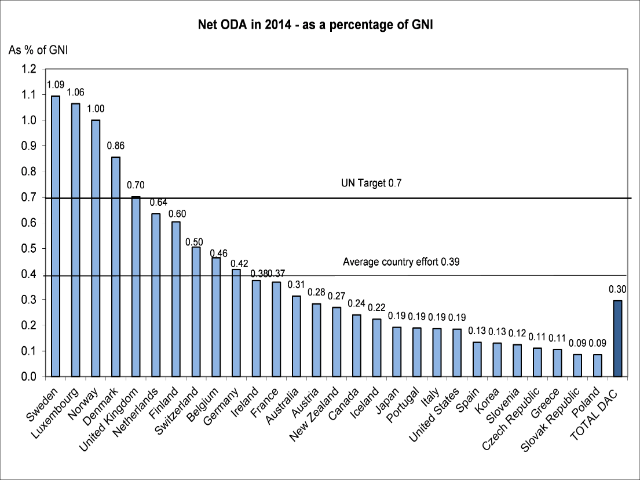
The Organization for Economic Co-operation and Development (OECD) has reported that official development assistance (ODA) for 2015 has decreased to the least developed countries, and as a percent of the Gross National Income of the donor states. Check especially the last chart in this OECD press release — also note that in many cases these data are strongly influenced by forgiveness of foreign debt, which does not represent funds available for new investment in development.

from the OECD web site at <http://www.oecd.org/dac/stats/final-oda-2014.htm>

Final Official Development Assistance Figures in 2015

Key aid totals

In 2014, final figures for net official development assistance (ODA) flows from DAC member countries totalled USD 137.2 billion, marking an increase of 1.2% in real terms over 2013 and surpassing the all-time high in 2013. As a share of GNI, ODA was 0.30%.

Preliminary ODA figures for 2014, published in April 2015, indicated a slight decline (0.5%) in total net ODA compared to 2013 (see http://www.oecd.org/dac/stats/development-aid-stable-in-2014-but-flows-to-poorest-countries-still-falling.htm), but this decline was reversed in the final data, as several members reported slightly higher volumes of aid for certain items (e.g. Italy reported about USD 600 million more in its final data, mostly for in-donor refugee costs).

In the past 15 years, net ODA has been rising steadily and has increased by nearly 70% since 2000.

DAC member performance

The largest DAC donor countries by volume were the United States, the United Kingdom, Germany, France and Japan. Denmark, Luxembourg, Norway, Sweden and the United Kingdom continued to exceed the United Nations’ ODA target of 0.7% of GNI.

G7 countries provided 71% of total net DAC ODA in 2014, and the DAC-EU countries 55%.

Net ODA disbursements by EU Institutions were USD 16.5 billion.

Net ODA allocations from all donors

The largest recipient of total net ODA in 2014 was Afghanistan, which received USD 4.8 billion. Viet Nam and the Syrian Arab Republic were the next largest recipients receiving USD 4.2 billion each, followed by Pakistan, Ethiopia (USD 3.6 billion each), Egypt (USD 3.5 billion) and Turkey (USD 3.4 billion). Total net ODA allocations to the Middle East region (i.e. amounts unspecified by recipient country) amounted to USD 12.3 billion.

Total ODA to the group of least developed countries was USD 43.7 billion, a decrease of 9.3% in real terms compared to 2013. Much of this was the result of lower levels of debt relief, which was relatively high in 2013 due to assistance to Myanmar. Excluding debt relief grants, ODA to the least developed countries fell by about 4.6%.

Total ODA to sub-Saharan Africa was USD 44.3 billion, a decrease of 4.4% in real terms from 2013. Excluding debt relief, the decrease was 2.7%.

For further information, see http://www.oecd.org/dac/stats/final2014oda.htm

Total net ODA in 2014 from DAC donors

Posted in Development, Governance | Tagged | Leave a comment

The “Wise Use” Roots of the Bundy Seizure of the Federal Refuge in Oregon

The Sunday New York Times provides some of this background <http://www.nytimes.com/2016/01/10/opinion/sunday/the-ideological-roots-of-the-oregon-standoff.html?_r=0>, but the 12-year-old piece quoted below from the September 2004 Sierra Club Magazine <http://vault.sierraclub.org/sierra/200409/wiseuse.asp> is clearer about the links to Wise Use and militants in the West, including especially Dick Cheney, James Watt and Gale Norton.

“Wise Use” in the White House
Yesterday’s fringe, today’s Cabinet official.
by David Helvarg

Fifteen years ago [i.e., 1990] the anti-environmental “wise use” movement made a splash with its talk of timber wars, threats to shoot “jackbooted” park rangers and resource managers, and attacks on grassroots environmental activists. You don’t hear much about wise use anymore, but that’s not because the wise-users went away.

Far from it. Just as neoconservatives like Paul Wolfowitz and Richard Perle long pushed their hawkish agenda from the sidelines before becoming key officials, veterans of once-discredited militant anti-environmental groups are now setting natural-resource policy for the [George W.] Bush administration.

Wise use arose in 1988, combining property-rights activists with elements of the timber, mining, oil, and off-road-vehicle industries and a smattering of Reagan administration leftovers. Its original focus was the perceived threat that George H. W. Bush would follow through on his pledge to be “the environmental president.”

Wise-use activists went on to confront the Nature Conservancy, the Sierra Club, and local environmental activists, sometimes with vigilante-style tactics ranging from telephone death-threats to arson and shootings. In Washington, Idaho, Montana, and New Mexico, a number of wise-users even united with the militia movement.

That alliance proved their undoing: Following the deadly 1995 attack on the Murrah Federal Building in Oklahoma City by militia associates Timothy McVeigh and Terry Nichols, wise use lost much of its industry backing and went into decline.

Today wise-use veterans and their lawyers and lobbyists are back, working for the son of the president they once detested. Among prominent appointees in the administration with wise-use backgrounds is Interior Department secretary Gale Norton, who began her career at the Mountain States Legal Foundation back when it billed itself as the “litigation arm of Wise Use.”

Mountain States was the brainchild of Reagan’s notoriously anti-environmental Interior secretary James Watt. (After being forced to resign, Watt told a group of ranchers that “if the troubles from environmentalists cannot be solved in the jury box or at the ballot box, perhaps the cartridge box should be used.”)

Department of Agriculture secretary Ann Veneman also has roots in the movement. As a lawyer in California, Veneman represented wise-use activists opposed to a federal conservation plan for the Sierra Nevada. Her chief of staff, Dale Moore, is a former lobbyist for the National Cattlemen’s Beef Association, a stalwart member of the wise-use coalition, while her undersecretary for natural resources, Mark Rey, was a timber lobbyist and featured speaker at wise-use events through the late 1990s.

Back in its heyday, the movement put forth a 25-point “Wise Use Agenda,” which at the time was dismissed as right-wing fantasy. It included a call to drill for oil in the Arctic National Wildlife Refuge, to log Alaska’s Tongass National Forest, to gut the Endangered Species Act, and to open up public lands to motorized recreation. These and other wise-use bullet points now frame Bush administration environmental policy.

Drilling for oil in the Arctic Refuge has been a constant preoccupation, and the Tongass was opened to wide-scale logging last December. The Endangered Species Act has been continuously undercut. Secretary Norton reversed a plan to ban snowmobiles from several national parks, instead increasing their numbers. She also directed the Bureau of Land Management to find ways to expedite coal, oil, and gas development on 250 million acres of public lands.

The Wise Use Agenda also called for privatizing the national parks and handing them over to people “with expertise in people-moving such as Walt Disney.” Norton has promoted “outsourcing” thousands of National Park Service jobs to the private sector to provide “better delivery of services to the public.”

“I wish we could take credit for that, but we can’t,” demurs wise use’s founding ideologue Ron Arnold of the Center for Defense of Free Enterprise. “Dick Cheney sits on my board of directors, but we’re not pen pals. Sometimes you just put something out there long enough and it gets picked up, despite what you do.”

One victory wise use will take credit for goes back to the early days of the Bush administration, when it appeared the White House might appoint John Turner as Interior secretary. Turner had been head of the Fish and Wildlife Service under the elder Bush, and was a fishing buddy of Dick Cheney’s.

But he was also president of the Conservation Fund, a “non-membership, non-advocacy” land preservation organization, so wise use considered him a “land-grabber” aligned with “the Rockefeller Family Foundation and their financing of the environmental left,” according to Chuck Cushman of the American Land Rights Association. Cushman (known to his admirers as “Rent-a-Riot”) organized an anti-Turner campaign; the angry protest spooked the Bush White House, and Turner’s name was replaced by Gale Norton’s.

“They caved, they blinked,” says wise-use founder Arnold. “Cheney’s probably angry at us, but who cares? Norton is a friend.”

This spring, wise use again stepped in to block the Senate from ratifying the Law of the Seas treaty, an innocuous framework agreement for ocean management and marine protection. With broad support from the Navy, oil companies, the White House, and environmentalists, the Senate Foreign Relations Committee had voted 19—0 to take the agreement to a final vote.

Then wise-use veteran Henry Lamb, former head of the so-called Environmental Conservation Organization (a group founded by developers opposed to wetlands protection) got involved. His new group, Sovereignty International, claimed that the Law of the Seas treaty was a plot to undermine the United States by establishing a “blue hull” United Nations navy (from which presumably to launch the black helicopters of militia-movement fantasy).

Lamb’s group got Senator James Inhofe (R) of Oklahoma to call a hearing regarding “national security concerns” over the treaty, leading Senate Majority Leader Bill Frist (R-Tenn.) to put off the vote until after the presidential elections so as not to alienate Bush’s supporters on the far right.

While traditional wise-use paranoia still proves effective, its rhetoric is softening. Where once leaders like Arnold railed against environmentalists (“We’re out to kill the f––s. We’re simply trying to eliminate them. Our goal is to destroy environmentalism once and for all”), today’s wise-use veterans like Interior secretary Norton take a softer tone.

“We have in many ways reached the limits of what we can do through government regulation,” she blandly asserts. Now that they occupy the seat of power, the wise-use movement no longer needs its blowhards and bullies as it quietly and effectively implements its radical agenda.

Posted in Access, Governance, Resource Management | Tagged | Leave a comment

Capital Gazette Profile: Erik Michelsen, Anne Arundel Watershed Protection and Restoration Program

An excellent profile of the man, and description of the program, by E. B. (Pat) Furgurson III at <http://www.capitalgazette.com/news/ph-ac-cn-people-watch-michelsen-0103-20160103-story.html>

People to watch:

Erik Michelsen

Watershed Protection and Restoration Program Administrator

Erik Michelsen oversees the administration of the county’s multi-million dollar stormwater program. (By Pat Furgurson / Staff)


“Now we are talking about rolling back that damage over a 10-to-15-year time frame. That’s a tall order.”

With the county’s Watershed Protection and Restoration Program slated to get running at full tilt in 2016 the program’s director Erik Michelsen expects to have a busy year.

Over $600 million is budgeted for hundreds of stormwater projects in the next few years, that’s just over half of the projected cost of the backlog of projects needed to meet federal pollution standards by 2025.

Michelsen is charged with coordinating the many moving pieces leading up to and through project construction, keeping the public informed, and more at the helm of the WPRP.

He is honest about the challenge.

“Up to this point we have been using the land aggressively for a few centuries,” he told The Capital last spring. “Now we are talking about rolling back that damage over a 10-to-15-year time frame. That’s a tall order.”

Michelsen’s previous experience as executive director of the South River Federation prepared him for the task. Much of his work there focused on gearing up the organization’s watershed restoration work.

In 2013 the county passed legislation to fund work through a stormwater fee that costs the majority of property owners in the county $85 a year. And the Watershed Protection and Restoration Program was created. In 2015, the County Council and County Executive Steve Schuh wrestled with proposals to gut the funding legislation and attempt to pay for the program through other means. The measures were defeated and the program survived intact.

Perceptions are part of the part of the myriad of issues ahead. Many believe that once stormwater projects are in place by 2025 per federal mandate, the county’s streams and rivers – and the Chesapeake Bay – will be all cleaned up.

But the reality is that 2025 goal means the infrastructure must be in place to begin the long recovery from 400 years of degradation. Results will not be immediately apparent.

Most of the work in the next few years will concentrate on converting stormwater ponds from mere runoff-holding to runoff-cleansing capacity and repairing stormwater outfalls, where pipes carrying stormwater from neighborhoods empty into creeks or other waterways. Those near the top of the list require less planning, design and permitting to accomplish.

The bulk of larger stream restoration projects that require rebuilding miles of eroded streambeds will come later because they require more intense design work, and permitting from federal and state agencies.

As Michelsen has said the WPRP will have an impact on local waterways first, our streams, then creeks, then rivers.

And results of all the effort will likely be enjoyed by his children, or theirs.

Posted in Governance, Watershed Management | Tagged , | Leave a comment

Science Magazine 4 December 2015: Protected Areas and Global Conservation of Migratory Birds — p 1255

An article by Runge, Watson, Butchart, Hanson, Possingham and Fuller.

at <http://www.sciencemagazinedigital.org/sciencemagazine/4_december_2015?sub_id=CrFR7S2tnqdZl&folio=1255&pg=166#pg166>

Bruce
bpotter

Posted in Uncategorized | Leave a comment

First Confusing Health Note of 2016

from the Washington Post Wonkblog: <https://www.washingtonpost.com/news/wonk/wp/2015/12/31/the-surprising-thing-ancient-mummies-tell-us-about-what-to-eat/?wpmm=1&wpisrc=nl_headlines>

Wonkblog

The surprising thing ancient mummies tell us about what to eat

By Peter Whoriskey December 31, 2015

A reconstruction of a 5,000-year-old man based on his mummified remains that were found in the Italian Alps. Signs of heart disease in mummies have led some scientists to reconsider the idea that heart disease is a purely modern phenomena. (A. Ochsenreiter/South Tyrol Museum of Archaeology)
On a foggy day in August 1936, an anthropologist and his crew set sail for Kagamil Island, a small volcanic speck of hot springs and cliffs in the Bering Sea. A person identified as “Brown Bear” had told them of a cave full of mummies and other human remains. Shortly after landing, they found the opening in the rocks near a steam jet.

According to the notes of the anthropologist, Ales Hrdlicka, the cave contained “wonderful riches”:

“Space within cave is limited, in most of it one can not stand up, in none of it can use shovels; must work with hands like badgers. … As the salt deposit is penetrated into, there appears mummy after mummy, in different states of preservation — male, female and especially children … a huge whale shoulder blade … two entire kayaks.”

Nearly 80 years later, the mummies from Kagamil and elsewhere have excited the interest of scientists who say what they have learned from the remains challenges a central tenet of conventional thinking about what we ought to eat.

Heart disease, the leading cause of death in the U.S., is often blamed on modern diets and a sedentary lifestyle. According to this thinking, if only people ate the “right” foods and exercised more, they could live longer. This view is encapsulated in the current version of the government’s Dietary Guidelines for Americans, which are under review and being reissued soon. They have long recommended dietary habits deemed good for your heart — lower intakes of saturated fat and salt, more emphasis on lean meat and seafood.

“Poor diet and physical inactivity are associated with major causes of morbidity and mortality in the United States,” according to those guidelines.

But examinations of the bodies of the Unangans from Kagamil Island and other pre-modern people indicate that, in fact, the modern scourge of heart disease is not at all new, and that people who exercised more than we do as a matter of necessity, and whose diet was free from modern temptations, also suffered striking levels of heart disease, according to the researchers.

In recent years, X-ray based scans of mummies from around the world – including the hunter gatherers of Kagamil as well as those from ancient Egypt, Peru and the American Southwest — found signs of heart disease or atherosclerosis, the plaque lining the arteries near the heart.

Even the reconstructed man shown above, who lived 5,000 years ago, showed signs of atherosclerosis. His mummified remains were discovered in the Italian Alps in September 1991.

[Congress: We need to review the Dietary Guidelines for Americans]

[For decades, the government steered millions away from whole milk. Was that wrong?]

For years, scientists have argued over the extent to which modern diets ought to be blamed for the high rates of heart disease. As an American Heart Association publication summarizes: “There can be little doubt that the Western diet is closely tied to the development of atherosclerosis.”

This belief is widely shared, but it has led to a fierce debate over how exactly people ought to reform their diet. Many leading health groups, including the American Heart Association, have concluded that a person’s heart disease risk depends on “both the quantity and quality of fat in an individual’s diet,” and they urge people to reduce the amount of animal products — especially beef, pork and lamb — that they consume.

That approach has met strong criticism in recent years by critics who argue instead that a diet rich in proteins and lower in carbohydrates — the so-called “cave man” approach — makes it easier to maintain a stable weight and metabolism.

The new research may undercut both positions. By turning up evidence of heart disease in populations with widely varying diets, the mummy research suggests that maybe some other unrecognized cause is at work besides what we choose to eat.

“Although commonly assumed to be a modern disease, the presence of atherosclerosis in pre-modern human beings raises the possibility of a more basic predisposition to the disease,” according to the researchers, who include specialists in cardiology, X-rays, anthropology and other fields.

As the research has found its way over the years into some of the world’s most esteemed medical journals, including the Lancet, which in 2013 published an article about four groups of mummies, critics of the work have charged that the number of mummies that have been examined is relatively small — only a couple hundred or so — and insufficient to support broad conclusions. Moreover, the bodies have been dead a long time, and maybe some other chemical changes create the appearance of arterial plaque.

But the very basic reaction to the mummy research has been this: Given all the research linking heart disease and diet, the results were too unlikely to believe.

“In my opinion the ancient populations did intense physical activity and followed a diet rich in vegetable, free from saturated fats, and therefore [had a] low risk of developing atherosclerosis,” Gino Fornaciari a paleopathologist at the University of Pisa, wrote in an email.

In the past, he said, only “elite individuals” such as kings would have suffered from atherosclerosis because they could have afforded foods that match those of the modern diet.

He said inaccuracies in reading the scans of tissues that were long dead, and dessicated, might have led to inaccuracies in conclusions. The scans, known as CT scans for computerized tomography, are based on computerized analysis of multiple X-ray images. The plaque that causes heart disease consists in part of calcium; those calcified remnants remain in the mummies and show up in the scans.

“On the basis of my long experience of paleo-pathologist of mummies,” Fornaciari said, many false findings are possible.

But the mummy researchers, including cardiologists who look at such scans in living humans, note that the appearance of the atherosclerosis in the CT scans in the mummies is “virtually identical” to the appearance of atherosclerosis in their patients.

This similarity, they said, makes it unlikely that some change in the ancient bodies has created an illusion of atherosclerosis.

Indeed, other researchers find the evidence of ancient heart disease around the world compelling.

“These results confirm that atherosclerosis was present in ancient civilisations with wide cultural differences,” Anthony M. Heagerty, a cardiologist at the University of Manchester, wrote in response to the Lancet article, citing other research along similar lines.

Moreover, the researchers can point to other evidence indicating that heart disease is an ancient affliction.

One text from Egypt dating as far back as 1550 BCE said: “If thou examinst a man for illness in his cardia, and he has pains in his arms, in his breast and on one side of his cardia … it is death threatening him.”

What is more difficult to know from the mummies is how far advanced the heart disease might have been in the individuals, or how much they may have felt the symptoms.

But the scientists said that some of the signs of heart disease appear to have been severe enough that they very likely caused people to suffer. For example, scientists point specifically to one of the mummies from Kagamil Island, a 40-ish woman who lived about 1900.

“What’s remarkable about her is that she would have had a marine diet, and consumed a lot of fish oil,” said one of the researchers, Gregory Thomas, medical director of the Heart Institute at Long Beach Memorial Hospital in Long Beach, Calif. “She ate plenty of sea lions and whale and fish. Inland there would have been berries and leaves.”

Yet the scientists found evidence of severe atherosclerosis in two of the three arteries that supply blood to the heart.

For the cardiologists like Thomas among the researchers, the ramifications of the work are not merely academic. They have changed the way they think about the conventional diet advice typically dispensed to heart patients.

Randall Thompson, a cardiologist at St. Luke’s Mid America Heart Institute in Kansas City and a professor at the University of Missouri-Kansas City School of Medicine, said the research has changed the way he views what we can do to prevent heart disease.

”I’m a clinical cardiologist and I want people to eat a healthy diet, but this puts all that in perspective. … At least part of this disease is not explained by traditional risk factors. These ancient people didn’t have preservatives, everything was organic, they didn’t smoke and they got plenty of exercise. But … the amount of atherosclerosis in ancient times isn’t much different from what you see in modern times. If you account for age, it looks like we’re in the same ballpark.”

Thomas said something similar.

“When I became a cardiologist 30 years ago, I was pretty dogmatic about the low-fat, low-cholesterol diet to prevent heart disease. [But] we’ve been unable to find a culture without atherosclerosis and I’m not really sure what to eat, personally, to delay atherosclerosis, or what to recommend to patients. Of late, I tell people to stay lean.”

Staying lean, he says, keeps cholesterol levels in the bloodstream lower, and helps stave off heart disease.

“We have this wistful hope that if we go back to nature that we would markedly delay atherosclerosis,” Thomas said. “But these people ate a natural diet, and they still had heart disease. I no longer think that way.”

Posted in Health | Tagged | Leave a comment

The Only Thing We Have to Fear is Fear Itself.

from the Boston Globe <http://www.bostonglobe.com/opinion/editorials/2015/04/11/have-seen-enemies-and-they-weak/Cho9J5Bf9jxIkHKIZvnVTJ/story.html?event=event25>

. . . . and no, I didn’t just think up the title of this piece myself. . .

STEPHEN KINZER

The world of threats to the US is an illusion

JOE KLAMAR/AFP/GETTY IMAGES

A Japanese officer watches as a Landing Craft Air Cushion transports US Marines and sailors and soldiers from Japan during a joint military exercise in California in 2014.

By Stephen Kinzer GLOBE STAFF APRIL 12, 2015

WHEN AMERICANS look out at the world, we see a swarm of threats. China seems resurgent and ambitious. Russia is aggressive. Iran menaces our allies. Middle East nations we once relied on are collapsing in flames. Latin American leaders sound steadily more anti-Yankee. Terror groups capture territory and commit horrific atrocities. We fight Ebola with one hand while fending off Central American children with the other.

In fact, this world of threats is an illusion. The United States has no potent enemies. We are not only safe, but safer than any big power has been in all of modern history.

Geography is our greatest protector. Wide oceans separate us from potential aggressors. Our vast homeland is rich and productive. No other power on earth is blessed with this security.

Our other asset is the weakness of potential rivals. It will be generations before China is able to pose a serious challenge to the United States — and there is little evidence it wishes to do so. Russia is weak and in deep economic trouble — not always a friendly neighbor but no threat to the United States. Heart-rending violence in the Middle East has no serious implication for American security. As for domestic terrorism, the risk for Americans is modest: You have more chance of being struck by lightning on your birthday than of dying in a terror attack.

Promoting the image of a world full of enemies creates a “security psychosis” that misshapes our view of the world. It tempts us to interpret defensive steps taken by other countries as threatening. In extreme cases, it pushes us into wars aimed at preempting threats that do not actually exist.

Arms manufacturers profit from the security psychosis even more directly than militarists. Americans take our staggeringly large defense budget almost for granted, and lament continuously that other countries do not build as many exotic weapons systems as we do. Finding new threats is always good business for someone.

With the United State so dominant in global politics, it’s time to secure this low-threat world. Our strategic goal should be to keep our country as safe as it is now. That means bringing troublemaking countries out of their isolation. Ignoring their interests, or seeking “full-spectrum dominance” to assure that they cannot rise, provokes reactions that will be bad for us in the long run.

Last year, after Russia began encouraging upheaval in Ukraine, NATO decided to “suspend all practical civilian and military cooperation” with Russia. Moments of crisis, however, are precisely the times when contact is most urgent. We took advantage of Russia when it was powerless a quarter-century ago. Future peace requires taking its security concerns seriously rather than treating the country as an enemy that is always seeking to best us.

Our policy toward China is less aggressive, but beneath its surface is often a presumption that one day there must be a showdown between our two countries. The recent deal between Western nations and Iran is being sold as the taming of an enemy — although Iran is not our enemy. Neither is Cuba, despite the warnings of revanchists in Washington and elsewhere. Nor are most of the enemies-for-a-day that we eagerly seek, from Sandinistas in Nicaragua to Houthis in Yemen.

I recently asked a United States Navy officer what threats he believed the United States might confront in the future. To my astonishment, he answered, “Venezuela.” The South American country is in political crisis and careening toward bankruptcy. Its combat navy counts six frigates and two submarines, none of them seaworthy. Yet last month President Obama designated Venezuela an “extraordinary threat to US national security.” The search for enemies can lead to odd places.

This impulse is not peculiarly American. Feeling threatened strengthens group solidarity. Some thinkers have gone so far as to suggest that since societies become more united and resolute in the face of enemies, those that have none should find some.

“It is always possible to bind together a considerable number of people in love,” Freud wrote, “so long as there are other people left over to receive the manifestations of their aggressiveness.” Nietzsche believed the nation-state’s “profound appreciation of the value of having enemies” produced a “spiritualization of hostility.” A young country especially, he said, “needs enemies more than friends: in opposition alone does it feel itself necessary.”

When Americans see threats everywhere, we fall into this trap. Believing we are besieged is strangely comforting. To recognize how safe we are would require a change of national mindset that we seem reluctant to make.

Stephen Kinzer is a visiting fellow at the Watson Institute for International Studies at Brown University. Follow him on Twitter @stephenkinzer.

Posted in Uncategorized | Leave a comment