No More Liberal Arts or Social Studies?

From Foreign Affairs, best articles of 2015: <https://www.foreignaffairs.com/articles/united-states/decline-international-studies?campaign=%3Fcid%3Demc-ozy_send-king-121715>

The added emphasis is my own.

ESSAY July/August 2015 Issue

The Decline of International Studies

Why Flying Blind Is Dangerous

By Charles King


In October 2013, the U.S. Department of State eliminated its funding program for advanced language and cultural training on Russia and the former Soviet Union. Created in 1983 as a special appropriation by Congress, the so-called Title VIII Program had supported generations of specialists working in academia, think tanks, and the U.S. government itself. But as a State Department official told the Russian news service RIA Novosti at the time, “In this fiscal climate, it just didn’t make it.” The program’s shuttering came just a month before the start of a now well-known chain of events: Ukraine’s Euromaidan revolution, Russia’s annexation of Crimea, and the descent of U.S.-Russian relations to their lowest level since the Cold War. The timing was, to say the least, unfortunate.
The end of the United States’ premier federal program for Russian studies saved taxpayers only $3.3 million—the cost of two Tomahawk cruise missiles or about half a day’s sea time for an aircraft carrier strike group. The development was part of a broader trend: the scaling back of a long-term national commitment to education and research focused on international affairs. Two years ago, the American Academy of Arts and Sciences warned of a hidden crisis in the humanities and social sciences. “Now more than ever,” the academy’s report concluded, “the spirit of international cooperation, the promotion of trade and foreign investment, the requirements of international diplomacy, and even the enhancement of national security depend in some measure on an American citizenry trained in humanistic and social scientific disciplines, including languages, transnational studies, moral and political philosophy, global ethics, and international relations.” In response to lobbying by universities and scholarly associations, Title VIII was resuscitated earlier this year, but it came back at less than half its previous funding level and with future appropriations left uncertain. Given the mounting challenges that Washington faces in Russia and eastern Europe, now seems to be an especially odd time to reduce federal support for educating the next cohort of experts.
The rise of the United States as a global power was the product of more than merely economic and military advantages. Where the country was truly hegemonic was in its unmatched knowledge of the hidden interior of other nations: their languages and cultures, their histories and political systems, their local economies and human geographies. Through programs such as Title VIII, the U.S. government created a remarkable community of minutemen of the mind: scholars, graduate students, and undergraduates who possessed the linguistic skills, historical sensitivity, and sheer intellectual curiosity to peer deeply into foreign societies. Policymakers sometimes learned to listen to them, and not infrequently, these scholars even became policymakers themselves.
That knowledge flourished in an environment defined by some of the great innovations of American higher education: unfettered inquiry, the assessment of scholarship via rigorous peer review, the expectation that the value of discovery lies somewhere other than in its immediate usefulness, and the link between original research and innovative teaching. If you want evidence-based expertise on terrorism in Pakistan, environmental degradation in China, or local politics in provincial Russia, there is someone in an American university who can provide it. It is harder to imagine a Pakistani scholar who knows Nebraska, a Chinese researcher who can speak with authority about the revival of Detroit, or a Russian professor who wields original survey data on the next U.S. presidential race.
But things are changing. Shifting priorities at the national level, a misreading of the effects of globalization, and academics’ own drift away from knowing real things about real places have combined to weaken this vital component of the United States’ intellectual capital. Educational institutions and the disciplines they preserve are retreating from the task of cultivating men and women who are comfortable moving around the globe, both literally and figuratively. Government agencies, in turn, are reducing their overall support and narrowing it to fields deemed relevant to U.S. national security—and even to specific research topics within them. Worse, academic research is now subject to the same “culture war” attacks that federal lawmakers used to reserve for profane rap lyrics and blasphemous artwork. Unless Washington stops this downward spiral, these changes will not only weaken national readiness. They will also erode the habit of mind that good international affairs education was always supposed to produce: an appreciation for people, practices, and ideas that are not one’s own.

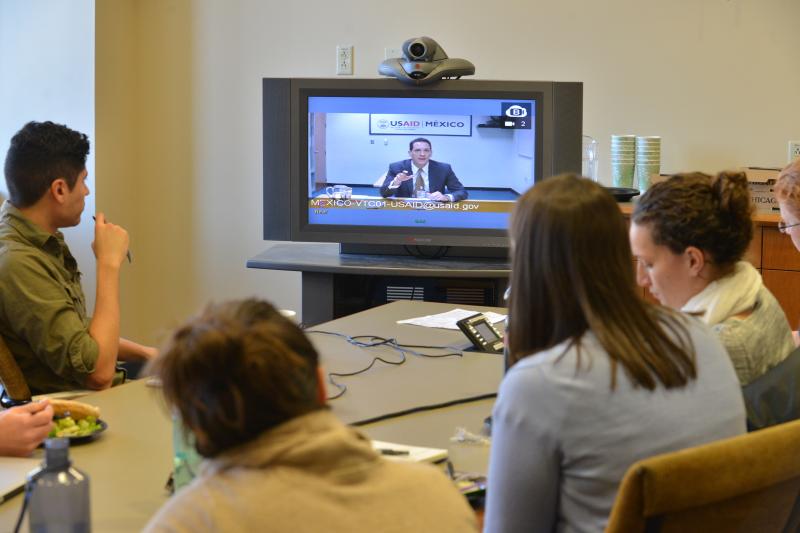
GERALD R. FORD SCHOOL OF PUBLIC POLICY / FLICKRUniversity of Michigan students videoconference with the USAID director for Mexico, August 2014.

LOST IN TRANSLATION?
Americans naturally swing between isolation and engagement with the world, but it is government that has usually nudged them in one direction or the other. A century ago, rates of foreign-language study in Europe and the United States were about the same, with roughly a third of secondary school students in both places learning a modern foreign language. After the United States entered World War I, however, almost half the U.S. states criminalized the teaching of German or other foreign languages in schools. It took a Supreme Court decision in 1923 to overturn that practice.
During World War II, the U.S. government made attempts to train up linguists and instant area experts, but these initiatives quickly faded. It was not until the onset of the Cold War that private universities such as Columbia and Harvard devoted serious attention to the problem and opened pioneering programs for Russian studies. The Carnegie, Ford, and Rockefeller Foundations launched grants for scholars working specifically on Soviet politics, history, or economics.
Only in the late 1950s did the focus on what is now known as internationalization become a national priority—a response to the Sputnik scare and the sense that the Soviets could soon gain superiority in fields well beyond science and technology. The National Defense Education Act of 1958, followed by the Higher Education Act of 1965 and its successors, provided special funding for regional studies and advanced language training for American graduate students. Among other measures, the legislation created a network of National Resource Centers located at major U.S. universities, which in turn ran master’s programs and other forms of instruction to train the next generation of specialists. In 2010, the total size of this allocation, known as Title VI, stood at $110 million, distributed across programs for East Asia, Latin America, the Middle East, Russia and Eurasia, and other areas. Along with the Fulbright-Hays scholarships for international academic exchanges, established in 1961, Title VI became one of the principal sources of funding for future political scientists, historians, linguists, anthropologists, and others working on distinct world regions.
On the face of it, that investment seems to have paid off. American universities have emerged as among the world’s most globally minded. No U.S. college president can long survive without developing a strategy for further internationalization. New schools for specialized study have sprung up across the United States—for example, the University of Oklahoma’s College of International Studies, founded in 2011, and Indiana University’s School of Global and International Studies, which opened in 2012. Older centers—including Georgetown University’s Edmund A. Walsh School of Foreign Service, Johns Hopkins University’s School of Advanced International Studies, Princeton University’s Woodrow Wilson School of Public and International Affairs, Tufts University’s Fletcher School of Law and Diplomacy, and George Washington University’s Elliott School of International Affairs—consistently top world rankings. The U.S. example has become the model for a raft of new institutions around the world, such as the Hertie School of Governance in Berlin and the Lee Kuan Yew School of Public Policy in Singapore, founded in 2003 and 2004, respectively, and the Blavatnik School of Government at Oxford University, founded in 2010.
Education and research are now less national priorities than objects of political jockeying.

True, young Americans can play video games with their peers in Cairo, chat online with friends in St. Petersburg, and download music from a punk band based in Beijing. But consuming the world is not the same as understanding it. After a steady expansion over two decades, enrollment in foreign-language courses at U.S. colleges fell by 6.7 percent between 2009 and 2013. Most language programs experienced double-digit losses. Even Spanish—a language chosen by more U.S. students than all other languages combined—has suffered its first decline since the Modern Language Association began keeping count in 1958. Today, the third most studied language in U.S. higher education, behind Spanish and French, is a homegrown one: American Sign Language.
Something similar has happened in the unlikeliest of places: among professional scholars of international relations. According to an annual survey conducted by the College of William and Mary, 30 percent of American researchers in the field say that they have a working knowledge of no language other than English, and more than half say that they rarely or never cite non-English sources in their work. (Forty percent, however, rank Chinese as the most valuable language for their students to know after English.) At least within the United States, the remarkable growth in the study of international relations in recent decades has produced one of the academy’s more parochial disciplines.
Part of the problem lies in the professoriate. An iron law of academia holds that, with time, all disciplines bore even themselves. English professors drift away from novels and toward literary theory. Economists envy mathematicians. Political scientists give up grappling with dilemmas of power and governance—the concerns of thinkers from Aristotle to Max Weber and Hans Morgenthau—and make their own pastiche of the natural sciences with careful hypotheses about minute problems. Being monumentally wrong is less attractive than being unimportantly right. Research questions derive almost exclusively from what has gone unsaid in some previous scholarly conversation. As any graduate student learns early on, one must first “fill a hole in the literature” and only later figure out whether it was worth filling. Doctoral programs also do a criminally poor job of teaching young scholars to write and speak in multiple registers—that is, use jargon with their peers if necessary but then explain their findings to a broader audience with equal zeal and effectiveness.

TIM SACKTON / FLICKRA sea of chairs ahead of Harvard University’s 2013 commencement.

Still, the cultishness of the American academy can be overstated. Today, younger scholars of Russia and Eurasia, for example, have language skills and local knowledge that are the envy of their older colleagues—in part because of decades of substantial federal investment in the field and in part because many current students actually hail from the region and have chosen to make their careers in American universities. Even the increasing quantification of political science can be a boon when abstract concepts are combined with grass-roots understanding of specific contexts. Statistical modeling, field experiments, and “big data” have revolutionized areas as diverse as development economics, public health, and product marketing. There is no reason that similar techniques shouldn’t enrich the study of international affairs, and the private sector is already forging ahead in that area. Companies such as Dataminr—a start-up that analyzes social-media postings for patterns to detect breaking news—now track everything from environmental crises to armed conflict. Foreign policy experts used to debate the causes of war. Now they can see them unspooling in real time.
The deeper problems are matters of money and partisan politics. In an Internet-connected world infused with global English, private funders have radically scaled back their support for work that requires what the political scientist Richard Fenno called “soaking and poking”: studying difficult languages, living in unfamiliar communities, and making sense of complex histories and cultures. Very few of the major U.S. foundations finance international and regional studies on levels approaching those of two decades ago. Foundation boards, influenced by the modish language of disruption and social entrepreneurship, want projects with actionable ideas and measurable impact. Over the short term, serious investments in building hard-to-acquire skills are unlikely to yield either. And these developments don’t represent a mere shift from the study of Russia and Eurasia to a focus on the Middle East and East Asia—a pivot that would be reasonable given changes in global politics. The Carnegie Corporation of New York, for example, ended its prestigious senior fellowship program on Muslim societies in 2009 and wound down its wider Islam Initiative shortly thereafter.
The U.S. government has followed suit. The suspension of Title VIII was only the latest in a series of cutbacks. The Foreign Language Assistance Program, created in 1988 to provide local schools with matching grants from the Department of Education for teaching foreign languages, ended in 2012. The previous year, Title VI funding for university-based regional studies fell by 40 percent and has flatlined since. If today’s Title VI appropriation were funded at the level it was during the Johnson administration, then it would total almost half a billion dollars after adjusting for inflation. Instead, the 2014 number stood at slightly below $64 million.

The same thing has happened with direct funding to undergraduates and graduate students, particularly when it comes to the National Security Education Program (NSEP), which offers students financial assistance for foreign-language study and cultural immersion. NSEP was established in 1991 on the initiative of David Boren, then a Democratic senator from Oklahoma, with the goal of training a new, post–Cold War generation of foreign affairs specialists. The program’s signature elements—Boren Scholarships and Boren Fellowships—offer grants of up to $30,000 to highly qualified undergraduates and graduate students in exchange for at least a year of federal government service in national security after graduation. For all its prestige, however, and despite nominal support among both liberals and conservatives, the Boren program offers fewer such awards today than it did in the mid-1990s.

Another element of NSEP is an innovative initiative for heritage speakers—American citizens who possess native abilities in a foreign language and wish to develop professional-level skills in English—and it, too, has shrunk. The initiative has never been able to fund more than 40 people per year, most of them native speakers of Arabic or Mandarin, and the number has been steadily falling, reaching just 18 in 2014. (This program is now housed at Georgetown University, where I teach.) In a somewhat encouraging sign, enrollment has been growing markedly in NSEP’s Language Flagship program, which gives grants to colleges to field advanced courses in languages deemed important for national security. But the raw numbers reveal just how small the United States’ next generation of linguists actually is. Last year, the total number of students enrolled in NSEP-sponsored courses for all the “critical languages”—Arabic, Chinese, Hindi, Korean, Persian, Portuguese, Russian, Swahili, Turkish, Urdu, and Yoruba—was under a thousand.
In tandem with these trends, scholarly research in global affairs, especially work funded by the National Science Foundation, has come under growing attack. The annual appropriation for the NSF is around $7.3 billion, of which a fraction—less than $260 million—goes to the behavioral, social, and economic sciences. Of that figure, only about $13 million goes to political scientists, and an even smaller amount goes to those doing research on international affairs. Still, these scholars now receive the kind of lambasting that used to be directed mainly against the National Endowment for the Arts.
As just one example, for the past two years, the NSF has been the particular focus of the House Committee on Science, Space, and Technology, which oversees the foundation along with portions of the Federal Aviation Administration, NASA, and other agencies. The committee intends to subject all NSF-funded projects to a relevance test that would require the foundation to certify that every taxpayer dollar is spent “in the national interest.” In a recent opinion piece for The Hill, Lamar Smith, the Republican representative from Texas who chairs the committee, pilloried NSF-funded researchers working on the environmental history of New Zealand, women and Islam in Turkey, and local politics in India. “How about studying the United States of America?” he wrote. “Federal research agencies have an obligation to explain to American taxpayers why their money is being used to provide free foreign vacations to college professors.” In response to this kind of criticism, academic associations have hired their own lobbyists—a recognition of the fact that education and research are now less national priorities than objects of political jockeying, on par with items on the wish lists of private corporations and interest groups.
The crusade for relevance is part of a broader development: the growing militarization of government-funded scholarship. Researchers in international and regional studies have always doffed a hat to strategic priorities. Even historians and literature professors became accustomed to touting their work’s policy significance when they applied for federal grants and fellowships. But today, a substantial portion of assistance comes directly from the U.S. Department of Defense. The department’s Minerva Initiative provides support for research on “areas of strategic importance to U.S. national security policy” and for “projects addressing specific topic areas determined by the Secretary of Defense,” as the call for applications says. In the current three-year cycle, which runs until 2017, the program expects to disburse $17 million to university-based researchers in the social sciences. Millions more have been allocated since the first round began in 2009.

MILLER CENTER / FLICKRFormer U.S. Secretary of State Madeleine Albright delivers a talk at the University of Virginia, February 2013.

But there is a substantial difference between research that broadly supports the national interest and work that directly enhances national security. Developing new techniques for teaching Arabic and Chinese, for example, or analyzing EU regulatory policy is the former without necessarily being the latter. When scholars need research money and Washington needs actionable analysis, the danger is that the meaning of the term “national security” can balloon beyond any reasonable definition. Even more worrying, in an era of real transnational threats, knowledge that used to be thought of as the purview of the police—say, how to manage a mass protest and deter crime—can easily slide into matters of surveilling and soldiering.
Congressional staff could spend their time on things other than trips to the NSF archives to root out recondite research topics for public ridicule.
It was once the case that state-supported research was meant to give the United States an edge in its relations with other countries. Now, with programs such as Minerva, the temptation is to give government an edge over the governed. Recent Minerva projects have focused on the origins of mass political movements, “radicalization” among Somali refugees in Minnesota, and—in the words of one project summary—“the study of Islamic conversion in America,” aimed at providing “options for governments to use for the tasking of surveillance.” Professors funded by Minerva work with project managers at U.S. military research facilities, who in turn report to the secretary of defense, who has by definition found the research topics to be matters of strategic concern. In an incentive structure that rewards an emphasis on countering global threats and securing the homeland, the devil lies in the definitions. In this framework, the Boston Marathon bombing becomes a national security problem, whereas the Sandy Hook massacre remains a matter for the police and psychologists—a distinction that is both absurd as social science and troubling as public policy.
THE PRICE OF GLOBAL ENGAGEMENT
Things could be different. Funding for foreign-language study, cultural immersion, and advanced inquiry could be a federal priority, with funding levels restored to what they were in previous years. Research and teaching could be placed at one remove from the national security apparatus, as they are in the Department of Education’s model for Title VI or in a public trust along the lines of the National Endowment for the Humanities. The creation of knowledge and its communication through instruction could be made immune from “gotcha” politics. And congressional staff members could spend their time on things other than trips to the NSF archives to root out recondite research topics for public ridicule.
At the same time, universities have their own part to play. Disciplines can, and do, go haywire. Researchers and graduate students should be judged not by how well they embed themselves in a scholarly mainstream but by how truly original and world-connected they aim to be. Fundable scholarship should not be reduced to a narrow matter of national security. But it is hard to see why anyone would make a career of international affairs—a pursuit that begins with valuing people, cultures, and polities in all their diversity—without some commitment to serving the public interest.
Given that no one can know where the next crisis will erupt, having a broadly competent reserve of experts is the price of global engagement. Yesterday’s apparent irrelevancies—the demographics of eastern Ukraine, for example, or popular attitudes toward public health in West Africa—can suddenly become matters of consequence. Acquiring competence in these sorts of topics forms the mental disposition that J. William Fulbright called “seeing the world as others see it”—an understanding that people could reasonably view their identities, interests, politics, and leaders in ways that might at first seem bizarre or wrong-headed. It also provides the essential context for distinguishing smart policy-specific questions from misguided ones. Great powers should revel in small data: the granular and culture-specific knowledge that can make the critical difference between really getting a place and getting it profoundly wrong.
International affairs education and research are also part of a country’s domestic life. Democratic societies depend on having a cadre of informed professionals outside government—people in universities, think tanks, museums, and research institutes who cultivate expertise protected from the pressures of the state. Many countries can field missile launchers and float destroyers; only a few have built a Brookings Institution or a Chatham House. Yet the latter is what makes them magnets for people from the very places their institutions study. The University of London’s nearly century-old SOAS, for example, which focuses on Asian and African studies, is a beehive of languages and causes, where Koreans, Nigerians, and Palestinians come to receive world-class instruction on, among other things, North and South Korea, Nigeria, and the Palestinian territories.
All of this points to just how important international and regional studies can be when they are adequately funded, publicly valued, and shielded from the exigencies of national security. Their chief role is not to enable the makers of foreign policy. It is rather to constrain them: to show why things will always be more complicated than they seem, how to foresee unintended consequences, and when to temper ambition with a realistic understanding of what is historically and culturally imaginable. For more than half a century, the world has been shaped by the simple fact that the United States could look at other countries—their pasts and presents, their myths and worldviews—with sympathetic curiosity. Maintaining the ability to do so is not only a great power’s insurance policy against the future. It is also the essence of an open, inquisitive, and critical society.

Enjoy this free article from Foreign Affairs

All visitors get access to one full-length article each month. Register for free to continue reading.
Registered users get access to one free article every month.
REGISTERHave an account? Log in here.

Related Tweets

t of 2015United States

Posted in Governance | Leave a comment

IISDRS Summary of the Paris Climate Change Conference UNFCCC COP21 — Deal of the Decade

@IISDRS Summary & Analysis from #UNFCCC #COP21
posted on Thursday, 17 December 2015

[Click here to visit IISD Reporting Services.]

Paris Climate Change Conference – November 2015 (UNFCCC COP 21)

30 November – 11 December 2015 | Paris, France

http://www.iisd.ca/climate/cop21/enb/

The Paris Climate Change Conference convened from 29 November to 13 December 2015, in Paris, France. It included the 21st session of the Conference of the Parties (COP 21) to the UN Framework Convention on Climate Change (UNFCCC) and the 11th session of the Conference of the Parties serving as the Meeting of the Parties to the Kyoto Protocol (CMP 11). Three subsidiary bodies (SBs) also met, the 43rd sessions of the Subsidiary Body for Scientific and Technological Advice (SBSTA 43) and the Subsidiary Body for Implementation (SBI 43), and the 12th part of the second session of the Ad Hoc Working Group on the Durban Platform for Enhanced Action (ADP 2-12).

The Paris Climate Change Conference brought together over 36,000 participants, nearly 23,100 government officials, 9,400 representatives from UN bodies and agencies, intergovernmental organizations and civil society organizations, and 3,700 members of the media.

Focus in Paris centered on advancing negotiations on the Paris Outcome, including a legally-binding agreement and associated decisions, to fulfill the mandate outlined in Durban, South Africa, at COP 17, for the ADP “to develop a protocol, another legal instrument or an agreed outcome with legal force under the Convention applicable to all Parties” to be adopted at COP 21. The ADP opened a day early, on Sunday, 29 November, in order to launch technical negotiations.

A leaders event, which brought together over 150 Heads of State and Government, was held on Monday, 30 November, to generate political will towards an agreement. During the first week, work concentrated under the ADP, which launched a contact group to consider crosscutting issues and items not associated with agreement articles, and established spin-off groups to work on the text of individual articles in the draft agreement text and their associated decision text, as well as decision text on pre-2020 ambition.

Following the closure of the ADP on Saturday, 5 December, and the transmission of the ADP’s outcome to the COP, the Comité de Paris was established under the COP 21 Presidency to continue work on the draft agreement and decision text. Minister-led indabas, bilaterals and other consultations took place under the Comité de Paris from Sunday through Saturday, 6-12 December. Following intensive consultations by the COP 21 Presidency on Thursday and Friday, 10-11 December, the Comité de Paris convened briefly on Saturday morning, 12 December, for the presentation of the final text. After consultations by groups of parties, the Comité de Paris reconvened in the evening to forward the final text of the Paris Agreement and associated decision to COP 21. At 7:29 pm, COP 21 adopted the Paris Agreement and the associated decision.

Parties also adopted 34 decisions, 23 under the COP and 12 under the CMP, that, inter alia: adopt the Paris Agreement; enhance technology development and transfer through the Technology Mechanism; decide on the process to assess progress made in the process to formulate and implement national adaptation plans (NAPs); extend the mandate of the Least Developed Countries Expert Group (LEG); adopt the terms of reference for the third comprehensive review of the implementation of the capacity-building framework; address methodological issues under the Kyoto Protocol, including clarification of the Section G, Article 7.3ter of the Doha Amendment; provide methodological guidance for reducing emissions from deforestation and forest degradation in developing countries, and the role of conservation, sustainable management of forests, and enhancement of forest carbon stocks (REDD+); provide guidance to the Clean Development Mechanism (CDM) and Joint Implementation (JI); and approve the programme budget for the UNFCCC for the biennium 2016-2017.

The Summary of this meeting is now available in PDF format

at http://www.iisd.ca/download/pdf/enb12663e.pdf and in HTML format at

http://www.iisd.ca/vol12/enb12663e.html

Like us on Facebook and Follow us on Twitter

A BRIEF ANALYSIS OF THE PARIS CLIMATE CHANGE CONFERENCE

In Paris, we have seen many revolutions.

The most beautiful, most peaceful revolution has been achieved, a climate revolution.

—François Hollande, President of France

The 2015 Paris Climate Change Conference was perhaps destined to succeed. After a bruising failure in Copenhagen in 2009 to produce a legally-binding agreement, many felt that Paris could not afford to fail. Yet there was also concern that the outcome would be watered-down or meaningless. In the end, the outcome of UNFCCC COP 21 exceeded expectations, producing an agreement that while perhaps not a revolution, is an important step in the evolution of climate governance and a reaffirmation of environmental multilateralism.

At COP 21, 195 countries gathered to complete the task they had set for themselves in Durban, in 2011, to complete a “protocol, another legal instrument or an agreed outcome with legal force under the Convention applicable to all parties.” This brief analysis explores the extent to which parties fulfilled this mandate, in terms of universal participation, but also in terms of the Paris Agreement’s ability to catalyze ambitious action by parties and action by a wide range of actors, which many cited as indispensable to address the climate crisis.

EVOLUTION AND REVOLUTION

The Paris Agreement can be characterized as an evolution in climate governance, and a revolution in the UNFCCC COP process. At the center of the Paris Agreement are five-year cycles: each nationally determined contribution (NDC) cycle is to be more ambitious than the last and a global “stocktake” will inform collective efforts on mitigation, adaptation and support, and occur midway through the contribution cycle, every five years after 2023.

Through these cycles, parties are to “ratchet up” efforts to keep global temperature rise “well below 2°C above pre-industrial levels and to pursue efforts to limit the temperature increase to 1.5°C above pre-industrial levels.” To track progress, parties are bound to a transparency framework, which represents the legally-binding portion of the agreement, alongside an obligation to undertake and communicate their NDCs.

The Paris Agreement also anchors, strengthens and creates institutions and mechanisms, particularly for means of implementation. The decision supporting the Agreement identifies modalities to be created or established for several new mechanisms, such as the new Paris Committee for Capacity-building and the mitigation and sustainable development mechanism. The decision also requests SBSTA to develop new modalities to account for public climate finance.

As many pointed out during the COP closing plenary, the Paris Agreement, as a compromise, “is good, but not perfect.” The communication of NDCs is legally-binding, but their content and targets are not. The Agreement includes reference to loss and damage, and the Warsaw International Mechanism on Loss and Damage associated with Climate Change Impacts, as a distinct article from adaptation. This separation was a “win” for many small island developing states (SIDS), yet the explicit exclusion of liability and compensation in the decision was a disappointment to many, as the costs associated with loss and damage cannot be covered by risk insurance alone.

In the immediate term, developed countries are not bound by the Agreement to increase their mitigation or support efforts beyond existing commitments. As many lamented, the US$100 billion finance mobilization goal, set to be reached by developed countries in 2020, is “essentially extended in the decision through 2025,” after which time parties will have to negotiate a new collective goal, which some interpreted as including an expectation that some developing countries should participate in the mobilization.

The inclusion of human rights in the preamble of the agreement was celebrated by many, including Venezuela and Bolivia. This makes the Paris Agreement the first multilateral environmental agreement to recognize human rights. The preamble also includes concepts not traditionally considered “climate issues,” such as intergenerational equity, climate justice and the right to health. Yet the Agreement does not operationalize these rights throughout, which disappointed, in particular, gender advocates who pointed out that the final text omits references to gender responsiveness that were present in a number of sections in earlier drafts.

In terms of the broader development of global climate governance, the Agreement reflects an evolution of the “bottom-up” approach. The Paris Agreement can be described as a hybrid between a top-down, rules-based system and a bottom-up system of pledge and review. The NDCs “codify” the bottom-up approach that emerged from Copenhagen. Yet, many pointed to “vestiges” of a Kyoto Protocol-type, top-down system, in the form of the common rules for transparency and the compliance mechanism, although some noted that the compliance mechanism is “merely” facilitative in nature as it lacks an enforcement branch. In short, the procedural aspects of the Paris Agreement are legally-binding. Nevertheless, most substantive elements, including the specific goals of the NDCs that will be housed in a public registry maintained by the Secretariat, are not legally-binding.

The Agreement also represents an evolution in how parties address differentiation. The Agreement builds on the compromise in Lima, which drew from a 2014 US-China joint announcement on climate change, that adds the element of “in light of different national circumstances” to the end of the familiar CBDR and respective capabilities. It makes no explicit mention of the annexes of the Convention, the historic harbingers of differentiation, but only developed and developing countries, with subtle re-alignments in various sections. The NDCs represent, as US Secretary of State John Kerry called them, a “monument to differentiation”: each country determines its “fair contribution,” according to its respective capabilities and in light of its “different national circumstances.”

The transparency framework is, according to one observer “subtly trifurcated,” asking all to take legally-binding reporting requirements, with recognition of developing countries’ need for support, and a further recognition of the special capacity-building needs of SIDS and least developed countries. As insisted by many developing countries, the provision of support is more strictly bifurcated, as developed countries “shall provide financial resources,” while other countries are encouraged to “provide such support voluntarily.”

Achieving such an evolution in global governance requires nothing short of a procedural revolution. This was the major innovation of the French Presidency. Under the guidance of COP 21 President Laurent Fabius, COP 21 managed to uphold a highly-transparent and inclusive process for parties, which catered to the needs of individual states, while challenging parties to craft an agreement that was more substantive than many thought possible.

The French borrowed the indaba model from the Durban COP, and learned from Copenhagen that Heads of State and Government provide political guidance and should not negotiate text. In a process that started before the 2014 Lima COP, the French Presidency worked in partnership with the Peruvian Presidency, to convene several ministerial meetings “to get the ministers well-acquainted.”

On the margins of the meetings organized by the French Presidency, a group of approximately 15 “like-minded” ministers from different regions and groups was brought together by the Marshall Islands. These informal meetings formed the basis of what became known as the “High-Ambition Coalition.” This loose alliance, eventually representing up to 100 countries, rallied around a list of “ambitious asks,” such as a clear long-term goal and five-year review cycles, creating a show of solidarity that some said effectively marginalized those not in the group. Many noted that these ambitious asks eventually found their way into the Agreement.

Another procedural revolution by the Presidency was to keep the full responsibility for the text’s development on the parties’ shoulders. Ministers had to engage with the lengthy, heavily bracketed text parties had developed in the ADP contact group, and subsequent iterations released during the second week faithfully reflected parties’ consultations. By not dropping a surprise text late in the proceedings, the French Presidency ensured that the text was party-owned and parties understood they had the collective responsibility for its success or failure. Many parties had quietly speculated throughout the meeting that the Presidency had its own text, but regardless of its existence, one was never unveiled. This galvanized ministers to do the heavy lifting of sorting through options and brackets themselves.

The transparency of the process, as one delegate put it, drove the ambition of what parties could achieve; this time, there was no “easy out of rejecting the President’s text.” Above all, the French Presidency said it would, and did, listen. That every party praised the Presidency is not only a tribute to the French Presidency, but a recognition that they all believed their positions were heard.

A PARTICIPATORY OR AN AMBITIOUS EVOLUTION?

Universal participation can come at the expense of ambition. Oftentimes, bringing all on board can result in a watering down of the overall level of ambition. At first glance, this appears to be the case, leading some observers to reject the deal as “business as usual.” Contributions that are nationally-determined, however, became a “necessity” to achieve universal participation because no single set of rules or targets could accommodate the vastly different circumstances of 195 states. The current set of 189 intended NDCs, representing 95% of global emissions―which many lauded as a remarkable level of participation―put collective efforts only on a path to an approximately 3 °C temperature increase. For some, much of the success of the Paris Agreement will hinge on its ability to encourage parties to ratchet up their contributions to a sufficient level of ambition to safeguard the planet.

One way to increase ambition that many sought when they arrived in Paris was a legally-binding agreement. Yet specifying that an agreement is legally binding does not guarantee implementation and may reduce both ambition and participation. As Minister Vivian Balakrishnan of Singapore observed, “the Kyoto Protocol had the best of intentions,” yet was modest in its aims. It also lacked participation by key countries. While the NDCs represent significant participation, their non-legally binding character raised concerns over their low collective ambition.

Others viewed goal-setting as a way to increase the ambition of the agreement. The Agreement’s references to pursuing efforts to limit global average temperature rise to 1.5 °C, coupled with references to peaking emissions as soon as possible, and achieving a balance between anthropogenic emissions and removals by sinks, a phrase many believe refers to net-zero emissions, are significantly more ambitious than many expected before COP 21. These new goals have implications for governments. As one delegate observed, the intended NDCs submitted before COP 21 need to be re-evaluated in light of the goals articulated in the Paris Agreement. Some observers hoped this would inspire at least some countries to revise their intended NDCs into more ambitious NDCs.

The transparency framework and the global stocktake were described by some as the Agreement’s “mechanisms for ambition.” The dual obligation to report and take stock of mitigation, adaptation and support every five years creates a collective assessment of achievements and needed efforts. Reviewing the extent of support provided “places a microscope” on developed countries to provide adequate support to meet developing countries’ mitigation and adaptation ambitions. Many hoped this would also provide assurances to help some countries remove the conditionalities from the mitigation section of their INDCs.

For many developing countries, post-2020 ambition relies on pre-2020 ambition. The Paris Outcome includes the Durban Platform’s workstream 2, tasked to address the pre-2020 mitigation gap, in a number of ways. These include a strengthened technical examination process (TEP) on mitigation that strives to involve more developing country experts and other actors, and formalizes the role of the technology and financial mechanisms of the Convention in the process. Also a new TEP is established on adaptation, welcomed by many developing countries where adaptation is as important as mitigation. Some viewed these institutional links as potentially moving the TEPs beyond “talk shops” and into “solutions spaces” where technologies and practices for both mitigation and adaptation become globally disseminated.

In addition, a facilitative dialogue at COP 22 will assess progress in pre-2020 implementation, and a high-level event at each COP from 2016-2020 will build on the current and previous COP Presidencies’ Lima-Paris Action Agenda (LPAA) initiative. Whether these processes together can raise pre-2020 ambition will only be determined in the coming years. For many, the answer to unlocking pre-2020 ambition lies in the Convention’s ability to engage transnational and subnational actors.

CREATING A “CLIMATE REVOLUTION FOR ALL”

As noted by COP 21 President Fabius, the success of the Paris conference would not only depend on a universal intergovernmental agreement. Action by state and non-state actors will ultimately determine whether Paris will go down in history as “the beginning of the end of the fossil fuel era,” as one country announced. The Paris Agreement could deliver in this area in three ways: through the agreement; by showcasing and mobilizing action by all actors; and by expanding the UNFCCC’s role in the fast-changing global implementation space.

At the Leaders Event on 30 November, numerous Heads of State and Government called for Paris to send strong long-term signals. UN Secretary-General Ban Ki-moon called on Paris to send a clear message to markets that transition to a low-carbon, climate resilient global economy is “inevitable, beneficial and already under way.” Also, some countries called for the Agreement to provide assurances that climate finance would be available and scaled up post-2020, in particular for the most vulnerable.

The Paris Agreement indeed sends strong signals for climate action by all. The ambitious goals of the Agreement, five-year review cycles, and the transparency framework were welcomed by many as much-needed signals to markets to enable investments to be redirected to low-carbon and climate-resilient development. Some also pointed out that the universal nature of the agreement and near-universal coverage of intended NDCs alone send signals that opportunities for investments, innovation and technology development are opening up around the world. Article 6 on cooperative approaches and mechanisms was also praised for “having something for everyone” and giving carbon markets a much-needed, renewed basis for support, complete with demand for credits driven by countries’ progressively ambitious NDCs.

Another important goal set for COP 21 was to accelerate climate action by both state and non-state actors. In forming the LPAA in late 2014, the Peruvian and French COP Presidencies, together with the UN Secretary-General and the UNFCCC Secretariat, built on the momentum achieved by the September 2014 UN Climate Summit to bring non-state actors “inside the COP walls,” as described by COP 20 President Manuel Pulgar-Vidal.

Despite some concern that COP 21 would be a one-off tour de force of state and non-state actor commitments, many initiatives were launched or strengthened in Paris that will build momentum in the longer term. These include India’s International Solar Alliance involving more than 120 countries and the private investor-led US$2 billion Breakthrough Energy Coalition. Also, thousands of pledges of action and hundreds of billions of dollars in commitments to emission reductions and resilience measures were articulated through and alongside the LPAA, ranging from electrification in Africa to emission cuts in forest countries and climate risk insurance in SIDS.

Finally, many felt the Durban Platform, in particular its pre-2020 workstream, offered the UNFCCC a chance to reposition itself as the hub for global climate action. By Paris, this opportunity was seized at least three ways: the LPAA’s Non-State Actor Zone for Climate Action (NAZCA) portal and the public registry for NDCs, both maintained by the UNFCCC Secretariat, will serve as important focal points for aggregated information on climate plans, actions and support. The strengthened mitigation TEP, new adaptation TEP, and the LPAA-based high-level events, too, are likely to spur accelerated engagement with non-state actors within the UNFCCC space. Also, while the Paris outcome decision simply includes an invitation to non-party stakeholders to scale up their efforts and support actions, UNFCCC COPs have already managed to establish themselves firmly as the main annual “cross-fertilization space” for civil society, scientists, businesses and industry from all around the world to rally public attention, network and share best practices.

“VIVE L’UN, VIVE LA PLANETE, VIVE LA FRANCE”

—François Hollande, President of France

Getting to an agreement was an arduous, lengthy task, and yet, as many recalled during the closing plenary “the work starts tomorrow.” Work to catalyze climate action before 2020 is pressing, and immediately lying ahead is the substantial technical and methodological work in order to prepare the many modalities to support the Paris Agreement for when it enters into force. It was not lost for many that the entry into force is not a foregone conclusion, given that 55 countries representing at least 55% of global emissions are required to ratify. Before 2020, many eyes will be on the major emitters whose ratification is necessary for the Paris Agreement to “come into effect and be implemented by 2020,” thereby completing the final leg of the Durban mandate.

During the COP 21 closing plenary, many lauded the Paris Agreement as an ambitious, fair and universal climate agreement, and many more celebrated the return to successful multilateral efforts to address climate change. Some observers viewed Paris as the culmination of a vital year for the UN development agenda, with the adoption of the 2030 Agenda for Sustainable Development, including its Sustainable Development Goals, and the Addis Ababa Action Agenda on financing for development, which together with the Paris Agreement on climate change can be said to provide a strong basis for multilateralism for the coming decade.

After years of doubt and indecision, the Paris Agreement represents renewed faith that multilateralism can address pressing challenges facing the international community. With its adoption on Saturday, 12 December 2015, most participants agreed with UNFCCC Executive Secretary Christiana Figueres that “we must, we can and we did.”

Posted in Civil Society, Climate Change, Governance | Tagged | Leave a comment

Holiday Giftlet

Tromelin_FT4TA

The fascinating story of tiny Ile Tromelin, as published in the double holiday edition of The Economist.

via Lèse humanité | The Economist.

Posted in Fun, Small Island | Leave a comment

Endocrine Disruptors Fingered as Cause of Smallmouth Collapse in Susquehanna

A key issue for the Bay is the duration or geographic reach of endocrine disruptor effects as they travel down the Bay, and how is this influenced by factors such as stream flow, temperature, and salinity. If effects are long-lived, the collapse of the smallmouth bass populations in the Susquehanna River may just be the first step in a Bay-wide disaster.

From the LancasterOnline

Study: hormone-disrupting chemicals, herbicides, pathogens and parasites likely cause of Susquehanna bass collapse

Updated Dec 14, 2015

Herbicides, hormone-disrupting chemicals, as well as pathogens and parasites in the water, are the most likely causes for the decade-long decline of prize game fish in the Susquehanna River, a new study by state and federal agencies says.

 “This study does not identify a single smoking gun,” said John Quigley, secretary of the state Department of Environmental Protection. “But it does point the way toward likely causes, which we will continue to pursue.”

The study by the agency, the Pennsylvania Fish and Boat Commission and six partner agencies is the latest and most extensive probe yet into the cause of die-offs of smallmouth bass and the alarming appearance of tumors, lesions and bass with both male and female organs.

Affected fish have been found in various parts of the Susquehanna and Juniata rivers.

The search for a cause — and solution — has at times pitted state agencies against each other.

In 2013, the Fish and Boat Commission and environmental groups urged the Department of Environmental Protection to declare the lower Susquehanna from the Holtwood Dam to Sunbury as impaired, which would have forced the state to find a solution.

But the agency refused, saying not enough was yet known about the causes. But it promised to conduct an extensive study into the sources of the problem.

Neil Shader, agency spokesman, said the agency was considering the latest study as it prepares its next round of listing impaired bodies of water for the federal Environmental Protection Agency.

Some 14 possible causes were researched. Now considered unlikely are high flows, pH and dissolved oxygen. Invasive species, habitat and blooms of algae are deemed uncertain.

The federal Environmental Protection Agency aided in the latest study.

Endocrine disruptors are chemicals that, at certain doses, can interfere with the hormone system in fish and mammals.

The study said sources can be from pharmaceuticals, fertilizers, and household cleaning products. Discharges from sewage plants and farm runoff would be likely sources. Quigley said endocrine disrupters can also come from industry, residential/commercial landscaping, golf courses and roadways.

Since the smallmouth bass collapse surfaced in 2005, the study team has used more than 30,000 water-quality records and latest research findings to narrow the list of causes.

“The health of the smallmouth bass in the Susquehanna River continues to be compromised and this analysis rules out certain causes, prioritizes other uncertain causes for further study and, most importantly, identifies likely causes which can be targeted for action,” said John Arway, the Fish and Boat Commission’s executive director.

The next step will be to focus on identifying the sources of endocrine-disrupting compounds and herbicides, and what is causing the increased prevalence and lethality of the pathogens and parasites in smallmouth bass, according to a press release by the Department of Environmental Protection.

Tributaries to the Susquehanna will be monitored more closely to try to pinpoint sources.

“The Susquehanna River’s smallmouth bass fishery once attracted anglers from all over the world,” Arway observed. “I am confident that the results from the study along with the continued commitment by DEP to identify the causes and reduce the sources will provide for the recovery and return of that once world-class recreational fishery.”

Posted in Governance, Watershed Management | Tagged , , | Leave a comment

Comments on the Sasha Wass Inquiry on Child Sexual Abuse in St. Helena and Ascension

The general and somewhat vague account of some of the social welfare/human rights issues on the British Overseas Territory of St. Helena and Ascension copied at the bottom of this message has been overtaken by the long-awaited publication of the Sasha Wass Inquiry on Child Sexual Abuse in St. Helena and Ascension, commissioned by the UK Foreign and Commonwealth Office to investigate accounts of incompetent government response to child abuse allegations in St. Helena has overtaken the widely disseminated “Social Work …” article copied at the bottom of this posting. The Sasha Wass Enquiry report is over 300 pages long and may be downloaded — for now at least — at <https://www.gov.uk/government/uploads/system/uploads/attachment_data/file/484129/51735_Wass_Inquiry_Web_Accessible_PDF.pdf>. 

Commentator Bob Conrich of Anguilla passes on this  Summary of the Sasha Wass Enquiry, with the caveat that the FCO distillation of the report is somewhat distorted, and that in turn, the Wass Enquiry may be deficient. Read the whole report above.

The Sasha Wass Inquiry on child sexual abuse in St. Helena and Ascension was released yesterday.  Four hours later, the FCO Minister for the Overseas Territories issued an
official statement that picked out the favourable parts of the 314-page report.  He made it sound like St Helena is an unblemished paradise for children and the adoring Saints.

Every subsequent press report in the UK that I’ve seen is either based solely on this misleading and deceptive ministerial summary, or emphasises a similar point of view. Finally, today, we have what I consider to be an accurate story from today’s St Helena Independent, which I post below.

I’ve said this before and it’s important that I repeat it: I’m not aware of any child sexual abuse in Tristan.  There are vast social, cultural, economic and historical differences between St. Helena and Tristan.

But the two islands have the same Governor, and the Head of the Governor’s Office is Sean Burns, the secretive previous Administrator of Tristan.  So they have the same management.  Or mismanagement, if I may.

Following last week’s Joint Ministerial Council in London, the Governor and his wife wisely disappeared “on leave.”  So much for leadership.

I continue to believe that the good people of all three islands deserve better.

Bob


The Governor and the Queen’s Counsel
by Vince Thompson of the St. Helena Independent

The Wass Report

On 20th November last year it was announced there will be an
Inquiry into allegations of child abuse in St Helena and that
Sasha Wass QC will lead the Inquiry. The Wass Inquiry Panel
visited St Helena in March 2015 for a period of 16 days to
conduct the most important phase of the Inquiry. March 2015
was the original date the Inquiry was intended to be com-
pleted and submitted to UK Government ministers. Progress
with the Inquiry was delayed for two main reasons, one of
which was the St Helena Attorney General claiming the In-
quiry had no legal authority in St Helena and the Inquiry Panel
would not be allowed access to the St Helena Government’s
police and social services files. The legal argument about the
Inquiry Panel’s rights of access to all St Helena Government
files continued until a few days before the Inquiry Panel was
due to travel to St Helena. The Panel’s solicitor stated Gover-
nor Capes, as the Queen’s representative, simply had to di-
rect that all files are to be made available to the Inquiry Panel.
The Wass Report states, ‘The approach by the St Helena
Government bypassed that singular solution, causing a delay
in the resolution of access to documents.’

On 28th November, eight days after the announcement of the
Wass Inquiry, St Helena Government announced that a new
Safeguarding Directorate was to be established; the first Safe-
guarding Director arrived in St Helena in January this year.

Since that time various improvements, new initiatives, addi-
tional facilities, extra staff and specialist training have been
put in place. Extra funding has been allocated to St Helena
by the UK Government to enable these various improvements
and changes.

Findings of the Wass Inquiry Panel

Lack of Continuity

The Wass Inquiry found the failings in the system go back at least 14 years and also identifies what some of the failings are. Lack of continuity is one of them. Arrangements for handover from one manager to another and from one governor to another is a main cause, Officials have not established procedures for maintaining best practice and are often inexperienced or ignorant of best practice concepts and how to establish the required procedures. Lack of continuity meant that several previous relevant reports were unknown to officials arriving to take up posts after they were published. The St Helena Government is also criticised for not advertising key professional posts until weeks after the previous post-
holder has left the Island.

With regard to the change-over from one governor to another
the Report states, ‘The handover from one Governor to the
next is clearly inadequate in both scope and depth. The cur-
rent Governor, Mark Capes, told the Inquiry Panel that he
was not made aware of the previous reports into child safety
prepared on St Helena until after he assumed office in 2011.
Governor Capes said: “I can’t speak for why those reports
were ignored…St Helena has been neglected for decades…by
the UK government.”

Failure to Act Quickly and Decisively

The Wass Report also states, ‘Governor Capes’ attention was
specifically drawn to matters which required urgent consid-
eration by an email from Viv Neary, the Child Protection Co-
ordinator for British Overseas Territories, in March 2012. These
included the lack of a formal arrangement for fostering chil-
dren on the island; and the fact that the only qualified social
worker was due to leave in May 2012 with no replacement
ready to take over. Neither of those two matters was re-
solved by the Governor, and his failure to heed the warnings
given to him directly impacted on the complications that arose
during the Child F adoption case in late 2013 and early 2014.’

Uninformed and Out of Touch

The Wass Inquiry Panel covered a wide range of organisa-
tions, departments and community interests during their 16-day visit to St Helena. During those 16 days it appears they
learnt more about St Helena than the governor had in three-
and-a-half years. The Report states, ‘On St Helena the In-
quiry Panel ‘looked in detail at the Police Service, the Social
Services Department, the four schools, the health service,
the criminal justice system, the prison service and the Gov-
ernment. We conducted formal recorded interviews with the
Governor, the Head of the Governor’s Office, the Chief Secre-
tary, the Assistant Chief Secretary, the Attorney General, the
Solicitor General, the Chief Magistrate, the Chief of Police,
the Public Solicitor, the heads of the various directorates and
other office holders.’ While discussing public health issues
with Governor Capes the Wass Report tells us, ‘Governor
Capes visited Barn View at Christmas 2011 in order to present
the staff with a cake. When asked by the Inquiry Panel about
the condition of the establishment, Governor Capes said:
“What impressed me was the level of care and the atmos-
phere of the place then was very very good.” The Inquiry Panel
was unanimously at a loss to explain how the Governor could
have come to this conclusion. Within months of Governor
Capes’ visit, the Police Development Officer in charge of safe-
guarding prepared a report for the St Helena Government de-
scribing some rooms in Barn View as being “akin to those of
solitary confinement in prison films: stark, cold and despair-
ing.’

When discussing the arrangements for medical evacuations
when the airport is operational the Wass Report states. ‘Gov-
ernor Capes told the Inquiry Panel in March 2015 that there
was no arrangement in place for St Helenians to receive medi-
cal treatment in Johannesburg.’ After having used this infor-
mation later to criticise St Helena Government the Wass In-
quiry was told, ‘The SHG Health Directorate has already com-
pleted an assessment of potential Private Healthcare Provid-
ers in Johannesburg and Pretoria with the view to concluding
a comprehensive service level agreement for healthcare for St
Helenians in South Africa. It is expected that there will be an
invitation to tender in December with the intention of having a
contract in place when flights commence.’

The lack of an air link between St Helena and Ascension was
also raised with Governor Capes. The Wass Report quotes
the Governor’s response as follows, ‘Any new link is not go-
ing to be subsidised and we’re going to pay full cost. Who’s
going to pay the full cost? That has to be the employers on
Ascension who are willing to help share the cost of that serv-
ice. And the signs are that some may not want to do that’.
The Wass Report notes that, ‘On 9 October 2015, the As-
cension Island Government and the St Helena Government
selected Comair Ltd as the preferred bidder for the provision
of a monthly air service between St Helena and Ascension’.

The Wass Report’s Assessment of Governor Capes as Governor

‘The picture that emerged to the Inquiry Panel was that St
Helena was still being run as a colony, with the Governor
acting as the Queen’s representative and delegating the day-
to-day responsibility of managing the island to others. The
island has a population of approximately 4,000. This is the
size of a small English village or a medium-sized company.
There is no justification for a disconnect between the Gover-
nor and the practical issues of day-to-day management. The
Governor’s dual role on St Helena is as de facto head of state
and his primary day-to-day role as Head of Government. It is
easy to appreciate that the two roles can conflict. The Gover-
nor, as head of state, effectively delegates tasks to himself
as Head of Government. It is essential that as Head of Gov-
ernment he follows up delegated tasks to ensure that they
are fulfilled. The Inquiry has seen evidence that Governor Capes
ignored warnings given to him about the management of the
island and has responded to the Inquiry on more than one
occasion that he had delegated certain tasks as if that were
the end of his responsibility. The Governor of St Helena’s role
in such a small community with limited resources requires
active and involved management such as the Inquiry found on
Ascension Island. The august title belies the need for a shirt-
sleeved manager. Matters of great concern cannot be effec-
tively dealt with from Whitehall. The commissioning of further
reports should be a matter of last resort, not a routine solu-
tion to local difficulties.’
:: Ends ::

The full report may be downloaded at:

https://www.gov.uk/government/uploads/system/uploads/attachment_data/file/484129/51735_Wass_Inquiry_Web_Accessible_PDF.pdf


Social work on a small island: safeguarding adults in St Helena

By Gerry Nosowska

St Helena is a volcanic island in the middle of the South Atlantic, 10.5 miles long by 6.5 miles wide, with a population of around 3, 700. Currently the only way to and from the island is the Royal Mail Ship which visits every month from Cape Town. It is a self-governing UK overseas territory and people there are British citizens.

Shaken by scandal

Last year the island was shaken by scandal when allegations emerged of covered up child abuse taking place on a large scale.

When I visited the Safeguarding Directorate responsible for children’s and adults’ social care set up last year, I found that its main focus has been child protection following the painful exposure of abuse. But I wanted to learn about how adult social care was being carried out amidst this pressure, in such a remote and remarkable setting.

St Helena has the advantages that small communities bring of strong relationships and opportunities for creative work. Research on social care in remote places shows that they encourage relationship-based work and community involvement, flexibility and joined up work with other agencies.

Small community

People on St Helena look out for each other, they talk to each other and they include one another. While I was there, people knew what I was doing, they asked me how I was getting on, helped me, waved to me and offered me lifts. There is nobody on the island whose need would not be noticed. People exchange expertise, barter and offer reciprocal help.

On the other side, remote places face issues from lack of resources, including expertise. Staff there need support for their development and with managing the tensions that arise from working with people they know well.

Potential

Adults’ services on the island have real potential. Vulnerable people currently have care and support from families and friends and, when needed, from sheltered housing, supported living and the Community Care Centre. There are disability living allowances and carers’ allowances; and there are close links with the hospital and community nurses.

However, there are no formal systems, no policies and procedures, and no community services. Much work is needed to create real choice and control for service users, to develop care workers’ skills, and to ensure everyone is safeguarded.

Person-centred work

I think there is great scope on the island for person-centred ways of working, and for care and support that builds on individuals’ and the community’s strengths. This needs to start with developing individual, responsive care for people who currently have very limited choice and control, particularly those who have been in institutional care.

The island’s new manager for adults’ services, Paul, aims to draw on local expertise and ensure local involvement so that services fit St Helena and are sustainable. For example, currently if someone has a concern about someone, they stop the social worker on the street and mention it. More formal systems might put people off raising issues.

Lessons to learn

St Helena has the opportunity to develop adults’ services that are less bureaucratic than in the UK, more approachable and more personal.

There is a lot to do in St Helena and a lot it can learn from the UK about what has worked here, including from Making Safeguarding Personal and Think Local Act Personal.

But I think we too have lessons to learn from this remote island about how to do good community social work.

Link to <http://www.communitycare.co.uk/2015/11/30/social-work-small-island-safeguarding-adults-st-helena/>

Posted in Governance | Leave a comment

Pacific Island Youth Speak Out on Climate Change

from the Deutsche-Welle web site: <http://www.dw.com/en/pacific-islands-youth-skeptical-of-cop21/a-18873278>

PACIFIC ISLANDS

Pacific islands youth skeptical of COP21

While small Pacific islands are in danger of vanishing due to rising sea levels, their younger inhabitants are skeptical that the climate summit in Paris will change that, a DW reporter discovered at a Bangkok forum.


In a building filled with hundreds of young people from all over the world, Tim Baice still clearly stands out. With a pink flower tucked behind his ear, his tall head overlooks the crowd. He is more calm and observing than many of his fellow attendees at the One Young World Forum in Bangkok.
“It is heartbreaking to think that at a future One Young World summit there will be no reps from Tuvalu, Kiribati, Vanuatu or Samoa,” the young Samoan says. “Because [then] we have no countries.”
Baice came together with young leaders from all around the world in Bangkok – at the youth-focused conference. Topics range across the humanitarian and business spectrum.
But one issue is looming over them all: Climate change. Only two weeks ahead of the 21st Conference of Parties (COP21) meeting on climate protection in Paris, Baice and other attendees are urging their countries’ leaders to make Paris a success.
Global warming at the front door

Tim Baice from Samoa believes that even if the Paris climate summit is a success, Pacific islands won’t be saved

During the conference, Baice meets up with Annette and Paulo, fellow attendees from Vanuatu and Timor-Leste. They are also somber about their countries’ issues, as climate change isn’t an abstract concept for them anymore.
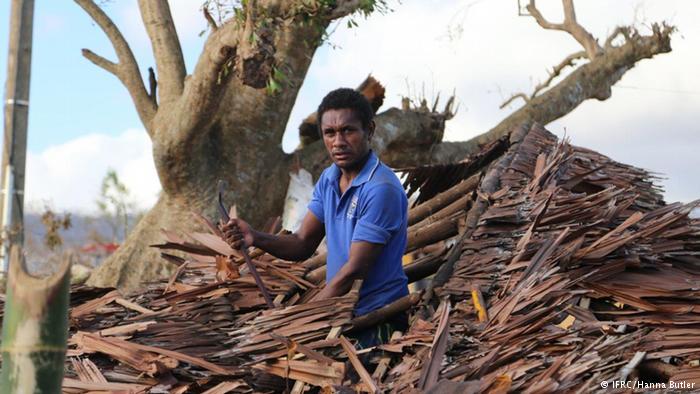
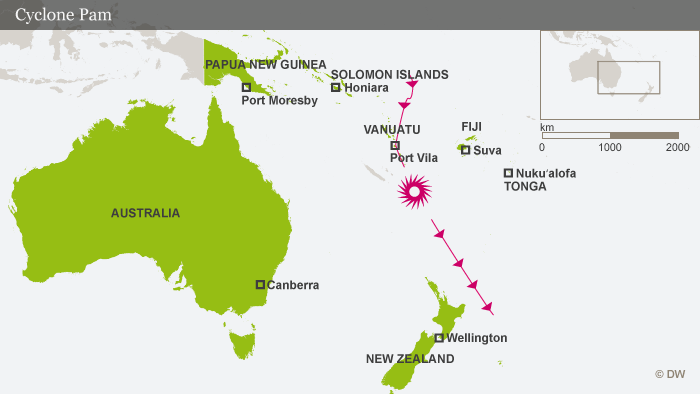
The effects of global warming are taking place right at their doorsteps. Smaller islands such as Kiribati are not only in danger of being swallowed by the rising sea level – changed weather conditions mean more frequent and intense storms – just like cyclone Pam earlier this year.
Young doctor Annette Garae worked the night when cyclone Pam hit her home island Vanuatu. “They called us in for an emergency caesarean,” recalls Garae of her shift that night. At that same moment, she remembers, the cyclone was about to make landfall.
“You could see the wind, and we had to evacuate patients into the new building – it was really scary.” The mother and child survived surgery under the extreme conditions. But in many cases, the true challenges await after the storm has passed.


‘Climate change will make them sick’
“It destroyed most of our resources and buildings,” Garae told DW. Aside from their struggle to get good healthcare – Garae worries that as climate change sets in, people in Vanuatu will be more exposed to infectious and other diseases. “These will start to rise as [impacts of] climate change increases,” the doctor is convinced.
Paulo Dos Santos Borges of the organization Science of Life Schools has to battle these health issues also in the educational field. His organization provides boarding schools and training programs for young people in Timor-Leste. But rising sea levels have been compromising the sanitation of buildings in his project. “The water has become fecal,” he says.

Young doctor Annette Garae from Vanuatu worked the night cyclone Pam hit her island

Former East Timor, first a Portuguese colony and then an Indonesian province, only gained independence in 2002. With half of its 1.2 million people living in poverty, education and health have been among the greatest challenges for the young country. Climate change has hindered progress on these issues.
Small Pacific islands need to unite
Tim Baice, Annette Garae and Paulo Dos Santos Borges stick together, with their fellow attendees from the small Pacific islands. In the evenings, they all meet up to have dinner together in a park in Bangkok.
“One of the highlights of this conference is that we kind of come together naturally and put aside those kinds of national boundaries,” says Baice.
“But how do we translate that into going home and affecting some changes and the thinking of governments?” To Baice, the small islands aren’t organized enough to find a united voice.

Climate Change is impeding healthcare in poverty-stricken Timor-Leste

“We are doing different things on different islands and spaces, it is so uncoordinated,” he told DW. This makes it hard for the young people to fight a common cause. Instead each small group battles its own issues.
Working as a communications advisor for the Samoa Youth council, Baice has reached out to the young attendees of bigger nations in their region such as Australia and New Zealand in hope they would unite for their cause.
“They couldn’t give two bleeps about what the islands are going through,” he says with clear disappointment. “They don’t see it for themselves.” This indifference for the fate of the small islands, he finds, is confirmed at the governmental level.
Hope for Paris?
Baice points out how Tuvalu prime minister and other Polynesian leaders have been calling on Australia to place a moratorium on building coal mines and to stop selling coal in the region.

Humanitarian worker Paulo Dos Santos Borges laments how many people don’t know Timor-Leste exists

But at the Pacific Island Forum in early September, former Australian Prime Minster Tony Abbott rejected such measures, also when directly asked by the Pacific island nations.
“I thought that was such a cold and heartless response, and basically focused on Australia’s need to make money,” Baice says bitterly.
The behaviour of Australia’s former prime minister makes Baice skeptical about the COP21 summit that begins at the end of November in Paris. “I have very little faith that this meeting will achieve anything,” says Tim Baice. If the neighbour countries don’t understand the issues of the small islands, how can the rest of the world? “Money matters, the economics and capitalism won’t change.” Not for a view islands in the Pacific ocean anyway.
Garae, the young doctor, has more hope. “I am grateful that I am here along with my other Pacific island nations, and I think just by being here, it is allowing us to put our voice to be heard,” Garae says.
Garae adds that she realized at the conference in Bangkok that this isn’t just a fight for the Pacific islands: “There are other small islands from Asia and around the world that are going through the same thing.”
Dos Santos Borges agrees. Although not everybody is aware about a small island like Timor-Leste, they might be more aware about how climate change is an issue for the small islands – and beyond.

DW RECOMMENDS

Vanuatu after the Cyclone

A report by Dieter Hermann (28.03.2015)


Exposed: Why Vanuatu is the world’s most ‘at-risk’ country for natural hazards

Vanuatu is the world’s most at-risk country for natural hazards, according to a UN University WorldRiskIndex. And it’s not just storms, earthquakes, volcanoes or tsunamis that are the Problem. (17.03.2015)


Climate change: The ‘greatest threat’ to the peoples of the Pacific

Amid growing concerns over rising sea levels, this year’s Pacific Islands Forum summit has started. Its Secretary General Tuiloma Slade reiterates that climate change threatens the viability of the forum’s member states. (30.07.2014)

Posted in Climate Change, Development, Small Island | Leave a comment

Funny Story from The Week Magazine

> “A Singapore Airlines flight had to make an emergency landing after emissions from a flock [sic] of flatulent goats triggered smoke alarms. The cargo plane was en route from Sydney to Kuala Lumpur, carrying 2,186 goats, when crewmembers heard a warning indicating the plane was on fire. The 747 diverted to Bali, where emergency services boarded the craft but were unable to find any trace of fire, heat, or smoke. Inspectors concluded that a harmless buildup of “exhaust gases and manure” produced by the live cargo had triggered the alarm.”

Some may remember Jim Alexander and Diana Josephson, who were our partners when we originally bought the house in Annapolis. At one point Jim was actively involved in trying to develop a new line of commercial airships (blimps) for transport. Jim figured a good market would be carrying sheep (or goats — many of us really can’t tell the difference) from Kenya to Saudi Arabia. . . .

. . . . or Sydney to Kuala Lumpur, I suppose.

In the event, it never got off the ground.

Posted in Fun | Leave a comment

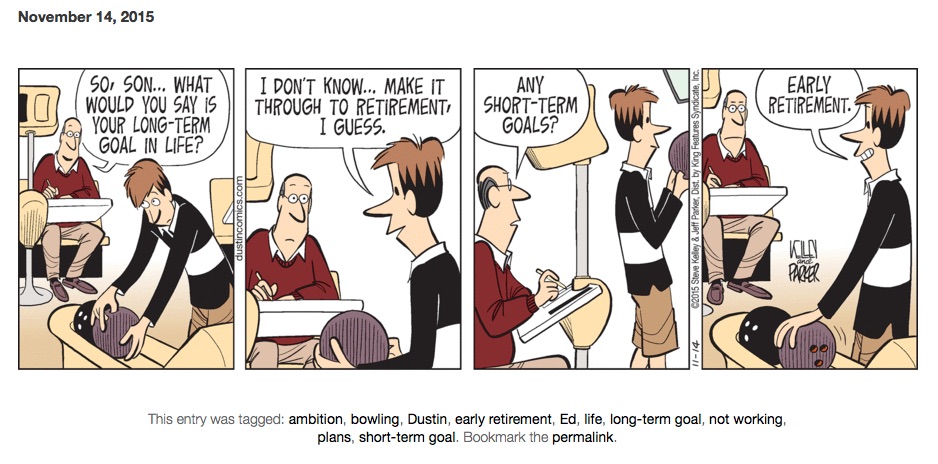
Twenty-first Century Ambition . . .

from Dustin: <http://dustincomics.com/comics/november-14-2015/>

November_14__2015___Dustin

Posted in Fun | Leave a comment

Routledge Handbook of Ocean Resources and Management

[From Tundi Agardy, Island Resources friend and an expert on the Caribbean Sea, among other marine topics.]

Edited by Hance D. SmithJuan Luis Suárez de ViveroTundi S. Agardy

© 2015 – Routledge

612 pages | 103 B/W Illus.

About the Book

This comprehensive handbook provides a global overview of ocean resources and management by focusing on critical issues relating to human development and the marine environment, their interrelationships as expressed through the uses of the sea as a resource, and the regional expression of these themes. The underlying approach is geographical, with prominence given to the biosphere, political arrangements and regional patterns – all considered to be especially crucial to the human understanding required for the use and management of the world’s oceans.

Part one addresses key themes in our knowledge of relationships between people and the sea on a global scale, including economic and political issues, and understanding and managing marine environments. Part two provides a systematic review of the uses of the sea, grouped into food, ocean space, materials and energy, and the sea as an environmental resource. Part three on the geography of the sea considers management strategies especially related to the state system, and regional management developments in both core economic regions and the developing periphery. The primary themes within each chapter are governance (including institutional and legal bases); policy – sets of ideas governing management; and management, both technical and general.

For details and to order, go to <https://www.routledge.com/products/9780415531757> and search on Routledge Handbook.

Posted in Resource Management, Watershed Management | Leave a comment

Civil Society Under Assault

An excellent overview by Doug Rutzen, president of the International Center for Non-Profit Law (ICNL, http://www.icnl.org) documenting steps taken in the last decade to restrict actions and freedoms of organizations of civil society. Published in the Journal of Democracy Volume 26, Number 4 October 2015, page 28.

Conclusion:

Several recent studies examining constraints on international funding and the political environments in which they arise support the UN Special Rapporteur’s (UNSR’s) assertions. One study found that in most countries where political opposition is unhindered and voting is conducted in a “free and fair” manner, international funding restrictions generally are not imposed on CSOs. By contrast, in countries where election manipulation takes place, governments tend to restrict CSO access to foreign support, fearing that well-funded CSOs could contribute to their defeat at the polls.  In other words, vulnerable regimes hoping to cling to power sometimes restrict international funding in order to weaken the opposition.

After the fall of the Berlin Wall, many countries saw the importance of defending civil society. Today, however, many countries are de-funding civil society. Using all sorts of pretexts, governments that feel threatened by such organizations impose restrictions on them. These governments are able to do so in part because the cornerstone concepts of civil society are still being developed, debated, and—at times—violently contested. The outcome of this debate will shape the future of civil society for decades to come.

2015_10_AuthoritarianismGoes Global-2_CivilSocietyUnderAssault-ICNL_Pres_Doug_Rutzen

Posted in Civil Society, Governance | Tagged | Leave a comment