Erik Michelsen Starts Work at Anne Arundel County DPW as Stormwater Czar

from the Baltimore Sun <http://www.baltimoresun.com/news/maryland/bs-md-ar-stormwater-profile-20140206,0,1882288.story> — also, Pat Furgurson has a similar, page-one story in the Annapolis Capital: <http://www.capitalgazette.com/news/environment/environmental-leader-takes-reins-of-stormwater-restoration/article_d68ef993-63e0-536c-ba69-19aa5b08ffe8.html>

South River environmentalist wades into Arundel’s stormwater program

  • By Pamela Wood, The Baltimore Sun

5:16 p.m. EST, February 6, 2014

As money begins flowing into Anne Arundel County government from its new stormwater fees, Erik Michelsen says he wants to make sure it’s spent on projects to reduce pollution harming the Chesapeake Bay.

County Executive Laura Neuman recently tapped Michelsen, a local environmentalist, to run the county’s stormwater management program, which is expected to spend tens of millions of dollars each year.

Michelsen moves to the new position from the nonprofit South River Federation in Edgewater, where he’s been executive director for the past five years.

He said he’s looking forward to taking the county’s existing program — which already executes a few remediation projects each year — and ramping it up with a new influx of money.

“You’re really talking about a game-changer in terms of implementation,” Michelsen said.

Starting last year, Anne Arundel County began collecting stormwater fees from all property owners. A residential fee is being phased-in that amounts to $34, $85 or $170 per year, depending on the type of property, with large, rural properties paying the most and condominiums and townhouses paying the least.

Commercial property owners pay based on square footage of impervious surfaces such as rooftops and parking lots. Nonprofit groups pay $1 per year.

Anne Arundel, along with nine other jurisdictions, is required to collect a stormwater fee under a state law passed in 2012. The law left the amount of the fee to local governments to decide. Last spring, Neuman vetoed fees that were approved by the County Council. Council members overrode her veto but subsequently made changes to reduce the fees in some cases.

The stormwater fees continue to be controversial — some legislators in Annapolis have targeted the program for revisions during the current General Assembly session, though House and Senate leaders have said the program won’t be gutted. And this week, Del. Steve Schuh, who is Neuman’s opponent in the Republican primary for county executive, proposed offsetting the fee with a property tax cut.

Neuman acknowledged she’s not a fan of the fees, but said she wants to make sure the money is spent effectively so it does, in fact, lead to pollution reductions.

She said she chose Michelsen for the job because he’s shown he can work well with environmentalists, private homeowners, businesses and government officials.

“He brings that balance of caring about the environment and the needs of the business community,” Neuman said. “For me, it was about finding both in a candidate.”

Michelsen, who campaigned to establish the stormwater fees, said he wasn’t deterred by Neuman’s veto of the fees last year.

“She intends to build the best program she can,” he said.

Sitting in his Edgewater office overlooking the South River, Michelsen said he’s excited to be a part of a major effort to stem stormwater pollution, which carries sediments and nutrients into creeks, rivers and the bay. He starts his new job later this month.

At the South River Federation, he’s helped carry out private stormwater projects and has worked with the county on some of its remediation efforts, which include restoring stream beds, creating wetlands and turning concrete outfalls and pipes into functioning streams that filter and slow runoff.

Michelsen said he plans to build on the programs Anne Arundel County already has in place. He said a lot of legwork already has been done in identifying problem sites and developing options to fix them.

“In Anne Arundel County, we’re in a great position because the county has invested money on the planning side. … We’ve lacked the dollars for implementation,” he said. “Now the dollars are there to do the work.”

Stormwater runoff is one of the key sources of pollution harming Anne Arundel’s creeks and rivers, and the Chesapeake Bay. Other sources include septic systems and sewage plants, which are being upgraded.

When it rains, the water washes over paved surfaces and into local waterways, carrying with it dirt, nutrients and chemicals. The fast-moving water causes erosion in streams and alters the landscape.

Remediation efforts are required for the county to comply with a federal stormwater permit it holds, as well as to meet its bay cleanup obligations under the federal “pollution diet,” Michelsen said. He said the county has a $1 billion backlog of needed stormwater pollution projects.

And while Michelsen is excited to take on that billion-dollar challenge, he has mixed feelings about leaving the South River Federation.

Michelsen said the federation has had some successes while he has worked there, including having Riverkeeper Diana Muller’s water quality data used by the federal government for official purposes — a big deal for a small nonprofit group. The federation also has focused on completing more on-the-ground projects — including stormwater projects — to help the river.

Leaving is “bittersweet,” Michelsen said, but “I feel it’s the right time to move on.”

pwood

twitter.com/pwoodreporter

Read more: http://www.baltimoresun.com/news/maryland/bs-md-ar-stormwater-profile-20140206,0,1882288.story#ixzz2skQxoGzC

Posted in Development, Erosion & Sediment Control, Governance | Leave a comment

Small Island Trivia. . . .

Just in case you were wondering. . . . .

bluenose

A native of Nova Scotia: a colloquial designation.

A Nova Scotian vessel.

A puritanical person; a prude.

This word as a Nova Scotian nickname comes from an allusion either to the hue given to the noses of its inhabitants by its severe winter, or to a kind of potato so named which is largely produced there.

from Wordnik —

Posted in Uncategorized | Leave a comment

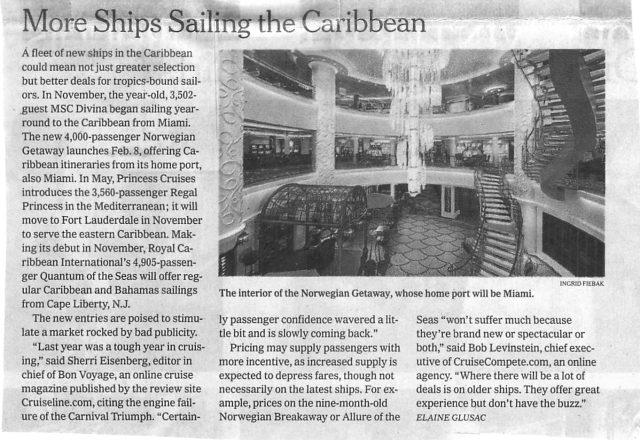
Good News — if You Want Many More Cruiseship Passengers in the Caribbean

Good News -- if You Want Many More Cruiseship Passengers in the Caribbean

This from the Washington Post Travel section, Sunday, 26 January 2014. Tens of thousands of new cruise berths for the Caribbean in coming months. . .

Posted in Uncategorized | Tagged , | Leave a comment

Star Democrat Article on Sea Grass Loss Doesn’t Mention Stormwater Runoff, Watershed Restoration, or Rain Tax

Apparently the Star Democrat <http://www.stardem.com/news/local_news/article_be81513f-74f1-5bb4-ab50-b87c8d28ae33.html> assumes that pure thoughts will solve the Chesapeake’s loss of Sea Grasses, or submerged aquatic vegetation (SAV) in scientific jargon. There is nothing in the article that would imply this is a social and economic problem that will require considerable effort and costs by the private and public sectors.

Maryland tries to restore dwindling bay grasses

PrintCreate a hardcopy of this pageFont Size:Default font sizeLarger font sizePrevious Next
Bay grassesCOURTESY OF MARYLAND DEPARTMENT OF NATURAL RESOURCES

Bay grasses

Widgeon grass in the Chesapeake Bay.

52bf6594757a7.preview-300.jpg52bf660edd8c8.preview-300.jpg

Posted:
By SARAH POLUS Capital News Service
ANNAPOLIS — Climate change and human pollution are reducing levels of grasses in the Chesapeake Bay, which are a crucial factor in restoring its health.
Bay grasses not only provide important habitats for wildlife, but experts are learning that healthy beds can be an important line of defense against severe coastal storms.
However, scientists are finding significant declines in the health and diversity of grasses found in the Chesapeake.

According to the Maryland Department of Natural Resources’ Program Chief Lee Karrh, there are at least 17 species of grasses in the Bay. Species locations vary throughout the Bay, depending on the water’s salt content.

Wild celery and stargrass like to grow in fresher waters of the northern region of the Bay, widgeon grass is commonly found in the middle regions, and eelgrass prefers areas of high salt content, such as the lower region near the Virginia state line.

Among the most common Bay grasses are eelgrasses, Brazilian and common waterweeds, wild celery and various kinds of pondweeds such as the American, curly and horned pondweeds, according to University of Maryland Atmospheric and Oceanic Science Professor Raghu Murtugudde.

There have been “a lot of changes in what species are most common,” Karrh said. “What’s very concerning is [in the lower part of the Bay] we’re losing a lot of eelgrass.” Karrh attributes this change to heat stress in the summers. “2005 and 2010 were very warm summers that impacted the eelgrass more so than other species,” Karrh said, noting that eelgrass is very slow to recover.

Other parts of the bay, especially the middle regions, are experiencing a decline in grass species as well, and a general loss of diversity, Karrh said.

Other factors such as the bay’s salt levels dictate grasses’ growth. Salt levels increase with sea level rise and hurricanes and tropical storms, and drop with extreme rainfall on land.

According to Rich Batiuk, associate director at the U.S. Environmental Protection Agency’s Chesapeake Bay Program office, good water quality is crucial to bay grasses’ health, since polluted or clouded water can block sunlight, and therefore stunt its growth.

Nutrient pollution can pose a big threat to bay grasses, since algae thrive on nitrogen and phosphorus. When these algae overpopulate, algae blooms are created, which cast a layer over the water’s surface that blocks out light, preventing underwater grasses from growing, Batiuk said.

Although nutrients and sedimentation are natural parts of river environments, humans have “modified the landscape extensively by urbanization, agriculture, deforestation, and so on which increases (sediment) loads,” Murtugudde said.

According to Batiuk, runoff from agriculture and residential lawns carries fine, silty material into the bay.

According to Murtugudde, maintaining good water quality in the bay is necessary, because grasses are natural filters, and can reduce harmful algae blooms. “We can hardly overemphasize their role,” he said. “Sub-aquatic vegetation is part of the integrated ecosystem of the bay.” How productive, resilient and biodiverse the bay is all depends on these grasses, he added.

Bay grasses are natural filters against strong storms and nutrient and sediment pollution from land, so they provide excellent habitats for everything from oysters, crabs and small fish to a very large number of microbes, bacteria, insects, and migratory and resident birds, Murtugudde said. “They are critical for maintaining required levels of oxygen for all living species.”

Underwater grasses also help reduce wave strength. “Good grasses will reduce coastal erosion…they have a nice buffering capacity,” Batiuk said. According to Batiuk, areas in Maryland with healthy bay grasses saw less shoreline damage after strong storms in recent years.

As the benefits of bay grasses are becoming clear, their popularity as a coastal protection device is increasing as well. New York City recently decided to restore its Jamaica Bay marshes for coastal defense after Sandy struck. “We don’t need to wait for a disaster to learn these simple lessons,” Murtugudde said, adding that maintaining bay grasses is crucial for the bay’s health.

According to Murtugudde, bay grass revival requires humans to reduce their pollution and runoff, which can be achieved by limiting nutrients used on lawns and agricultural farms, and using permeable paving materials to reduce runoff.

Batiuk said, “People who live in houses can do some simple things” like create rain gardens, place rain barrels under drain-spouts to prevent runoff, and make smart public transportation choices, such as driving low-emission cars and taking public transportation. “This should extend to smart growth concepts and reducing commuter miles on the watershed,” Murtugudde said.

According to Batiuk, public efforts can have “small but incrementally important impacts.”

Posted in Uncategorized | Leave a comment

Snowy Owl in VT

Denis —

Thanks

Heard the story below on As It Happens, the Canadian Broadcasting Corp. telephone interview show that WAMU broadcasts at 11:05.

Birders welcome more snowy owls to Atlantic Canada but it may not be good news for the birds

Monday, December 9, 2013 | Categories: Features 0

Share
201

Alain ClavetteAlain Clavette

Listen

Birders in Atlantic Canada are racking up an unusually high number of snowy owl sightings. The birds are beautiful to see but they may not have long to live. They come from the Arctic, so they’ll have to find different food sources further south, plus they’ll be competing for resources with other birds.

Alain Clavette could see one owl through his telescope when we reached him in Shediac, New Brunswick. He’s on Twitter @Acadian_Birder. Listen to the avid bird watcher here:

This massive (continent-wide) migration of the Snowy Owls is said to be due to a collapse in the lemming population, which is a major food source. These kind of “ad hoc” migrations are not rare, and can also affect other species such as grosbeaks a few years ago when a pine cone crop failed. The phenomenon is called an irruption.

The scarier part of the story — about which I have seen no speculation yet — is that this is the second Snowy irruption in the past two or three years — last time (I think) I recall it was because some mice or moles or some such had had a die-off.

thanks again for the story / / /

Bruce

On Dec 10, 2013, at 12:52 PM, Denis Bogan <denis_bogan> wrote:

Thought you guys might be interested in this, copied from the SkiVT list,

Denis

Yes, cool -- hard to mistake the Snowy. Most of the individuals that make it this far south are tracked (by casual birders and professionals), and they usually show up here (on this other UVM list-serv type dealie-o): jdbonin> wrote: > >> I've mis-identified birds before so I will just report what I saw and you >> can make your own decision: >> Sunday morning, while I was entering the medical building, a huge white >> bird flew over the access road and landed on the ground, across the street >> from me. My first thought was: "that seagull is huge." My second thought >> was: "what is a seagull doing at Killington?" >> As I was looking at it, it turned it's head and stared directly at me with >> piercing yellow eyes. It's head was very large and it's neck was wide and >> bulky. It looked like an owl, but it was completely white. >> After staring me down for a few seconds, it took flight and perched on the >> top of the Ramshead lodge for a while. >> I hope that it takes up residence. Maybe I can get a picture. >> >> -- >> *John Bonin* >> 

Bruce
bpotter

Posted in Uncategorized | Leave a comment

21st Century Craftsmanship

Eight year old, million-dollar (original price) house in Kingsport with mold/algae on exterior wall because of condensation caused by poor insulation.

Posted in Uncategorized | Leave a comment

Ideas Your Legislator Can Use . . . .

[the headline above is intended to be ironic. . . but . . . .

from <http://www.theecologist.org/News/news_analysis/2127057/how_ag_gag_laws_target_those_exposing_horrors_of_factory_farming.html>]

Special report How ‘ag gag’ laws target those exposing horrors of factory farming

21st October, 2013

Andrew Wasley

Faced with threats, draconian gagging laws and even violence, journalists and activists investigating the secrets of the global food industry tread a dangerous path. Andrew Wasley reports

The call came early in the end. Around seven. We were on, our contact said. Tonight was the night. We’d been waiting most of the day after last night’s plans had been aborted at the eleventh hour. Staff at the hotel’s reception must have thought it odd that three guests were heading out at nearly midnight. This wasn’t a place with nightlife.

The taxi picked us up, as arranged. The driver had been paid well above the going rate for this and wasn’t interested in the details. Privately, he must have thought it was unusual. Ferrying two foreigners and a fellow countryman deep into the black countryside, dropping them off in the middle of nowhere, returning at a predetermined time unless– as we’d warned him – he got a call stating otherwise.

As the car lights disappeared slowly into the night, someone approached. The security man. He spoke with our translator in haste before beckoning us through the unlocked gate. Across a piece of rough ground, towards one of several vast shed-like buildings set in a row. You could smell it was a farm well before it looked like one. The unmistakable waft of animal waste and straw and feed and chemicals.

Inside, with the door now closed behind us, hundreds of young pigs were visible under the dazzling artificial lights. We didn’t have long. The security man had returned to his post outside, to smoke cigarettes and re-read the same paper he’d been reading all evening. He would be watching his clock closely.

The pigs were crammed in; moving, squealing, eating, shitting – these animals didn’t have the luxury of outdoor exercise or daylight. This barn (more like a warehouse in fact) was home for now. Locals told us the farm contained 13,000 pigs, and was an intensive piglet “nursery”, where young animals were brought from breeding establishments elsewhere to fatten up before being dispatched to the slaughterhouse and people’s dinner plates.

‘Emaciated, sick and frail’

We flicked the cameras on – video and stills, as is normal for assignments like this – and recorded what we saw. There were healthy animals, but plenty were lame and injured. One pig had an abnormal growth the size of a grapefruit. Some pigs looked emaciated, others appeared sick, some looked frail. There were dead pigs left abandoned on the ground, live animals rustling around the carcasses.

On the wall, charts recorded the number of animals that had died on specific days, and summarised medical treatment records – the names of antibiotics and other chemicals administered to specific pigs, along with details of the dose.

Time to go, the security man had summoned us. Out through the door, across the rough ground, the taxi was waiting. Handshakes with the security guard – and an acknowledgement of what he’d enabled. It was tricky and risky, sure, he responded, but what did he care, he was leaving in a matter of days. Good luck with the footage, hope it’s useful when it’s shown god knows where.

As well as the visual evidence of animal welfare conditions, and proof of the drugs in use (difficult to prove usually), we’d collected testimonies from an ex-employee who had spilled the beans on procedures and processes, and from local people, many of who were complaining about the pollution and other impacts of having a foreign-owned factory farm arrive on your doorstep unannounced.

The locals had taken us to a giant open-air waste lagoon linked to another farm run by the same company. We’d filmed dead pigs floating in the cesspit, along with intravenous needles, plastic gloves and other filth.

Stifling the food scoops

Things could have been very different if we were reporting on US soil. That’s because colleagues and I could have faced prosecution: in an attempt to thwart the capacity of investigative journalists and activist groups reporting on food scoops, recent years have seen a wave of so-called “ag-gag” legislation introduced in many US states.

Seven states currently have “ag gags” in place, including Iowa, Missouri and North Dakota; seven are believed to have laws pending, including Pennsylvania; and three, California among them, have withdrawn similar legislation. Although details vary from state to state, the premise is the same: to criminalise those who seek to record evidence of animal cruelty (and other abuses) at factory farms or other farm-related locations.

In Iowa, successfully obtaining employment at agricultural premises under false pretences was made illegal in March 2012. In North Dakota, similar legislation was passed as far back as 1991, making it an offence to trespass or create a recording at a farm. In Missouri, a law passed in July 2012 forces an undercover investigator or journalist to officially report any animal rights abuses seen within 24 hours of their discovery.

New Mexico and California have both recently seen “ag-gags” introduced, but the proposed laws were rejected following public concerns. In Pennsylvania, legislation currently being considered seeks to outlaw trespass and filming at factory farms.

Bad for PR, bad for business

Such unprecdented attempts to stifle food investigations are being made, quite simply, because they are bad for PR – especially when accompanied by powerful video images – and thus bad for business. They hit companies where it hurts by shocking consumers and galvanising opinion.

A groundbreaking investigation released in 2008 by pressure group Humane Society of the United States resulted in the largest meat recall in US history, after an undercover worker at the Westland/Hallmark slaughterhouse in California secretly filmed horrific treatment of cattle. The facility had supplied beef to schools across the US.

And campaigners say there is a directcorrelation between such image-denting investigations and the roll out of “ag-gags”: hot on the heels of “watershed moment” undercover filming by the Mercy For Animals’ group at Butterball turkey farms in North Carolina, legislation which hampers this kind of journalism was rolled out.

The investigation, the results of which were published in 2011, led to several arrests and convictions of workers who were caught on camera maliciously abusing animals, including the first ever felony conviction related to cruelty to farmed poultry in US history. The probe also led to the conviction of a senior Department of Agriculture official for obstruction of justice after she attempted to forewarn Butterball that law enforcement planned to raid the company’s facility, says Mercy For Animals.

Some commentators believe the current crop of “ag-gags” have borrowed from the model adopted by the controversial American Legislative Exchange Council (ALEC). The powerful lobby group – made up of corporations and politicians – crafts laws, according to its critics, which serve members’ own vested interests before handing them over, pre-packaged and ready to roll, to legislators on a state by state basis.

Unsurprisingly, many food corporations and agricultural organisations support ALEC, which in 2003 introduced the contentious Animal and Ecological Terrorism Act, a federal law designed to target radical environmental and animal rights groups.

Other investigations at risk?

Some fear that “ag-gags”, designed to suppress investigations into factory farming, could be used to target activists and journalists probing other aspects of the food industry.

Recent years have seen an explosion of investigative reporting being used to highlight, amongst other things, exploitation of migrant workers harvesting fruit and vegetable crops, and poor conditions for those toiling unseen in many restaurant kitchens.

The fallout from these investigations can be just as damaging – and costly – as exposes of farm animal cruelty, particularly when the findings provoke a public outcry. In the ground-breaking book Tomatoland, an examination of the tomato growing industry, journalist Barry Estabrook highlighted the shocking case of the “Immokalee babies” born with severe deformities after their mothers were exposed to pesticides whilst harvesting tomatoes.

And, alarming as they are, “ag-gags” are just one of the obstacles and dangers facing those investigating food issues – both in the US and beyond.

Working undercover carries its own inherent risks – not least being caught red-handed whilst wearing a hidden camera or disturbed after entering a property clandestinely – and both activists and journalists, including colleagues of mine, have been threatened or attacked while carrying out their work.

In Brazil, in 2006, one undercover researcher investigating the impacts of the export-led cattle industry was outed in a chilling advert placed in a local newspaper and had to quickly flee the region. His safety – and that of colleagues – was judged to be under threat.

In Japan, two investigators were almost killed in 2003 while trying to document the controversial Taiji dolphin hunt. Morgan Whorwood and Brooke McDonald managed to obtain graphic film of the slaughter of striped dolphins, killed for their meat, but desperate to seize the footage, fishermen attempted to throw the pair off a cliff into the sea. Although they managed to smuggle the footage out – subsequently beamed around the world and temporarily halting the Taiji killing – the activists were forced to leave Japan after receiving threats.

Legal threats

Legal threats are also a constant peril. Again in Japan, activists from Greenpeace went undercover to expose an embezzlement ring involving crew members working on the whaling ship Nisshin Maru. Following revelations that some of the ship’s crew were linked to the illegal sale of whale meat, in 2008, Japanese police raided Greenpeace offices in Tokyo, and the homes of Greenpeace staff; two campaigners – Junichi Sato and Toru Suzuki – were arrested and held in jail for their part in exposing the corruption. Another member of the investigative team cannot return to Japan for fear of being prosecuted.

Those investigating large food corporations also run the risk of being sued for libel. Swedish journalist Fredrik Gertten was targeted by US fruit company Dole Food in 2009 after releasing a documentary, Bananas!,examining the risks to plantation workers’ health from pesticides used on company farms. Dole launched a lawsuit against the Gertten documentary and lobbied the Los Angeles Film Festival to have that documentary removed from its bill, leading to allegations of censorship. It was screened but not as part of the main festival competition.

Similarly, UK filmmaker Tracy Worcester’s Pig Business documentary was the subject of several legal threats by pork giant Smithfield Foods in 2008 and 2009. The company sent four letters to Channel 4 threatening legal action, the last of which was sent an hour before the film was broadcast. As a result of the letter, Channel 4 delayed broadcast of the film and footage was removed in order to make one of the perpetrators less identifiable. The lawyers acting on behalf of the company also contacted London’s Barbican arts centre, claiming the film was defamatory and asking them not to show it. The screening only went ahead after Worcester agreed to indemnify the Barbican.

Sometimes, the threats – and the dangers – can be more subtle. While I was investigating slave labour linked to southern Italy’s orange and tomato harvests, where thousands of (largely African) migrants suffer brutal exploitation and squalid living conditions, we asked who wasreally running the show – not the gangmasters, farmers or processors who undoubtedly turn a blind eye to the suffering, but someone else; someone who was benefitting, financially or otherwise, from the racket. We never had a firm answer. Nobody knew for sure – or would say. Why ask, people said, it makes no difference. The problem is what it is. It was a question better not to answer. This was mafia country after all.

Andrew Wasley is a UK-based investigative journalist specialising in food and the environment. He is co-founder and director of Ecostorm, and a co-founder of the Ecologist Film Unit. His book, The Ecologist Guide to Food, is published later this year by Ivy Press.

A version of this article appears in the Autumn 2013 edition of Index on Censorship magazine

Posted in Uncategorized | Leave a comment

The Most Useless Man in DC . . .

after the Republicans in Congress

A flag man on a road project, on a blind alley!

Posted in Uncategorized | Leave a comment

Government Shutdown Impacts Illustrate Damage of Sequestration

This from Ezra Klein’s Wonkblog at <http://www.washingtonpost.com/blogs/wonkblog/wp/2013/10/01/the-nine-most-painful-consequences-of-a-government-shutdown/>

It’s also worth noting that we’ve already seen disruptive cuts this year after Congress allowed sequestration to hit — and lawmakers haven’t exactly rushed to reverse those haphazard budget cuts. Indeed, much of Washington appears to have made peace with sequestration. That makes it hard to guess exactly how long a shutdown might last.

Posted in Uncategorized | Leave a comment

Interesting Graphic and Article about Corruption in Defense & Security Agences of 19 Countries

from Transparency International: <http://www.transparency.org/news/pressrelease/two_thirds_of_parliaments_fail_to_be_watchdogs_of_defence_corruption>

ANNEX 1: OVERALL RESULTS

If the countries analysed were parliamentarians, and the levels of corruption risk they displayed were political parties, the distribution of seats in the global parliament would look like the image below.

DSP_parliament.JPG

VERY LOW (4 countries): AUSTRALIA, GERMANY, NORWAY, UNITED KINGDOM

LOW (12 countries): AUSTRIA, BRAZIL, BULGARIA, COLOMBIA, FRANCE, JAPAN, POLAND, SLOVAKIA, SOUTH KOREA, SWEDEN, TAIWAN, UNITED STATES

MODERATE (14 countries): ARGENTINA, BOSNIA AND HERZEGOVINA, CHILE, CROATIA, CYPRUS, CZECH REPUBLIC, HUNGARY, ITALY, LATVIA, MEXICO, SOUTH AFRICA, SPAIN, THAILAND, UKRAINE

HIGH (17 countries): GEORGIA, GHANA, GREECE, INDIA, INDONESIA, ISRAEL, KAZAKHSTAN, KENYA, KUWAIT, LEBANON, NEPAL, PHILIPPINES, RUSSIA, SERBIA, TANZANIA, TURKEY, UGANDA

VERY HIGH (21 countries): AFGHANISTAN, BAHRAIN, BANGLADESH, BELARUS, CHINA, ETHIOPIA, IRAQ, JORDAN, MALAYSIA, MOROCCO, NIGERIA, OMAN, PALESTINE, PAKISTAN, RWANDA, SINGAPORE, TUNISIA, UNITED ARAB EMIRATES, UZBEKISTAN, VENEZUELA, ZIMBABWE

CRITICAL (14 countries): ALGERIA, ANGOLA, CAMEROON, COTE D’IVOIRE, DRC, EGYPT, ERITREA, IRAN, LIBYA, QATAR, SRI LANKA, SAUDI ARABIA, SYRIA, YEMEN

Posted in Uncategorized | Leave a comment