


-
Recent Posts
Recent Comments
Bruce on Dr Kenrick Leslie, CBE, ED of… Bruce Potter on K Street at Twilight bpotter1 on Who is putting us in the … Michael O'Neal on Virgin Islands Natural Resourc… Bruce Potter on Maybe this is how the end of t… Archives
- September 2025
- June 2024
- February 2024
- May 2023
- November 2022
- October 2022
- September 2022
- August 2022
- May 2022
- March 2022
- February 2022
- January 2022
- December 2021
- November 2021
- September 2021
- August 2021
- July 2021
- June 2021
- May 2021
- April 2021
- March 2021
- February 2021
- January 2021
- December 2020
- November 2020
- October 2020
- September 2020
- August 2020
- July 2020
- June 2020
- May 2020
- April 2020
- March 2020
- February 2020
- January 2020
- December 2019
- November 2019
- October 2019
- September 2019
- August 2019
- July 2019
- June 2019
- May 2019
- April 2019
- March 2019
- February 2019
- November 2018
- October 2018
- September 2018
- August 2018
- July 2018
- June 2018
- May 2018
- April 2018
- March 2018
- February 2018
- January 2018
- December 2017
- November 2017
- October 2017
- September 2017
- August 2017
- July 2017
- June 2017
- May 2017
- April 2017
- March 2017
- February 2017
- January 2017
- December 2016
- November 2016
- October 2016
- September 2016
- August 2016
- July 2016
- June 2016
- May 2016
- March 2016
- February 2016
- January 2016
- December 2015
- November 2015
- October 2015
- September 2015
- July 2015
- June 2015
- May 2015
- April 2015
- March 2015
- February 2015
- January 2015
- December 2014
- November 2014
- October 2014
- September 2014
- August 2014
- July 2014
- June 2014
- May 2014
- April 2014
- March 2014
- February 2014
- January 2014
- December 2013
- November 2013
- October 2013
- September 2013
- August 2013
- July 2013
- June 2013
- May 2013
- April 2013
- March 2013
- January 2013
- December 2012
- November 2012
- October 2012
- August 2012
- July 2012
- June 2012
- April 2012
- March 2012
- February 2012
- January 2012
- December 2011
- November 2011
- October 2011
- September 2011
- August 2011
- July 2011
- June 2011
- May 2011
- April 2011
- March 2011
- February 2011
- January 2011
- December 2010
- November 2010
- October 2010
- September 2010
- August 2010
- July 2010
- June 2010
- May 2010
- April 2010
- March 2010
- February 2010
- January 2010
- December 2009
- November 2009
- October 2009
- September 2009
- August 2009
- July 2009
- June 2009
- May 2009
- April 2009
- March 2009
- February 2009
- December 2008
- November 2008
- October 2008
- September 2008
- May 2008
- March 2008
- January 2008
- December 2007
Categories
- Access
- Beaches
- Biodiversity
- Chesapeake Bay
- Civil Society
- Climate Change
- Close to Home
- Conservation
- Coral Reefs
- Development
- Disaster Management
- Dissemination
- energy
- Erosion & Sediment Control
- Finance Services
- Fracking
- Fun
- Futures
- Governance
- Health
- Information
- Media
- Monitoring
- politics
- Resource Management
- Sand mining
- Science
- Small Island
- Tourism
- Uncategorized
- Watershed Management
Meta
Stormwater Projects Going forward in Anne Arundel County
from the Stormwater site at http://www.stormh2o.com/july-august-2011/restoring-chesapeake-watershed.aspx
Restoring the Chesapeake Bay Watershed
Federal and state grants, combined with matching local funding, help pay for projects with more than just local benefits.By Margaret Buranen
Some parts of the Chesapeake Bay are pristine, but other sections are so full of silt and runoff that they appear muddy even at ground level. Years of unregulated agricultural runoff, the growing amount of impervious surface from suburban sprawl, and the bureaucracy of several states intertwined with their own interests are the main reasons for the decline of the Chesapeake.The Chesapeake’s watershed covers 64,000 square miles. That territory includes large and small cities, suburbs, farmlands, forests, and wetlands in Washington, DC, and six states (Delaware, Pennsylvania, Maryland, New York, Virginia, and West Virginia).People and organizations, including the Chesapeake Bay Foundation, have been working for years to improve the bay. Now, increasingly, they are working together and taking a big-picture, watershed approach toward achieving that improvement.The watershed approach is clearly evident in the latest round of Innovative Nutrient and Sediment Reduction (INSR) grants. These 11 EPA-funded grants (totaling $5.8 million and chosen from 89 proposals) were awarded through the National Fish and Wildlife Fund (NFWF) in late summer 2010.NFWF has been involved with restoration of the Chesapeake Bay since 1999, awarding more than 670 grants totaling over $59 million. Local matching funds have added up to another $100 million.Under the name Chesapeake Bay Stewardship Fund, NFWF operates both the INSR grant program and the Chesapeake Bay Small Watershed (CBSW) grants. CBSW grants, which totaled $3.4 million in 2010, are for smaller, local-level projects. They range from $20,000 to $200,000.Amanda Bassow, NFWF’s manager for Chesapeake programs, agrees that the INSR grants reflect the growing trend of considering and creating stormwater projects in relation to their watersheds.“I would say this is absolutely the case in the Chesapeake from the perspective of state and federal agencies and the nonprofit community that is working aggressively to improvement stormwater management in the region,” says Bassow. “Certainly, individual projects still strive to meet their permit requirements on a site-by-site basis, but in the larger picture, the types of projects we fund strive to restore the landscape function of our built environment, which means they really must have a perspective that is broader than simply one development site or parcel.”Bassow says that the 2010 INSR awardees “represent the most innovative stormwater projects that were the most likely to have a significant impact on reducing pollution to the Chesapeake from urban stormwater.”That urban stormwater is in unexpected places. “You see innovative stormwater management that you might perceive to be rural and therefore where stormwater might not be an issue—like Lancaster, Pennsylvania, and the Onancock watershed on Virginia’s Eastern Shore,” notes Bassow.Farming lands are disappearing from the region. Since “urban stormwater runoff represents the only growing source of nutrient pollution to the Chesapeake, it stands to reason that it is going to be an issue every place that people are building houses, starting businesses, and so on,” explains Bassow. She adds, “It’s great to see these more rural communities getting a leg up on the issue.”These most recent grants are part of a total of 56 INSR grants made from 2006 to 2010, totaling $32.6 million. INSR grants range from $200,000 to $1 million. They were leveraged with more than $34.2 million of local matching funds. (EPA requires 100% matching for these awards.)The projects “really represent the state of science, policy, and practice for stormwater,” says Bassow. “Some of the projects are trying to refine the effectiveness of [best management] practices, such as pervious pavement and bioretention, while others are really taking on the big policy questions, like how do local codes and ordinances provide barriers to innovative stormwater management, and how can they, instead, encourage them.”Regenerative Stormwater Conveyance Wetlands
One of the INSR grants is for the installation of sand seepage regenerative stormwater conveyance (RSC) wetlands on two of the creeks in the Lower Western Shore of Maryland. To the $900,000 grant it received, South River Federation added $3,817,500 in matching funds for this project.RSC technology uses a high marsh zone (-6 to +6 inches, relative to the normal pool of water) rather than trying to establish plants any lower than 6 inches below the normal pool. It features a greater mix of plants, including trees and shrubs that can thrive in water, for the wetland will do best if it is allowed to evolve over time into a forest.Water levels don’t fluctuate as much as they did in earlier wetland restoration projects. RSC wetlands are less deep, with gentler side slopes, and definitely not as flat. They include sand weirs, pools, tree roots, and other devices to vary the topography.RSC, also known as step pool stormwater conveyance, offers another advantage: It can be used inside natural channels without disrupting the adjacent natural ecosystem.South River Federation chose Church Creek on the South River and Saltworks Creek on the Severn River because they are among the most highly impaired subwatersheds within the Chesapeake watershed. As the land is narrow there, these watersheds are less than half of a mile apart. The RSCs will be less than 3 miles apart.
Advertisement
Watersheds of the Severn and South Rivers are adjoining. Their proximity to Annapolis has subjected both to increasing pollution from expanding impervious surfaces that are inevitable with development.Church Creek is on the South River. Its watershed is 42% impervious, and it sits downstream of five major shopping centers and two major highways. Saltworks Creek, a tributary of the Severn River, is equally distressed, thanks to runoff from the nearby Bestgate Road and the expanding Westfield Mall, with more development planned. South River Federation will work with the University of Maryland’s Chesapeake Biological Lab to monitor the effectiveness of the RSCs in Church Creek and Saltworks Creek. The two-year monitoring period will assess both reduction of volume and quality of downstream waters.
Photo: River Federation
Church Creek’s is one of the most impaired watersheds in the region.The RSC projects on these two creeks will create more than 10 acres of high-quality non-tidal wetlands to treat stormwater from watersheds that continue to grow more impervious. Waterfowl and fish will gain much-needed habitat. Sediments and nutrients reaching the Chesapeake Bay will be significantly reduced.Church Creek’s installation (set for mid-2012) will treat an estimated 2,975 pounds of nitrogen, 905 pounds of phosphorus, and 140 tons of sediment per year. The project on the Cabin Creek branch of Saltworks Creek (scheduled for late 2011) will reduce nitrogen load by 40%, total suspended solids (TSS) by 60%, and phosphorus by 40%.The two projects should be excellent models of an innovative, cost-effective, and sustainable way to reduce pollution. Chuck Fox, special assistant to the EPA administrator for the Chesapeake Bay, suggested, at a meeting in Annapolis in October 2009, that RSC projects are applicable at many places within the Chesapeake Bay watershed.Sara Caldes, of the Severn Riverkeeper Program and South River Federation, is project manager for the Cabin Creek Branch/Saltworks Creek installation. She says she has “been pleasantly surprised by the level of support that residents and neighboring property owners have exhibited. To date, everyone has demonstrated a high level of understanding that these are distressed watersheds and a desire to see them improved.”
Posted in Uncategorized
Leave a comment
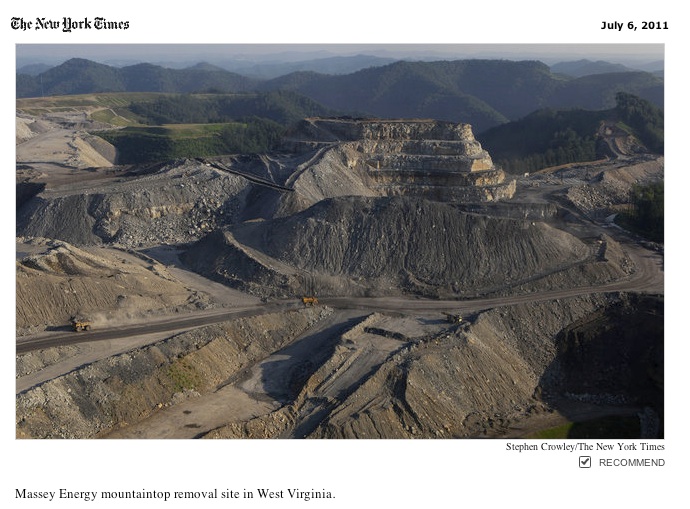
West Virginia. . . Massey Mountain. . .
SOOO, is this what John Denver was singing about? West Virginia. . .
Posted in Uncategorized
Leave a comment
Socialized US Medical Care: circa 1798
from a Forbes blog — http://blogs.forbes.com/rickungar/2011/01/17/congress-passes-socialized-medicine-and-mandates-health-insurance-in-1798/
Congress Passes Socialized Medicine and Mandates Health Insurance -In 1798
Jan. 172011 – 9:08 pm | 179,899 views | 5 recommendations | 396 comments
 Image via Wikipedia
The ink was barely dry on the PPACA when the first of many lawsuits to block the mandated health insurance provisions of the law was filed in a Florida District Court.
The pleadings, in part, read –
The Constitution nowhere authorizes the United States to mandate, either directly or under threat of penalty, that all citizens and legal residents have qualifying health care coverage.
It turns out, the Founding Fathers would beg to disagree.
In July of 1798, Congress passed – and President John Adams signed –“An Act for the Relief of Sick and Disabled Seamen.” The law authorized the creation of a government operated marine hospital service and mandated that privately employed sailors be required to purchase health care insurance.
Keep in mind that the 5th Congress did not really need to struggle over the intentions of the drafters of the Constitutions in creating this Act as many of its members were the drafters of the Constitution.
And when the Bill came to the desk of President John Adams for signature, I think it’s safe to assume that the man in that chair had a pretty good grasp on what the framers had in mind.
Here’s how it happened.
During the early years of our union, the nation’s leaders realized that foreign trade would be essential to the young country’s ability to create a viable economy. To make it work, they relied on the nation’s privatemerchant ships – and the sailors that made them go – to be the instruments of this trade.
The problem was that a merchant mariner’s job was a difficult and dangerous undertaking in those days. Sailors were constantly hurting themselves, picking up weird tropical diseases, etc.
The troublesome reductions in manpower caused by back strains, twisted ankles and strange diseases often left a ship’s captain without enough sailors to get underway – a problem both bad for business and a strain on the nation’s economy.
But those were the days when members of Congress still used their collective heads to solve problems – not create them.
Realizing that a healthy maritime workforce was essential to the ability of our private merchant ships to engage in foreign trade, Congress and the President resolved to do something about it.
Enter “An Act for The Relief of Sick and Disabled Seamen”.
I encourage you to read the law as, in those days, legislation was short, to the point and fairly easy to understand.
The law did a number of fascinating things.
First, it created the Marine Hospital Service, a series of hospitals built and operated by the federal government to treat injured and ailing privately employed sailors. This government provided healthcare service was to be paid for by a mandatory tax on the maritime sailors (a little more than 1% of a sailor’s wages), the same to be withheld from a sailor’s pay and turned over to the government by the ship’s owner. The payment of this tax for health care was not optional. If a sailor wanted to work, he had to pay up.
This is pretty much how it works today in the European nations that conduct socialized medical programs for its citizens – although 1% of wages doesn’t quite cut it any longer.
The law was not only the first time the United States created a socialized medical program (The Marine Hospital Service) but was also the first to mandate that privately employed citizens be legally required to make payments to pay for health care services. Upon passage of the law, ships were no longer permitted to sail in and out of our ports if the health care tax had not been collected by the ship owners and paid over to the government – thus the creation of the first payroll tax in our nation’s history.
When a sick or injured sailor needed medical assistance, the government would confirm that his payments had been collected and turned over by his employer and would then give the sailor a voucher entitling him to admission to the hospital where he would be treated for whatever ailed him.
While a few of the healthcare facilities accepting the government voucher were privately operated, the majority of the treatment was given out at the federal maritime hospitals that were built and operated by the government in the nation’s largest ports.
As the nation grew and expanded, the system was also expanded to cover sailors working the private vessels sailing the Mississippi and Ohio rivers.
The program eventually became the Public Health Service, a government operated health service that exists to this day under the supervision of the Surgeon General.
So much for the claim that “The Constitution nowhere authorizes the United States to mandate, either directly or under threat of penalty….”
As for Congress’ understanding of the limits of the Constitution at the time the Act was passed, it is worth noting that Thomas Jefferson was the President of the Senate during the 5th Congress while Jonathan Dayton, the youngest man to sign the United States Constitution, was the Speaker of the House.
While I’m sure a number of readers are scratching their heads in the effort to find the distinction between the circumstances of 1798 and today, I think you’ll find it difficult.
Yes, the law at that time required only merchant sailors to purchase health care coverage. Thus, one could argue that nobody was forcing anyone to become a merchant sailor and, therefore, they were not required to purchase health care coverage unless they chose to pursue a career at sea.
However, this is no different than what we are looking at today.
Each of us has the option to turn down employment that would require us to purchase private health insurance under the health care reform law.
Would that be practical? Of course not – just as it would have been impractical for a man seeking employment as a merchant sailor in 1798 to turn down a job on a ship because he would be required by law to purchase health care coverage.
What’s more, a constitutional challenge to the legality of mandated health care cannot exist based on the number of people who are required to purchase the coverage – it must necessarily be based on whether anyAmerican can be so required.
Clearly, the nation’s founders serving in the 5th Congress, and there were many of them, believed that mandated health insurance coverage was permitted within the limits established by our Constitution.
The moral to the story is that the political right-wing has to stop pretending they have the blessings of the Founding Fathers as their excuse to oppose whatever this president has to offer.
History makes it abundantly clear that they do not.
UPDATE: January 21- Given the conversation and controversy this piece has engendered, Greg Sargent over at The Washington Post put the piece to the test. You might be interested in what Greg discovered in his article, “Newsflash: Founders favored government run health care.”
Contact Rick at thepolicypage@gmail.com
Posted in Uncategorized
Leave a comment
Great Statement: Why I Love America by Fred Tutman, Patuxent River Keeper
from the Capital, July 3rd: http://www.hometownannapolis.com/news/nbh/2011/07/03-43/Why-we-love-the-USA.html#cfirst
Published07/03/11What do you love about America? What would you change about this great country of ours?
Find Us On Facebook
Those were the questions put forward last week to dozens of local politicians, dignitaries, professors, gadflies and county residents.
In response, The Capital received no shortage of answers. People love the freedoms outlined in the U.S. Constitution and the spirit of this nation’s citizenry. But they could do without the partisanship that often comes along with that spirit.
Here are some of their responses.
Fred Tutman, the Severn Riverkeeper
What he loves: “Free speech, a great legal system, amazing natural resources, good – albeit expensive – health care, and a country with a really big heart and an unsinkable spirit.”
What he would change: “We need to be more global in our understanding of the world and our true place in it. We are a wasteful and self-involved society obsessed with our own privileges and blind to how we fit into the present-day global village.”
Posted in Uncategorized
Leave a comment
Cool . . . either a new Eddie Murphy Movie, or the Japanese really can relax. . .
from the TT Guardian . . .
Caribbean reggae men help revive Japan

From left, Chin, of Irish And Chin, journalist/publicist Anthony Turner, and reggae crooner Gramps (Morgan), one of many top reggae artistes who performed at the historic concert.
Reggae music has been described as music that emancipates the soul, frees the heart of shackles, and uplifts the mind. These are only some of the expressions used to describe a music that was born in the ghettos of Kingston, Jamaica, and taken to far-flung corners of the globe by exponents such as the late great Robert Nestor Marley, Peter Tosh, and the illustrious and pioneering Jimmy Cliff, who is still with us today.
One of the places in which reggae music has found a home is Japan. So it was no surprise that members of the fraternity of reggae music and a throng of their fans journeyed to York College Performing Arts Centre in Queens, New York, in a venture to raise funds to bring relief to the thousands of victims affected by the recent earth quakes, tsunamis and the associated nuclear incidents which came in the aftermath of these natural disasters.
The show was dubbed Reggae 4 Japan, and this unprecedented benefit concert brought together members of reggae music’s family, all with one sense of purpose—to raise funds for humanitarian relief for Japan. The profits from the event, which was put on by Japanese sound system Mighty Crown and their management Irish and Chin, were donated to the American Red Cross—Japan Earthquake and Pacific Tsunami Relief Efforts. The artistic line-up included a mixture of singers of classic reggae, as well as those who performed the more trendy, dance hall reggae. Some of the performers represented the cream of the crop of reggae music, among them Freddie McGregor, Tarrus Riley, Maxi Priest, Alaine, Tanya Stephens, Capelton, Etana, Damian “Jr Gong” Marley, Gramps & Peter Morgan, and Fire Ball (Japan’s No1 dancehall reggae group).
All of them delivered electrifying performances to a sold-out audience, made up of the young and not-so-young. Fans were able to consume a most delicious fare of music, which placed a strong emphasis on the drum and the base. Maxi Priest, the evergreen singer of reggae ballads, summed up most succinctly the feelings of the artistes who made the concert a success when he said: “Japan is like home and family, as I have been going to Japan since the mid 80s. I have a lot of close friends in Japan and know people who are directly affected by the disaster.
“Japan has done a lot for the reggae industry, so I am unquestionably involved with Reggae 4 Japan because of my connection to that place, and also for the sheer love of humanity.”
Similar sentiments were echoed by Tanya Stephens, who remarked: “The disaster which hit Japan geographically, affects all of us socially. The Jamaican music industry has benefited enormously from the patronage of the Japanese reggae community, and we are too intertwined for the recent events to not be seen as a shared experience to grow from. “It’s an honour for me to be a part of this re-growth as the affected areas regain their footing, and Japan becomes an even greater nation than before.”
The producers were very grateful for the tremendous patronage, which made the show one of the best reggae concerts to be staged in New York, in recent times. It was also felt that the event once more brought greater public attention to the situation in Japan as a result of the earthquake and tsunami.
Posted in Uncategorized
Leave a comment
From Christian Science Monitor blog: ~ 5% of income inequality from immigrant competition for low income jobs
try this instead — http://j.mp/mkLX64
Is immigration behind wage, income inequality? Not so much.
Globalization, technology, union decline, and other factors have caused rich to get rich and poor to get poorer. Immigration plays only a small role.
In this June 16, 2011, photo, Robert Dawson picks cucumbers on a farm in Leslie, Ga. Just weeks after Georgia Gov. Nathan Deal signed one of the toughest laws in the country cracking down on illegal immigration, the Republican conservative said probation workers could take the jobs of illegal immigrants whom farmers say are no longer showing up for work for fear they could be deported.
John Bazemore/AP
In an earlier post today, I listed the factors that I believe are most widely agreed to be behind the increase in wage and income inequality. Here they are again: Globalization, “labor-saving” technology, much diminished union power, declining minimum wages, “financialization” of growth, tax incentives favoring capital (though these numbers are all pretax, the incentives still play a role), and what Harold Meyerson the other day called shareholder vs. stakeholder capitalism.

Jared Bernstein
Before joining the Center on Budget and Policy Priorities as a senior fellow, Jared was chief economist to Vice President Joseph Biden and executive director of the White House Task Force on the Middle Class. He is a contributor to MSNBC and CNBC and has written numerous books, including ‘Crunch: Why Do I Feel So Squeezed?’
Recent posts
Related stories
Topics
You will note, perhaps to your dismay, that immigration is not on the list. That’s not because I think it doesn’t matter. It’s because its impact on the growth of inequality is small, maybe 5% according to one carefulstudy by David Card, a very highly regarded researcher in this field. That’s not nothing, but it’s probably a lot less than you thought.
How can this be? In fact, there’s an important lesson here: start with supply and demand analysis, but don’t stop with it.
The intuition behind the notion that immigration explains the growth of wage inequality is that if immigration increases the relative supply of low-skilled workers without a commensurate increase in relative demand (employers suddenly need a bunch of new low-skilled workers), the pay of low wage workers will fall relative to that of high wage workers, i.e., increased inequality.
Makes sense. Just like it makes sense that increases in the minimum wage will lead to widespread unemployment or that federal stimulus will crowd out private investment and lead to higher interest rates. Yet evidence solidly tilts against these results too. It’s actually what makes empirical economics interesting. The dictates of supply and demand will often rule, except when they don’t.
Posted in Uncategorized
Leave a comment
Two Favorite Amazon Bird Watching Fotos
Pretty similar!

Lotsa birds, but what the hey …… ???

Posted in Uncategorized
Leave a comment
Video of Deployment of Autonomous Underwater Vehicle on Severn (and South River)
The Facebook video was posted by Diana Muller, South River Keeper, at
It shows the initial deployment of the REMUS, a surplused autonomous underwater vehicle programmed to collect environmental data on conditions where it goes — in this case, the length of the Severn River. The vehicle collects info such as dissolved oxygen, temperature, salinity, etc. Dr. Andrew Muller’s Oceanography classes at the Academy are using it as part of their lab work, and it is being deployed to measure conditions in both the Severn and the South River.
The South River Federation is probably the most data intensive monitoring program on the Chesapeake Bay, and its information is being used to re-define the models of how the mid-Bay actually works — much better science than the 20+ year old Bay models used by the Chesapeake Bay Program, which sometimes supports and increasingly has been recognizing the significance of this new science.
Check the Southriverfederation.net website . . . and join the Federation to support good science in support of more effective watershed conservation. and restoration.
Posted in Uncategorized
Leave a comment
Congrats to NGS Staffers
Congratulations to all the National Geographic Society staffers who ride the Dillon Bus into 17th Street every day (there are quite a few, actually). National Geographic won the Magazine of the Year award — ASME — http://is.gd/GgeykM
Posted in Uncategorized
Leave a comment


 Potter's Weal