

Yup, snow. . . . . not too bad shoveling, though.
Yup, snow. . . . . not too bad shoveling, though.
Sure glad we solved this problem forever. . . . . hahahahahahahahahhahahahahahahaha
Florida law firm to pay $2 million to settle foreclosure fraud charges
A Florida law firm agreed Friday to pay the state $2 million in penalties for allegedly mishandling foreclosures — the first deal of its kind since the uproar over the issue began last fall.
40Comments
- Weigh In
- Corrections?
Investigations into these practices are being conducted on several parallel tracks. Besides investigations by various states, federal regulators are conducting a review of national banks. Attorneys general from 50 states have joined with the Obama administration to try to negotiate a broader settlement with the mortgage industry.
Many of the parties involved disagree about the deal’s provisions, including the size of the cash penalty the banks should pay.
In the Marshall C. Watson case, homeowners complained about robo-signing and notary issues as well as whether documents had been forged, according to the Florida attorney general’s office.
They added that their foreclosure notices were not served properly. In some cases, relatives with no stake in the process were served notices and the homeowners were billed to cover the cost of those actions.
The settlement does not include any admission of guilt by the law firm.
Marshall C. Watson, president and chief executive of firm, said in a statement that he was “pleased” with the settlement. “With our firm’s tight controls now in place we are setting a high bar for the mortgage law provider industry, and our clients recognize and value the positive steps we are taking.”
Florida Attorney General Pam Bondi said the settlement will help ensure that “homeowners, lending institutions and the courts deserve to know that the law is being followed and all documentation is true and accurate.”
Bondi is among the Republican attorneys general who have expressed doubts about the deal being crafted by the Obama administration and the other state attorneys general.Half of the fees paid by Marshall Watson will go to the Florida attorney general’s office to fund investigations; the rest will go to a state nonprofit group that provides legal assistance to Florida homeowners facing foreclosure. The settlement also requires the firm to prepare foreclosure paperwork beyond what is required by Florida law.
Thomas Ice, whose Florida law firm was the first to depose Jeffrey Stephan, the now famous “robo-signer” whose testimony forced banks to impose a mass freeze on foreclosures last fall, said the settlement is “a step in the right direction” but does not go far enough because it does not help those who have lost their homes to possibly fraudulent practices.
“I think there are going to be a lot of people upset about this,” Ice said.
One of the other firms under investigation, DJSP Enterprises, a foreclosure business run by lawyer David Stern, has stopped processing home seizures, according to a March filing with the Securities and Exchange Commission.
Freddie Mac and Fannie Mae, which were once among Stern’s top clients, barred the firm from handling their foreclosure cases last year after the firm came under scrutiny from Florida law enforcement.
Stern is suing Freddie Mac for $1.3 million in legal service fees he says he is owed.
> ———- Forwarded message from “OpentheGovernment.ORG ———-
> From: “Amy Fuller”
> Date: Mar 24, 2011 10:49 AM
> Subject: [openhouseproject] Free Access to CRS Reports – 2 new sign-on
> letters – sign-on by April 4
> To:
>
> Hi everyone (apologies for cross listing),
>
> We are circulating two new letters promoting free, online access to > CRS
> reports. The letters were drafted in cooperation with Steve > Aftergood of the
> Federation of American Scientists and Daniel Schuman of the Sunlight
> Foundation. One is to members of the Legislative Branch Appropriations
> Subcommittee requesting they no longer use language from past > appropriations
> bills that prohibit CRS from expending funds to make its products > publicly
> available; the second is to the Chairs and Ranking Members of the > Senate
> Committee on Homeland Security and Governmental Affairs and the House
> Oversight and Government Reform Committee asking that they introduce
> legislation to authorize and promote the public distribution of CRS > reports.
> Text of the letters is below.
>
> Sign-ons for all the letters should be sent to me (
> afuller@openthegovernment.org) by *noon on Monday, April 4*. Please > help us
> spread the word!
>
> Thanks,
>
> Amy Bennett
> OpenTheGovernment.org
>
>
> ****
>
> *Leg Branch letter*
>
> Dear [Legislative Branch Subcommittee member]:
>
> We are writing to ask you untie the hands of the Congressional > Research
> Service so that the agency has the option of allocating funds to > make its
> reports publicly available.
>
> Prior legislative branch appropriations language prohibits CRS from
> expending funds to make its products publicly available. This archaic
> provision no longer makes practical sense. It runs counter to the > principles
> of government openness and transparency. And its original purpose is
> undercut by the fact that many CRS products are already available to > the
> public from the Constitution Annotated to bill summaries to a > significant
> subset of CRS reports.
>
> Removing this language would eliminate a legislative stumbling block > that
> currently frustrates efforts to promote the authorized publication > of these
> reports. Its elimination would not necessarily result in more CRS > reports
> becoming publicly available. Rather, it would clear the way so that a
> decision made on the merits of the question could readily be > implemented. We
> are not asking for any new authorization or appropriation for this > purpose.
>
> In support of the requested action, we would note the following:
>
> * CRS products are a valuable, non-partisan resource for informing
> discussion of nearly every topic of legislative activity, from > agricultural
> subsidies to the space program. Improving public access to CRS > reports would
> help to enrich public discourse and to promote informed citizen > engagement
> in the political process.
>
> * We respect the confidentiality of CRS support to Members of > Congress, and
> we have no wish to infringe upon it. We are seeking public access > only to
> those “published” reports that are broadly available to any Member > or staff
> person through the CRS intranet, and not to any private communications
> between CRS and an individual Member or office.
>
> * These reports play a critical role in our legislative process, > and, when
> made available, inform the public debate about our nations policies. > In the
> last two years alone, major newspapers cited the Congressional > Research
> Service 779 times, with 70 mentions in the *Washington Post* and 65 > in the *New
> York Times*. The U.S. Supreme Court has cited CRS 34 times and the > circuit
> court made 112 citations, with 130 judicial citations in the last > decade
> alone.
>
> * More than ten thousand CRS reports have already been made publicly
> available by commercial vendors and by public interest groups, with no
> adverse effect on CRS performance.
>
> * We are not asking you to make the decision regarding whether CRS > reports
> should be publicly available. Instead, we are asking you to smooth > the way
> should such a decision be reached.
>
> We therefore urge you to remove the statutory obstacle to authorized
> distribution of non-confidential CRS reports, and to help promote > their
> distribution in an effective manner.
>
> Representatives from the undersigned organizations would be happy to > meet
> with you or your staff at any time to discuss this important issue. > Please
> contact Amy Bennett, Program Associate, OpenTheGovernment.org (
> afuller@openthegovernment.org or 202-332-6736), at your convenience.
>
> ********
>
> *Senate Committee on Homeland Security and Governmental Affairs > letter*
>
> Dear Senators Lieberman and Collins:
>
> We are writing to ask you to quickly reintroduce legislation to > authorize
> and promote the public distribution of reports that are published by > the
> Congressional Research Service (CRS).
>
> As you know, CRS products are a valuable, non-partisan resource for
> informing discussion of nearly every topic of legislative activity, > from
> agricultural subsidies to the space program. These reports play a > critical
> role in our legislative process, and, when made available, inform > the public
> debate about our nations policies. In the last two years alone, major
> newspapers cited the Congressional Research Service 779 times, with 70
> mentions in the *Washington Post* and 65 in the *New York Times*. > The U.S.
> Supreme Court has cited CRS 34 times and the circuit court made 112
> citations, with 130 judicial citations in the last decade. We strongly
> believe, as we know you do from your past leadership on this issue, > that
> improving public access to CRS reports would help to enrich public > discourse
> and to promote informed citizen engagement in the political process.
>
> We respect the confidentiality of CRS support to Members of > Congress, and we
> have no wish to infringe upon it. We are seeking public access only > to
> those “published” reports that are broadly available to any Member > or staff
> person through the CRS intranet, and not to any private communications
> between CRS and an individual Member or office.
>
> American taxpayers spend over $100 million a year to fund the CRS, yet
> current distribution of these reports is haphazard and often > expensive.
> Several private companies now sell copies of these reports for a > price,
> meaning these reports are readily available to lobbyists, executives > and
> others who can afford to pay. Meanwhile, the vast majority of > people lack
> the information necessary to even request reports from their Members > of
> Congress. And the reports that are publicly available are often out-> of-date.
> The public deserves a consistent and official way to access the
> non-classified, non-biased information CRS provides.
>
> We urge you to act soon to help lead a formal revision of CRS > publication
> policy in favor of public distribution of non-confidential reports. > We will
> strongly support your efforts.
>
> Representatives from the undersigned organizations would be happy to > meet
> with you or your staff at any time to discuss this important issue. > Please
> contact Daniel Schuman, Policy Counsel, Sunlight Foundation (
> dschuman@sunlightfoundation.com or 202-742-1520 x 273), at your
> convenience.
>
> *******
>
> *House Oversight and Gov Reform letter*
>
> Dear Representatives Issa and Cummings:
>
> We are writing to ask you to quickly reintroduce legislation to > authorize
> and promote the public distribution of reports that are published by > the
> Congressional Research Service (CRS).
>
> As you know, CRS products are a valuable, non-partisan resource for
> informing discussion of nearly every topic of legislative activity, > from
> agricultural subsidies to the space program. These reports play a > critical
> role in our legislative process, and, when made available, inform > the public
> debate about our nations policies. In the last two years alone, major
> newspapers cited the Congressional Research Service 779 times, with 70
> mentions in the *Washington Post* and 65 in the *New York Times*. > The U.S.
> Supreme Court has cited CRS 34 times and the circuit court made 112
> citations, with 130 judicial citations in the last decade. We strongly
> believe, as we think you do, that improving public access to CRS > reports
> would help to enrich public discourse and to promote informed citizen
> engagement in the political process.
>
> We respect the confidentiality of CRS support to Members of > Congress, and we
> have no wish to infringe upon it. We are seeking public access only > to
> those “published” reports that are broadly available to any Member > or staff
> person through the CRS intranet, and not to any private communications
> between CRS and an individual Member or office.
>
> American taxpayers spend over $100 million a year to fund the CRS, yet
> current distribution of these reports is haphazard and often > expensive.
> Several private companies now sell copies of these reports for a > price,
> meaning these reports are readily available to lobbyists, executives > and
> others who can afford to pay. Meanwhile, the vast majority of > people lack
> the information necessary to even request reports from their Members > of
> Congress. And the reports that are publicly available are often out-> of-date.
> The public deserves a consistent and official way to access the
> non-classified, non-biased information CRS provides.
>
> We urge you to act soon to help lead a formal revision of CRS > publication
> policy in favor of public distribution of non-confidential reports. > We will
> strongly support your efforts.
>
> Representatives from the undersigned organizations would be happy to > meet
> with you or your staff at any time to discuss this important issue. > Please
> contact Daniel Schuman, Policy Counsel, Sunlight Foundation (
> dschuman@sunlightfoundation.com or 202-742-1520 x 273), at your
> convenience.
>
> * *
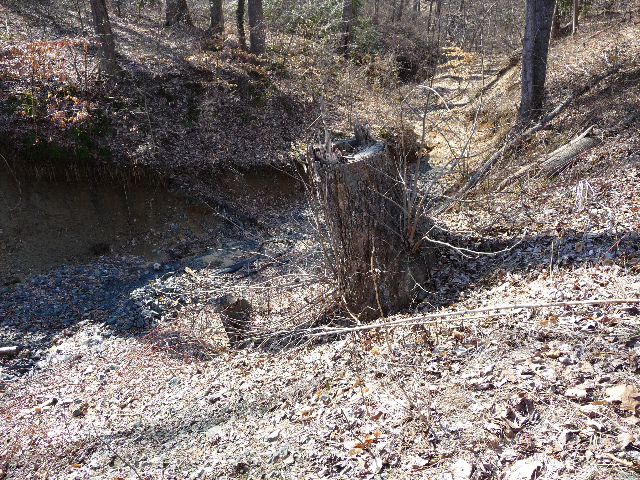
People in central Anne Arundel seem to take more pictures of “blown out” stream beds, but north county has nice ones too. . . these two gulches are north of Pasadena. . . .
Keep in mind that all of the soil that is cut out of these gullies becomes sediment that colors and pollutes the downstream creeks and rivers, smothering grasses and oyster beds.

The Broadneck School gully below. . . maybe 12 to 15 feet cut into the usual grade. . .






Kayaking in the South River on Tuesday, 9 March, we were looking for an osprey, since we had seen or heard individual birds since Sunday.
Saw nothing, but paddled over to see if there was any nest-building sign on mark #15 (in front of the Londontown House) where there is usually a nest. All of a sudden this fine guy started swooping around the mark, making three or four attempts to land before finally sticking it. He then proceeded to holler at me to assert his prior claim to the mark as prime nesting area. I figure he’s waiting for the lady bird to come along and will let her build the nest. (That’s the way I’d do it anyway.)
… to be continued
—The graphs below were assembled by Paula Jasinski of Chesapeake Environmental Communications, and published on their Facebook page at:

Key: Each square = 10 storms. Blue= severe storms. Orange= Tornadoes.
The NY Times had this great TWO FULL PAGE article on fracking — people with a short attention span can just jump to the last two paragraphs
The American landscape is dotted with hundreds of thousands of new wells and drilling rigs, as the country scrambles to tap into this century’s gold rush — for natural gas.
The gas has always been there, of course, trapped deep underground in countless tiny bubbles, like frozen spills of seltzer water between thin layers of shale rock. But drilling companies have only in recent years developed techniques to unlock the enormous reserves, thought to be enough to supply the country with gas for heating buildings, generating electricity and powering vehicles for up to a hundred years.
So energy companies are clamoring to drill. And they are getting rare support from their usual sparring partners. Environmentalists say using natural gas will help slow climate changebecause it burns more cleanly than coal and oil. Lawmakers hail the gas as a source of jobs. They also see it as a way to wean the United States from its dependency on other countries for oil.
But the relatively new drilling method — known as high-volume horizontal hydraulic fracturing, or hydrofracking — carries significant environmental risks. It involves injecting huge amounts of water, mixed with sand and chemicals, at high pressures to break up rock formations and release the gas.
With hydrofracking, a well can produce over a million gallons of wastewater that is often laced with highly corrosive salts, carcinogens like benzene and radioactive elements like radium, all of which can occur naturally thousands of feet underground. Other carcinogenic materials can be added to the wastewater by the chemicals used in the hydrofracking itself.
While the existence of the toxic wastes has been reported, thousands of internal documents obtained by The New York Times from the Environmental Protection Agency, state regulators and drillers show that the dangers to the environment and health are greater than previously understood.
The documents reveal that the wastewater, which is sometimes hauled to sewage plants not designed to treat it and then discharged into rivers that supply drinking water, contains radioactivity at levels higher than previously known, and far higher than the level that federal regulators say is safe for these treatment plants to handle.
Other documents and interviews show that many E.P.A. scientists are alarmed, warning that the drilling waste is a threat to drinking water in Pennsylvania. Their concern is based partly on a 2009 study, never made public, written by an E.P.A. consultant who concluded that some sewage treatment plants were incapable of removing certain drilling waste contaminants and were probably violating the law.
The Times also found never-reported studies by the E.P.A. and a confidential study by the drilling industry that all concluded that radioactivity in drilling waste cannot be fully diluted in rivers and other waterways.
But the E.P.A. has not intervened. In fact, federal and state regulators are allowing most sewage treatment plants that accept drilling waste not to test for radioactivity. And most drinking-water intake plants downstream from those sewage treatment plants in Pennsylvania, with the blessing of regulators, have not tested for radioactivity since before 2006, even though the drilling boom began in 2008.
In other words, there is no way of guaranteeing that the drinking water taken in by all these plants is safe.
That has experts worried.
“We’re burning the furniture to heat the house,” said John H. Quigley, who left last month as secretary of Pennsylvania’s Department of Conservation and Natural Resources. “In shifting away from coal and toward natural gas, we’re trying for cleaner air, but we’re producing massive amounts of toxic wastewater with salts and naturally occurring radioactive materials, and it’s not clear we have a plan for properly handling this waste.”
The risks are particularly severe in Pennsylvania, which has seen a sharp increase in drilling, with roughly 71,000 active gas wells, up from about 36,000 in 2000. The level of radioactivity in the wastewater has sometimes been hundreds or even thousands of times the maximum allowed by the federal standard for drinking water. While people clearly do not drink drilling wastewater, the reason to use the drinking-water standard for comparison is that there is no comprehensive federal standard for what constitutes safe levels of radioactivity in drilling wastewater.
Drillers trucked at least half of this waste to public sewage treatment plants in Pennsylvania in 2008 and 2009, according to state officials. Some of it has been sent to other states, including New York and West Virginia.
Yet sewage treatment plant operators say they are far less capable of removing radioactive contaminants than most other toxic substances. Indeed, most of these facilities cannot remove enough of the radioactive material to meet federal drinking-water standards before discharging the wastewater into rivers, sometimes just miles upstream from drinking-water intake plants.
In Pennsylvania, these treatment plants discharged waste into some of the state’s major river basins. Greater amounts of the wastewater went to the Monongahela River, which provides drinking water to more than 800,000 people in the western part of the state, including Pittsburgh, and to the Susquehanna River, which feeds into Chesapeake Bay and provides drinking water to more than six million people, including some in Harrisburg and Baltimore.
Lower amounts have been discharged into the Delaware River, which provides drinking water for more than 15 million people in Philadelphia and eastern Pennsylvania.
In New York, the wastewater was sent to at least one plant that discharges into Southern Cayuga Lake, near Ithaca, and another that discharges into Owasco Outlet, near Auburn. InWest Virginia, a plant in Wheeling discharged gas-drilling wastewater into the Ohio River.
“Hydrofracking impacts associated with health problems as well as widespread air and water contamination have been reported in at least a dozen states,” said Walter Hang, president of Toxics Targeting, a business in Ithaca, N.Y., that compiles data on gas drilling.
Problems in Other Regions
While Pennsylvania is an extreme case, the risks posed by hydrofracking extend across the country.
There were more than 493,000 active natural-gas wells in the United States in 2009, almost double the number in 1990. Around 90 percent have used hydrofracking to get more gas flowing, according to the drilling industry.
Gas has seeped into underground drinking-water supplies in at least five states, including Colorado, Ohio, Pennsylvania, Texas and West Virginia, and residents blamed natural-gas drilling.
Air pollution caused by natural-gas drilling is a growing threat, too. Wyoming, for example, failed in 2009 to meet federal standards for air quality for the first time in its history partly because of the fumes containing benzene and toluene from roughly 27,000 wells, the vast majority drilled in the past five years.
In a sparsely populated Sublette County in Wyoming, which has some of the highest concentrations of wells, vapors reacting to sunlight have contributed to levels of ozone higher than those recorded in Houston and Los Angeles.
Industry officials say any dangerous waste from the wells is handled in compliance with state and federal laws, adding that drilling companies are recycling more wastewater now. They also say that hydrofracking is well regulated by the states and that it has been used safely for decades.
But hydrofracking technology has become more powerful and more widely used in recent years, producing far more wastewater. Some of the problems with this drilling, including its environmental impact and the challenge of disposing of waste, have been documented by ProPublica, The Associated Press and other news organizations, especially out West.
And recent incidents underscore the dangers. In late 2008, drilling and coal-mine waste released during a drought so overwhelmed the Monongahela that local officials advised people in the Pittsburgh area to drink bottled water. E.P.A. officials described the incident in an internal memorandum as “one of the largest failures in U.S. history to supply clean drinking water to the public.”
In Texas, which now has about 93,000 natural-gas wells, up from around 58,000 a dozen years ago, a hospital system in six counties with some of the heaviest drilling said in 2010 that it found a 25 percent asthma rate for young children, more than three times the state rate of about 7 percent.
“It’s ruining us,” said Kelly Gant, whose 14-year-old daughter and 11-year-old son have experienced severe asthma attacks, dizzy spells and headaches since a compressor station and a gas well were set up about two years ago near her house in Bartonville, Tex. The industry and state regulators have said it is not clear what role the gas industry has played in causing such problems, since the area has had high air pollution for a while.
“I’m not an activist, an alarmist, a Democrat, environmentalist or anything like that,” Ms. Gant said. “I’m just a person who isn’t able to manage the health of my family because of all this drilling.”
And yet, for all its problems, natural gas offers some clear environmental advantages over coal, which is used more than any other fuel to generate electricity in the United States. Coal-fired power plants without updated equipment to capture pollutants are a major source of radioactive pollution. Coal mines annually produce millions of tons of toxic waste.
But the hazards associated with natural-gas production and drilling are far less understood than those associated with other fossil fuels, and the regulations have not kept pace with the natural-gas industry’s expansion.
Pennsylvania, Ground Zero
Pennsylvania, which sits atop an enormous reserve called the Marcellus Shale, has been called the Saudi Arabia of natural gas.
This rock formation, roughly the size of Greece, lies more than a mile beneath the Appalachian landscape, from Virginia to the southern half of New York. It is believed to hold enough gas to supply the country’s energy needs for heat and electricity, at current consumption rates, for more than 15 years.
Drilling companies were issued roughly 3,300 Marcellus gas-well permits in Pennsylvania last year, up from just 117 in 2007.
This has brought thousands of jobs, five-figure windfalls for residents who lease their land to the drillers and revenue for a state that has struggled with budget deficits. It has also transformed the landscape of southwestern Pennsylvania and brought heavy burdens.
Drilling derricks tower over barns, lining rural roads like feed silos. Drilling sites bustle around the clock with workers, some in yellow hazardous material suits, and 18-wheelers haul equipment, water and waste along back roads.
The rigs announce their presence with the occasional boom and quiver of underground explosions. Smelling like raw sewage mixed with gasoline, drilling-waste pits, some as large as a football field, sit close to homes.
Anywhere from 10 percent to 40 percent of the water sent down the well during hydrofracking returns to the surface, carrying drilling chemicals, very high levels of salts and, at times, naturally occurring radioactive material.
While most states require drillers to dispose of this water in underground storage wells below impermeable rock layers, Pennsylvania has few such wells. It is the only state that has allowed drillers to discharge much of their waste through sewage treatment plants into rivers.
Regulators have theorized that passing drilling waste through the plants is safe because most toxic material will settle during the treatment process into a sludge that can be trucked to a landfill, and whatever toxic material remains in the wastewater will be diluted when mixed into rivers. But some plants were taking such large amounts of waste with high salt levels in 2008 that downstream utilities started complaining that the river water was eating away at their machines.
Regulators and drilling companies have said that these cases, and others, were isolated.
“The wastewater treatment plants are effective at what they’re designed to do — remove material from wastewater,” said Jamie Legenos, a spokeswoman for the Pennsylvania Department of Environmental Protection, adding that the radioactive material and the salts were being properly handled.
Overwhelmed, Underprepared
For proof that radioactive elements in drilling waste are not a concern, industry spokesmen and regulators often point to the results of wastewater tests from a 2009 draft report conducted by New York State and a 1995 report by Pennsylvania that found that radioactivity in drilling waste was not a threat. These two reports were based on samples from roughly 13 gas wells in New York and 29 in Pennsylvania.
But a review by The Times of more than 30,000 pages of federal, state and company records relating to more than 200 gas wells in Pennsylvania, 40 in West Virginia and 20 public and private wastewater treatment plants offers a fuller picture of the wastewater such wells produce and the threat it poses.
Most of the information was drawn from drilling reports from the last three years, obtained by visiting regional offices throughout Pennsylvania, and from documents or databases provided by state and federal regulators in response to records requests.
Among The Times’s findings:
¶More than 1.3 billion gallons of wastewater was produced by Pennsylvania wells over the past three years, far more than has been previously disclosed. Most of this water — enough to cover Manhattan in three inches — was sent to treatment plants not equipped to remove many of the toxic materials in drilling waste.
¶At least 12 sewage treatment plants in three states accepted gas industry wastewater and discharged waste that was only partly treated into rivers, lakes and streams.
¶Of more than 179 wells producing wastewater with high levels of radiation, at least 116 reported levels of radium or other radioactive materials 100 times as high as the levels set by federal drinking-water standards. At least 15 wells produced wastewater carrying more than 1,000 times the amount of radioactive elements considered acceptable.
Results came from field surveys conducted by state and federal regulators, year-end reports filed by drilling companies and state-ordered tests of some public treatment plants. Most of the tests measured drilling wastewater for radium or for “gross alpha” radiation, which typically comes from radium, uranium and other elements.
Industry officials say they are not concerned.
“These low levels of radioactivity pose no threat to the public or worker safety and are more a public perception issue than a real health threat,” said James E. Grey, chief operating officer of Triana Energy.
In interviews, industry trade groups like the Marcellus Shale Coalition and Energy in Depth, as well as representatives from energy companies like Shell and Chesapeake Energy, said they were producing far less wastewater because they were recycling much of it rather than disposing of it after each job.
But even with recycling, the amount of wastewater produced in Pennsylvania is expected to increase because, according to industry projections, more than 50,000 new wells are likely to be drilled over the next two decades.
The radioactivity in the wastewater is not necessarily dangerous to people who are near it. It can be blocked by thin barriers, including skin, so exposure is generally harmless.
Rather, E.P.A. and industry researchers say, the bigger danger of radioactive wastewater is its potential to contaminate drinking water or enter the food chain through fish or farming. Once radium enters a person’s body, by eating, drinking or breathing, it can cause cancer and other health problems, many federal studies show.
Little Testing for Radioactivity
Under federal law, testing for radioactivity in drinking water is required only at drinking-water plants. But federal and state regulators have given nearly all drinking-water intake facilities in Pennsylvania permission to test only once every six or nine years.
The Times reviewed data from more than 65 intake plants downstream from some of the busiest drilling regions in the state. Not one has tested for radioactivity since 2008, and most have not tested since at least 2005, before most of the drilling waste was being produced.
And in 2009 and 2010, public sewage treatment plants directly upstream from some of these drinking-water intake facilities accepted wastewater that contained radioactivity levels as high as 2,122 times the drinking-water standard. But most sewage plants are not required to monitor for radioactive elements in the water they discharge. So there is virtually no data on such contaminants as water leaves these plants. Regulators and gas producers have repeatedly said that the waste is not a threat because it is so diluted in rivers or by treatment plants. But industry and federal research cast doubt on those statements.
A confidential industry study from 1990, conducted for the American Petroleum Institute, concluded that “using conservative assumptions,” radium in drilling wastewater dumped off the Louisiana coast posed “potentially significant risks” of cancer for people who eat fish from those waters regularly.
The industry study focused on drilling industry wastewater being dumped into the Gulf of Mexico, where it would be far more diluted than in rivers. It also used estimates of radium levels far below those found in Pennsylvania’s drilling waste, according to the study’s lead author, Anne F. Meinhold, an environmental risk expert now at NASA.
Other federal, state and academic studies have also found dilution problems with radioactive drilling waste.
In December 2009, these very risks led E.P.A. scientists to advise in a letter to New York that sewage treatment plants not accept drilling waste with radium levels 12 or more times as high as the drinking-water standard. The Times found wastewater containing radium levels that were hundreds of times this standard. The scientists also said that the plants should never discharge radioactive contaminants at levels higher than the drinking-water standard.
In 2009, E.P.A. scientists studied the matter and also determined that certain Pennsylvania rivers were ineffective at sufficiently diluting the radium-laced drilling wastewater beingdischarged into them.
Asked about the studies, Pennsylvania regulators said they were not aware of them.
“Concerned? I’m always concerned,” said Dave Allard, director of the Bureau of Radiation Protection. But he added that the threat of this waste is reduced because “the dilutions are so huge going through those treatment plants.”
Three months after The Times began asking questions about radioactive and other toxic material being discharged into specific rivers, state regulators placed monitors for radioactivity near where drilling waste is discharged. Data will not be available until next month, state officials said.
But the monitor in the Monongahela is placed upstream from the two public sewage treatment plants that the state says are still discharging large amounts of drilling waste into the river, leaving the discharges from these plants unchecked and Pittsburgh exposed.
Plant Operators in the Dark
In interviews, five treatment plant operators said they did not believe that the drilling wastewater posed risks to the public. Several also said they were not sure of the waste’s contents because the limited information drillers provide usually goes to state officials.
“We count on state regulators to make sure that that’s properly done,” said Paul McCurdy, environmental specialist at Ridgway Borough’s public sewage treatment plant, in Elk County, Pa., in the northwest part of the state.
Mr. McCurdy, whose plant discharges into the Clarion River, which flows into the Ohio and Mississippi Rivers, said his plant was taking about 20,000 gallons of drilling waste per day.
Like most of the sewage treatment plant operators interviewed, Mr. McCurdy said his plant was not equipped to remove radioactive material and was not required to test for it.
Documents filed by drillers with the state, though, show that in 2009 his facility was sent water from wells whose wastewater was laced with radium at 275 times the drinking-water standard and with other types of radiation at more than 780 times the standard.
Part of the problem is that industry has outpaced regulators. “We simply can’t keep up,” said one inspector with the Pennsylvania Department of Environmental Protection who was not authorized to speak to reporters. “There’s just too much of the waste.”
“If we’re too hard on them,” the inspector added, “the companies might just stop reporting their mistakes.”
Recently, Pennsylvania has tried to increase its oversight, doubling the number of regulators, improving well-design requirements and sharply decreasing how much drilling waste many treatment plants can accept or release. The state is considering whether to require treatment plants to begin monitoring for radioactivity in wastewater.
Even so, as of last November, 31 inspectors were keeping tabs on more than 125,000 oil and gas wells. The new regulations also allowed at least 18 plants to continue accepting the higher amounts set by their original permits.
Furthermore, environmental researchers from the University of Pittsburgh tested wastewater late last year that had been discharged by two treatment plants. They say these tests will show, when the results are publicly released in March, that salt levels were far above the legal limit.
Lax Oversight
Drilling contamination is entering the environment in Pennsylvania through spills, too. In the past three years, at least 16 wells whose records showed high levels of radioactivity in their wastewater also reported spills, leaks or failures of pits where hydrofracking fluid or waste is stored, according to state records.
Gas producers are generally left to police themselves when it comes to spills. In Pennsylvania, regulators do not perform unannounced inspections to check for signs of spills. Gas producers report their own spills, write their own spill response plans and lead their own cleanup efforts.
A review of response plans for drilling projects at four Pennsylvania sites where there have been accidents in the past year found that these state-approved plans often appear to be in violation of the law.
At one well site where several spills occurred within a week, including one that flowed into a creek, the well’s operator filed a revised spill plan saying there was little chance that waste would ever enter a waterway.
“There are business pressures” on companies to “cut corners,” John Hanger, who stepped down as secretary of the Pennsylvania Department of Environmental Protection in January, has said. “It’s cheaper to dump wastewater than to treat it.”
Records back up that assertion.
From October 2008 through October 2010, regulators were more than twice as likely to issue a written warning than to levy a fine for environmental and safety violations, according to state data. During this period, 15 companies were fined for drilling-related violations in 2008 and 2009, and the companies paid an average of about $44,000 each year, according to state data.
This average was less than half of what some of the companies earned in profits in a day and a tiny fraction of the more than $2 million that some of them paid annually to haul and treat the waste.
And prospects for drillers in Pennsylvania are looking brighter.
In December, the Republican governor-elect, Tom Corbett, who during his campaign took more gas industry contributions than all his competitors combined, said he would reopen state land to new drilling, reversing a decision made by his predecessor, Edward G. Rendell. The change clears the way for as many as 10,000 wells on public land, up from about 25 active wells today.
In arguing against a proposed gas-extraction tax on the industry, Mr. Corbett said regulation of the industry had been too aggressive.
“I will direct the Department of Environmental Protection to serve as a partner with Pennsylvania businesses, communities and local governments,” Mr. Corbett says on his Web site. “It should return to its core mission protecting the environment based on sound science.”
 | Bruce on Dr Kenrick Leslie, CBE, ED of… |
 | Bruce Potter on K Street at Twilight |
| bpotter1 on Who is putting us in the … |
| Michael O'Neal on Virgin Islands Natural Resourc… |
| Bruce Potter on Maybe this is how the end of t… |


 Potter's Weal