NY Times on Marcellus Shale and FRACKING, 27 February 2011

The NY Times had this great TWO FULL PAGE article on fracking — people with a short attention span can just jump to the last two paragraphs

free for the week

———-

February 26, 2011

Regulation Lax as Gas Wells’ Tainted Water Hits Rivers

The American landscape is dotted with hundreds of thousands of new wells and drilling rigs, as the country scrambles to tap into this century’s gold rush — for natural gas.

The gas has always been there, of course, trapped deep underground in countless tiny bubbles, like frozen spills of seltzer water between thin layers of shale rock. But drilling companies have only in recent years developed techniques to unlock the enormous reserves, thought to be enough to supply the country with gas for heating buildings, generating electricity and powering vehicles for up to a hundred years.

So energy companies are clamoring to drill. And they are getting rare support from their usual sparring partners. Environmentalists say using natural gas will help slow climate changebecause it burns more cleanly than coal and oil. Lawmakers hail the gas as a source of jobs. They also see it as a way to wean the United States from its dependency on other countries for oil.

But the relatively new drilling method — known as high-volume horizontal hydraulic fracturing, or hydrofracking — carries significant environmental risks. It involves injecting huge amounts of water, mixed with sand and chemicals, at high pressures to break up rock formations and release the gas.

With hydrofracking, a well can produce over a million gallons of wastewater that is often laced with highly corrosive salts, carcinogens like benzene and radioactive elements like radium, all of which can occur naturally thousands of feet underground. Other carcinogenic materials can be added to the wastewater by the chemicals used in the hydrofracking itself.

While the existence of the toxic wastes has been reported, thousands of internal documents obtained by The New York Times from the Environmental Protection Agency, state regulators and drillers show that the dangers to the environment and health are greater than previously understood.

The documents reveal that the wastewater, which is sometimes hauled to sewage plants not designed to treat it and then discharged into rivers that supply drinking water, contains radioactivity at levels higher than previously known, and far higher than the level that federal regulators say is safe for these treatment plants to handle.

Other documents and interviews show that many E.P.A. scientists are alarmed, warning that the drilling waste is a threat to drinking water in Pennsylvania. Their concern is based partly on a 2009 study, never made public, written by an E.P.A. consultant who concluded that some sewage treatment plants were incapable of removing certain drilling waste contaminants and were probably violating the law.

The Times also found never-reported studies by the E.P.A. and a confidential study by the drilling industry that all concluded that radioactivity in drilling waste cannot be fully diluted in rivers and other waterways.

But the E.P.A. has not intervened. In fact, federal and state regulators are allowing most sewage treatment plants that accept drilling waste not to test for radioactivity. And most drinking-water intake plants downstream from those sewage treatment plants in Pennsylvania, with the blessing of regulators, have not tested for radioactivity since before 2006, even though the drilling boom began in 2008.

In other words, there is no way of guaranteeing that the drinking water taken in by all these plants is safe.

That has experts worried.

“We’re burning the furniture to heat the house,” said John H. Quigley, who left last month as secretary of Pennsylvania’s Department of Conservation and Natural Resources. “In shifting away from coal and toward natural gas, we’re trying for cleaner air, but we’re producing massive amounts of toxic wastewater with salts and naturally occurring radioactive materials, and it’s not clear we have a plan for properly handling this waste.”

The risks are particularly severe in Pennsylvania, which has seen a sharp increase in drilling, with roughly 71,000 active gas wells, up from about 36,000 in 2000. The level of radioactivity in the wastewater has sometimes been hundreds or even thousands of times the maximum allowed by the federal standard for drinking water. While people clearly do not drink drilling wastewater, the reason to use the drinking-water standard for comparison is that there is no comprehensive federal standard for what constitutes safe levels of radioactivity in drilling wastewater.

Drillers trucked at least half of this waste to public sewage treatment plants in Pennsylvania in 2008 and 2009, according to state officials. Some of it has been sent to other states, including New York and West Virginia.

Yet sewage treatment plant operators say they are far less capable of removing radioactive contaminants than most other toxic substances. Indeed, most of these facilities cannot remove enough of the radioactive material to meet federal drinking-water standards before discharging the wastewater into rivers, sometimes just miles upstream from drinking-water intake plants.

In Pennsylvania, these treatment plants discharged waste into some of the state’s major river basins. Greater amounts of the wastewater went to the Monongahela River, which provides drinking water to more than 800,000 people in the western part of the state, including Pittsburgh, and to the Susquehanna River, which feeds into Chesapeake Bay and provides drinking water to more than six million people, including some in Harrisburg and Baltimore.

Lower amounts have been discharged into the Delaware River, which provides drinking water for more than 15 million people in Philadelphia and eastern Pennsylvania.

In New York, the wastewater was sent to at least one plant that discharges into Southern Cayuga Lake, near Ithaca, and another that discharges into Owasco Outlet, near Auburn. InWest Virginia, a plant in Wheeling discharged gas-drilling wastewater into the Ohio River.

“Hydrofracking impacts associated with health problems as well as widespread air and water contamination have been reported in at least a dozen states,” said Walter Hang, president of Toxics Targeting, a business in Ithaca, N.Y., that compiles data on gas drilling.

Problems in Other Regions

While Pennsylvania is an extreme case, the risks posed by hydrofracking extend across the country.

There were more than 493,000 active natural-gas wells in the United States in 2009, almost double the number in 1990. Around 90 percent have used hydrofracking to get more gas flowing, according to the drilling industry.

Gas has seeped into underground drinking-water supplies in at least five states, including Colorado, Ohio, Pennsylvania, Texas and West Virginia, and residents blamed natural-gas drilling.

Air pollution caused by natural-gas drilling is a growing threat, too. Wyoming, for example, failed in 2009 to meet federal standards for air quality for the first time in its history partly because of the fumes containing benzene and toluene from roughly 27,000 wells, the vast majority drilled in the past five years.

In a sparsely populated Sublette County in Wyoming, which has some of the highest concentrations of wells, vapors reacting to sunlight have contributed to levels of ozone higher than those recorded in Houston and Los Angeles.

Industry officials say any dangerous waste from the wells is handled in compliance with state and federal laws, adding that drilling companies are recycling more wastewater now. They also say that hydrofracking is well regulated by the states and that it has been used safely for decades.

But hydrofracking technology has become more powerful and more widely used in recent years, producing far more wastewater. Some of the problems with this drilling, including its environmental impact and the challenge of disposing of waste, have been documented by ProPublica, The Associated Press and other news organizations, especially out West.

And recent incidents underscore the dangers. In late 2008, drilling and coal-mine waste released during a drought so overwhelmed the Monongahela that local officials advised people in the Pittsburgh area to drink bottled water. E.P.A. officials described the incident in an internal memorandum as “one of the largest failures in U.S. history to supply clean drinking water to the public.”

In Texas, which now has about 93,000 natural-gas wells, up from around 58,000 a dozen years ago, a hospital system in six counties with some of the heaviest drilling said in 2010 that it found a 25 percent asthma rate for young children, more than three times the state rate of about 7 percent.

“It’s ruining us,” said Kelly Gant, whose 14-year-old daughter and 11-year-old son have experienced severe asthma attacks, dizzy spells and headaches since a compressor station and a gas well were set up about two years ago near her house in Bartonville, Tex. The industry and state regulators have said it is not clear what role the gas industry has played in causing such problems, since the area has had high air pollution for a while.

“I’m not an activist, an alarmist, a Democrat, environmentalist or anything like that,” Ms. Gant said. “I’m just a person who isn’t able to manage the health of my family because of all this drilling.”

And yet, for all its problems, natural gas offers some clear environmental advantages over coal, which is used more than any other fuel to generate electricity in the United States. Coal-fired power plants without updated equipment to capture pollutants are a major source of radioactive pollution. Coal mines annually produce millions of tons of toxic waste.

But the hazards associated with natural-gas production and drilling are far less understood than those associated with other fossil fuels, and the regulations have not kept pace with the natural-gas industry’s expansion.

Pennsylvania, Ground Zero

Pennsylvania, which sits atop an enormous reserve called the Marcellus Shale, has been called the Saudi Arabia of natural gas.

This rock formation, roughly the size of Greece, lies more than a mile beneath the Appalachian landscape, from Virginia to the southern half of New York. It is believed to hold enough gas to supply the country’s energy needs for heat and electricity, at current consumption rates, for more than 15 years.

Drilling companies were issued roughly 3,300 Marcellus gas-well permits in Pennsylvania last year, up from just 117 in 2007.

This has brought thousands of jobs, five-figure windfalls for residents who lease their land to the drillers and revenue for a state that has struggled with budget deficits. It has also transformed the landscape of southwestern Pennsylvania and brought heavy burdens.

Drilling derricks tower over barns, lining rural roads like feed silos. Drilling sites bustle around the clock with workers, some in yellow hazardous material suits, and 18-wheelers haul equipment, water and waste along back roads.

The rigs announce their presence with the occasional boom and quiver of underground explosions. Smelling like raw sewage mixed with gasoline, drilling-waste pits, some as large as a football field, sit close to homes.

Anywhere from 10 percent to 40 percent of the water sent down the well during hydrofracking returns to the surface, carrying drilling chemicals, very high levels of salts and, at times, naturally occurring radioactive material.

While most states require drillers to dispose of this water in underground storage wells below impermeable rock layers, Pennsylvania has few such wells. It is the only state that has allowed drillers to discharge much of their waste through sewage treatment plants into rivers.

Regulators have theorized that passing drilling waste through the plants is safe because most toxic material will settle during the treatment process into a sludge that can be trucked to a landfill, and whatever toxic material remains in the wastewater will be diluted when mixed into rivers. But some plants were taking such large amounts of waste with high salt levels in 2008 that downstream utilities started complaining that the river water was eating away at their machines.

Regulators and drilling companies have said that these cases, and others, were isolated.

“The wastewater treatment plants are effective at what they’re designed to do — remove material from wastewater,” said Jamie Legenos, a spokeswoman for the Pennsylvania Department of Environmental Protection, adding that the radioactive material and the salts were being properly handled.

Overwhelmed, Underprepared

For proof that radioactive elements in drilling waste are not a concern, industry spokesmen and regulators often point to the results of wastewater tests from a 2009 draft report conducted by New York State and a 1995 report by Pennsylvania that found that radioactivity in drilling waste was not a threat. These two reports were based on samples from roughly 13 gas wells in New York and 29 in Pennsylvania.

But a review by The Times of more than 30,000 pages of federal, state and company records relating to more than 200 gas wells in Pennsylvania, 40 in West Virginia and 20 public and private wastewater treatment plants offers a fuller picture of the wastewater such wells produce and the threat it poses.

Most of the information was drawn from drilling reports from the last three years, obtained by visiting regional offices throughout Pennsylvania, and from documents or databases provided by state and federal regulators in response to records requests.

Among The Times’s findings:

¶More than 1.3 billion gallons of wastewater was produced by Pennsylvania wells over the past three years, far more than has been previously disclosed. Most of this water — enough to cover Manhattan in three inches — was sent to treatment plants not equipped to remove many of the toxic materials in drilling waste.

¶At least 12 sewage treatment plants in three states accepted gas industry wastewater and discharged waste that was only partly treated into rivers, lakes and streams.

¶Of more than 179 wells producing wastewater with high levels of radiation, at least 116 reported levels of radium or other radioactive materials 100 times as high as the levels set by federal drinking-water standards. At least 15 wells produced wastewater carrying more than 1,000 times the amount of radioactive elements considered acceptable.

Results came from field surveys conducted by state and federal regulators, year-end reports filed by drilling companies and state-ordered tests of some public treatment plants. Most of the tests measured drilling wastewater for radium or for “gross alpha” radiation, which typically comes from radium, uranium and other elements.

Industry officials say they are not concerned.

“These low levels of radioactivity pose no threat to the public or worker safety and are more a public perception issue than a real health threat,” said James E. Grey, chief operating officer of Triana Energy.

In interviews, industry trade groups like the Marcellus Shale Coalition and Energy in Depth, as well as representatives from energy companies like Shell and Chesapeake Energy, said they were producing far less wastewater because they were recycling much of it rather than disposing of it after each job.

But even with recycling, the amount of wastewater produced in Pennsylvania is expected to increase because, according to industry projections, more than 50,000 new wells are likely to be drilled over the next two decades.

The radioactivity in the wastewater is not necessarily dangerous to people who are near it. It can be blocked by thin barriers, including skin, so exposure is generally harmless.

Rather, E.P.A. and industry researchers say, the bigger danger of radioactive wastewater is its potential to contaminate drinking water or enter the food chain through fish or farming. Once radium enters a person’s body, by eating, drinking or breathing, it can cause cancer and other health problems, many federal studies show.

Little Testing for Radioactivity

Under federal law, testing for radioactivity in drinking water is required only at drinking-water plants. But federal and state regulators have given nearly all drinking-water intake facilities in Pennsylvania permission to test only once every six or nine years.

The Times reviewed data from more than 65 intake plants downstream from some of the busiest drilling regions in the state. Not one has tested for radioactivity since 2008, and most have not tested since at least 2005, before most of the drilling waste was being produced.

And in 2009 and 2010, public sewage treatment plants directly upstream from some of these drinking-water intake facilities accepted wastewater that contained radioactivity levels as high as 2,122 times the drinking-water standard. But most sewage plants are not required to monitor for radioactive elements in the water they discharge. So there is virtually no data on such contaminants as water leaves these plants. Regulators and gas producers have repeatedly said that the waste is not a threat because it is so diluted in rivers or by treatment plants. But industry and federal research cast doubt on those statements.

A confidential industry study from 1990, conducted for the American Petroleum Institute, concluded that “using conservative assumptions,” radium in drilling wastewater dumped off the Louisiana coast posed “potentially significant risks” of cancer for people who eat fish from those waters regularly.

The industry study focused on drilling industry wastewater being dumped into the Gulf of Mexico, where it would be far more diluted than in rivers. It also used estimates of radium levels far below those found in Pennsylvania’s drilling waste, according to the study’s lead author, Anne F. Meinhold, an environmental risk expert now at NASA.

Other federal, state and academic studies have also found dilution problems with radioactive drilling waste.

In December 2009, these very risks led E.P.A. scientists to advise in a letter to New York that sewage treatment plants not accept drilling waste with radium levels 12 or more times as high as the drinking-water standard. The Times found wastewater containing radium levels that were hundreds of times this standard. The scientists also said that the plants should never discharge radioactive contaminants at levels higher than the drinking-water standard.

In 2009, E.P.A. scientists studied the matter and also determined that certain Pennsylvania rivers were ineffective at sufficiently diluting the radium-laced drilling wastewater beingdischarged into them.

Asked about the studies, Pennsylvania regulators said they were not aware of them.

“Concerned? I’m always concerned,” said Dave Allard, director of the Bureau of Radiation Protection. But he added that the threat of this waste is reduced because “the dilutions are so huge going through those treatment plants.”

Three months after The Times began asking questions about radioactive and other toxic material being discharged into specific rivers, state regulators placed monitors for radioactivity near where drilling waste is discharged. Data will not be available until next month, state officials said.

But the monitor in the Monongahela is placed upstream from the two public sewage treatment plants that the state says are still discharging large amounts of drilling waste into the river, leaving the discharges from these plants unchecked and Pittsburgh exposed.

Plant Operators in the Dark

In interviews, five treatment plant operators said they did not believe that the drilling wastewater posed risks to the public. Several also said they were not sure of the waste’s contents because the limited information drillers provide usually goes to state officials.

“We count on state regulators to make sure that that’s properly done,” said Paul McCurdy, environmental specialist at Ridgway Borough’s public sewage treatment plant, in Elk County, Pa., in the northwest part of the state.

Mr. McCurdy, whose plant discharges into the Clarion River, which flows into the Ohio and Mississippi Rivers, said his plant was taking about 20,000 gallons of drilling waste per day.

Like most of the sewage treatment plant operators interviewed, Mr. McCurdy said his plant was not equipped to remove radioactive material and was not required to test for it.

Documents filed by drillers with the state, though, show that in 2009 his facility was sent water from wells whose wastewater was laced with radium at 275 times the drinking-water standard and with other types of radiation at more than 780 times the standard.

Part of the problem is that industry has outpaced regulators. “We simply can’t keep up,” said one inspector with the Pennsylvania Department of Environmental Protection who was not authorized to speak to reporters. “There’s just too much of the waste.”

“If we’re too hard on them,” the inspector added, “the companies might just stop reporting their mistakes.”

Recently, Pennsylvania has tried to increase its oversight, doubling the number of regulators, improving well-design requirements and sharply decreasing how much drilling waste many treatment plants can accept or release. The state is considering whether to require treatment plants to begin monitoring for radioactivity in wastewater.

Even so, as of last November, 31 inspectors were keeping tabs on more than 125,000 oil and gas wells. The new regulations also allowed at least 18 plants to continue accepting the higher amounts set by their original permits.

Furthermore, environmental researchers from the University of Pittsburgh tested wastewater late last year that had been discharged by two treatment plants. They say these tests will show, when the results are publicly released in March, that salt levels were far above the legal limit.

Lax Oversight

Drilling contamination is entering the environment in Pennsylvania through spills, too. In the past three years, at least 16 wells whose records showed high levels of radioactivity in their wastewater also reported spills, leaks or failures of pits where hydrofracking fluid or waste is stored, according to state records.

Gas producers are generally left to police themselves when it comes to spills. In Pennsylvania, regulators do not perform unannounced inspections to check for signs of spills. Gas producers report their own spills, write their own spill response plans and lead their own cleanup efforts.

A review of response plans for drilling projects at four Pennsylvania sites where there have been accidents in the past year found that these state-approved plans often appear to be in violation of the law.

At one well site where several spills occurred within a week, including one that flowed into a creek, the well’s operator filed a revised spill plan saying there was little chance that waste would ever enter a waterway.

“There are business pressures” on companies to “cut corners,” John Hanger, who stepped down as secretary of the Pennsylvania Department of Environmental Protection in January, has said. “It’s cheaper to dump wastewater than to treat it.”

Records back up that assertion.

From October 2008 through October 2010, regulators were more than twice as likely to issue a written warning than to levy a fine for environmental and safety violations, according to state data. During this period, 15 companies were fined for drilling-related violations in 2008 and 2009, and the companies paid an average of about $44,000 each year, according to state data.

This average was less than half of what some of the companies earned in profits in a day and a tiny fraction of the more than $2 million that some of them paid annually to haul and treat the waste.

And prospects for drillers in Pennsylvania are looking brighter.

In December, the Republican governor-elect, Tom Corbett, who during his campaign took more gas industry contributions than all his competitors combined, said he would reopen state land to new drilling, reversing a decision made by his predecessor, Edward G. Rendell. The change clears the way for as many as 10,000 wells on public land, up from about 25 active wells today.

In arguing against a proposed gas-extraction tax on the industry, Mr. Corbett said regulation of the industry had been too aggressive.

“I will direct the Department of Environmental Protection to serve as a partner with Pennsylvania businesses, communities and local governments,” Mr. Corbett says on his Web site. “It should return to its core mission protecting the environment based on sound science.”

Posted in Uncategorized | Leave a comment

Kincey Potter: Two More Awards; OK, 1 Award, 1 Thank You

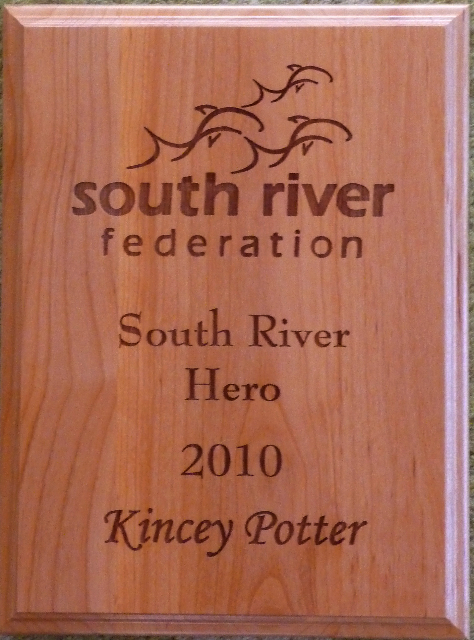
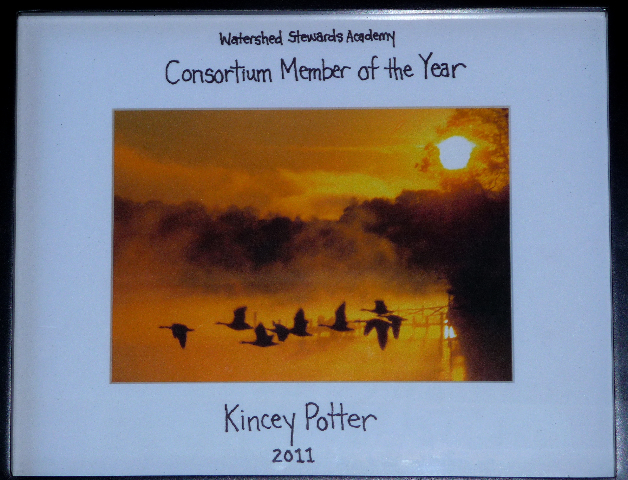
To round out her February, Kincey Potter, who retired as Chair of the South River Federation last October, received two awards in two days from local environmental groups. 

At the annual “South River on the Half Shell” auction fund raiser of the South River Federation, she received the South River Hero Award for her past seven years of service and accomplishments in leading the Federation to its current leadership in watershed conservation, preservation and restoration, and its advocacy for sustainable development policies for the watershed going forward.

P1050508_srf_hero_of_the_south

The second award — Kincey insists it was just a little thank your gift — was from a group that Kincey has  worked with for only the past year: the [Anne Arundel] Watershed Stewards Academy, which is a new private sector group being organized to take over a former public initiative to train citizen-volunteers in actual land use practices and restoration activities (think rain gardens and rain barrels) to prevent and mitigate negative effects of development on watersheds throughout the county. Kincey was especially recognized for the major investment she has made over the past year to recruit and organize a high powered Board of Directors that can provide useful guidance and leverage for the activities of the volunteers trained by the Academy. In addition to the nice photo-plaque below, they gave her a book on the Chesapeake and a Cedar (maybe three). Very nice, and thanks guys.

P1050538_watershed_stewards_20

Posted in Uncategorized | Leave a comment

Busy Beavers . . .

Took advantage of the nice weather, and a relatively high tide to re-visit the beaver dam and lodge in the headwaters of Church Creek. It seems that the beavers have been busy in the past year, and maybe they’ve been able to take advantage of the relatively dry conditions the past few months to do more work on dams.

P1050515

The beaver lodge is quite a bit higher, and lots of indications that the beavers have been adding to the dirt and sticks on the top.

P1050521

Substantial dam erected within the past year by beavers, just below Rt. 665, Aris T. Allen Blvd., and 30 or 40 feet upstream from the lodge.

P1050513

This is a second dam about 100 feet downstream from the lodge. This has been considerably reinforced by the beavers in the past year. There was red fox hunting in the bush behind, and later I saw several white tail deer on the nearby hillside.

Posted in Uncategorized | Tagged , | Leave a comment

Healthy Home Construction Industry on the South River

Interesting juxtaposition: 

At the bottom of this post is a report from the California Fish and Wildlife Commission, documenting the  irreversible deterioration of coastal California ecosystems because of continued construction of high density coastal developments. 

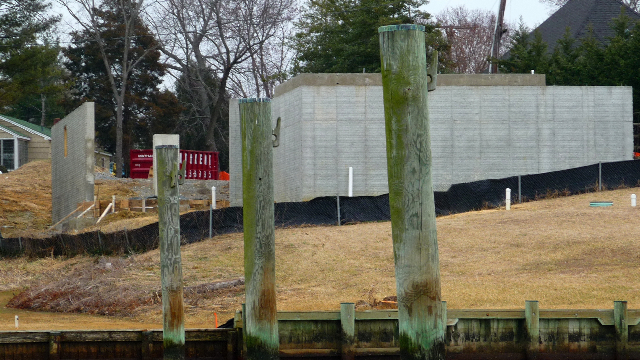
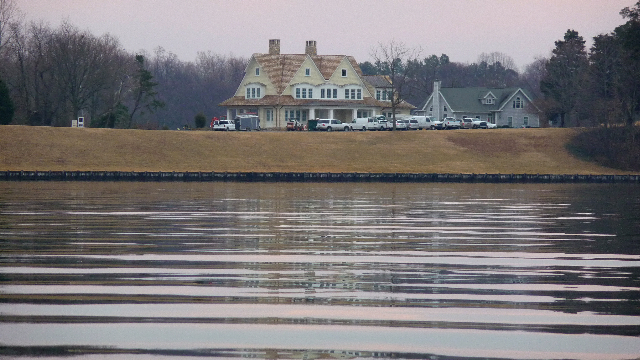
And then this morning I went kayaking and captured these three large new house or hotels or junior colleges (the scale of the buildings makes it hard to tell — maybe we could just call them demi-chateau) all newly started within a 45-minute kayak ride — two are on Ferry Point. I guess developments and building crowding the shores of the Chesapeake Bay don’t affect the environment, here on the right coast???

– – – – – – – – – – – – – – – – 
P1050472_first_house
– – – – – – – – – – – – – – – – 
P1050468_second_house
– – – – – – – – – – – – – – – – 
P1050459_3rd_house

– – – – – – – – – – – – – 

Report by the San Diego News on the December 15th  State of California Marine Life Protected Areas program.

California Fish and Game Commission pass final Southern California Marine Life Protected Areas
Environment and Resources
– 
Land
BY ALBERT H. FULCHER
  
WEDNESDAY, 22 DECEMBER 2010 18:34
Southern California’s coastline now has more Marine Life Protected Areas (MLPA), with several falling on San Diego County’s shores.

More than four years in planning, the California Fish and Game Commission passed regulations creating 36 new Marine Protected Areas (MPA) in the California South Coast Study Region in Santa Barbara on Dec. 15 with a 3-2 vote.

Many of these areas generated heavy debate amongst communities, with environmentalists, scientists, commercial and recreational fishermen, and residents joining into the fray on how best to protect the future of coastal natural habitats, preserve local economy and provide public recreational freedom.

Regional boundaries extend from Point Conception to the California-Mexico border. Regulations were adopted as part of the Marine Life Management Act of 1998, which focused on maintaining the health of marine ecosystems and biodiversity in order to sustain resources. This passage encompasses about 187 square miles of state waters in the region.

Planning groups for the expansions of MLPAs include the Blue Ribbon Task Force (BRFT), Science Advisory Team (SAT), Regional Stakeholder Group, Statewide Interests Group, and the California Fish and Game Commission. New regulations were passed following more than 50 days of meetings with formal public comment and are expected to go into effect mid-2011.

Fish and Game Commissioners Dan Richards and President Jim Kellogg voted against adopting the Commission’s Integrated Preferred Alternative (IPA) proposed regulation. Richards named three distinct reasons for his “no” vote.

“First and foremost, the protection of the ocean and its habitat is as important to Kellogg and myself as [it is to] the other commissioners,” said Richards. “What we are looking for is a fair, transparent process for all constituents – a plan that truly considers the economic impact of this decision and an adaptive management plan that can be properly funded and implemented.”

The Final Environmental Impact Report (EIR) states that the IPA includes changes in allowable fishing and other uses: “Though these changes may result in economic impacts to commercial fishing interest and ocean-dependent fishing businesses, these impacts have been evaluated and minimized during the design of the proposed Project IPA and alternatives.”

Richards argues that the EIR does not address the negative economic impacts on the fishing industry and the actual impact is unknown.

“The economic impact here is huge,” Richards said. “This plan will put thousands of Californians out of work.”


Posted in Uncategorized | Leave a comment

Global Oyster Species Stressed: The Independent . .

Wild oysters in danger of extinction

Overfishing has claimed more than 85 per cent of the world’s reefs, and the BP oil spill has taken its own toll

By Guy Adams

Sunday, 6 February 2011

Dredging and the BP oil spill have contributed to the scarcity of wild oysters

AFP/GETTY IMAGES

Dredging and the BP oil spill have contributed to the scarcity of wild oysters

Enjoy your shucking while it lasts. Wild oysters are now “functionally extinct” in many places around the world where they were once plentiful. More than 85 per cent of their reefs have been lost due to overfishing, according to a new study.

The decline of the mollusc is so severe that three-quarters of the world’s remaining stock can be found in only five locations in North America. And in once famous harvesting locations such as Britain’s Essex coast, the Wadden Sea off the Netherlands and Narragansett Bay, off Rhode Island, a mere 1 per cent of reefs remain. If nothing is done to protect remaining wild oysters, they could disappear within a generation, says Michael Beck of the University of California, Santa Cruz.

Dr Beck led a team of marine biologists who examined 144 former strongholds of the creatures in 40 regions around the world. The overall condition of the various species is “poor”, concludes the largest ever investigation into wild oyster stocks, published this week in the journal BioScience. Their loss is important since they play a vital role in filtering impurities from sea water, supporting fish populations, and preventing coastal erosion.

Last summer’s oil spill in the Gulf of Mexico hit the one place in the world native oyster catches had stayed at historical levels. The disaster destroyed as much as half of the most productive reefs, Dr Beck estimates.

“Oyster reefs are at less than 10 per cent of their priorabundance in most bays (70 per cent) and eco-regions (63 per cent),” reads his study. “They are functionally extinct, in that they lack any significant ecosystem role and remain at less than 1 per cent of prior abundances – in many bays (37 per cent) and eco-regions (28 per cent), particularly in North America, Australia and Europe.”

The fate of wild oysters is starkly apparent when weighed against their role in history. During the time of the Roman Empire, they were abundant enough to keep the English Channel crystal clear. As recently as the late Victorian era, they were thought of as a staple food of the working class. In 1880, about 120,000 people worked as oyster-catchers in Britain alone, and the world consumed about 700 million native oysters each year.

Their populations were subsequently destroyed by modern fishing methods, most notably dredging, a method by which the entire ocean floor is effectively ripped up. The advent of global travel made things worse, since non-native species, and therefore diseases, were introduced to new regions. Today, almost all the oysters consumed in restaurants (except those from the Gulf of Mexico, where there are still wild catchers) are farmed, rather than wild.

“The loss of oysters tends to get ignored because most people have forgotten how abundant they once were,” says Dr Beck. “In San Francisco in the 19th century, they were fed to workers building the transcontinental railroad. There were so many of them that the writer Jack London was both an oyster pirate and an oyster policeman. But today, there’s not a single wild oyster bed in San Francisco Bay.”

Oysters grow best in coastal regions where fresh water mixes with salt water. Over long periods of time, the shells of dead oysters build into reefs, which provide a valuable habitat for other fish and protect shorelines from erosion. But activity that damages parts of the reef leaves oysters vulnerable to stresses caused by changes in the environment.

In the Gulf of Mexico, many important reefs were destroyed last summer when clean-up workers decided to release vast amounts of fresh water from the Mississippi to help disperse oil spewing from BP’s Deepwater Horizon rig. It changed salt concentrations and killed off as many as half the living oysters in some parts of the region.

Mr Beck recommends that all areas where less than 10 per cent of former wild oyster reefs remain should be closed to dredging, oyster harvesting and all activities that might harm stocks. “If we do nothing, then they could disappear,” he says. “In many places, we’ve found that they are already functionally extinct. But if we act now, with reasonable measures, then I am confident that we can get them back.”

Posted in Uncategorized | Leave a comment

TNC Provides Some Good Science on Oysters, reported by BBC Environment blogger Richard Black

Lots of added comments will be found at the BBC web site at

=========

Oysters clear seas for local remedies

 | 11:43 UK time, Thursday, 3 February 2011

This week saw formal scientific publication of a report that produces one of the starkest conclusions I’ve seen about humanity’s relationship with the oceans.

Oysters

Globally, 85% of oyster beds have basically disappeared.

The paper, in the journal BioScience(though not apparently on its website yet), formalises results from a study conducted a few years ago co-ordinated by The Nature Conservancy (TNC), the US-based environment organisation.

The scientists behind the report (which we covered when TNC released the findings a couple of years ago) say this makes oyster beds “the most severely impacted marine habitat on the planet” – though researchers looking at the big ocean-going predators such as sharks, tuna and marlin might claim they’re ahead in the race for this most undesirable of trophies.

In one sense it’s not surprising. Oysters congregate in bays and estuaries – the easiest parts of the sea for humans to exploit.

From this, you might deduce that over-exploitation of oyster-beds (and indeed mussel-beds and other shellfish zones) isn’t a new phenomenon; and you’d be right.

The Romans not only used oysters but farmed them [pdf link], constructing artificial beds along inhabited parts of the Italian coast.

Excavations in south-western France yielded piles of more than one trillion oyster shells; while in the late 1800s, the UK’s oyster industry supported 120,000 workers – a far cry from today.

What happened next is a story all too familiar to anyone who’s looked at the history of fisheries for more than a few seconds: we industrialised, mechanising the process of excavation.

In the New World, settlement in oyster-rich areas such as Chesapeake Bay increased demand for the shellfish many times over.

Oysters

Oysters need a hard surface – in nature it is usually made from shells of other oysters

So fishermen increased the supply, until many of these grounds became shadows of their former glory.

Oysters need something hard to cling onto; a sea-floor of shifting sediment is no good to them.

What this means is fishing out an oyster reef basically means it won’t come back.

Young oysters attach onto the shells of old ones, which are nice and hard.

When there are no shells left, there’s nothing to cling onto, and even if there are any young around, they cannot survive.

Charles Clover, in that remarkable bookThe End of the Line, makes the case that parts of the North Sea owe their modern-day turbidity to the removal of beds that a century ago, were producing 100 times more oysters than today.

Oysters filter the water, clearing nutrients suspended in it; and the hardness of the bed means there’s far less sediment stirred up by wave action.

“Nineteenth-century maps show oyster beds 200km (100 miles) in length on the Dutch and German side, but the last of these were fished out before the Second World War.

“Since then, there have been no oysters left to form a hard substrate across the bottom.”

The implication is that if previous generations had looked after the resource better, present-day Britons (and Dutch and Germans) would not only have a much larger supply of oysters, we’d also have clearer waters for swimmers and divers to enjoy.

Without the luxury of being able to turn the clock back, two questions arise.

One is what can be done now to restore exhausted oyster beds.

The other is where the history of oyster overfishing should point us in terms of establishing regimes that protect and nurture valuable marine resources, so that our generation uses them sustainably and leaves some for the next.

Oyster restoration

Restoration projects in the Gulf of Mexico have successfully rebuilt some oyster reefs

The Nature Conservancy has pioneered the replenishment of defunct reefs andhas a number of projects running, many in the Gulf of Mexico – although there, restoration has been compromised by defences deployed against the Deepwater Horizon oil leak.

Fresh water was allowed to flow in far greater quantities than usual into the sea in an attempt to push oil away from the shoreline.

But fresh water kills marine oysters; and TNC says millions have indeed been killed along the coast.

Nevertheless, it appears that where there’s money and will, replenishment can be made to work.

On the longer-term question, we’ve recently had the UN biodiversity convention summit in Nagoya, Japan, and in just over a year we’ll have the second Rio Earth Summit – both events concerned largely with the sustainability of biological resources.

In terms of ocean conservation, Nagoya wasn’t a huge success, with nations pledging to slap protection orders on just 10% of the marine world – although other components of the agreement there should also help conservation, such as the move from “harmful” subsidies towards an economic regime that penalises destruction and encourages sustainable use.

With Rio+20, there’s concern in some quarters that marine issues might be marginalised, given the attention now being focussed on the urban environment, forests, climate change, agriculture, food security, and such like.

There’s no logical reason why that to happen – after all, climate change and food security are as relevant to the seas as they are to the land.

But the concern is there; and in an attempt to bring some attention to the issue, the Pew Environment Group recently launched a set of recommendations [pdf link] that went before delegates to the first preparatory conference in the process leading up to Rio+20.

Its top line:

 “With 70% of the Earth covered by the ocean, and given the importance of the ocean as the life support system of Planet Earth, now is the time for [the UN Commission on Sustainable Development] to pay due attention to the needs of the ocean, and to the hundreds of millions of people who depend on healthy ocean ecosystems for their very survival.”

One of the approaches to marine management that is working well in some places, and that environment organisations support, is giving control to local communities, allowing them to manage their resource in association with scientific advice.

Logically, oysters should be a prime candidate for this kind of approach. They nestle in inshore waters where regulations can be easily enforced, and they’re relatively high-value commodities, meaning that communities who manage the fishery properly are virtually guaranteed a long-term, stable source of revenue.

One of the problems with assessing the state of our environment is that it’s easy to assume what we’re used to is “natural”.

That’s why the kind of historical study TNC has just published is so valuable – to show us what we might never have suspected we were missing, and what we might rebuild given the resources, the knowledge and the will.

Posted in Uncategorized | Leave a comment

Book Burning the Modern Way — Let Google Do It . . . .

from the Saturday Buffalo Evening News . . . . 

Media_httpwwwbuffalon_hocoi
Library director Bridget Quinn-Carey says: “Since we’ve been here, we have been looking pretty aggressively at the reference collections to see what is more appropriate to have in print versus online, and what’s more cost-effective, balanced with what’s being used.”

Derek Gee / Buffalo News File Photo

Book weeding, changes stir debate at Central Library

NEWS STAFF REPORTER
Published:January 21, 2011, 12:00 AM

Updated: January 21, 2011, 3:42 PM

Librarians say the Central Library is moving away from its commitment as a research library, hastily discarding thousands of books and degrading their professional roles within an increasingly demoralized workplace.

However, administrators say they are weeding large numbers of books to largely make way for a new tagging system while undertaking prudent changes in collections and needed staff restructuring during a period of great change.

The cash-strapped Buffalo and Erie County Public Library system currently has a nearly $4 million budget gap that is being covered by a rainy day fund, reductions in hours and elimination of 36 1/2 full-time equivalent positions across four unions. That has affected 76 people, including 35 librarians, who have been laid off, seen a reduction in hours or changes to their job.

Administrators had considered eliminating 105 full-time equivalent positions before the Erie County Legislature restored $3 million of the $4 million that County Executive Chris Collins had tried to cut from the 2011 budget.

“We’re looking at changing the Central Library from a combination research collection and popular materials collection to more of the popular, at the expense of a more complex and diverse collection,” said Tim Galvin, president of the Buffalo and Erie County Librarians Association.

“The policy seems to be diminishing the role of the Central Library as we know it.”

Galvin said the discarding of “thousands and thousands” of books from the library’s collection since October has borne that out. “They are greatly

diminishing the size of the reference collection,” he said.

But the Central Library has been steadily moving away from being a research library for the past dozen years because academic libraries are fulfilling that role, said Bridget Quinn-Carey, director of the library system.

She said she was not aware whether a disproportionate number of books removed in the ongoing weeding process were from the research collection. But she said the print reference collection is shrinking as more content becomes available online.

“Since we’ve been here, we have been looking pretty aggressively at the reference collections to see what is more appropriate to have in print versus online, and what’s more cost-effective, balanced with what’s being used,” she said.

The main reason for taking books off the shelves now, she said, is that the library is converting to radio frequency identification technology over the next 18 months, which requires retagging every book in the system. Discarding books now, she said, makes sense to save on retagging costs for books no longer desired in the collection.

The timing — amid job layoffs and reassignments, and floor consolidation at the downtown library — was coincidental, she insisted.

The removal of so many library books has become a flash point for some librarians.

Both librarians and administrators say libraries must weed their collections for books that are in bad shape, contain outdated material or are rarely checked out. The library maintains a “dusty book list” for books that have not circulated in five years.

But what has happened since October goes far beyond that, with thousands of books winding up in bins marked Metro Waste Paper Recovery (now owned by recycler Cascades Recovery), said a librarian who asked not to be named for fear of reprisal.

“We were instructed by the administration that anything that was a duplicate, even if it was a popular title, or books that hadn’t been checked out since 2008 were to be taken for a book sale. But not all of them made it to the book sale,” the librarian said.

The librarian claims to have seen 18 large bins full of books discarded for recycling in the past three months. “It was against all weeding policies that we have ever learned. I couldn’t do it. It was horrible. It’s not what I do,” the librarian said.

Galvin agreed.

“The standards are not the same as they were, and I have been a librarian for 22 years and at Central since 2004,” he said. “We were offered to come in and volunteer at overtime, but many of us were too nauseated at the thought and refused to be a part of it.”

But Quinn-Carey and Mary Jean Jakubowski, chief operating officer, disagreed.

The books — with the exception of ones in poor condition, or with outdated information— were offered at book sales first before being discarded, they said.

Four book sales were held at the Central Library during the first week of December and included books moved from basement storage and used books already for sale in the now-closed bookstore.

“We take very seriously the rules that govern how we must get rid of materials. We have to make them available to the public for sale, or give them to [not-for-profits]. If they don’t sell, then they go into recycling,” Quinn-Carey said.

Galvin remains unconvinced. “I don’t see how that is possible. It has gone on since October, and thousands and thousands of books have gone out the door,” he said.

A library spokeswoman said the library would provide figures on the total number of books removed to date on Tuesday.

Other librarian concerns, Galvin said, include:

• Librarians are being moved out of their area of expertise without consultation.

• Librarians fear being driven into “irrelevance” to save costs.

• Centralizing collection development responsibilities will diminish a primary librarian responsibility.

• Librarians have not been consulted on management changes. They say consultation, though not contractually required, could improve morale. 

“One of the things we’re concerned about as a union,” Galvin said, “is that if you dumb down the collection, and dumb down the position of librarians, then you push us toward irrelevance.”

Quinn-Carey said the entire library profession is struggling with redefining the role of libraries and librarians as public libraries continue to change in the 21st century.

“As a librarian, I obviously embody and feel very strongly about the importance of libraries and librarians’ roles,” she said.


msommer@buffnews.com

Posted in Uncategorized | Leave a comment

Detailed Study of Coast Impacts of Climate Change in Nearby North Carolina

A good article from the Charlotte Observer 

that spells out both the effects and some of the policy conflicts to result from a one-meter sea level rise on the North Carolina coast and the large Pamlico Sound estuarine systems:

Rising seas may make N.C. coast unrecognizable

JOHN D. SIMMONS – JSIMMONS@CHARLOTTEOBSERVER.COM
A small canal cut from the Pamlico Sound into the Alligator River refuge accommodates a blue crab.

EmailPrintOrder Reprint

Share: Yahoo! Buzz
Text

 – THE CHARLOTTE OBSERVER

MANNS HARBOR — The sea that sculpted North Carolina’s coast, from its arc of barrier islands to the vast, nurturing sounds, is reshaping it once again.

Water is rising three times faster on the North Carolina coast than it did a century ago as warming oceans expand and land ice melts, recent research has found. It’s the beginning of what a state science panel expects to be a 1-meter increase by 2100.

Rising sea level is the clearest signal of climate change in North Carolina. Few places in the United States stand to be more transformed.

About 2,000 square miles of our low, flat coast are 1 meter (about 39 inches) or less above water.

At risk are more than 30,500 homes and other buildings, including some of the state’s most expensive real estate. Economists say $6.9 billion in property, in just the four counties they studied, will be at risk from rising seas by late this century.

Climate models predict intensifying storms that could add billions of dollars more in losses to tourism, farming and other businesses.

While polls show growing public skepticism of global warming, the people paid to worry about the future – engineers, planners, insurance companies – are already bracing for a wetter world.

“Sea-level rise is happening now. This is not a projection of something that will happen in the future if climate continues to change,” said geologist Rob Young of Western Carolina University, who studies developed shorelines.

Posted in Uncategorized | Leave a comment

The Last Super PAC of 2010

The Sunlight Foundation is pretty cool . . . http://reporting.sunlightfoundation.com/2011/last-super-pac-2010-started-wife-congressional-challenger/

Last Super PAC of 2010 started by wife of congressional challenger

We missed it between Christmas and New Years, but Heartland Revolution registered as an independent expenditure only committee with the Federal Election Commission. Such committees, also known as Super PACs, can take contributions in any amount from any source, and spend that money influencing federal elections.

Heartland Revolution shares a Post Office box with John Waltz for Congress, the eponymous campaign committee for the Democratic challenger to Rep. Geoffrey Davis, R-Ky. In filings with the FEC, the committee discloses just one official–Janie Waltz, which is the name of Waltz’s wife.

Super PACs are bared from coordinating with federal candidates.

Posted in Uncategorized | Leave a comment

Maryland Critical Area Commission vs Anne Arundel Board of Land Use Appeals

Interesting letter NOT admitted in the County Council debate on nominations to the Anne Arundel County Board of Appeals January 3rd, 2010.

Posted in Uncategorized | Leave a comment