Book Burning the Modern Way — Let Google Do It . . . .

from the Saturday Buffalo Evening News . . . . 

Media_httpwwwbuffalon_hocoi
Library director Bridget Quinn-Carey says: “Since we’ve been here, we have been looking pretty aggressively at the reference collections to see what is more appropriate to have in print versus online, and what’s more cost-effective, balanced with what’s being used.”

Derek Gee / Buffalo News File Photo

Book weeding, changes stir debate at Central Library

NEWS STAFF REPORTER
Published:January 21, 2011, 12:00 AM

Updated: January 21, 2011, 3:42 PM

Librarians say the Central Library is moving away from its commitment as a research library, hastily discarding thousands of books and degrading their professional roles within an increasingly demoralized workplace.

However, administrators say they are weeding large numbers of books to largely make way for a new tagging system while undertaking prudent changes in collections and needed staff restructuring during a period of great change.

The cash-strapped Buffalo and Erie County Public Library system currently has a nearly $4 million budget gap that is being covered by a rainy day fund, reductions in hours and elimination of 36 1/2 full-time equivalent positions across four unions. That has affected 76 people, including 35 librarians, who have been laid off, seen a reduction in hours or changes to their job.

Administrators had considered eliminating 105 full-time equivalent positions before the Erie County Legislature restored $3 million of the $4 million that County Executive Chris Collins had tried to cut from the 2011 budget.

“We’re looking at changing the Central Library from a combination research collection and popular materials collection to more of the popular, at the expense of a more complex and diverse collection,” said Tim Galvin, president of the Buffalo and Erie County Librarians Association.

“The policy seems to be diminishing the role of the Central Library as we know it.”

Galvin said the discarding of “thousands and thousands” of books from the library’s collection since October has borne that out. “They are greatly

diminishing the size of the reference collection,” he said.

But the Central Library has been steadily moving away from being a research library for the past dozen years because academic libraries are fulfilling that role, said Bridget Quinn-Carey, director of the library system.

She said she was not aware whether a disproportionate number of books removed in the ongoing weeding process were from the research collection. But she said the print reference collection is shrinking as more content becomes available online.

“Since we’ve been here, we have been looking pretty aggressively at the reference collections to see what is more appropriate to have in print versus online, and what’s more cost-effective, balanced with what’s being used,” she said.

The main reason for taking books off the shelves now, she said, is that the library is converting to radio frequency identification technology over the next 18 months, which requires retagging every book in the system. Discarding books now, she said, makes sense to save on retagging costs for books no longer desired in the collection.

The timing — amid job layoffs and reassignments, and floor consolidation at the downtown library — was coincidental, she insisted.

The removal of so many library books has become a flash point for some librarians.

Both librarians and administrators say libraries must weed their collections for books that are in bad shape, contain outdated material or are rarely checked out. The library maintains a “dusty book list” for books that have not circulated in five years.

But what has happened since October goes far beyond that, with thousands of books winding up in bins marked Metro Waste Paper Recovery (now owned by recycler Cascades Recovery), said a librarian who asked not to be named for fear of reprisal.

“We were instructed by the administration that anything that was a duplicate, even if it was a popular title, or books that hadn’t been checked out since 2008 were to be taken for a book sale. But not all of them made it to the book sale,” the librarian said.

The librarian claims to have seen 18 large bins full of books discarded for recycling in the past three months. “It was against all weeding policies that we have ever learned. I couldn’t do it. It was horrible. It’s not what I do,” the librarian said.

Galvin agreed.

“The standards are not the same as they were, and I have been a librarian for 22 years and at Central since 2004,” he said. “We were offered to come in and volunteer at overtime, but many of us were too nauseated at the thought and refused to be a part of it.”

But Quinn-Carey and Mary Jean Jakubowski, chief operating officer, disagreed.

The books — with the exception of ones in poor condition, or with outdated information— were offered at book sales first before being discarded, they said.

Four book sales were held at the Central Library during the first week of December and included books moved from basement storage and used books already for sale in the now-closed bookstore.

“We take very seriously the rules that govern how we must get rid of materials. We have to make them available to the public for sale, or give them to [not-for-profits]. If they don’t sell, then they go into recycling,” Quinn-Carey said.

Galvin remains unconvinced. “I don’t see how that is possible. It has gone on since October, and thousands and thousands of books have gone out the door,” he said.

A library spokeswoman said the library would provide figures on the total number of books removed to date on Tuesday.

Other librarian concerns, Galvin said, include:

• Librarians are being moved out of their area of expertise without consultation.

• Librarians fear being driven into “irrelevance” to save costs.

• Centralizing collection development responsibilities will diminish a primary librarian responsibility.

• Librarians have not been consulted on management changes. They say consultation, though not contractually required, could improve morale. 

“One of the things we’re concerned about as a union,” Galvin said, “is that if you dumb down the collection, and dumb down the position of librarians, then you push us toward irrelevance.”

Quinn-Carey said the entire library profession is struggling with redefining the role of libraries and librarians as public libraries continue to change in the 21st century.

“As a librarian, I obviously embody and feel very strongly about the importance of libraries and librarians’ roles,” she said.


msommer@buffnews.com

Posted in Uncategorized | Leave a comment

Detailed Study of Coast Impacts of Climate Change in Nearby North Carolina

A good article from the Charlotte Observer 

that spells out both the effects and some of the policy conflicts to result from a one-meter sea level rise on the North Carolina coast and the large Pamlico Sound estuarine systems:

Rising seas may make N.C. coast unrecognizable

JOHN D. SIMMONS – JSIMMONS@CHARLOTTEOBSERVER.COM
A small canal cut from the Pamlico Sound into the Alligator River refuge accommodates a blue crab.

EmailPrintOrder Reprint

Share: Yahoo! Buzz
Text

 – THE CHARLOTTE OBSERVER

MANNS HARBOR — The sea that sculpted North Carolina’s coast, from its arc of barrier islands to the vast, nurturing sounds, is reshaping it once again.

Water is rising three times faster on the North Carolina coast than it did a century ago as warming oceans expand and land ice melts, recent research has found. It’s the beginning of what a state science panel expects to be a 1-meter increase by 2100.

Rising sea level is the clearest signal of climate change in North Carolina. Few places in the United States stand to be more transformed.

About 2,000 square miles of our low, flat coast are 1 meter (about 39 inches) or less above water.

At risk are more than 30,500 homes and other buildings, including some of the state’s most expensive real estate. Economists say $6.9 billion in property, in just the four counties they studied, will be at risk from rising seas by late this century.

Climate models predict intensifying storms that could add billions of dollars more in losses to tourism, farming and other businesses.

While polls show growing public skepticism of global warming, the people paid to worry about the future – engineers, planners, insurance companies – are already bracing for a wetter world.

“Sea-level rise is happening now. This is not a projection of something that will happen in the future if climate continues to change,” said geologist Rob Young of Western Carolina University, who studies developed shorelines.

Posted in Uncategorized | Leave a comment

The Last Super PAC of 2010

The Sunlight Foundation is pretty cool . . . http://reporting.sunlightfoundation.com/2011/last-super-pac-2010-started-wife-congressional-challenger/

Last Super PAC of 2010 started by wife of congressional challenger

We missed it between Christmas and New Years, but Heartland Revolution registered as an independent expenditure only committee with the Federal Election Commission. Such committees, also known as Super PACs, can take contributions in any amount from any source, and spend that money influencing federal elections.

Heartland Revolution shares a Post Office box with John Waltz for Congress, the eponymous campaign committee for the Democratic challenger to Rep. Geoffrey Davis, R-Ky. In filings with the FEC, the committee discloses just one official–Janie Waltz, which is the name of Waltz’s wife.

Super PACs are bared from coordinating with federal candidates.

Posted in Uncategorized | Leave a comment

Maryland Critical Area Commission vs Anne Arundel Board of Land Use Appeals

Interesting letter NOT admitted in the County Council debate on nominations to the Anne Arundel County Board of Appeals January 3rd, 2010.

Posted in Uncategorized | Leave a comment

So, Do You Want More or Less Coal Ash in Your Backyard?

From “The Hill” Energy and Environment blog — today

Greens say EPA analysis on coal ash riddled with errors

By Andrew Restuccia

– 12/29/10 12:14 PM ET

An analysis by the Environmental Protection Agency (EPA) on the costs and benefits of regulating the disposal of coal ash is riddled with errors, environmental groups alleged Wednesday.

The EPA cost-benefit analysis, environmentalists fear, will lead the agency to impose less stringent standards on the substance, a move they say would disregard the potential health effects of coal-ash exposure.

The allegations come two years after a coal-ash pond in Kingston, Tenn., ruptured, dumping more than a billion gallons of the potentially toxic substance in the surrounding area. The disaster led the EPA to initiate an effort, still ongoing, to regulate coal ash, a byproduct of the burning of coal.

At issue is whether the EPA will regulate coal ash as a hazardous or a non-hazardous waste. Environmentalists have been calling for regulation as a hazardous waste, which would require a number of additional safeguards, while industry groups have said the substance should be regulated as a non-hazardous waste.

The environmentalists say the EPA cost-benefit analysis greatly overstates the benefits of coal-ash recycling, a process by which coal ash is used to make a number of common products like wall board. In overstating the benefits, the agency is perpetuating the idea that more stringent coal ash regulation will make it harder to recycle the substance.

Speaking to reporters on a conference call Wednesday, officials from the Environmental Integrity Project and Earthjustice, which reviewed the EPA cost-benefit analysis, laid out their concerns.

EPA’s analysis is “full of mistakes large and small,” said Frank Ackerman, senior economist at the Stockholm Environment Institute, which also reviewed the EPA analysis.

“The largest error is the overstatement of the benefits of coal-ash recycling” and the underestimation of environmental and health concerns, Ackerman said.

Ackerman conducted a separate analysis that found “the sum total of all the changes creates a stronger case for strict regulation than there is in EPA’s original version,” he said.

Abigail Dillen, staff attorney at Earthjustice, stressed that EPA has yet to make a decision on how it will regulate coal ash, but raised concern that the agency is “painting itself into a corner” with its analysis.

While the groups are not taking legal action regarding the analysis, Dillen suggested the groups could use their findings in a future lawsuit if the EPA decides to regulate coal ash as a non-hazardous waste.

An EPA spokesperson did not respond immediately to a request for comment.

Posted in Uncategorized | Leave a comment

Fortunately, this Can’t Happen Here. Oh, it CAN?? – Marsh Loss by Sea Level Rise etc.

from South Carolina

Study finds marsh being drowned as sea off S.C. rises

By Bo Petersen

The (Charleston) Post and Courier/The Sun News

The salt marsh might be the defining feature of the Lowcountry coast, miles after miles of sweeping grasses. It’s the nursery of countless marine creatures including shrimp. It’s a filter that helps keep the waters clean.

And it’s drowning, right in front of our eyes, being flooded faster than it can move inland as the sea rises. A Boston University study of tidal creeks in Cape Romain National Wildlife Refuge offers some of the first, see-it-for-yourself evidence.

The loss of marsh compounds the damage from the overwash of barrier islands, jeopardizing the future of the 64,000-acre island seascape refuge northeast of Charleston that is singular habitat for a host of species. For example, the refuge is maybe the best nesting area in the Southeast for sea turtles.

What the marsh loss suggests for the rest of the coast is even more disturbing. The study is the latest in a series of alarming research that shows the coastal grasses being literally eaten away.

There’s an estimated 400,000 acres of coastal marshes in South Carolina. A federal Environmental Protection Agency study in 1998 indicated sea level is rising about a foot per century on the East Coast. Conservationists warn the climate warming is exacerbating that.

The study focuses on a stretch of Horsehead Creek behind remote Cape Island east of McClellanville. On the south bank of Horsehead, smaller tidal creeks work their way back into the marsh in the classic, winding pattern. But on the north bank, creeks are forming that plunge straight into the marsh, to pits where crabs have devoured the grasses.

It’s called rapid headward erosion, and it’s trouble. The sediment is disappearing, the grasses aren’t replenishing, and the bare spots are filling in with creek, not marsh.

“There’s no doubt it’s happening there,” said Dennis Allen, lab director at Baruch Marine Institute in North Inlet, just outside Cape Romain, who has spent 30 years studying tidal creeks in the Lowcountry. In North Inlet, researchers have found low-lying marshes flooding more frequently, the marsh grasses thinning and dying off.

“There are signs for sure the marsh is having a hard time keeping up with sea level rise in this day and age,” Allen said. Research by Baruch director Jim Morris suggests 20-50 percent of what we see today as salt marsh will become sand flats and open water lagoon systems in the next 20-30 years, he said.

For Sarah Dawsey, U.S. Fish and Wildlife Service biologist at Cape Romain, the study is documentation of what she has been seeing. Cape Island alone holds 1,041 of a total 3,129 sea turtle nests in South Carolina this year. Nearly 25 percent of the island has been overwashed since 1954. There is, as Dawsey says, “not much we can do about it.”

On Bull Island, south of Cape Island, 20-25 feet of shoreline is disappearing per year. A levee has been rebuilt twice back in the dunes for a brackish water impoundment on the island’s edge, because the impoundment is habitat for hundreds of wading birds, waterfowl and alligators. There’s no longer any dune shoulder left to attach the levee. One big storm will likely destroy the impoundment, said Raye Nilius, refuge project leader.

Posted in Uncategorized | Leave a comment

Texas: The Lower Rio Grande

Tourist brochure: “One of the advantages of the Lower Rio Grande Valley is the more than 500 RV Parks.”

You betcha. . .

Posted in Uncategorized | Leave a comment

November Water Quality summary

Here is the blog-posted summary of conditions from this month’s water quality testing by Diana Muller, South River Keeper, and Americorps-person Jennifer Carr (see the Washington Post for 27 November, Metro Section) on the South River. 
Maybe water clarity was degraded by tannins in the water from decomposing leaves?

[Note that this summary does some violence to the fine-scale resolution of the hundreds of sample points that represent Diana’s sampling scheme (0.1 meter vertical resolution for each of 19 sampling sites the length of the tidewater portions of the river and major tributaries). It is that fine scale sampling and detailed analysis of the results that’s permitting Diana and the several scientists working with her (including of course Dr. Andrew Muller, her husband, at the Naval Academy) who are changing our fundamental picture of the pollution-causing and mitigating role of small estuarine rivers in the mid-Bay.]

Nov 29
2010

November’s Water Quality Monitoring

Posted by: diana 

Tagged in: Untagged 

Print PDF

The surface and bottom salinity profiles show a direct influence of “fresher” water at the toward the headwaters of the South River, verses the more saline water at the mouth of the River.  The average water temperature was 50°, pH 7.2, Dissolved Oxygen 10 mg/l, Water Clarity 0.8m – still does not meet the criteria of 1 meters.
–Diana


Posted in Uncategorized | Leave a comment

Beavers have been beavering away . . . .

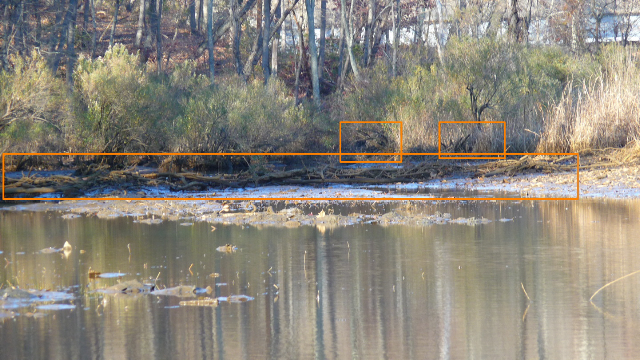
“Erik’s Beavers” (Michelsen, of course) on the middle branch of the top of Church Creek have been busy.

We kayaked and pushed the kayak about as far as it would go with the very low tide Sunday, and got a good look at the new lower level of the beavers’ construction activities. . In this picture, you can see the Route 665 bridge above, and two of the beaver lodges are also visible.

A couple of months ago this dam appeared to be only a couple of small branches stuck in the bottom of the stream. . .

P1050280sm

Posted in Uncategorized | Leave a comment

That’s just wrong. . . .

Great story from the Cape Verde islands.. . . .

The Professional Windsurfers Association just held their final event for 2010 on our little island.  They built an enclosure with concrete and metal on a turtle nesting beach.  Nobody bothered to find out if there were still nests on the beach.  The walls went from the back of the beach to the water preventing anyone else from using this public beach.  They built a huge stage with massive lights and held parties and football tournaments every night One of the concrete poles narrowly missed the egg chamber of a nest that hatched on the first night of the tournament – the majority of hatchlings died of course. Whilst we were scooping all the bodies up the next day the organiser (a world champion windsurfer) consoled us with the thought that at least we were finding them.  A second nest hatched two nights later but fortunately some good citizens collected the majority and called us.

The wind did not blow for eight days and so few heats were completed that the standings remained as they were when the tournament started.

Karma?

‘Friends’ of the ocean aren’t always what they seem.


Jacquie Cozens
SOS Tartarugas Cabo Verde
Posted in Uncategorized | Leave a comment