First Water Quality Report of the Season from the South River Keeper

The first part of Diana Muller’s report . .  be sure to go to 

for the whole picture .. . .  Question # 1, Why is the Bay so low in Oxygen in April?

RiverkeeperPollution 19 May 2010
Eyes Under the South River – Main stem water quality by diana
Print PDF

The following is our own “Eyes Under the South River”.  This comes from my weekly water quality monitoring program, therefore this is REAL data and not a model.  The graphs and interpretations are performed  by Andrew Muller, PhD USNA-Oceanography and Diana Muller, South RIVERKEERER.

Posted in Uncategorized | Leave a comment

Damn Egret

Damn Egret

Zooming along on my road bike

my beloved American River bike path

late April still deep green grasses

mini-jungle carpets hiding wild beasts

the green was punctuated by a white

large, long-necked, longer-legged

killing sword-long beak a great egret.


Damn, that damn egret

has speared a frog

my number one spirit helper frog

still squirming, but quickly

to be the egret’s fast-food lunch.


My quick thought was of rescue

but it would have been too late.

Besides the frog was stupid

April careless

or it’s just frog fate.


Down path I ponder.

I lament the swallowed frog.

I decide to bless the frog.

I even bless the crafty, murderous egret.

Yet wonder what message it portents for me?


a.
     
That it’s my lunch time too.


b.
     
Even frogs have to pass on.


c.
      
Frogs need to organize.


d.
     
I should give up bike riding


Back home I had a succulent

great egret meat on sourdough

sandwich for lunch.

                           Andy

= = = = = = = = = = = = = = = = = = = = = = = = 

Lesson is:

If you’re cold-blooded, and therefore slow in cool spring days and cold water,
look both ways when coming up out of the hibernating mud. . . . or wait for May.
. .

Posted in Uncategorized | Leave a comment

Update: Mermaid 2 Gone — More Good News for South River

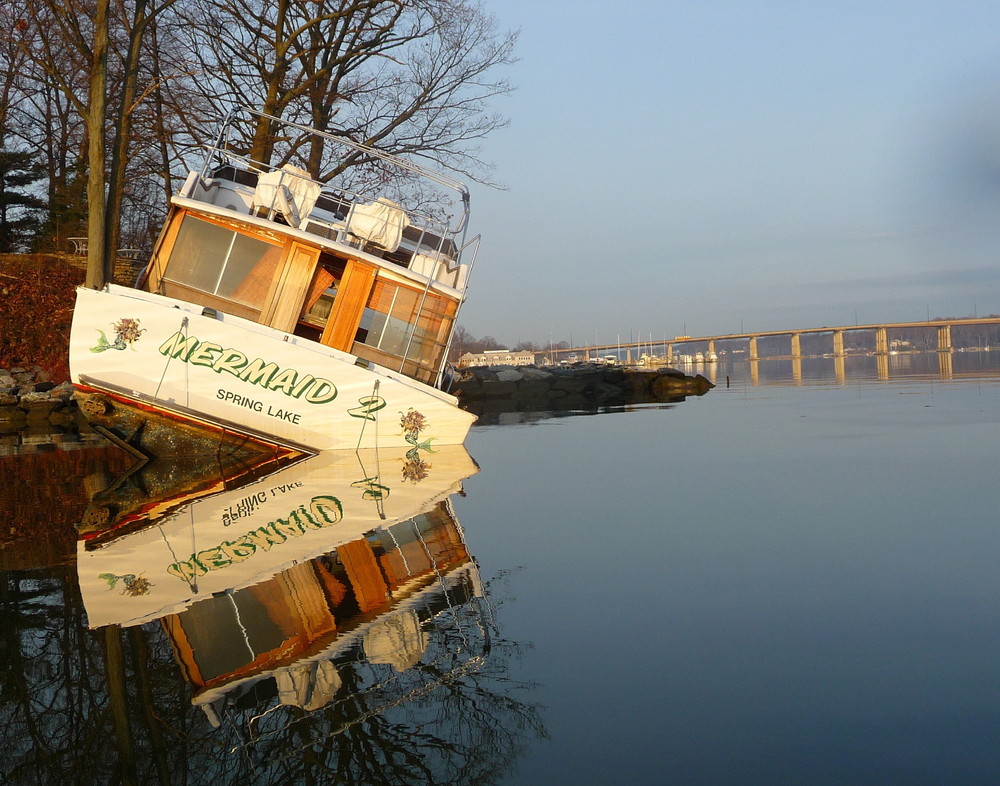
Following on Erik Michelsen’s recent post about the successful tracking down of the sewer leak on Gingerville Creek <http://southriverfederation.net/index.php/news/blog/Another-Sewer-Success.html>, another piece of good news is that over the winter the Mermaid 2, featured in the post below in December, is now gone, and hopefully is safely secured someplace where she is in no danger of breaking up and further polluting the River.

Good work, Anne Arundel County (or whoever got it moved) and THE RIVERKEEPER for helping the wheel to squeek. . .

P1020848_md-9684-am

Wreck: Mermaid 2 Polluting the South River

This wreck, the “Mermaid 2“MARYLAND REGISTRATION # “MD-9684-AM” has been aground in the South River, just outside Alehouse Creek, near Mark #15, for several weeks, maybe months. It should be condemned and removed before a storm breaks up and does serious damage to this shoreline.

Let’s hope there’s some way to recover the costs of disposing of the wreck from the owner. This is definitely one time when we favor the “Polluter Pays Principle.”
Posted in Uncategorized | Tagged , | Leave a comment

Million Dollar/year for five year Environment Grant for SERC Research of

Just happened across this six-month-old clipping from NOAA —

NOAA and Smithsonian Project to Improve Chesapeake and Delaware Bays’ Nearshore Habitat Management

October 30, 2009

Smith Island, Md.

Marshes such as this one at Smith Island, Md., are vulnerable to a host of stresses, including climate change, invasive species, and shoreline alterations.

High resolution (Credit: NOAA)

NOAA has awarded the Smithsonian Institution’s Environmental Research Center and several partner organizations $946,000 for the first year of an anticipated five-year, $5 million collaborative project to study the degradation of nearshore coastal habitats in the Chesapeake and Delaware Bays. Research will be used by environmental managers and local officials to better protect and restore these estuaries over the long-term, as well as plan for sea level rise and other consequences of climate change.

Invasive species, contaminants, excessive nutrients and sediment are just some of the many factors threatening sensitive wetlands and seagrass beds. An additional issue has been community efforts to “harden” shorelines by lining shores with bulkhead, rock or rubble to try to protect adjoining lands against erosion and sea level rise. These structures can threaten the health of living shorelines, such as wetlands and marshes. This project will look at the combined effects of these multiple stresses on nearshore habitats and their dependent species.

“These habitats, which are nursery and feeding grounds for so many species, have typically been managed in a piecemeal, parcel-by-parcel fashion and are slipping away in areas of heavy development,” said Robert Magnien, Ph.D., and director of the NOAA National Centers for Coastal Ocean Science’s Center for Sponsored Coastal Ocean Research, which awarded the grant. “Developing scientific information that ties multiple species and their environment will be used to advance management approaches.”

The Smithsonian Institution’s Environmental Research Center will lead a team of investigators from the Virginia Institute of Marine Sciences, the University of Maryland Center for Environmental Science, the Maryland Department of Natural Resources, the University of Delaware, Pennsylvania State University, and the United States Geological Survey. Area coastal managers are also part of the research team and will provide input. Program managers from NOAA’s National Ocean Service will provide oversight.

The research supports President Obama’s Executive Order for Chesapeake Bay Protection and Restoration, which specifically calls for strengthening scientific support for decision-making to protect and restore living resources and water quality of the Chesapeake Bay and its watershed. It also relates to a major goal of the Mid-Atlantic Governor’s Agreement and multi-state Chesapeake Bay Agreement to preserve, protect and restore habitats and natural areas that are vital to the survival and diversity of the living resources of the Bay.

Agencies such as the Environmental Protection Agency, the Army Corps of Engineers, the Chesapeake Bay Foundation, Virginia Marine Resources Commission and the NOAA Chesapeake Bay Office will utilize information resulting from this research. In a letter of support for the proposed research, Rich Batiuk of the EPA said that this program will “address critical issues related to habitat degradation, invasive species, and shoreline hardening. All of these ecosystem impacts are recognized in the Chesapeake 2000 agreement, and therefore are critical concerns to Chesapeake Bay Program partnership.”

“Developing the science for understanding the combined effects of shoreline hardening on water quality, underwater grasses, fish and shellfish will help support policy for accelerating Bay restoration,” stated Maryland Department of Natural Resources Secretary John Griffin. “Maryland is firmly committed to making management decisions based on sound science. This project will provide the practical information for driving wetland restoration and managing development in Maryland’s critical areas.”

The mid-Atlantic region is only one area where shoreline hardening is seen as an important issue. The results of this research can potentially be extrapolated to hardened shorelines in other coastal states.

The Smithsonian Environmental Research Center leads the nation in research on linkages of land and water ecosystems in the coastal zone and provides society with knowledge to meet critical environmental challenges in the 21st century.

NOAA understands and predicts changes in the Earth’s environment, from the depths of the ocean to the surface of the sun, and conserves and manages our coastal and marine resources. 

Posted in Uncategorized | Leave a comment

Gunk in Church Creek

P1000381

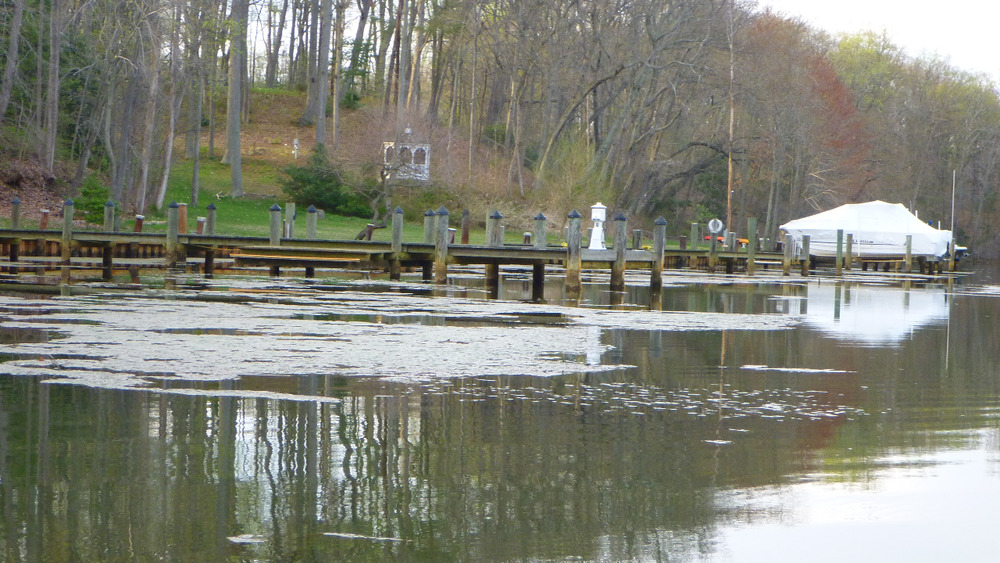
This is some sort of early season algae bloom (before the really hot weather) that we have seen before, but it seems to have been smaller in previous years.

Kayaking the Creek, saw the occasional small individual fry jumping — don’t know if that’s a symptom of low oxygen already??

bp

Posted in Uncategorized | Leave a comment

High Housing and Transport Costs in Anne Arundel — ?environmental consequences?

The Center for Neighborhood Technology (CNT) in Chicago has developed a complicated model to 337 neighborhoods around the country, showing the real economic and environmental costs of sprawl.

A URL for some of the interactive, on-line map products is at

http://htaindex.org/mapping_tool.php#region=Baltimore%2C%20MD&theme_menu=0&layer1=23&layer2=24

or

http://j.mp/9S6fDU

Anne Arundel County is notable for the fact that 100% of the county has combined housing and transportation costs OVER 45% of median income. . . . shows darker blue in the map on the right. . .

Ht_affordability_index_baltimo

Guess BRAC will be good for the county by reducing the average commuting time for county residents.. .

Posted in Uncategorized | Leave a comment

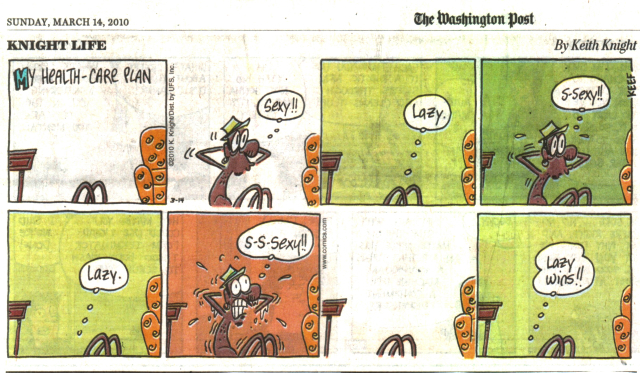
Lazy Wins. . .

Seems right to me . . .

Sit_ups_health_care_plan_carto

bp

Posted in Uncategorized | Leave a comment

The Weather: Cocktail Chatter for two or three parties here . . . .

good post by one of the bloggers on Weather Underground . . . 

Posted by: JeffMasters, 3:26 PM GMT on March 12, 2010
The U.S. just experienced its coldest winter in 25 years, according to the National Climatic Data Center. The winter period December – February was the 18th coldest winter in the contiguous U.S. over the past 115 years, and the coldest since 1984 – 1985. It was also a wet winter, ranking 19th wettest. The states experiencing the coldest winters, relative to average, were Texas and Louisiana, which had their 5th coldest winters on record. Mississippi, Georgia, Alabama, Oklahoma, Arkansas, Florida, and South Carolina also had a top-ten coldest winter. The only state much above average was Maine, which had its 3rd warmest winter. As I discussed earlier this week, this winter’s cold weather over the U.S. is largely due to the Arctic Oscillation/North Atlantic Oscillation, which assumed its most extreme negative configuration since record keeping began in 1950. El Niño helped keep things cool from Texas to the Southeastern U.S., as well.


Figure 1. Winter temperatures for the winter of 2009 – 2010. Image credit: National Climatic Data Center.

A cold February in the U.S.
February temperatures were 2.2°F below average across the contiguous U.S., making it the 29th coldest February in the 115-year record. For the second month in a row, Florida was the coldest state, relative to average. Florida had its 4th coldest February on record. Seven other states had February temperatures between 5th and 8th coldest on record: Louisiana, Texas, Alabama, Mississippi, Arkansas, Georgia, and South Carolina. Maine had its 3rd warmest February, New Hampshire its 5th, and Washington its 6th. Precipitation across the U.S. was near average in February.

Warmest and driest winter on record in Canada
Canada had its warmest winter on record, 4.0°C (7.2°F) above average, according to Environment Canada. The previous record was 3.9°C above average, set in 2005-2006. Canada also experienced its driest winter on record this year, with precipitation 22.0% below normal. The previous driest winter was 1977-1978 (20.1% below normal). Canadian weather records go back 63 years, to 1948. David Phillips, a senior climatologist with Environment Canada, warned of potential “horrific” water shortages, insect infestations, and wildfires this summer due to the warm, dry winter. Phillips blamed the warm winter weather on El Niño and the severe loss of arctic sea ice last fall. The winter season in Canada has warmed, on average, by 2.5°C (4.5°F) over the past 63 years.


Figure 2. Departure of temperature from average in Canada for the winter of 2009 – 2010. Image credit: Environment Canada.

— 
—————————————————
Bruce Potter
1818 Woods Road
Annapolis, MD 21401

home landline: 410-280-6254; home fax: same
CELL  –>>      1-443-454-9044  <<—  
SMS Text message to 443 454 9044@tmomail.net   (no spaces)

DC Office:
Island Resources Foundation

1718 P Street NW, #T-4, Washington, DC 20036

202/265-9712 
off fax: 202/232-0748

STT Office:  
340/775-6225
STT fax:  340/779-2022

E-mail: 

bpotter@irf.org    

TWITTER:

brucepotter 

—————————————————————-
“Ignoranti quem portem petat, nullus suus ventas est”
“If one does not know to which port one is sailing…..no wind is favorable” 
– Seneca the Younger (3BC-65AD) 
—————————————————————-
Posted in Uncategorized | Leave a comment

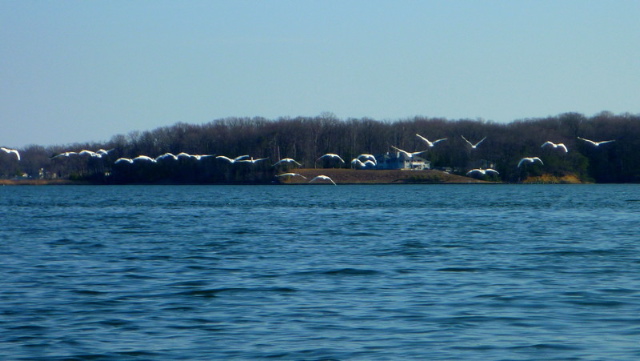
Trumpeter Swans Resting on the South River, en route north

Tuesday afternoon — there were about 30 swans in the middle of the river – really looked like 15 pairs. Sorry I spooked them from the kayak.

P1000024_15_pair_swansP1000025_take-offP1000027

Posted in Uncategorized | Leave a comment

NewScientist on Invasives Control on South Georgia

excerpt from the New Scientist at http://www.newscientist.com/article/mg20527501.200-extermination-in-paradise.html?full=true

Extermination in paradise

AS ISLANDS go, you would be hard pressed to find one more remote. Deep in the southern Atlantic Ocean sits South Georgia, a haven for wildlife in the midst of ferocious seas. Over 30 million birds of 31 species breed here and a further 50 species have been spotted. It is home to grey-headed albatrosses, northern giant petrels, white chinned petrels, Antarctic prions, half of the entire population of macaroni penguins and most of the planet’s population of the South Georgia blue-eyed shag.

But it is not as idyllic as it sounds. Under the surface lurks a menace that is slowly ripping the ecosystem apart: rats.

The rodents were stowaways on sealing and whaling ships that visited the island until the mid-20th century. When the hunters stopped coming, the rats were left to their own devices along with a small population of reindeer that had been brought for food and now roam wild. Without natural predators, the rat population has swollen to many million, eating their way through tens of millions of ground-nesting birds’ eggs and chicks in the process. As a result, the island’s endemic wildlife is under threat, and its only songbird, the South Georgia pipit, is on the brink of extinction.

Now the South Georgia Heritage Trust (SGHT) is going to fight back. In what will be the largest mass extermination ever attempted, the SGHT plans to poison every rat on the island. “The difference between success and failure is the survival of two rats on the entire island,” says Tony Martin, project manager of the SGHT Habitat Restoration Programme. “We don’t have to get rid of most or even 99.9 per cent of the rats – we have to eradicate 100 per cent.”

Absolute eradication is the only option because rats breed rapidly. They can live for around two years, achieve sexual maturity at two months old and are able to produce seven litters of 8 to 10 offspring a year. Female rats reach menopause at around 18 months. Even in the harsh climate of South Georgia, a sexually mature female is likely to have around four litters a year. If just one couple survive, it will only take a few years before the island is overrun again (see diagram).

go to the link above for graphics and the rest of the article . . . 

Sanjida O’Connell is an editor in New Scientist‘s Opinion section

Posted in Uncategorized | Leave a comment