This is the Chesapeake Bay Program that was voluntary and did not work.
Celebrating 35 Years of Restoration
In 1983, a partnership was born with the signing of the first Chesapeake Bay Agreement
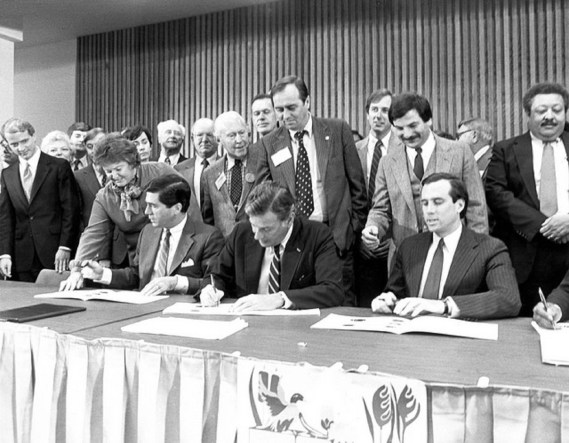
The Chesapeake Bay Agreement is signed on Dec. 9, 1983 by Governors Charles S. Robb (Va.) Harry Hughes (Md.) and Richard Thornburgh (Pa.), DC Mayor Marion Barry and EPA Administrator William Ruckleshaus. (Image by Chesapeake Bay Program)
by Rachel Felver
October 11, 2018
Did you know that the Chesapeake Bay Program celebrates its 35th anniversary this year? On December 9, 1983, the governors of Virginia, Maryland and Pennsylvania, the mayor of the District of Columbia, the chair of the Chesapeake Bay Commission and the administrator of the Environmental Protection Agency met at George Mason University in Fairfax, Virginia to sign a one-page pledge that recognized that a cooperative approach was necessary to address the pollution issues that plagued the Chesapeake Bay.
This one-page document became the original Chesapeake Bay Agreement, which established the Chesapeake Bay Program liaison office in Annapolis, Maryland. It also formed the Chesapeake Executive Council, dictating that this group would meet annually to “assess and oversee the implementation of coordinated plans to improve and protect the water quality and living resources of the Chesapeake Bay estuarine systems”.
Keep an eye on the Chesapeake Bay Program’s blog and social media accounts this fall, as we continue to look back at the history that made this program what it is today.
About Rachel Felver – Rachel is the Director of Communications for the Chesapeake Bay Program. She has the experience of growing up in a headwaters state – Pennsylvania – and is now living life right next to the Bay in Maryland. After obtaining her masters’ in environmental policy and management from the University of Pittsburgh, she spent almost nine years with the Environmental Protection Agency before a stint with the National Aquarium. Her favorite Bay activities include paddleboarding and taking her dog swimming.
[Frankly, I’m getting a bit impatient with the number and variety of problems in the medical professions that seem to stem directly from the inability — even refusal — to address the self-generated errors that practitioners inflict on patients.
At least a decade ago I remember reading a similar article about the inability of doctors to understand basic statistics — in one example, 80% of doctors defined the significances of “percentiles” wrong.
So here we are a half-a-generation on, and they still don’t “ … acknowledge the gaps in our understanding,” as Dr. Morgan notes in his last paragraph. . . . . Couldn’t we make doctors pass a humility test before they can practice, and then have to renew it every five years? bp]
What the tests don’t show
Doctors are surprisingly bad at reading lab results. It’s putting us all at risk.
By Daniel Morgan October 5, 2018
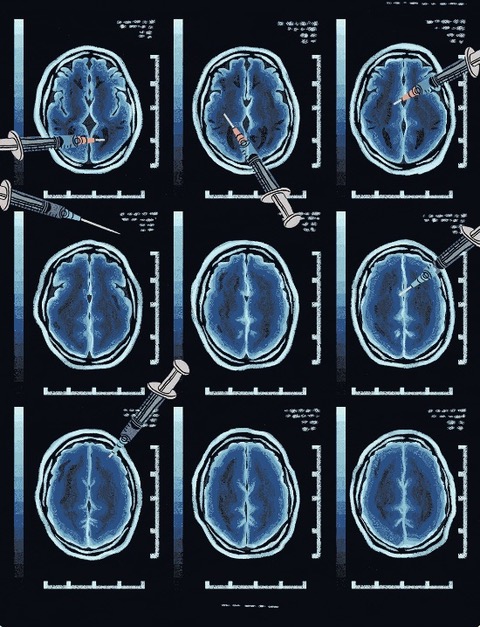
The man was 66 when he came to the hospital with a serious skin infection. He had a fever and low blood pressure, as well as a headache. His doctors gave him a brain scan just to be safe. They found a very small bulge in one of his cranial arteries, which probably had nothing to do with his headache or the infection. Nevertheless, doctors ordered an angiogram to get images of brain blood vessels. This test, in which doctors insert a plastic tube into a patient’s arteries and inject dye, found no evidence of any blood vessel problems. But the dye injection caused multiple strokes, leading to permanent issues with the man’s speech and memory.
That case, recounted in JAMA Internal Medicine three years ago, is no surprise. As a doctor in a large urban hospital, I know how much modern medicine has come to rely on tests and scans. I review about 10 cases per day and order and interpret more than 150 tests for patients. Every year, doctors in this country order more than 4 billion tests. They’ve gotten more sophisticated and easier to execute as technology has advanced, and they’re essential to helping doctors understand what might be wrong with their patients.
But my research has found that many physicians misunderstand test results or think tests are more accurate than they are. Doctors especially fail to grasp how false positives work, which means they make crucial medical decisions — sometimes life-or-death calls — based on incorrect assumptions that patients have ailments that they probably don’t. When we do this without understanding the science of risk and probability, we unacceptably increase the chances of making the wrong choice. In the worst cases, as with the man whose angiogram caused otherwise avoidable strokes, we increase the odds of unnecessarily putting patients in danger.
The first problem that doctors (and thus, patients) face is a basic misunderstanding of probability. Say that Disease X has a prevalence of 1 in 1,000 (meaning that 1 out of every 1,000 people will have it), and the test to detect it has a false-positive rate of 5 percent (meaning 5 of every 100 subjects test positive for the ailment even though they don’t really have it). If a patient’s test result comes back positive, what are the chances that she actually has the disease? In a 2014 study, researchers found that almost half of doctors surveyed said patients who tested positive had a 95 percent chance of having Disease X.
This is radically, catastrophically wrong. In fact, it’s not even close to right. Imagine 1,000 people, all with the same chance of having Disease X. We already know that just one of them has the disease. But a 5 percent false-positive rate means that 50 of the remaining 999 would test positive for it nonetheless. That means 51 people would have positive results, but only one of those would really have the illness. So if your test comes back positive, your true chance of having the disease is actually 1 out of 51, or 2 percent — a heck of a lot lower than 95 percent.
A 5 percent false-positive rate is typical of many common tests. The primary blood test to check for a heart attack, known as high-sensitivity troponin, has a 5 percent false-positive rate, for instance. U.S. emergency rooms often administer the test to people with a very low probability of a heart attack; as a result, 84 percent of positive results are false, according to a study published last year. These false-positive troponin tests often lead to stress tests, observation visits with expensive co-pays and sometimes invasive cardiac angiograms.
In one study, gynecologists estimated that a woman whose mammogram was positive had a higher than 80 percent chance of having breast cancer; the reality is that her chance is less than 10 percent. Of course, women who have a positive mammogram often undergo other tests, such as an MRI and a biopsy, which can offer more precision about the presence of cancer. But researchers have found that even after the battery of exams, about 5 of every 1,000 women will have a false-positive result and will be told they have breast cancer when they do not.
The confusion has serious consequences. These women are likely to receive unnecessary treatment — generally some combination of surgery, radiation or chemotherapy, all of which have serious side effects and are stressful and expensive. Switzerland and France, grasping this problem, are halting and reconsidering their mammogram programs. In Switzerland, they’re not screening ahead of time, preferring to manage cases of breast cancer as they’re diagnosed. In France, doctors are letting women decide for themselves whether to have the tests.
Studies have found that doctors make similar errors with other tests, including those for prostate and lung cancer, heart attack, asthma and Lyme disease. Of course, no test is perfect, and even very careful, statistically sophisticated doctors can sometimes make mistakes. That’s not the problem.
Too many of my colleagues do not understand that many of the tests they rely on are deeply fallible. In a study I published last year with several colleagues, we reviewed the treatment of 177 patients who were admitted to hospitals with a wide range of problems, from broken bones to severe intestinal pain, to see how necessary their tests were, as judged by the latest medical guidelines. We found that nearly 90 percent of the patients received at least one unnecessary test and that, overall, nearly one-third of all the tests were superfluous. When patients receive tests that aren’t needed, there is a reasonable chance that doctors are using the results to make choices about treatment; by definition, these choices have a higher danger of being flawed.
In another paper, from 2016, my colleagues and I interviewed more than 100 doctors to gauge their understanding of the risks and benefits of 10 common medical tests or treatments. We found that nearly 80 percent of our subjects overestimated the benefits. Strangely, the doctors themselves acknowledged this, with two-thirds rating themselves as not confident in their understanding of tests and probability. Eight out of 10 said they rarely, if ever, talked to patients about the probability of test results being accurate.
I have to admit that I, too, sometimes fall prey to overvaluing test results regardless of their probability. Last year, I saw a patient who had problems breathing. His symptoms were typical of chronic obstructive pulmonary disease (COPD), but a test for a blood clot in the lung came back positive. This test has a relatively high false-positive rate, but we still started the patient on a blood thinner, which can treat clots but also has serious risks, such as internal bleeding. Within a few days, another test confirmed that he did not have a blood clot, so we discontinued the anticoagulant, which caused no permanent harm. But things could have gone much worse.
Basic misunderstandings about how tests work and how accurate they are contribute to a bigger problem. Although precise numbers are hard to come by, every year, many thousands of patients are diagnosed with diseases that they don’t have. They receive treatments they don’t need, treatments that may have harmful side effects. Perhaps just as important, they and those around them often experience enormous stress from these incorrect diagnoses. Treating nonexistent diseases is wasteful and often expensive, not only for patients but for hospitals, insurance companies and governments.
Doctors also tend to overuse some tests. In a paper last year, my colleagues and I highlighted some key examples: One was computed tomography (CT), a high-tech scanning technology that is increasingly used in patients with nonspecific respiratory symptoms. In cases with only mild respiratory problems, the test does not improve patient outcomes, and it can lead to false positives. Often, the test shows small lung nodules that can lead doctors to follow up with a high-risk surgical biopsy for cancer — which is very unlikely to be the cause of the symptoms. The scan also exposes patients to radiation, which is a risk in itself; studies have found that between 1.5 and 2 percent of all cancers in the United States are caused by radiation from CT scans.
To be fair, it is not surprising that doctors tend to overestimate the precision and accuracy of medical tests. The companies that provide tests work hard to promote their products. Doctors often think that ordering more tests will protect against lawsuits. Moreover, medical schools offer limited instruction on how to understand test results, which means many doctors are not equipped to do this well. Even when medical students have short classroom instruction in test interpretation, it is rarely taught in a clinic with actual patients.
There is no simple solution. One key step is for doctors to acknowledge the gaps in our understanding and to improve our knowledge of what each test can accurately tell us. Medical schools and professional associations can also do a much better job of educating doctors to understand how risk and probability work. Patients must also play an important role. They should realize that doctors, even quite capable ones, may not fully understand the statistical underpinning of the tests they use. In essence, your doctor may have a blind spot, an unconscious tendency to have too much trust in a test. Being aware of this problem and asking your doctor about disease probability can reduce hassles and anxiety — and sometimes even save lives.
Well, probably. In any case, if you care about resource management issues in the American West, you cannot not read High Country News. Subscribe and then give them an extra donation — they’re that good.
Here’s a story of the Western version of pizza-gate — a fake news “child sex-trafficking ring” report from Tucson promoted by right-wing loonies.
On May 31, a strange story aired on the nightly news in Tucson, Arizona. KOLD News 13 reporter Kevin Adger told viewers that a local veterans’ rights activist named Lewis Arthur had made a horrific discovery in the bushes beside a frontage road: a bunker used as a stopover by child sex traffickers. The reporter pointed out children’s clothes, an old toilet seat and a septic tank where Arthur claimed kids had been held against their will.
Arthur had stumbled across the camp while canvassing the area for homeless vets. He posted an outraged rant on Facebook and started getting comments — a lot of them. When he posted videos arguing that there were probably bodies buried at the camp and that it was part of a network of Arizona sex trafficking sites, he topped 680,000 views in days.
There was just one problem with Arthur’s story: It wasn’t true. Tucson police and sheriff’s deputies both investigated the site and found nothing more than a former homeless camp — no evidence of sex trafficking. Arthur then claimed he and two friends had found proof: a child’s skull. Officers sent the skull to the Pima County medical examiner, who concluded that it had belonged to an adult and been found miles away from the homeless camp.
The Arizona Daily Star and other local news outlets published stories debunking the claims. In a pre-internet world, the whole thing might have ended there, without any more newspaper ink or the involvement of the FBI. But in 2018 — at a time when social media, a conspiracy-minded president, and the erosion of trust in public institutions are providing fertile ground for wild-eyed theories — the story kept gaining life.
From as far away as Australia, believers travelled to the Tucson desert to deliver vigilante justice to the sex traffickers. Their stories became more elaborate: The skull became a partial corpse. One person told me it was so fresh when it was found, they saw it “dripping.” The camp became evidence of a massive pedophile ring implicating Cemex, the Mexican cement company that owns the property. Some of Arthur’s followers found more bones and suggested they came from people who had died terrible deaths. But the medical examiner analyzed them, too, and concluded they were animal remains. At least one was from a deer.
Lewis Arthur, the founder of Veterans on Patrol, an organization that provides shelter and resources to homeless veterans in Tucson, Arizona, stands outside a camp which he started in early June 2018 in an effort to fight what he believes is the trafficking of migrant women and children for sex in the Tucson area.
Andrew Cullen for High Country News
I FIRST HEARD of Lewis Arthur in early June, when JJ MacNab, an expert on anti-government movements, tweeted about his “one-sided standoff.” It caught my eye because Arthur had connections to the Bundy family, the Nevada ranchers at the center of two recent armed confrontations with federal land managers. Arthur had traveled to Bunkerville, Nevada, in 2014 to help prevent the Bureau of Land Management from removing the cows Cliven Bundy had illegally grazed for decades. Two years later, he showed up at the armed occupation of Oregon’s Malheur National Wildlife Refuge led by Cliven’s sons.
But even in those far-right circles, Arthur is considered a fringe character, known as “Screwy Louie.” At Bundy Ranch, he reportedly called police to the protest site, and in Oregon, he tried to “help” an acquaintance, militiaman Ryan Payne, and “women and children” by rescuing them from the refuge, the occupation of which Arthur believed was misguided. Bundyites kicked him out of both events.
Arthur, 39, is 6 foot 2, with red hair, freckles and hazel eyes. His full name is Michael Lewis Arthur Meyer, but “Michael Meyer,” he says, is an entirely different man. The personal story he tells is one of victimhood and redemption. On a walk through the desert this summer, he told me that he’s originally from Ohio, was sexually abused as a kid, and later fell into selling drugs. He now lives in Tucson, where his wife works in the pharmaceutical industry, supporting him and his daughter.
Arthur, who is not a veteran, started the group Veterans on Patrol (VOP) in 2015, to provide temporary shelter to homeless vets in Mesa, Prescott, Nogales and Tucson. Helping vets was a worthy cause, but Arthur seemed to be searching for something more. In recent years, he also started climbing towers wielding upside-down American flags to draw attention to homelessness and suicide among veterans. In 2015, he perched atop an 80-foot-tall light pole in Surprise, Arizona, for four hours. This July, he occupied a tower on the Cemex property for nine days, demanding officials investigate child sex trafficking.
After he announced his discovery of the sex camp, Arthur started gaining the attention he seemed to seek. Within 24 hours, he gained 55,000 Facebook followers, which grew to 77,000 in July. “For him this is a religious mission,” tied to his Christian faith, says MacNab, who has followed Arthur’s activities for several years. “He has a huge heart. But he’s got this other side that is desperate for drama and attention.”
And what about his followers, I wondered? What compelled them to sprint to the scorching desert to join one man’s fantastical crusade? And what does it mean for communities when the unreality of the internet so easily crosses the threshold into real life?
The Veterans on Patrol camp has hosted dozens of volunteers since it started in June.
Andrew Cullen for High Country News
IT WAS 105 DEGREES on the June afternoon I arrived at Camp Pulaski, the base Arthur set up near Picture Rocks, a Tucson suburb, from which to launch his new mission: intercepting sex traffickers coming from the southern border. In the early mornings and after nightfall, the camp’s residents patrol on foot and in ATVs, trucks and jeeps. “If they want to come into our backyard,” Arthur declared via livestream, “we’ll give them a fight.”
Camp Pulaski consisted of a couple large tarp structures and five or six camping tents clustered almost a mile off a county road. A large map of the Sonoran Desert hung in one tent, with push pins marking the locations of additional camps Arthur said he’d established. That afternoon, I did what everyone else was doing: I sat in a folding chair, drank water and asked people why they’d come.
I sat next to a 70-year-old woman from Colorado Springs, who wore peach lipstick and cowboy boots. In between bites of Starkist tuna, she told me she’d heard about the mission on Facebook and felt a personal connection. “I had been in an abused situation with my mother,” she said. “It makes me want to be able to do something to those people.” Several people I talked to were driven by curiosity; they saw strange stories on Facebook and wanted to find the truth. There were longtime friends of Arthur’s who had found a home at his shelters, or helped with Veterans on Patrol. And there were also hardcore conspiracy theorists, who believed the “sex camp” was part of a global pedophile ring run by rich elites.
Pedophile rings allegedly involving high-profile Democrats are central to some of the conspiracy theories that have metastasized for years in right-wing online forums and social media. And the Tucson gathering wasn’t the first time this online chatter had real-world consequences. The infamous 2016 incident known as “Pizzagate” — where a fantasy about Hillary Clinton sexually abusing minors in a Washington, D.C., pizza joint prompted a man to barge into the restaurant and fire an AR-15 while looking for victims — was the fruit of the same poisonous tree.
And new branches keep growing. Some of Lewis’ acolytes were also followers of “Q,” or QAnon, a shadowy figure purporting to be a high-level government agent and leaker. The information Q posts online supports anti-Hillary Clinton, pro-Donald Trump conspiracies that often involve sex crimes against children. And while sex trafficking is a real problem in the U.S., there is as little evidence for the salacious particulars popular in these fringe forums as there was at the camp Arthur “discovered.”
Veterans on Patrol volunteers David Armstrong, Tim and Quoin crawl under a barbed-wire fence during a hike through the desert near a residential neighborhood outside Tucson, Arizona while searching for evidence of human trafficking. During the search exercise, members of the group crossed private property and looked for suspicious items as they passed homes and yards.
Andrew Cullen for High Country News
After a couple days at Camp Pulaski, it started to seem as if its denizens were living in a dark version of the smartphone game Pokémon Go, in which fictional creatures populate the physical landscape players move through. A group of patrollers saw a business sign showing a human eye and believed it was the mark of a secret society. When they saw white crosses painted or laid down in the desert sand — signs experts say are used in aerial mapping — they interpreted them as the insignia of sex traffickers. One day, a man named Frank gave me a ride from Camp Pulaski to the main road, and talked about how many kids go missing every year where he’s from in West Virginia. (Most people I met at Camp Pulaski spoke on the condition that their last names or full names not be revealed.) Then he told me that Anthony Bourdain, the famous chef who had committed suicide days earlier in France, had actually been murdered. Authorities, he claimed, had covered it up. As I hopped out of his jeep, I wondered what Bourdain and missing kids in West Virginia had to do with sex traffickers in the Sonoran Desert. “If you’re really looking for the truth, I will stay here another day and will pull up as much information as I can for you,” Frank said.
Believers see these imaginary global webs of malfeasance as huge and intangible problems, like climate change. For Frank and others I met at Camp Pulaksi, Arthur’s call to arms offered a direct answer, one five-hour desert patrol at a time.
In some ways, their activities are just a twist on the long-standing vigilante tradition in which white men take up arms to try to keep migrants from crossing the border. Such contemporary volunteer “militias,” including the Minutemen, Arizona Border Recon, the Arizona State Militia, and their precursors, have operated in the Borderlands since the 1990s. Most people I spoke with at Camp Pulaski had never been part of a militia. But a similar, racially charged hostility toward immigrants permeates Arthur’s rhetoric, which is unmistakably Trumpian. The then-candidate’s 2015 statement that Mexicans are “rapists” and drug dealers echoes through VOP livestreams. Arthur says he’s not only helping ranchers keep “illegals” off their land, he’s also trying to save migrant “women and children” from Mexican coyotes.
And like many things Trumpian, Arthur’s crusade has unleashed a novel sort of chaos.
Rachel Krause working in her home. Krause started a Facebook page with a friend to illuminate what they felt were inaccuracies and bad behavior from the Veterans on Patrol volunteers camped in the desert a few miles from her home in Marana, Arizona.
Andrew Cullen for High Country News
IT WAS SWELTERING when I pulled into a suburb a few miles from Camp Pulaski. The houses sat in neat rows with sandy driveways and minimal landscaping, and it was a relief to walk into Rachel Krause’s cool home. An American flag was folded in a triangle displayed in the kitchen, and her laptop slept quietly on a desk near the front door.
Krause is among a couple dozen individuals in Tucson and across the country who have taken it upon themselves to monitor Arthur, debunk his claims, and provide facts and commentary online. They are vigilantes in their own right, seeing themselves not as enforcers of the law but of the truth.
Krause, 42, has brown hair and a tattoo of a snowflake on her shoulder. She is a former accountant whose husband works in the military and in local law enforcement. “I’m a liberal,” she told me. “He’s the Boy Scout, the Republican.” In early June, she and another woman started a Facebook page called “Citizens Against VOP.” Krause couldn’t stand seeing people get duped into sending gift cards and supplies to support Arthur, and she was angry that her community was the staging ground.
Within days, 300 people had liked the group. “We had no idea that the responses would be just so vast,” Krause said. She installed the Facebook page manager app on her smartphone to help her keep up, but deleted it a couple days later because she got so many notifications from commenters. She’d skipped lunch the day I visited because things were so busy online.
“It’s better than television,” Tucson resident Sherry Peterman told me later by phone. “It’s a real-life drama.” When Peterman first heard about the sex camp on local TV, she believed Arthur’s claims. But then she started following Krause’s Facebook page and researching Veterans on Patrol, and she decided Arthur was misleading people. By then, she couldn’t look away.
A white plastic bottle sits on top of a metal pole near the Veterans on Patrol camp. Volunteers said that a series of similar poles with jugs were a navigational guide for migrants crossing through the desert.
Andrew Cullen for High Country News
Despite the entertainment and sense of purpose that Peterman and Krause have found in debunking Arthur’s claims, it’s also been an unnerving experience. Krause has received threatening messages from his supporters, and online trolls have warned her to watch her back and posted screenshots of her house. Peterman, a senior citizen who lives alone, says she locked herself in her house after watching a particularly angry livestream. Arthur spoke of unleashing “demons” on his opposition, something that Peterman took as a threat of physical violence. “It was enough to say, ‘Hey, lock your windows, watch your car, and goodness, don’t answer your door until you know who’s on the other side,’ ” Peterman told me. She notified the police, but they said the threat was too vague to act on.
The police did, however, take action after Arthur and several associates trespassed on private property. In June, Arthur livestreamed them walking through a ranch house, pointing out evidence of alleged criminal activity: A chair facing the window was a trafficker’s lookout, a child’s bedroom proof of abuse.
Kyle Cuttrell, who runs cattle from the property in question, told me the claims were absurd. “It’s just an unoccupied ranch house,” another rancher who manages the property, told Arthur in a July phone call that was recorded and posted online, apparently without the rancher’s permission. “I don’t want to be slandered and called a goddamn pedophile,” he said. The harder the rancher tried to reason with Arthur, the clearer it became that nothing would change his mind about what he thought he saw. On July 8, Tucson authorities arrested Arthur on a charge of trespassing, and he spent one night in jail. (He was arrested again on July 22 for the Cemex tower occupation and an unrelated assault charge.)
Overall, though, it’s been challenging for local law enforcement to figure out how to respond to Veterans on Patrol. Sgt. Tiffany Hogate of the Pima County Sheriff’s Department told me in July that she was inundated with reports of weird happenings, some of which turned out to be too vague or unsubstantiated to address. The complaints ranged from online threats to suspicious foot traffic on private land. She was tasked with monitoring VOP’s activities and had put one detective on it full-time; another deputy was helping out part-time.
Hogate and the detective spent hours some days monitoring Arthur’s livestreams, where local officials were also coming under attack. Arthur publicly called out Tucson’s mayor and sheriff on Facebook, arguing that because they don’t support his cause, they must be complicit in sex trafficking. In mid-July, he publicly thanked the secretive hacker group Anonymous for posting names, addresses and passwords for certain law enforcement employees online. That month, one of Arthur’s supporters threatened on Facebook to slit the mayor’s throat, line up local police officials “in front of a firing squad,” and put them in a wood chipper. According to local sources, the FBI began monitoring Arthur and VOP this summer. As of July, Hogate was hoping to create a joint task force of local agencies to more efficiently monitor VOP. She had submitted a request for the FBI to conduct a threat assessment, but hadn’t heard back yet.
To add to the chaos, around the time of the break in, a contingent of the Oath Keepers, a national militia group, launched “Operation Child Shield,” and came to town to look for more sex trafficking sites. “They’re looking for a cause,” MacNab explained. They offered advice to Arthur’s followers on handling crime scene evidence, then also met with Cuttrell and other ranchers, suggesting the militia could protect their properties. “I was real nervous about meeting with those guys,” Cuttrell told me. “But they’re legit.”
Volunteer Chris Murray cooks pasta in the makeshift kitchen area of the Veterans on Patrol camp.
Andrew Cullen for High Country News
AS OF EARLY SEPTEMBER, Veterans on Patrol continues to work from Camp Pulaski; Arthur says they’ll stay for three years. They have now traveled as far south as the Mexican border, placing American flags atop hills believed to be lookouts used by migrants and cartels. The fringe group that gathered in the desert never seemed to grow to more than a few dozen, and most in Tucson never knew of its existence.
Still, it’s worth paying attention to what’s happening here. It appears to be an extreme expression of broader trends, such as the eroding trust in traditional institutions like government, science and journalism, and the increasing reliance — by people across the political spectrum — on alternative news sources and social media for information. The Rand Corporation, a global policy think tank, called this phenomenon, along with an increasing disagreement about basic facts, “truth decay” in a report earlier this year.
“I think individuals are finding only a very few people they trust, distilling into smaller communities,” said Rutgers University media studies associate professor Jack Bratich, describing a pattern that seemed evident in how Arthur’s followers and his opposition organized into factions online. “I don’t think it’s just filter bubbles, where you get only the news you want, but clusters of information communities.”
This social splintering, along with “truth decay,” increasingly pervades American life. Donald Trump rode baseless claims that President Barack Obama was not born in the U.S. all the way to the White House. In his first year and a half in office, the Washington Post calculated that Trump made 4,229 false or misleading claims, with some taking root in the public imagination: A Washington Post-ABC News poll last year found 48 percent of Americans believed in a “deep state,” or a conspiracy of “military, intelligence and government officials who try to secretly manipulate government policy.” This normalization of conspiratorial thinking raises questions about whether ideas incubating in fringe circles like Arthur’s may find pathways to wider audiences.
“We’re in a perfect storm right now because we have a conspiracy theory president,” says University of Miami political scientist Joseph Uscinski, adding that, “the media has to constantly cover his conspiracy rhetoric and the actions people are taking based on his rhetoric.”
Here in the desert, it seemed fortuitous that the consequences had not yet included violence. Boise State University associate professor Seth Ashley, who recently co-authored research on news literacy and conspiracy theories, pointed out that Dylann Roof, the white supremacist who killed nine black parishioners in a South Carolina church in 2015, similarly projected misinformation he found online onto the world around him. “(Roof) Googled black-on-white crime and got all these links about the prevalence of black people killing white people,” Ashley said. “It’s totally false.” And yet it shaped his worldview and his actions, and nine people died. “The content and the behavior is all connected,” Ashley explained. “It’s great that we can all voice our opinions and do our own research and find our own information. But that also makes it harder than ever to sort truth from fiction.”
Veterans on Patrol founder Lewis Arthur rubs his forehead in the midday heat at the desert camp he started as a base from which to fight human trafficking in the desert near Tucson, Arizona.
Andrew Cullen for High Country News
ONE SUMMER EVENING at dusk, I visited the notorious Cemex lot, finding it empty except for an unmarked cruiser. Long shadows yawned over the dirt and asphalt. The former homeless camp was tucked into a brambly slope, invisible from the road. Nearby, a casino’s billboard promised fast cash: “Your shot at $1,000,000!” A dilapidated blue children’s pool full of gravel and old chunks of cement sat next to the locked fence. It was hard to imagine this place had provoked such distracting drama.
“They’re out there chasing ghosts,” Scott Cutright, a veteran who spent a few weeks in one of Arthur’s shelters this year, had told me. “That’s the term you use in the military. You hear things go bump in the night, you think it’s the enemy, but in reality it’s your imagination because you’re scared or you’re amped up. You think there’s something out there, you pour resources into (it). But in reality, it’s ghosts.”
An appreciation of Kincey Potter: ‘She was just a force’
Kincey Potter, who died Sept. 15, leaves a deep legacy for area waterways through her efforts building organizations and nurturing leaders. (Courtesy photo)
About 15 years ago the South River Federation was a fledgling group of citizens trying to organize their efforts to save their river. And the idea to create a permanent source of money to restore Anne Arundel’s watersheds was just talk.
Then Kincey Potter came along.
Over the next decade her guiding hand molded the federation into the premier watershed group in the Chesapeake Bay region with paid staff, formal offices, solid science and a deep commitment to preservation that secured funding for and implemented about $20 million worth of restoration projects in the watershed.
And Potter was a key player in shepherding the idea of a dedicated source of money for the law creating the Watershed Protection and Restoration Program, and fighting the efforts to first veto the bill and then repeal it.
Then she turned to the Watershed Stewards Academy, which Sunday celebrates its 10th anniversary graduating — yet another class of trained watershed advocates — and helped grow that, too.
Later she and Bob Gallagher formed the Anne Arundel County Chapter of the Maryland League of Conservation Voters to encourage candidates and note those with strong environmental bonafides.
And she did all that in retirement from a business career after surviving the Sept. 11, 2001, terrorist attack on the World Trade Center — and while battling the metastatic breast cancer that took her life Sept. 15 in her sleep.
She would have eschewed credit for the good works, noting she had plenty of help from others, and she did. But her steadfast example, no-nonsense approach, sense of strategic plan and personal touch, and boundless energy remains a model to those who follow.
Her legacy will be measured in swimmable, fishable waters throughout Anne Arundel County’s 12 watersheds restored by thousands of projects large and small, public awareness and her pluck.
It will also live on through a group of organizations led by a generation of leaders she molded by recognizing potential, demanding commitment and giving opportunity.
Drew Koslow was the first South Riverkeeper and the South River Federation’s first hire.
“She imprinted on us that we were to become a professional organization. She set standards, expectations of me and the board,” said Koslow, who now runs a nonprofit working with farmers on the Eastern Shore to reduce water pollution.
She led people to think big, he said. In a work session to develop a working list of potential watershed restoration projects, she pushed them to include “big, hairy, audacious” plans, to go big or go home, Koslow recalled.
“We came up with 75 prioritized projects,” he said. “Then she hired people like Erik Michelsen and Kirk Mantay to get it done.”
All 75 projects have been implemented, Koslow said, including the two most audacious: the major restoration project in the headwaters of Church Creek, and the project to restore a large section of Broad Creek near the Park and Ride lot off Harry S. Truman Parkway.
“She had an eye for talent, a capacity from her business career,” Koslow said. “And she gave us the tools, the avenue and encouragement to go out and do it.”
He continued, “She was just a force.”
Michelsen had been working for Underwood and Associates, one of the earliest companies doing streambed restoration work, and volunteering with the South River Federation when Potter tapped him to take the reins as Executive Director.
“I had not contemplated that at the time. I was not sure I was suited for it that early in my career,” he said. “But she was able to see something in me that maybe I didn’t see in myself at that point.”
With the support of staff and an engaged board of directors, “I was able to rise to the occasion as a result of her support, her mentorship and guidance.”
And after serving as executive director at SRF under Potter’s wing, he applied for and landed the job to direct the county Watershed Protection and Preservation Program.
Long before Chris Trumbauer became an Anne Arundel County councilman, he was a volunteer, then board member, at SRF. Soon he was off to become the West/Rhode Riverkeeper.
“Kincey was a real mentor to me at that time. She was able to leverage other’s talents and get people involved, giving them responsibility and amplifying individual effort,” he told The Capital when Potter won the Ellen Fraites Wagner Award from the Chesapeake Bay Trust.
“When you think about someone like Kincey passing, you tend to think about their legacy,” Trumbauer said last week. “And her legacy is going to be there for a long time in those organizations.”
Diana Muller came on board as the South Riverkeeper to form a solid scientific foundation of legally defensible scientific data to forward the federation’s arguments on behalf of the watershed.
“She had a unique ability to listen, to cut through the noise to get to (the core) of problems,” Muller said. “She was a strong female role model. She told me to get over myself and do it.”
Muller, who has been battling breast cancer this year, said she was even more in awe of the energy and leadership Potter exhibited with a more devastating prognosis. “I just went through it and realized all the energy it took. She gave me the backbone to go get it done.”
Bob Gallagher, who founded the West/Rhode Riverkeeper based on the example of the South River Federation’s stepped-up presence under Potter’s leadership, practiced law before retiring and was amazed at her work ethic.
“She was always over-prepared,” he wrote in a guest column in The Capital last week. “She always sought partnerships in the environmental and business communities. When she committed to do something, she did it, and if you committed to do something, she followed up and made sure you did it.”
When Suzanne Etgen presented the idea for the Watershed Stewards Academy to a group of leaders including Potter, she found her future mentor in doubt. “She said, ‘It sounds like a good idea but it will never work, you’ll never get people to sign up for a year of training and that work.’
“Nevertheless she became part of the founding board and served on all the committees.”
When the first year’s class of Master Watershed Stewards graduated, Potter was hooked and went to work even harder.
“The Watershed Stewards would not be what they are today without her,” Etgen said.
But as others who were touched by Potter’s hand attest, she not only grew organizations but people, too.
“I was so lucky to work under her wing. It was life-changing. She was with me for every twist and turn,” Etgen said. “Kincey had faith in the model and in me as a person. She pushed people beyond their comfort zone and was 100 percent sure you could achieve your goal.
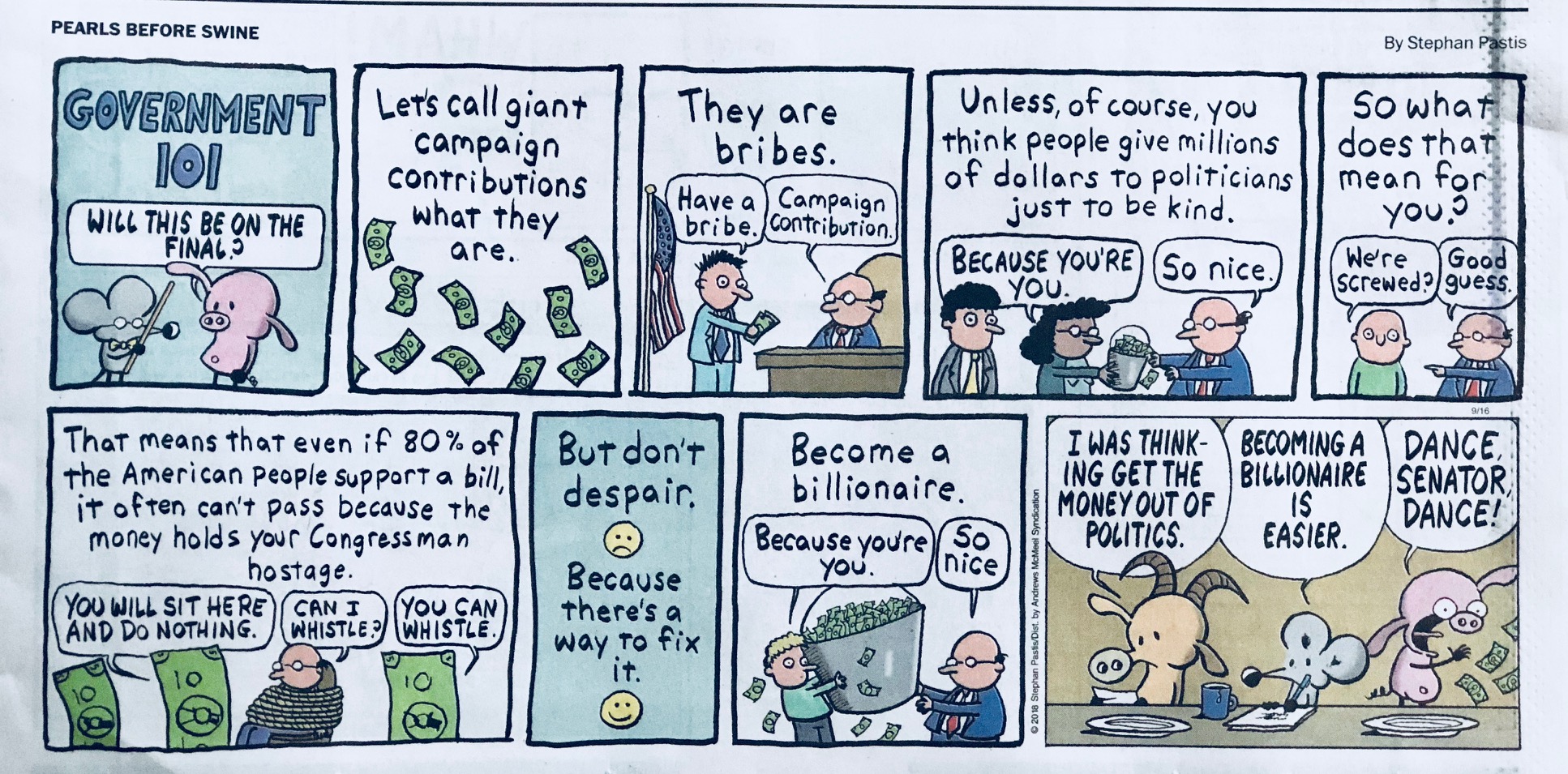
Professor Werner Moss, the patrician head of the Government Department at William & Mary in 1960, didn’t teach it exactly the same way to both Kincey and I, but as an observation, I think he would agree with Rat.
But as a small “d” democrat, Dr. Moss also believed in direct action, and he drove a bunch of us to the Capitol in Richmond to testify against proposals to restrict the College’s admissions policies.
Posted inFun|Comments Off on Government 101 — Now and Then
Raw tensions over race and gender shape midterms, reflecting schism in Trump era
The National Republican Congressional Committee released an ad on Sept. 12 about Democratic congressional candidate Antonio Delgado.(National Republican Congressional Committee)
Democrat Antonio Delgado is a Rhodes Scholar and attorney with a Harvard Law degree running in one of the country’s most hotly contested congressional races.
But Republicans want to instill a different image in the minds of voters in New York’s 19th Congressional District. Their latest ad, released Wednesday, features grainy clips of Delgado, who is African American and made a 2007 rap album. His censored explicit lyrics dominate the ad, along with the album cover, which shows a glaring Delgado in a hoodie.
Raw tensions over race, gender and personal identity are shaping battleground contests from Upstate New York to the Deep South, reflecting the marked schism in the country during the Trump era and the increasingly stark demographic divide between the two political parties.
With just one primary day left, on Thursday, Democrats have set or essentially matched records for the number of female, black and LGBT nominees, a Washington Post analysis shows. Republicans’ diversity statistics have either remained static or declined in each category, leading to a heavily white, male slate of nominees.
Republicans are aggressively trying to cast Democratic candidates as scary, threatening figures with unfamiliar values. A super PAC linked to House Speaker Paul D. Ryan (R-Wis.) has aired an ad in Ohio tenuously connecting a candidate of Tibetan and Indian descent to Libyan interests and asking if he is “selling out Americans.” In Kentucky, a GOP incumbent released an ad showing his female Democratic opponent declaring that she is a feminist.
Democrats are increasingly calling out the GOP, saying these are sexist, racist attacks that remind them of the divisive tactics that Donald Trump used as a candidate and has reprised as president. Even some Republicans are troubled by the tone.
“The difference between the past and the present is that you have a political actor like the president who makes it okay, who gives license to it, said Michael Steele, who was the first black chairman of the Republican National Committee. “If you don’t speak to that and call it out, it will germinate, it will become an infection and will create the kind of disease in our politics, which I think to some degree, we are already seeing.”
Republicans behind the attacks are making no apologies. They argue that they are informing voters about their rivals.
“The Democratic rejoinder is to cry racism when all I am saying is he should explain his words,” said Rep. John Faso, the Republican incumbent Delgado is trying to unseat in an Upstate New York district that is nearly 84 percent white. In an interview, Faso, who is white, rattled off some of Delgado’s explicit lyrics. “I think they would generally bother anyone that would hear them,” Faso said.
The ad from the National Republican Congressional Committee features clips from the album Delgado released, under the name AD the Voice. In his songs, Delgado addresses social and political issues and uses obscenities and a racial epithet.
“If Democrats are upset about Antonio Delgado’s own rap lyrics being used in ads, then they shouldn’t have nominated him,” said Jesse Hunt, an NRCC spokesman.
Pressed on whether the ad and others launched by Republican candidates and groups are racist or sexist, a spokesman for Ryan did not directly respond. Instead, Jeremy Adler said the campaign should be about the economy and House GOP policies.
Asked what he thought of some of the ads on Thursday, Ryan emphasized that he cannot discuss ad strategy with super PACs. “I abhor identity politics,” he added. “I don’t think identity politics should be played by anybody at any time.” Ryan did not comment on specific ads.
Delgado has called the criticism of his album a “blatant attempt at distraction from the real issues.”
Race has also recently roiled the Florida gubernatorial contest. Democrat Andrew Gillum, the state’s first black major-party nominee for governor, said in an interview that he expected to face racially charged attacks — just not on Day One.
The morning after the primary, GOP nominee Ron DeSantis, who is white, used a phrase many African Americans have found offensive, suggesting on Fox News that electing Gillum and his liberal policies would “monkey this up” at a time when Florida is on the right track under conservative control.
Gillum spoke to his wife that evening to brace her for how ugly the contest might get. “Hold on, because God knows, you know, what depths this may go to,” he recalled saying.
DeSantis’s campaign spokesman, Stephen Lawson, said it was “absurd” to characterize the remark as anything other than a policy comment. One of his donors, Dan Eberhart, said DeSantis “certainly tripped” with “his inartful comment” and will “have to avoid those kind of gaffes in the future.”
Gillum is one of two black Democratic nominees for governor in the South, joining Georgia’s Stacey Abrams, who is also running against a Trump-backed candidate, Secretary of State Brian Kemp.
Democrats have at least 62 black nominees for the House, according to Collective PAC and a review of candidates by The Post. The number is on par with the records set in recent years, as documented by researcher David Bositis. Republicans have identified 10 black GOP House nominees, which is down from recent years and from as many as two dozen in the 1990s.
Democrats have a record 20 LGBT nominees for the House and Senate, according to an analysis by the LGBTQ Victory Fund; Republicans have none after fielding a handful in recent years.
The sharpest change in candidate diversity has been among Democratic women. Democrats have nominated 182 women for the House this year, according to the Rutgers Center for American Women and Politics, already cresting 40 percent of all House districts and setting a record that shatters the old mark of 120 nominees in 2016 by more than half.
Republicans have 52 women, which is in line with recent elections. But the GOP’s share of all female candidates — 22 percent — is the lowest it has been in at least 40 years. Democrats have also set a record of 15 female nominees for the Senate and 12 in gubernatorial races. Republicans have fewer than half in each case.
“I think this administration and the president and his divisive policies are a great motivator,” said Rep. Katherine M. Clark (D-Mass.), recruitment vice chair for the House Democratic campaign arm. “I think that many of the women candidates we have running started with the Women’s March and ended up marching to their local town halls to register as candidates.”
These women have won their primaries. Will they be elected in November?
In Kentucky, Democratic nominee Amy McGrath, a former fighter pilot, would be the first woman to represent the Lexington-based 6th Congressional District if she unseats Republican Rep. Garland “Andy” Barr. She is contending with a barrage of negative ads, including one from Barr that shows her saying, “Hell yeah, I’m a feminist.”
Another ad from the Congressional Leadership Fund shows her photo alongside Sen. Elizabeth Warren (D-Mass.), House Minority Leader Nancy Pelosi (D-Calif.) and Hillary Clinton, depicting her with other powerful women.
“It is inherent sexism,” McGrath said. “But I’m not focused on that.”
“No. I’m the father of two daughters,” Barr said when asked for his response to McGrath’s claim. “Of course I believe in equal opportunity regardless of gender.” He also listed the women in senior positions in his congressional office.
The Congressional Leadership Fund, a major super PAC for which Ryan has raised money but crafts strategy independent of him, has run some of the most controversial ads. In Ohio’s Cincinnati-based 1st Congressional District, the group released an ad aligning Democratic nominee Aftab Pureval with Libyan interests, by way of the law firm that employed him.
Ominous music plays and dark images of plane wreckage and ex-Libyan dictator Moammar Gaddafi flash on-screen. “Aftab Pureval can’t be trusted,” the narrator says. The ad received four Pinocchios from The Post’s Fact Checker.
“I leave it to other people to ascribe motives,” Pureval said of the strategy behind the ad. Later, Pureval, who is of Tibetan and Indian descent, issued a statement from a campaign aide calling on his opponent, Republican Rep. Steve Chabot, to condemn what he says are racist attacks in the spot. “Our campaign had nothing to do with the ad, but we also see nothing in the ad that isn’t factual,” said Cody Rizzuto, a Chabot campaign spokesman.
In a statement, CLF communications director Courtney Alexander defended the ads: “It’s flattering to see how stressed Democratic candidates are from our ads as we educate voters about their extreme, liberal records.”
As the focus in the GOP has increasingly shifted to turning out conservative base voters, many of whom are loyal to Trump, the party that once made diversity a goal, most recently after the 2012 election, has fallen behind on that measure.
In addition to the GOP’s share of female nominees falling to at least a 40-year low, its share of black nominees is the lowest in at least 20 years, at less than 1 in 6 (14.5 percent); and its share of LGBT nominees is also lower than in recent election cycles (15 percent).
As recently as 2010, the GOP had 34 percent of female nominees and 25 percent of all black nominees. Republicans had about twice as many black nominees in 1994 and 2000 as they do today.
Sean SullivanSean Sullivan has covered national politics for The Washington Post since 2012. He previously was the editor of Hotline On Call, National Journal Hotline’s politics blog, and has also worked for NHK Japan Public Broadcasting and ABC News. Follow
Aaron BlakeAaron Blake is senior political reporter, writing for The Fix. A Minnesota native, he has also written about politics for the Minneapolis Star Tribune and the Hill newspaper. Follow
Posted inUncategorized|Comments Off on Political Analysis that Seems to Make Sense
I’m posting this in PottersWeal.com rather than Wake Me When We’re Great Again because Yarimar Bonilla’s op-ed in the Washington Post really addresses the issue of how the USA treats its colonies (and, to a lesser extent, how some US governmental practices are pure bullying — if you need examples, look at the comments in the on-line version of this WaPo posting).
Perspective
Trump’s false claims about Puerto Rico are insulting. But they reveal a deeper truth.
Unlike most U.S. politicians, the president doesn’t even pretend to treat the island equally.
By Yarimar Bonilla
Yarimar Bonilla is the author of “Non-Sovereign Futures: French Caribbean Politics in the Wake of Disenchantment” and a founder of the Puerto Rico Syllabus project. She is professor of anthropology and Caribbean studies and a 2018-19 Carnegie Fellow.
September 14 at 12:52 AM
Puerto Ricans woke up Thursday, a mere week before the anniversary of Hurricane Maria, to a new storm. Once again, President Trump had minimized the tragedy on the island, suggesting on Twitter that the multiple scientific studies regarding the death count in Puerto Rico were really the product of political interests seeking to tarnish his recovery efforts. His tweets were received with shock and horror across both Puerto Rico and the mainland United States, with many asking themselves: What kind of cruelty does it take to portray death and disaster as “fake news”?
Taken at face value, Trump’s claims are absurd. The death toll in Puerto Rico was not the result of simple wind and rain but infrastructural failures that the Federal Emergency Management Agency has already admitted. Mass casualties are not, as House Speaker Paul D. Ryan claimed in Trump’s defense Thursday, simply a thing that happens — they are the product of structural failure and imperial neglect.
Puerto Ricans died because of a lack of access to health care and medication. They died of sleep apnea, untreated heart and liver disease, and bacterial infections contracted while trying to clear roads or find sources of water. These deaths are tragic precisely because they were preventable. They were not a product of angry storm waters but of a neglectful government that failed to protect and care for its citizens. This is the tragedy, this is the cruelty. Trump simply added another insult.
Yet his insistence on maligning Puerto Rico and its people might have an unintended positive outcome: to cast a spotlight on Puerto Rico’s long-standing problems. Previous administrations have been just as neglectful in their policy toward the island, but they’ve done so in ways that silenced or glossed over Puerto Rico’s relationship to the United States.
Trump, on the other hand, lays it bare.
President Barack Obama visited the island in 2011 and warmed hearts by dancing salsa and eating local delicacies. Many were hopeful that an African American president would take seriously the structural inequalities and politics of exclusion that shape U.S. territorial relations. But when it came time to deal with the island’s debt crisis, he only worsened the disparities. The same president who led bailouts for banks and car companies closed the door on using the Federal Reserve to restructure the debt, as many had recommended. Instead, he passed the buck to Congress, which imposed a fiscal-control board that costs Puerto Ricans more than $2 million a month and whose sole focus is on cutting services, pensions and wages, while raising taxes and the cost of living. It was precisely these policies that placed the island on the path of disaster to begin with.
Trump has remarked that Puerto Rico’s power company was already “dead” before the storm. This is false, but it reveals a truth: The power company was undergoing economic restructuring, which had led to disinvestments, layoffs and a lack of inventory — all of which contributed to residents spending nearly a year in the dark. These very same policies are now being extended by the fiscal board following the storm.
Trump might be the only president to overtly assert that Puerto Rican deaths don’t matter, that they don’t need to be counted. But he is certainly not the only politician in Washington who believes that Puerto Rican lives, and those of the other U.S. territories, matter less than those on the mainland. On both sides of the aisle, politicians in Washington have repeatedly voted against granting the island parity when it comes to health care, wages, disability benefits or even veterans’ rights.
Despite this long history of disparity and inequality, it has really only been under the Trump administration that Puerto Rico’s colonial status has made headlines — and even then barely so. Studies have shown that media coverage of Hurricane Maria paled in comparison to that of Harvey, which struck the mainland United States. It was only when Trump picked a fight with the San Juan mayor that attention shifted toward Puerto Rico.
More U.S. citizens died as a result of Hurricane Maria than as a result of either Hurricane Katrina or 9/11. Yet it is only when Trump shows his disdain toward Puerto Rico’s tragedy that the island becomes a part of the national consciousness. Its usual absence is the larger truth that his tweets reveal.
Puerto Rico’s disaster does not begin or end with Trump’s disregard. It is a product of more than a century of colonial policy that has led to a distorted economy built for the benefit of the few, corruption that has lined pockets from San Juan to Montana and everywhere in between, and a crisis of migration and displacement that has, in turn, fueled a crisis of imagination.
Trump’s tweets were just another sign of disrespect from the United States for its Caribbean colony. But whether he meant to or not, he still managed to reveal some otherwise hidden truths.
Central American security conference scrapped amid U.S. tensions with Guatemala, El Salvador
Guatemalan President Jimmy Morales, center, places a sash on Gen. Manuel Pineda Saravia, right, during the 145th anniversary of the military school in San Juan Sacatepequez, Guatemala, on Sept. 1, 2018. Morales says he is shutting down a crusading U.N.-sponsored anti-corruption commission that pressed a number of high-profile graft investigations, including one pending against the president himself over purported illicit campaign financing. (Moises Castillo/AP)
A high-level conference intended to highlight U.S. security cooperation with Mexico and Central America was abruptly called off Friday amid flaring diplomatic tensions with El Salvador and Guatemala, according to two Trump administration officials.
Top diplomats and security officials from the United States, Mexico and Central America were scheduled to meet next week in Washington as a follow-up to the “Conference on Prosperity and Security in Central America,” held in Miami last year and attended by then-Secretary of Homeland Security John F. Kelly and Rex Tillerson, the U.S. secretary of state at the time.
The talks scheduled for next week were scrapped after the governments of El Salvador and Guatemala notified U.S. diplomats that their representatives would not travel to Washington, according to the two administration officials, who spoke on the condition of anonymity because no formal announcement has been made. They said the conference has been “postponed,” though new dates have not been set.
A DHS official said the agency was working to reschedule the talks and “looks forward to the conference at a later date.”
The DHS official said the cancellation was due to a scheduling conflict, not diplomatic tensions.
U.S. diplomats and Homeland Security officials have sought to promote a partnership with Mexico and the nations of Central America’s Northern Triangle — Guatemala, Honduras and El Salvador — as a key to addressing the gang violence and endemic poverty that fuel illegal migration.
But strains emerged with Guatemala this week after President Jimmy Morales blocked the entry of the head of a U.N.-backed commission that investigates high-level corruption. The body, known as the CICIG, has enjoyed broad U.S. and international support, but Morales said he would not extend its mandate beyond this year. One of the commission’s inquiries targeted possible illegal campaign donations to Morales himself, and his decision to oust the U.N. program drew rebukes from U.S. lawmakers as well as calls to suspend American aid to Guatemala.
The tensions with El Salvador and its leftist government are more geopolitical. After El Salvador severed ties with Taiwan last month, seeking to cultivate closer ties to China, Washington recalled its diplomats in protest of the move, which Salvadoran officials characterized as an economic decision.
China has been increasing its investment in ports, railways and other infrastructure projects across Latin America for years, challenging long-standing U.S. dominance in the region.
Last year, Panama cut ties with Taiwan and turned to China, and the Dominican Republic made the same decision this year.
These moves have raised concerns that the United States is ceding influence in Latin America to China, particularly during the Trump administration. One theme across the region has been that these Chinese diplomatic negotiations take place quietly — with economic or investment promises largely unknown — and results are announced with little public debate.
U.S. Ambassador to El Salvador Jean Manes, in a message on Twitter, described El Salvador’s decision last month as “worrisome.”
There have been other recent sources of tension between Central American governments and the Trump administration.
Trump’s border crackdown this spring that separated more than 2,500 migrant children from their parents caused an uproar across the region, and Central American governments say they are still working to reunite families after hundreds of mothers and fathers were deported from the United States without their children. The Trump administration has also announced it will terminate the provisional residency permits of more than 250,000 Salvadorans, Hondurans and Nicaraguans who have been living and working in the United States under “temporary protected status.”
While Trump continues to push for a border wall, Mexico’s president-elect, Andrés Manuel López Obrador, has called for economic development in Central America as the best way to address illegal migration to the United States.
Partlow reported from Mexico City.
Checkpoint newsletter
News about military, defense and security at home and abroad. Delivered Wednesdays and Fridays.
Nick MiroffNick Miroff covers immigration enforcement, drug trafficking and the Department of Homeland Security on The Washington Post’s National Security desk. He was a Post foreign correspondent in Latin America from 2010 to 2017, and has been a staff writer since 2006. Follow
Joshua PartlowJoshua Partlow is The Washington Post’s bureau chief in Mexico. He has served previously as the bureau chief in Kabul and as a correspondent in Brazil and Iraq. Follow
(As former Peace Corps Desk Officer for El Salvador and a 40-year worker in small island development in the Caribbean, I especially regret the third-rate policy management practices of this administration.)
[Lest we forget: The Russian objective is to make the truth seem unknowable. ]
Posted inGovernance, politics|Comments Off on Washington Post: Central American Security Conference Scrapped amid U.S. Tensions with Guatemala, El Salvador
On this, the date of the annual Carnival in Brooklyn, an appropriate time to celebrate the accomplishments of the great steel pan designer and promoter, Ellie Mannette, and his Mannette Musical Instruments. of Morgantown, West Virginia. Ellie of course was a Trini, but he was given national awards and recognitions by both the governments of Trinidad and Tobago, and the USA. He and his brothers in San Souci, TT, established the Invaders Steel Band in 1940, and by the 1960s he was hired to come to the US to establish the (US) Navy Steel Band. Details from yesterday’s NY Times obituary. . . .
Ellie Mannette, Father of the Modern Steel Drum, Dies at 90
Ellie Mannette crafting a drum at his workshop in Morgantown, W.Va., in 2006. He was among the first to fashion a steel drum that had all the notes of the chromatic scale, so it could play any melody in any key.
CreditCreditvia Mannette Musical Instruments
Ellie Mannette, a Trinidadian musician known in the United States as the father of the modern steel drum, died on Wednesday at a hospital in Morgantown, W.Va. He was 90.
The cause was kidney failure, his daughter Juliette Mannette said.
As a child in Port of Spain, Trinidad’s capital, Mr. Mannette became fascinated with the bands he saw using trash cans and buckets as drums, hitting them in different ways to create different sounds. For the rest of his life, he sought to elevate and expand the craft of steel-pan music, and to share it with the world.
He became a master tuner, builder and teacher. His shop, Mannette Instruments in Morgantown, is a major supplier of the instruments in the United States, and he trained students in tuning at West Virginia University for nearly 20 years. Numerous American universities now have steel-pan ensembles of their own, some led by Mr. Mannette’s former apprentices.
Mr. Mannette was among the first to fashion a steel drum that had all the notes of the chromatic scale, so it could play any melody in any key.
“He imagined a sound of this instrument that nobody else had imagined for it,” Shannon Dudley, an ethnomusicologist at the University of Washington, said in a telephone interview. “He strove to create that sound, and it captivated a lot of people.”
[Ellie Mannette: Father of the Modern Steel Drum Credit Video by Smithsonian Folklife ]
Mr. Dudley added that steel pans, now seen as a symbol of innovation and resistance, were once disparaged. Earlier percussion instruments had been banned by colonialists in Trinidad, and in the 1940s and ’50s the music was associated with rivalries and fights. But Mr. Mannette, he said, “helped to bring it out of that denigrated status, by making the music more and more compelling.”
Kim Johnson, the director of the Carnival Institute of Trinidad and Tobago, said that Mr. Mannette’s greatest contribution was how he shared his knowledge generously, even before he left the island.
“He was a natural teacher,” Mr. Johnson said in a telephone interview. “His way of making pans became the first globalized way, the first way you’d find all over the country, from people he taught, from bands whose instruments he made, and from people trying to copy him.”
Elliott Anthony Mannette was born on Nov. 5, 1927, in the small beach town of Sans Souci. His father, Sydney, was a carpenter and mason, and his mother, Imelda, was a homemaker. He was one of nine children.
He gravitated to carnival celebrations and music as a child and joined his first band when he was 11. Before long, he was creating his own instruments out of old oil drums and other discarded items. By 1940, he had formed the Invaders Steel Orchestra with two of his brothers and other musicians.
He designed and tuned the pans for the band, drawing on skills he picked up working in an iron foundry. He fashioned drums out of 55-gallon barrels and made them concave, like a bowl, which gave them a different sound. He tuned the instruments by ear, tapping with a hammer to get the exact note he wanted from the metal.
In 1951, Trinidad and Tobago sent him to Britain as part of the Trinidad All-Steel Percussion Orchestra. By 1959, the band had a contract with Columbia Records.
In the 1960s, Mr. Mannette traveled to the United States to help develop the Navy Steel Band, which brought steel-band music to the American public.
In 1967 he made the transition permanent, moving to New York to work with urban youth in music programs. He would not return to Trinidad until 2000, when he received the Chaconia Medal from Trinidad and Tobago, the country’s second-highest state decoration. That same year, he was awarded an honorary doctorate from the University of the West Indies at St. Augustine.
Mr. Mannette was named a National Heritage Fellow by the National Endowment for the Arts in 1999. He was inducted into the Percussive Arts Society Hall of Fame in 2003.
Mr. Mannette, who lived in Morgantown, is survived by his second wife, Jacqueline Edwards; six children: Kendal, Karen, Earl, Eric, Anthony, Juliette; four stepchildren: Garth, Charlene, Marva and Francine; and many grandchildren and great-grandchildren. His first wife, Joyce Kingston, died many years ago.
Mr. Mannette’s shop will continue to be run by his former students and apprentices, said Chanler Bailey, a builder and tuner there.
Mr. Bailey said Mr. Mannette wanted the steel drum to be seen as more than a novelty, and to be respected as a complex instrument. He was, he said, a perfectionist constantly seeking to improve his work and a demanding instructor.
“Ellie was a consummate craftsman,” Mr. Bailey said. “It’s been the greatest privilege to be able to work under that man and the standards he set.”
Amie Tsang contributed reporting.
A version of this article appears in print on Sept. 2, 2018, on Page A20 of the New York edition with the headline: Ellie Mannette, 90, Innovator of Steel Drum. Order Reprints | Today’s Paper | Subscribe
Posted inFun|Comments Off on Ellie Mannette — THE Steel Pan Man — 1927-2018





 Potter's Weal