Jenny Daltry: Antigua Clears Alien Mammals from 15 Offshore Cays

An Article by Dr. Jenny Daltry, the Fauna & Flora International (FFI) expert who has worked with the Antigua Environmental Awareness Group (EAG), and other partners to clear rats, mongooses and similar alien species from offshore cays in Antigua-Barbuda in the northeastern Caribbean since 1995. Led by Kevel Lindsay, Island Resources Foundation was a founding member of the Offshore Island Conservation Programme of EAG.
PDF.js viewer.pdf

Posted in Monitoring | Leave a comment

Anatomy of a Copyright Coup: Jamaica’s Public Domain Plundered

from a post on the Civic e-mail group

JULY 24, 2015 | BY JEREMY MALCOLM

HTTPS://WWW.EFF.ORG/DEEPLINKS/2015/07/ANATOMY-COPYRIGHT-COUP-JAMAICAS-PUBLIC-DOMAIN-PLUNDERED


A bill extending the term of copyright by an additional 45 years—almost doubling it, in the case of corporate and government works—sailed through the Jamaican Senate on June 26, after having passed the House of Representatives on June 9. The copyright term in Jamaica is now 95 years from the death of the author, or 95 years from publication for government and corporate works. This makes it the third-longest copyright term in the world, after Mexico and Côte d’Ivoire respectively with 100 and 99 years from the death of the author.

Worse than this, the extension was made retroactive to January 1962. Besides being the year when Jamaica attained independence, 1962 also just so happens to have been the year when Jamaican ska music (a popular genre in its own right, but also a precursor of the even more popular reggae) burst onto the international music scene. The parallels with the extension of the U.S. copyright term in the “Mickey Mouse Protection Act” are quite eerie. But, worse than what happened into the U.S., the retrospective effect of the law means that works that havealready passed into the public domain in Jamaica are now to be wrenched back out again. Jamaica will now be one of the last countries in the entire world to enjoy free access to works that are already in the public domain in the United States—such as Charlie Chaplin’s The Kid, from 1921.

If Jamaica hoped that this measure would bring in additional royalties for its musicians from overseas markets, then the tactic that it chose to pursue was doomed to failure from the outset. Foreign users of Jamaican copyrights are not bound by the extended copyright term; only Jamaicans are; but conversely, Jamaicans are now obliged to honor foreign copyrights for the full extended term.1 As opposition spokesperson on culture Olivia Grange put it during debate on the new law, “what will happen is that we will, in fact, be paying out to foreign copyright holders in foreign exchange for the continued use of foreign works in Jamaica, while our own rights holders will only benefit up to the 50, 70 or 80 years that exist in other countries”. So all that this measure has accomplished is that citizens of Jamaica, a developing country, will be paying more money into Hollywood’s coffers, while Jamaica’s own rich cultural heritage draws in not a penny more in return. Yay?

This measure is so stupid on its face that it is a wonder it passed through parliament at all. But what pains us even more is that it was deemed a trivial enough change to the law that it went unreported in the press until it was already a fait accompli. We could’ve spotted it earlier, and we’re not proud of missing it. But it also came as an unwelcome shock to all the other activists with whom we work, including the International Federation of Library Associations and Institutions, whose members in Jamaica have suffered a sudden and severe setback to their mission to preserve and disseminate the early written records of newly-independent Jamaica.

That fact that proposals to lock up copyright works for an additional two, three or four decades or more isn’t even considered newsworthy is something that we want to urgently change—especially now that six countries around the Pacific Rim are facing that very prospect, all at the same time, with the impending conclusion of the Trans-Pacific Partnership (TPP) that could enshrine a life plus 70 year copyright term in stone. Copyright term extension is not a positive sum, or even a zero sum game. It enriches big media corporations, not struggling artists; it impedes libraries, archives, educators and people with disabilities; and it locks away an entire corpus of works that belong in the public domain, preventing them from being repurposed by a new generation of artists and innovators (particularly in countries, like Jamaica, that lack a “fair use” right).

Jamaica has sadly fallen into the copyright trap, and it may be too late for it to escape. But it isn’t yet too late for Canada, Japan, Malaysia, Brunei, New Zealand or Vietnam. Over the following weeks we will be highlighting the harmful effects of the extension of copyright terms in some of these countries, and providing an easy mechanism for you to use to take action, in these final days of the negotiations of the TPP.

On our TPP’s Copyright Trap page we link to more articles about how the threat of copyright term extension under the TPP impacts users around the world.

Posted in Access, Governance, Information | Leave a comment

Last Saturday on the South River . . .

Posted in Watershed Management | Leave a comment

Kincey’s Kit

Kit, growing into his ears, on Childs Point Road, 15 July 2015

Posted in Fun | Leave a comment

Intelligent Tourism Talk from VietNam

from the English-language VietNam News <http://vietnamnews.vn/sunday/features/273049/limited-tourism-helps-keep-island-green.html>

Updated
July, 12 2015 08:38:00

Limited tourism helps keep island green

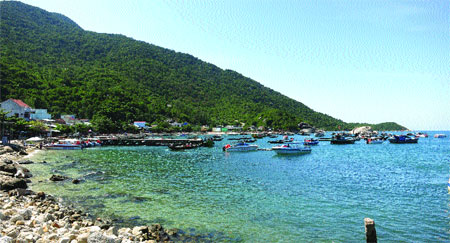
Still pristine: Many visitors to Hoi An City cannot resist the unspoilt beauty of Cham Island, which they can reach in just 25 minutes.

Tourism has been a boon for residents of islands off the coast of Hoi An, but it is the authorities decision to limit the number of visitors that will help sustain these benefits. Cong Thanh reports.

Born and raised on the Cham Islands, Tran Quy Tay has seen the area undergo a complete facelift in the last almost half a century.

The quiet, green islands, 20km off the coast of Hoi An, are a favourite rendezvous for travellers and nature lovers. Thousands of tourists visit the islands each day.

About 2,400 people live in the four villages on the islands, 80 per cent of whom immigrated there. In total they earn VND75 billion (US$3.6 million), 65 per cent of which is from tourism and service. Most islanders have stopped fishing and turned to the eco-tourism sector, which has doubled its income since the area was recognised as a World Biosphere Reserve in 2009.

“It’s a great change,” Tay said. “I had seen a poor life in the island when I was a child here. My parents were emigrants in the island in 1968 and I was born eight years later. Most islanders lived by onshore fishing, and they trade the fish they catch for daily food and other necessities from the mainland.”
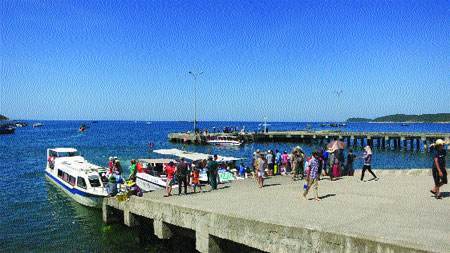
You’ve arrived: The wharf on Cham Island where speed boats from Hoi An dock. Thousands of visitors flock to the Islands on day tours. — VNS Photos Truong Vi

Of the four villages, Bai Huong, Bai Lang, Bai Ong and Cam, the beaches of Bai Ong attract 70 per cent of the total visitors.

“Tourism is a crucial part of the Cham Islands’ sustainable development,” said Nguyen Van An, chairman of the Tan Hiep Commune People’s Committee. “Islanders were asked to change livelihoods from inshore fishing to the ‘green and clean’ trade. It could create a good income for them, while protecting the islands’ environment and culture.”

He said local residents earned about VND27 million (US$1,300) per month, double what they earned in 2009.

“We encourage investment in tourism, while boosting environment, biodiversity and native culture,” he said.

Tourism has seen rapid development over the past year, with a fleet of 125 speedboats carrying passengers from Hoi An to the islands and back every day.

“It would result in overloaded accommodations and service and over exploitation of seafood and other marine resources, or destruction of the ecological system,” he added.

Getting to know the locals: Visitors look at samples of marine life at the Marine Protection Centre on Cham Island.

The number of tourists can exceed the number of villagers on the islands at times, so the Hoi An People’s Committee set a daily tourist limit of 3,000.

“It’s a bit of a shame for us, as we get less money from our speedboat services, but it’s the right decision and we (travel agencies and speedboat services) support it,” said Phan Van Tin of Dao Xanh (Green Island) Travel Agency.

No plastic bags

Islanders and tourists are told not to use plastic bags, to protect the coral reefs and fish. It is the first place in Viet Nam to ban plastic bags.

“Previously, plastic bags and rubbish released by local fishermen and tourists heavily polluted the islands,” Tay said. “Plastic bags, which are stuck at coral reefs, killed sea turtles and polluted water and food for fish. Most residents are educated on protecting the environment, and being friendly with tourists.”

Truong Thanh Phuong, a local fisherman, said he quit fishing and started working in tourism.

“My small boat could only catch fish in water near the island, so I wasn’t very productive and didn’t make much money,” Phuong said. “I was told to shift to tourism service and that I would get VND30 million ($1,400) in support from the local administration.”

The 40-year-old said his family could earn VND300,000 ($14) per visitor by opening a restaurant and homestay service, or provide fishing tourism.

Efforts paying off

Efforts to protect the marine environment by local residents and the Maritime Protection Centre over the past decade have paid off.

Le Vinh Thuan, an official from the Management Board of the Cham Islands, said a small colony of young coral had been growing back off the islands’ coast in recent years.
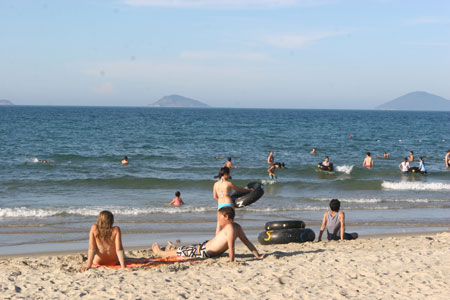
Sunny days: Cham Island is a perfect getaway, where visitors can relax and do nothing, or have fun swimming in the sea.

“It’s a sign of a well-protected environment,” Thuan said. “The environment around the port, which was seen as a heavily polluted area, has improved due to the 3-R (reduce, reuse and recycle) programmes that have been in operation since 2011.

“We have grown 4,800 colonies of coral on an area of 4,000sq.m since 2012. We also localised some areas of corals that are vulnerable to human activities.”

He said experts from the islands’ Maritime Protection Centre also collect crown-of-thorns starfish (acanthaster planci) – a shellfish that eats and destroys coral reefs.

Chu Manh Trinh, an expert from the centre, said islanders have gradually recognised the importance of protecting coral reefs in the area.

“Local people have nearly stopped dumping garbage and plastic bags,” Trinh said. “They are working on creating a clean and safe environment for coral reef to grow again. Now they join us in protecting the environment.

“We provide between five and seven educational training courses on fauna and flora conservation for the locals, and the benefits from marine and environmental protection,” Trinh said.

The seas around the Cham Islands is home to 1.26sq.km of coral reef. It also houses sea snail species, coral reefs, land crabs, lobster, and seaweed.

A community-based group of 30 households were formed to get the exploitation of crabs under control. Land crabs have been conserved and protected by the residents and the centre for the past 10 years.

“Only grown crabs (about 14 years or older) caught by the group under the centre’s supervision can be sold in the market,” said Cham Islands chairman An.

Nguyen Van Nga, a resident in Bai Ong Village, said the crab would have gone extinct on the islands if the centre had not taken such strong steps to protect it.

“The crab has been a source of income for local people in the offseason. We only caught 7,000 crabs, a fourth of the total on the island. We could sell crabs for VND1.2 million ($57) per kilo at the market,” Nga said, adding that the crab population has grown in recent years.

Tourism services

“Tourists can easily find homestay services on the islands,” Tay said. “Sixty households offer accomodation, with prices of between VND100,000 and 200,000 per night per person, and VND100,000 per meal.

People just going for the day can get to the islands from Hoi An’s Cua Dai Beach for VND30,000. They can take their bicycles on board to explore the islands, as well. It takes 25 minutes to travel to the islands by speedboat.

Various tourism services are also offered off the islands’ coasts, including scuba diving, snorkeling, sunbathing, trekking and bird watching at Hon Lao (Lao Islet).

Tourists can rent motorbikes and bicycles to travel around the islands during the day, before enjoying night fishing with fishermen off the coast.

Despite their success in tourism, the islands have had trouble with power, education, fresh water and sanitation.

A diesel-generated power source provides electricity for nine hours a day, with subsidised prices for the locals. It still limits tourism, seafood storage and living conditions, said chairman An.

WiFi is available, but the lack of power at night is still a problem for homestays. So most foreign tourists prefer day trips over staying overnight.

Green technology applications such as wind and solar power, sea water filters or recycled waste water have failed because of a lack of funds.

“Many projects have opened on the islands, but they are limited due to a lack of funds for restoring and repairing equipment,” An said. “Only the recycled waste treatment plant is operating effectively, with a capacity of 1 tonne per day. An 80,000 cubic metre reservoir provides enough water for islanders and tourists, but it’s a natural water source.”

Sanitation has yet to be improved, though, he said. Flies swarm the islands in the summer as organic waste from restaurants piles up.

Pham Vu Dung, director of Rose Travel, said the islands should find safer ways to clean the environment.

“Safe chemical agents should be used to clean the islands several times per month,” Dung suggested.

Every Saturday, art performances, good food and shopping markets open to lure in more overnight visitors.

“All tourists are welcome, but don’t take plastic bags or litter on the islands,” Tay said. “We offer you all nature and the freshest seafood you have ever tasted.” — VNS

Posted in Resource Management | Leave a comment

Coral Bleaching Threat Increasing in Western Atlantic and Pacific Oceans

Coral bleaching threat increasing in western Atlantic and Pacific oceans

Rising ocean temperatures threaten spread of major heat stress to Hawaiian reefs

[For added information on this topic, see Nick Robson’s Climate Change blog.]

July 6, 2015

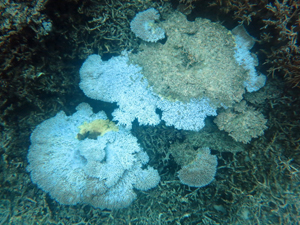
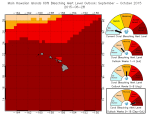
Bleached and dead Acorpora coral in the NOAA Fagatele Bay National Marine Sanctuary in American Samoa. Warm Pacific ocean temperatures may lead to an increase in coral bleaching, NOAA scientists said. (Credit: NOAA)

As unusually warm ocean temperatures cover the north Pacific, equatorial Pacific, and western Atlantic oceans, NOAA scientists expect greater bleaching of corals on Northern Hemisphere reefs through October, potentially leading to the death of corals over a wide area and affecting the long-term supply of fish and shellfish.
While corals can recover from mild bleaching, severe or long-term bleaching kills corals. Even if corals recover, they are more susceptible to disease. Once corals die, it usually takes decades for the reef to recover — but recovery is only possible if the reefs are undisturbed. After corals die, reefs degrade and the structures corals build are eroded away, providing less shoreline protection and less habitat for fish and shellfish.
“The bleaching that started in June 2014 has been really bad for corals in the western Pacific,” said Mark Eakin, NOAA Coral Reef Watch coordinator. “We are worried that bleaching will spread to the western Atlantic and again into Hawaii.”
Earlier this year, NOAA’s Coral Reef Watch four-month Coral Bleaching Outlook accurately predicted coral bleaching in the South Pacific, including the Solomon Islands, Papua New Guinea, Nauru, Fiji, and American Samoa. It also recently predicted the coral bleaching in the Indian Ocean, including the British Indian Ocean Territory and the Maldives.

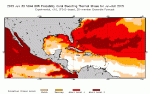
(Credit: NOAA)

Coral bleaching occurs when corals are stressed by changes in environmental conditions such as temperature, light or nutrients. The coral expels the symbiotic algae living in its tissue, causing the tissue to turn white or pale. Without the algae, the coral loses its major source of food and is more susceptible to disease. Scientists note, however, that only high temperatures can cause bleaching over wide areas like those seen since 2014.
In fall 2014, Hawaii saw widespread coral bleaching for the first time since 1996. If corals in Hawaii bleach again this year, it would be the first time it happened in consecutive years in the archipelago.
Warmer ocean temperatures in 2014 also dealt a blow to coral nurseries in the Florida Keys, where scientists are growing threatened coral species to transplant onto local reefs. Coral reefs in Florida and the Caribbean have weathered repeated and worsening coral bleaching events for the past thirty years. The NOAA Coral Reef Watch monitoring team says that more bleaching so soon could spell disaster for corals that have yet to recover from last year’s stress.
“Many healthy, resilient coral reefs can withstand bleaching as long as they have time to recover,” Eakin said. “However, when you have repeated bleaching on a reef within a short period of time, it’s very hard for the corals to recover and survive. This is even worse where corals are suffering from other environmental threats, like pollution or overfishing.”
NOAA’s bleaching prediction for the upcoming months supports the findings of a paper published in the journal Science last week that examined the threat to marine ecosystems and ecosystem services under two different carbon dioxide emission pathways.
“The paper reports that even if humans limit the Earth’s warming to two degrees C (3.8 degrees F), many marine ecosystems, including coral reefs, are still going to suffer,” said Eakin, an author on the paper. “The increase we are seeing in the frequency and severity of bleaching events is part of why the climate models in that paper predict a dire future for coral reefs.”
The NOAA Coral Reef Watch program’s satellite data provide current reef environmental conditions to quickly identify areas at risk for coral bleaching, while its climate model-based outlooks provide managers with information on potential bleaching months in advance. The Coral Reef Watch mission is to utilize remote sensing and in situ tools for near-real-time and long term monitoring, modeling and reporting of physical environmental conditions of coral reef ecosystems.
The four-month Coral Bleaching Outlooks, based on NOAA’s operational Climate Forecast System, use NOAA’s vast collection of environmental data to provide resource managers and the general public with the necessary tools to help reduce effects of climate change and other environmental and human caused stressors.
The outlook is produced by NOAA’s Satellite and Information Service and funded by the Coral Reef Conservation Program, Climate Program Office, and National Centers for Environmental Prediction.
For more information on coral bleaching and these products, visit: http://www.coralreefwatch.noaa.gov/satellite/index.php.
NOAA’s mission is to understand and predict changes in the Earth’s environment, from the depths of the ocean to the surface of the sun, and to conserve and manage our coastal and marine resources. Join us on Facebook, Twitter, Instagram and our other social media channels.

Posted in Climate Change | Leave a comment

Who Is the Greatest Threat to Western Civilization?

A note from Bruce Potter

Posted in Civil Society | Leave a comment

What Happened to the Uyghurs Who Went to Palau . . .

A great story from the Globe and Mail . . . <http://www.theglobeandmail.com/news/world/after-guantanamo-life-on-pacific-island-was-difficult/article25172787/>

After Guantanamo, life on Pacific island was difficult

NATHAN VANDERKLIPPE
BEIJING — The Globe and Mail
Published Sunday, Jun. 28, 2015 10:24PM EDT

A piece of plywood seals the hand-dug tomb on a hill in Palau. Buried inside is a toddler, a young boy of perhaps four placed with his face toward Mecca.

His grave is the only remaining trace of the six men who came to the tiny Pacific island state in 2009. The men were Muslim Uyghurs, leaving U.S. detention in Guantanamo Bay, and the Republic of Palau was one of the few places on earth to let them in. In exchange for money from the U.S. – including $93,333 (U.S.) for each man – Palau allowed the Uyghurs to trade life behind barbed-wire fences for life in one of earth’s most isolated places, an island chain with a local population of just 20,000.

They are gone now. The last man, a gregarious dreamer named Davut Abdurahim, left earlier this year. Where the six men and their families went is a secret kept even from some of the country’s most senior leaders.

What remain, instead, are memories of men who, from the day they touched down, fit uncomfortably amid a heavily Christian population that viewed their arrival – after a deal struck in secret with the U.S. by Palau’s then-president – with skepticism. A local newspaper greeted their arrival with a story declaring them “six bearded Moslem terrorists in shackles.” It was, in parts, a factual account: the U.S. transported the men to Palau on a military aircraft, shackled to their seats and accompanied by more than 30 Marines. They were bearded. They initially scared people in Palau.

Soon after they arrived, they walked and prayed on the beach to taste new freedom – and invited then-president Johnson Toribiong to a celebration. “They wanted to offer a sacrifice to Allah so we found them a goat and they killed it according to the Islamic ritual,” Mr. Toribiong said in an interview. “After they made a sacrifice, they cooked it for the first time in their own way. I joined them for dinner.”

The men were given individual rooms in a house owned by Mr. Toribiong’s sister-in-law – a potential conflict that prompted a lawsuit which remains unresolved. Palau set up a private tutor at the local Palau Community College for English instruction, and built the men a private bathroom to allow them to participate in ablution rituals.

Within a year, some of the men’s wives and family had arrived in Palau, and some began work. They found a local department store that had already started importing halal products for a small local Bangladeshi population. They tried a variety of jobs, working in construction, lawn maintenance and rock quarrying. But the men chafed at the hours, and conflicts arose over their prayer schedule. Eventually, most of them took jobs as security guards, one at the local port, others at the college.

“For them, dealing with people was the hard part,” said Ngiraibelas Tmetuchl, a local real-estate developer who was Mr. Toribiong’s special assistant and charged with caring for the Uyghur men. “Getting them security guards’ jobs was easy, because they don’t have to deal with anybody.”

But it was difficult to merge with a tropical island society so different from their own homes in the sprawling desert-and-mountains Xinjiang region of western China, and its heavily Muslim Uyghur population. The nearest imams lived in the Philippines and Indonesia, both nearly 1,000 kilometres away.

“Their traditional ways of doing things were very different from ours. They dressed differently. And I don’t think they really felt comfortable,” said Camsek Elias Chin, a former vice-president who is now president of Palau’s Senate. “Not in the sense that they were discriminated against, but the way they live is just different from Palauans.”

The Uyghur men made progress in English, and were able to communicate. But they found life hard on a small island that, for all its natural beauty, still felt constrained. They compared it to a bigger, lusher Guantanamo. (Palau initially agreed to accept 17 Uyghurs; 11 chose not to go.)

At first, they thought “we are restored, this is our vacation, everything beautiful, and the swimming, and the view, and the weather,” Ahmad Tourson, one of the men, told PBS in 2013. They pooled money to buy a used car and moved into separate apartments with family members. They took positions of religious leadership among the small local Muslim community. Some had skills as makers of jewellery and leather, and talked about securing tools to make products they could sell. But they never succeeded.

After years as security guards on an island they were unable to leave, they were left feeling “homeless, stateless, moneyless,” Mr. Tourson said.

Their lives saw joy, such as marriages with new brides who flew in from Russia and other places. But they could not shake tragedy, too, such as when the toddler fell off a balcony while his father washed a car below. A few days later, the boy died in hospital. The men struggled to find a suitable place to bury the child, rejecting offers of local plots as religiously incompatible. They chose instead a hill overlooking a small village.

The men spoke only rarely of the nightmare that had brought them here – how they were taken into American custody after the U.S. military promised money to Afghans who turned in “enemies.”

“Listening to their stories was sort of surreal – biblical, to an extent,” said Mr. Tmetuchl. “The way they told it, they were sold as terrorists. All they were were merchants, or looking for jobs in Afghanistan.”

Palau, too, offered no escape from the crush of secrecy and politics that surrounded the men’s lives. Mr. Toribiong, the former president, lost an election in part due to anger over his handling of their situation. But the men also welcomed their freedom relative to Guantanamo: they spoke regularly with Uyghur activists from around the world.

“They were very active politically from here,” said Mr. Tmetuchl.

He is among the few in Palau who know where the men are now – not even Mr. Chin, the Senate president, has been informed. But Mr. Tmetuchl won’t say where they’ve gone, save that they are not all in the same country – and that they haven’t been in touch since the U.S. pulled them out, in groups of one or two at a time, melting onto commercial flights and new lives.

“They went to a country that is favourable to their style of living,” he said. “I think they are more happy than they were here.”

Posted in Civil Society, Governance, Small Island | Leave a comment

Conservation Magazine: Science-based Biodiversity Conservation for the Continental USA

The kind of approach to conservation planning that needs to be extended to lots of areas, including multi-island/transnational planning for island areas.

From the April edition of Conservation Magazine —  conservationmagazine.org


The US Could Save its Unique Wildlife
by Protecting 9 Areas

The United States has one of the oldest systems for protecting wilderness in its many forms in the world. There’s just one problem: in general, protected areas in the US were designated to protect landscapes, not biodiversity. Sure, the biodiversity within those landscapes often benefits from living inside a protected space, but many of the species most in need of protection live elsewhere. The basic mismatch is that most of the country’s protected lands are in the West, while most of the vulnerable species are in the Southeast. That’s the result of a new analysis published this week in PNAS.

Researcher Clinton N. Jenkins from Brazil’s Instituto de Pesquisas Ecológicas, together with colleagues from NOAA, Duke University, and the University of Maryland, set about comparing the United States’ current map of protected areas with data on the conservation status of terrestrial vertebrates, freshwater fish, and trees, in order to identify future conservation priorities.

They began by noting the distinction between species richness and species in need of conservation efforts. Wide-ranging species like coyotes or raccoon, for example, tend to dominate species richness trends, but many are designated as species of least concern. Vulnerable species, on the other hand, tend to have small geographic ranges (and are by definition more rare), or are anatomically large but sparsely distributed, and in many cases (like wolves) are locally extirpated and subject to persecution where they persist. To make the greatest impact on US biodiversity, Jenkins needed to identify landscapes high in species richness that also contained the greatest number of vulnerable species. An area high in biodiversity itself is not necessarily worthy of protection if all the species there are thought of as species of “least concern.”

Next, they classified which vulnerable species were endemics. These are species’ whose entire range falls within the United States. That means the US has the unique ability to protect them from extinction. 70% of amphibians and 68% of freshwater fish considered by the study were US endemics, followed by 30% of reptiles, 29% of trees, 28% of mammals, and 3% of birds. The highest levels of endemism, for all taxa, were in the Southeast.

endemics combined small

In all cases, their areas of greatest need fell outside of protected lands, which generally come in one of two flavors.

Most publicly owned lands (at the local, state, or federal levels) are in the West, where landscapes are less suited to agriculture and development. Even still, while enjoying some measure of protection, the majority of those places are subject to extractive industries like logging, mining, or grazing.

US Protected Lands, with their IUCN classifications.

In the Midwest and in the East, most land is unprotected and privately owned. In those places, the main tools for conservation are easements, rather than federally owned lands. “The partial data [that currently exist] suggest that much of the land thus far protected is not ideally positioned for biodiversity conservation,” write the researchers.

For example, 22.6% of the documented easement area is in Maine and Montana. Together, the two states cover just 6% of the total area of the lower 48 states, and have “almost no endemism or small-ranged species.” Southeastern states that have high rates of endemism, like Tennessee, Kentucky, North Carolina, South Carolina, Mississippi, Alabama, Georgia, contain only 7.8% of the country’s easement area. “It appears that private land protection efforts, similar to public protected areas, are not prioritizing the most endemic-rich areas of the country, or at least are having less success in those areas,” conclude the researchers.

By calculating the ratio of the proportion of a species’ range that is currently unprotected to the species’ entire known range, the researchers created a “priority score.” As a species’ range size decreases, the score increases. That pattern is supported by empirical data: as a species’ range becomes smaller, its risk of extinction grows. Likewise, if a species’ range is mostly contained within protected areas, the score goes down, because they are already being reasonably well protected, at least theoretically.

USA_biodiversity_priorities_topo

After combining all that data, nine “priority areas” emerged. Protecting these places would disproportionately protect US biodiversity in places currently not protected:
(1) Blue Ridge Mountains (salamanders, fish, trees)
(2) Sierra Nevada Mountains (amphibians, trees)
(3) California Coast (trees, amphibians, mammals)
(4) Tennessee, Alabama, and northern Georgia watersheds (fish, reptiles, amphibians)
(5) Florida panhandle (trees, fish, reptiles)
(6) Florida Keys (trees)
(7) Klamath Mountains (trees, amphibians, fish)
(8) South-Central Texas, particularly Austin & San Antonio areas (amphibians, fish, reptiles)
(9) California’s Channel Islands (trees, reptiles, mammals)

Posted in Biodiversity, Conservation, Science | Tagged | Leave a comment

Complexities of the Foreign Assistance Game — from the US Side

from DevEx <https://www.devex.com/news/does-ird-have-a-case-against-usaid-86379>

INSIDE DEVELOPMENTSUSPENSION AND DEBARMENT

Does IRD have a case against USAID?

By Molly Andersmollyanders_dev19 June 2015

Posted in Civil Society, Development, Governance | Leave a comment