-
Recent Posts
Recent Comments
Bruce on Dr Kenrick Leslie, CBE, ED of… Bruce Potter on K Street at Twilight bpotter1 on Who is putting us in the … Michael O'Neal on Virgin Islands Natural Resourc… Bruce Potter on Maybe this is how the end of t… Archives
- September 2025
- June 2024
- February 2024
- May 2023
- November 2022
- October 2022
- September 2022
- August 2022
- May 2022
- March 2022
- February 2022
- January 2022
- December 2021
- November 2021
- September 2021
- August 2021
- July 2021
- June 2021
- May 2021
- April 2021
- March 2021
- February 2021
- January 2021
- December 2020
- November 2020
- October 2020
- September 2020
- August 2020
- July 2020
- June 2020
- May 2020
- April 2020
- March 2020
- February 2020
- January 2020
- December 2019
- November 2019
- October 2019
- September 2019
- August 2019
- July 2019
- June 2019
- May 2019
- April 2019
- March 2019
- February 2019
- November 2018
- October 2018
- September 2018
- August 2018
- July 2018
- June 2018
- May 2018
- April 2018
- March 2018
- February 2018
- January 2018
- December 2017
- November 2017
- October 2017
- September 2017
- August 2017
- July 2017
- June 2017
- May 2017
- April 2017
- March 2017
- February 2017
- January 2017
- December 2016
- November 2016
- October 2016
- September 2016
- August 2016
- July 2016
- June 2016
- May 2016
- March 2016
- February 2016
- January 2016
- December 2015
- November 2015
- October 2015
- September 2015
- July 2015
- June 2015
- May 2015
- April 2015
- March 2015
- February 2015
- January 2015
- December 2014
- November 2014
- October 2014
- September 2014
- August 2014
- July 2014
- June 2014
- May 2014
- April 2014
- March 2014
- February 2014
- January 2014
- December 2013
- November 2013
- October 2013
- September 2013
- August 2013
- July 2013
- June 2013
- May 2013
- April 2013
- March 2013
- January 2013
- December 2012
- November 2012
- October 2012
- August 2012
- July 2012
- June 2012
- April 2012
- March 2012
- February 2012
- January 2012
- December 2011
- November 2011
- October 2011
- September 2011
- August 2011
- July 2011
- June 2011
- May 2011
- April 2011
- March 2011
- February 2011
- January 2011
- December 2010
- November 2010
- October 2010
- September 2010
- August 2010
- July 2010
- June 2010
- May 2010
- April 2010
- March 2010
- February 2010
- January 2010
- December 2009
- November 2009
- October 2009
- September 2009
- August 2009
- July 2009
- June 2009
- May 2009
- April 2009
- March 2009
- February 2009
- December 2008
- November 2008
- October 2008
- September 2008
- May 2008
- March 2008
- January 2008
- December 2007
Categories
- Access
- Beaches
- Biodiversity
- Chesapeake Bay
- Civil Society
- Climate Change
- Close to Home
- Conservation
- Coral Reefs
- Development
- Disaster Management
- Dissemination
- energy
- Erosion & Sediment Control
- Finance Services
- Fracking
- Fun
- Futures
- Governance
- Health
- Information
- Media
- Monitoring
- politics
- Resource Management
- Sand mining
- Science
- Small Island
- Tourism
- Uncategorized
- Watershed Management
Meta
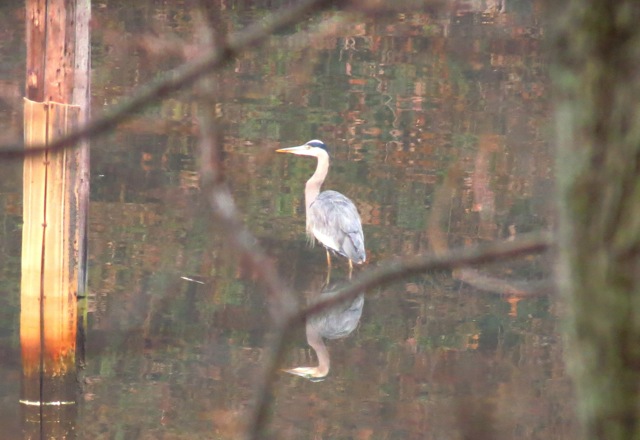
Easier Foraging for Herons
This image is an interesting reminder that when our local waters are clearer (unfortunately, only in the winter time around here!)
the foraging habitat for birds like this Great Blue Heron is substantially increased because he (or she!) can see further into the water
to grab fish and the other yucky things that they eat. In the summer time when the water is practically opaque from algae and runoff, the
herons seem to just shuffle along much closer to shore in 6″ water depth.
We need cleaner creeks and rivers — even if it costs money.
Posted in Uncategorized
Leave a comment
Pay No Attention to the Man Behind the Curtain … Robin Red Breast at Lost Hollow Farm
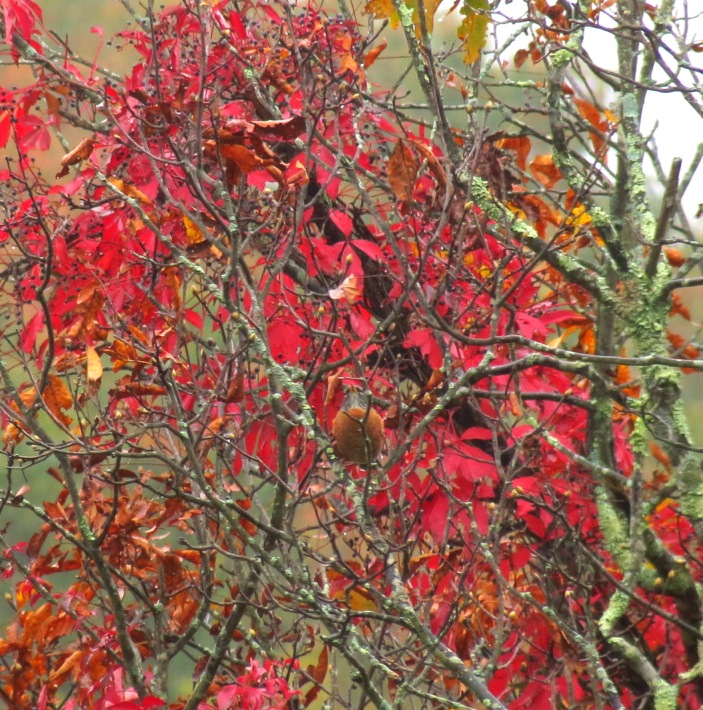
Sue Horrocks Miller invited us up to Lost Hollow Farm outside Mathias, West Virginia, last fall where I took this picture . . .
With new technologies, it’s all too tempting to push all the buttons, all the time — so this time, YOU get to decide. The top picture is the picture “as taken” with the 35X telephoto lens . . . and the bottom photo is cropped and has lots of buttons pushed. . . .
In this case, I tend to prefer the second one, because it’s actually more like the color of the robin’s breast “in the wild” at that time of year (the distance between the camera and the vines attenuates the reds because of the autumn haze that day), and because it’s more “fun” for my pretty-much-colorblind eyes.
Posted in Uncategorized
Leave a comment
Nice Work if You Survive ….
Change of Governor of Anguilla
| Author | Comment | |||
|---|---|---|---|---|
simvog |
Change of Governor of Anguilla |
Lead | ||
|
Change of Governor of Anguilla She will succeed Mr William Alistair Harrison CMG CVO, who will be transferring to another Diplomatic Service appointment. Ms Scott will take up her appointment during summer 2013. Ms Scott has had a wide ranging civil service career working across a range of domestic and international policies. Currently Director of the Civil Contingencies Secretariat in the Cabinet Office, she previously spent three years as Private Secretary to the Prime Minister. She has also worked at HM Treasury, in the Department for Transport and at the European Commission. Ms Scott will transfer from the Cabinet Office to the FCO for this appointment. On her appointment as Governor of Anguilla, Ms Scott said: “It is a great honour to be appointed as Governor. I very much look forward to working with the people of Anguilla and their elected representatives as they build a vibrant, successful and resilient future”.
|
||||
|
|
||||
Islander |
#1 | |||
|
http://www.dailymail.co.uk/news/article-2257692/Well-thats-way-avoiding-ex-Civil-servant-lands-plum-Caribbean-job-4-000-miles-estranged-husband–happens-PMs-aide.html
In today’s artlcle about our new Governor-designate, the “Governor’s Residence” is actually Landsome House, which was unfortunately destroyed by arson in 1967, during the Revolution. The site is now occupied by Landsome Bowl, otherwise known as the Carnival Village, in The Valley.
Being the Governor of Anguilla is a difficult and stressful job, trying to balance the representation of British interests in Anguilla and Anguillian interests in the UK. Experience in foreign affairs is of little help, especially in trying to work with our combative current government. I expect Her Excellency will have little time for lying on our beaches.
Fortunately, Ms. Scott will undergo extensive briefing, which will not depend entire upon articles from The Daily Mail. I quote from a rather different article from several years ago:
THE INDEPENDENT: IT MAY LOOK LIKE PARADISE BUT IF YOU ARE GOVERNOR THEN IT’S HARD WORK. HONEST IT’S A TOTAL NIGHTMARE IF YOU ARE THE GOVERNOR
The Independent – United Kingdom Jan 29, 2000 ROBERT HARRIS did not enjoy his time in the Caribbean. It was a waste of time, he said as he flew out. But then Mr Harris was not a holidaymaker. He was one of the last of a dying breed, the Governor of one of Britain’s overseas territories, and like many of those hard-pressed men and women, he discovered that there is more to it than wearing a feathered hat. As Governor of Anguilla, Mr Harris had a tough time, a symptom of the increasing problems of many of the last red dots on the map. “I did not have a successful tour and I have not found it possible to work closely with the government of Anguilla any more than my predecessors did,” Mr Harris said as he departed. “I would go as far as to say I personally regard it as a waste of my professional time.” Anguilla, a flat, dusty patch of scrub in the Leeward Islands, is the destination of choice for wealthy tourists seeking a quiet but luscious time: it has some of the best beaches in the world. — ends — The local government Mr. Harris was referring to was headed by our present Chief Minister, Hubert Hughes. During his time here, Harris suffered a heart attack. Mr. Hughes later joked or bragged about it, claiming to have been its cause. I wish Ms. Scott the strength and endurance promised in our national shield:
Islander |
||||
A note from Bruce Potter based on Bob’s blog post
Posted in Uncategorized
Leave a comment
New Housing Designs
think about it:
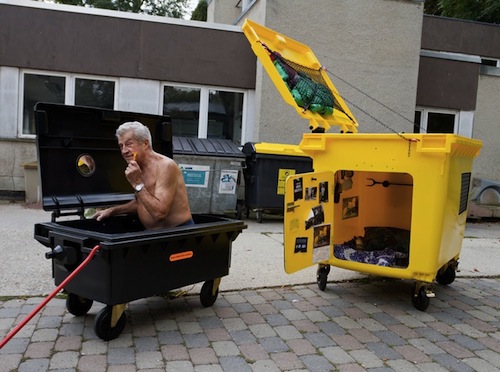
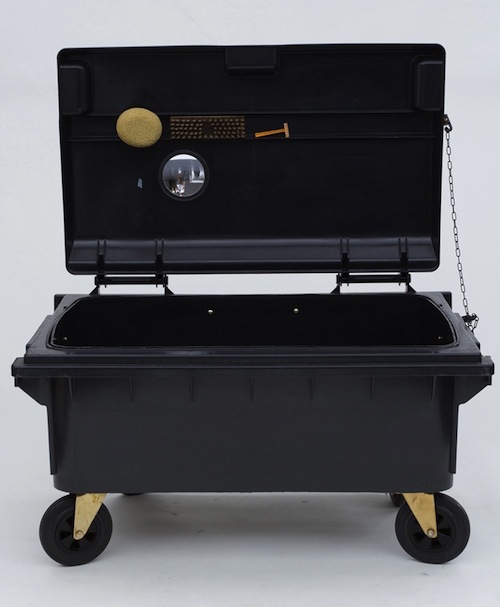
Apocalypse-ready German designer makes tiny houses from Dumpsters
By Sarah Miller
German designer Philipp Stingl has fashioned homes for the homeless out of Dumpsters. They’re actually pretty nifty, too. They have locks, trash disposal systems, even a little sewage system. Sure, they’re not spacious, but if they’re your only alternative — if you’re homeless, but also if you’re just trying to hide from marauders after the coming ecopocalypse — they seem reasonably cozy.
Stingl submitted his work to be featured on designboom, and this is what he wrote:
as the demographic evolution in germany and other countries becomes more dramatic, social systems will collapse and from the ashes an aging society will rise, marked by crime, sickness and poverty. developed by german designer philipp stingl, these products designed for the homeless and elderly population presents ’house containers’ consisting of disposable trashboxes, drinking water canisters, freighthold and a lockable livingspace with sewage systems. essentially, these ‘living containers’ testify to an active and creative lifestyle for the old age without compromises.
It’s pretty ambitious to expect people (especially old people!) to maintain an “active and creative lifestyle” given that “social systems will collapse and from the ashes an aging society will rise, marked by crime, sickness and poverty.” It all sounds very depressing. But if anything can create a miracle, it’s a Dumpster we can sleep and poop in.
Dumpsters Get Turned Into Living Containers
13 Dec 2012 | Subscribe to RSS | Get news delivered to your email
To help house the homeless and elderly, Germany-based designer Philipp Stingl has turned garbage dumpsters into living containers. Dubbed ‘House Containers’, the dumpsters were equipped with disposable trash boxes, drinking water canisters, sewage systems and locks—so that they could become real ‘homes’ for people, while providing a future solution for the lack of living spaces to house the poor.
Posted in Uncategorized
Leave a comment
‘Specialist knowledge is useless and unhelpful’
from the NewScientist: <http://www.newscientist.com/article/mg21628930.400-specialist-knowledge-is-useless-and-unhelpful.html?page=2>
‘Specialist knowledge is useless and unhelpful’
- 07 December 2012 by Peter Aldhous
- Magazine issue 2893. Subscribe and save
- For similar stories, visit the Interviews Topic Guide
Kaggle.com has turned data prediction into sport. People competing to solve problems are outclassing the specialists, says its president Jeremy Howard
Kaggle has been described as “an online marketplace for brains”. Tell me about it.
It’s a website that hosts competitions for data prediction. We’ve run a whole bunch of amazing competitions. One asked competitors to develop algorithms to mark students’ essays. One that finished recently challenged competitors to develop a gesture-learning system for the Microsoft Kinect. The idea was to show the controller a gesture just once, and the algorithm would recognise it in future. Another competition predicted the biological properties of small molecules being screened as potential drugs.
How exactly do these competitions work?
They rely on techniques like data mining and machine learning to predict future trends from current data. Companies, governments and researchers present data sets and problems, and offer prize money for the best solutions. Anyone can enter: we have nearly 64,000 registered users. We’ve discovered that creative data scientists can solve problems in every field better than experts in those fields can.
These competitions deal with very specialised subjects. Do experts enter?
Oh yes. Every time a new competition comes out, the experts say: “We’ve built a whole industry around this. We know the answers.” And after a couple of weeks, they get blown out of the water.
So who does well in the competitions?
People who can just see what the data is actually telling them, without being distracted by industry assumptions or specialist knowledge. Jason Tigg, who runs a pretty big hedge fund in London, has done well again and again. So has Xavier Conort, who runs a predictive analytics consultancy in Singapore.
You were once on the leader board yourself. How did you get involved?
It was a long and strange path. I majored in philosophy in Australia, worked in management consultancy for eight years, and then in 1999 I founded two start-ups – one an email company, the other helping insurers optimise risks and profits. By 2010, I had sold them both. I started learning Chinese, and building amplifiers and speakers because I hadn’t made anything with my hands. I travelled. But it wasn’t intellectually challenging enough. Then, at a meeting of statistics users in Melbourne, somebody told me about Kaggle. I thought: “That looks intimidating and really interesting.”
How did your first competition go?
Setting my expectations low, my goal was to not come last. But I actually won it. It was on forecasting tourist arrivals and departures at different destinations. By the time I went to the next statistics meeting I had won two out of the three competitions I entered. Anthony Goldbloom, the founder of Kaggle, was there. He said: “You’re not Jeremy Howard, are you? We’ve never had anybody win two out of three competitions before.”
How did you become Kaggle’s chief scientist?
I offered to become an angel investor. But I just couldn’t keep my hands off the business. I told Anthony that the site was running slowly and rewrote all the code from scratch. Then Anthony and I spent three months in America last year, trying to raise money. That was where things got really serious, because we raised $11 million. I had to move to San Francisco and commit to doing this full-time.
Do you still compete?
I am allowed to compete, but I can’t win prizes. In practice, I’ve been too busy.
What explains Kaggle’s success in solving problems in predictive analytics?
The competitive aspect is important. The more people who take part in these competitions, the better they get at predictive modelling. There is no other place in the world I’m aware of, outside professional sport, where you get such raw, harsh, unfettered feedback about how well you’re doing. It’s clear what’s working and what’s not. It’s a kind of evolutionary process, accelerating the survival of the fittest, and we’re watching it happen right in front of us. More and more, our top competitors are also teaming up with each other.
Which statistical methods work best?
One that crops up again and again is called the random forest. This takes multiple small random samples of the data and makes a “decision tree” for each one, which branches according to the questions asked about the data. Each tree, by itself, has little predictive power. But take an “average” of all of them, and you end up with a powerful model. It’s a totally black-box, brainless approach. You don’t have to think – it just works.
What separates the winners from the also-rans?
The difference between the good participants and the bad is the information they feed to the algorithms. You have to decide what to abstract from the data. Winners of Kaggle competitions tend to be curious and creative people. They come up with a dozen totally new ways to think about the problem. The nice thing about algorithms like the random forest is that you can chuck as many crazy ideas at them as you like, and the algorithms figure out which ones work.
That sounds very different from the traditional approach to building predictive models. How have experts reacted?
The messages are uncomfortable for a lot of people. It’s controversial because we’re telling them: “Your decades of specialist knowledge are not only useless, they’re actually unhelpful; your sophisticated techniques are worse than generic methods.” It’s difficult for people who are used to that old type of science. They spend so much time discussing whether an idea makes sense. They check the visualisations and noodle over it. That is all actively unhelpful.
Is there any role for expert knowledge?
Some kinds of experts are required early on, for when you’re trying to work out what problem you’re trying to solve. The expertise you need is strategy expertise in answering these questions.
Can you see any downsides to the data-driven, black-box approach that dominates on Kaggle?
Some people take the view that you don’t end up with a richer understanding of the problem. But that’s just not true: the algorithms tell you what’s important and what’s not. You might ask why those things are important, but I think that’s less interesting. You end up with a predictive model that works. There’s not too much to argue about there.
Profile
When Jeremy Howard graduated in philosophy from the University of Melbourne, Australia, he was already working as a management consultant for McKinsey & Company. Later he founded email company FastMail and the Optimal Decisions Group, which helps insurance companies set premiums. He is now president and chief scientist of Kaggle, San Francisco
Posted in Uncategorized
Leave a comment
Final Report: Grounding of M/V OLIVA on Nightingale Island, Tristan da Cunha, 16 March 2011
The document described below is the final report by the Marine Safety Investigation Unit of Transport Malta which explains how a relatively new bulk carrier was able to sail into an island in the middle of the ocean, causing great harm to the natural environment and the loss of the vessel and cargo.
It is a cautionary tale for anyone counting on effective sea transport.
A copy of this report can be downloaded or read on-line at the bottom of this post.
A copy can also be found in the FILES archive of the Tristan da Cunha e-mail group at <http://groups.yahoo.com/group/tristan-da-cunha/files/> — to become a member of that group, send a blank e-mail to <tristan-da-cunha-subscribe@yahoogroups.com>
Below are excerpts from the report and additional information from blogs and web sites about the wreck:
Finally! Why the M/S Oliva ran into Nightingale Island at 14 knots
>From the official Tristan website:
MS Oliva ran aground at 04.30 on 16th March 2011 at Spinners Point, the far north-west promontory of Nightingale Island.
Following a Malta Marine Safety Investigation Report we now know how the accident occurred and lessons to be learned
Why MS Oliva ran aground and lessons to be learned
Compiled by Newsletter Editor Richard Grundy from a Malta Marine Safety Investigation Report
Context of the report
MS Oliva Marine Safety Investigation Report was published by Malta’s Marine Safety Investigation Unit. The detailed and professional report was produced following International and European regulations and directives. Its sole purpose is confined to the dissemination of safety lessons and therefore may be misleading if used for other purposes. The report `shall be inadmissible in any judicial proceedings whose purpose or one of whose purposes is to attribute or apportion liability or blame, unless, under prescribed conditions, a Court determines otherwise.’
The Full Document
The full PDF document of 51 pages can be obtained direct from the Malta Government Ministry for Infrastructure, Transport and Communications Website by using this link: https://mitc.gov.mt/mediacenter
The Report
The report contains: A Summary of Events, Factual Information (1.) about the ship and a detailed Analysis (2.) of the causes of the grounding and events following. As this is a technical report intended to inform future marine safety there is a danger that any précis may be misleading. Nevertheless it makes fascinating reading for those who have followed the whole MS Oliva wreck saga.
We publish below in full the report’s Conclusions (3.), Safety Actions Taken (4.) and Recommendations (5.) which clearly identify the cause of the grounding, other findings, safety actions taken subsequently by TMS Bulkers Ltd and recommendations.
We will not here make any comments (although it would be tempting so to do), but leave visitors to draw their own conclusions, perhaps after consulting the full report. The February 2013 Tristan da Cunha Newsletter will contain an article including part of the report and an update on the Tristan Conservation and Fisheries Department monitoring.
3. Conclusions
Findings and safety factors are not listed in any order of priority.
3.1 Immediate Safety Factors
3.1.1 Oliva ran aground because the planned course the vessel was following on the plotting sheet was found to have taken the vessel directly over Nightingale Island.
3.1.2 Although the bridge team was aware that the vessel would be passing close to some islands, it was not aware as to when that event would take place.
3.1.3 Although the vessel did not have BA (British Admiralty) Chart 1769, other appropriate available charts covering the area had not been used.
3.1.4 Both the second mate and chief mate were not aware that the vessel was heading towards Nightingale Island. This was because there was no indication on the plotting chart to alert them of the dangers ahead.
3.1.5 Both the second mate and chief mate saw some echoes on the radar screen, but did not investigate them and dismissed them as rain clouds.
3.1.6 There was no suitable mark placed across the ship’s track to indicate the need to change to a hydrographic chart.
3.1.7 Neither officer had consulted BA Chart 4022. Although this chart was of an unsatisfactory scale, it could have prompted them to adopt a precautionary approach when radar echoes were sighted on the radar.
3.1.8 The combination of the cold, the medication, lack of sleep, the time of the day and reaction to the vessel’s grounding suggests that the chief mate was probably not fit to stand a navigational watch.
3.1.9 Although the company had provided comprehensive guidance and procedures in its SMS (Safety Management System) to prevent this accident, these were not followed on board.
3.2 Latent Conditions and other Safety Factors
3.2.1 The passage plan did not comply with the company’s instructions of clearing distances when a vessel was in open waters.
3.2.2 The master made no reference to the passing of Islands in his night orders. Reference to the Islands, could have alerted the second mate and chief mate to the significance of radar echoes.
3.2.3 The handing over checklist required the chief mate to establish the proximity of any hazards to the vessel. This appears not to have happened and he relied on the brief hand-over he received from the second mate.
3.2.4 The chief officer did not check the position which the AB (Able Bodied Seaman) plotted on the chart.
3.3 Other Findings
3.3.1 The company had adopted the concept of bridge team management to address performance variability. However, in this case it appears that the crew members’ interaction was not effective and they did not identify and eliminate the factors that resulted in the grounding.
3.3.2 The lifeboat was lowered soon after daylight as a precautionary measure, but was lost when the painters parted. Had the fishing vessel not been in the near vicinity, given the remoteness of the area, the crew of Oliva would have found themselves in a difficult position without a lifeboat.
3.3.3 Although the master had saved the VDR (Voyage Data Recorder) data, he was unable to retrieve it as he abandoned the vessel.
4. Safety Actions Taken
4.1 Safety actions taken during the course of the safety investigation
TMS Bulkers Ltd has carried out its own internal investigation, which has resulted in a review of its procedures. These include:
instructions on the use of plotting sheets during ocean navigation;
requiring all officers on board to complete computer based training in voyage planning and bridge team management.
TMS Bulkers Ltd. also intends to increase the frequency of internal navigational audits so as to identify any potential problems of a similar nature within its fleet.
5. Recommendations
In view of the conclusions and taking into consideration the safety actions taken during the course of the safety investigation, TMS Bulkers Ltd. are recommended to:
14/2012_R1 Consider holding unscheduled navigational audits at sea, so as to verify compliance of its operational procedures while the vessel is underway;
14/2012_R2 Ensure that emergency checklists are amended in order to include the need to save the VDR data.
Copied sections of the report are:
©Copyright TM, 2012
Marine Safety Investigation Unit
Malta Transport Centre
Marsa MRS 1917
Malta
St Helena Online
South Atlantic news, in association with The St Helena Independent
Revealed: blunders that caused Tristan da Cunha wreck disaster
Posted on 29 November, 2012 by Simon Pipe
Last year’s shipwreck disaster on Tristan da Cunha was caused by a drowsy officer who thought Nightingale Island was a rain cloud, an investigation has revealed.
The chief mate of the MS Oliva failed to change course when Tristan’s sister island showed up on radar, and the ship ploughed on to rocks.
People on Tristan spent weeks trying to save the lives of rockhopper penguins that were plucked from rocks after the cargo ship broke up in heavy swell.
Last month the entire 260-strong community was awarded a medal by the Royal Society for the Protection of Birds (RSPB).
It took a week for salvage crews to make the 1,700-mile voyage across the South Atlantic to the wreck, while the captain and crew were sheltered in homes.
The 75,300-tonne Oliva was wrecked on uninhabited Nightingale in the early hours of 16 March 2011.
Now a report by the Marine Safety Investigation Unit in Malta, where the ship was registered, has revealed a succession of human failures.
The ship’s officers knew they would pass close to some islands on their voyage from South America to Singapore, but not when. They failed to follow their route properly on charts, relying mainly on a satellite navigation system.
Just after four in the morning, the ship passed only 3.25 nautical miles from Inaccessible Island – a World Heritage Site that was later polluted by escaped oil.
The second mate saw its radar echo but “assumed it was either rain clouds or an iceberg”, says the report.
Soon after 0500, the chief mate “noticed a large echo on the radar screen, very close ahead. He assumed it was a heavy storm cloud and thereafter, he felt the vessel’s impact of running aground.
“The vibration of the vessel running aground and the change in the main engine noise woke up most of the crew, including the master.”
The ship slid on the sea bottom as conditions worsened and at about 0300 the next day, a rock pierced one of the holds. The engine room flooded and an oil slick appeared.
The unnamed Greek captain and the Filippino crew were taken off by a trawler and boats from a cruise ship.
Nearly 48 hours after the collision, Oliva broke in two in heavy swells, spilling 1,500 tonnes of oil into the sea, and most of its cargo of soya beans.
The investigation report says the chief mate had been unable to sleep until five hours before he was due on night watch, because of a cold, and had taken medicine.
“He required two wake-up calls before he arrived on the bridge to take over his watch.
“The combination of the cold, medication, lack of sleep, the time of the day and reaction to the ship’s grounding suggested that the chief mate was probably not fit to stand a navigational watch.”
The report also says that bridge management systems were not followed. Charts were not marked with a “no go” area around the islands, and a plotting error meant that the ship’s projected route took it straight over the mile-wide Nightingale Island.
The RSPB has praised the Tristanians for a “phenomenal” response to the resulting ecological disaster.
The fishing vessel Edinburgh transported 3,718 penguins to Tristan da Cunha, where 80 islanders worked for three months to clean and feed the birds. Conservation workers arrived from South Africa to help, bringing medicines.
A works shed was transformed into a penguin hospital, and recovering birds took over the island’s swimming pool.
Chief islander Ian Lavarello said: “Many of us are descendants of shipwrecked sailors who settled on Tristan, so it was natural for us to shelter the rescued men from the Oliva and at the same time, turn to saving as many of the affected penguins as possible.”
But only 12 per cent of those taken to the main island survived to be released into the sea. It is thought most of Nightingale’s penguins had already left the island after breeding when the ship broke up.
Dr Ross Wanless of Birdlife South Africa, who called the outcome “an unmitigated disaster”, criticised insurers for delay in sending bird experts to join the clean-up.
Months after the incident, scientists found rotting soya beans had killed sea creatures and caused severe damage to the lobster fishery that provides islanders with most of their income.
Seventeen months after the incident, the Nightingale fishery remained closed and the quota at Inaccessible Island had been halved.
In September 2012, the ship’s owners agreed to pay compensation to the islanders.
About Simon Pipe
Former print and BBC journalist, running St Helena Online news website about British territories in the South Atlantic at www.sthelenaonline.org and blogging occasionally on other sites.
Posted in Uncategorized
Leave a comment
Final Report: Grounding of M/V OLIVA on Nightingale Island, Tristan da Cunha, 16 March 2011
The document below by the Marine Safety Investigation Unit of Transport Malta explains how a relatively new bulk carrier was able to sail into an island in the middle of the ocean, causing great harm to the natural environment and the loss of the vessel and cargo.
It is a cautionary tale for anyone counting on effective sea transport.
Additional information from blogs and web sites:
Finally! Why the M/S Oliva ran into Nightingale Island at 14 knots
>From the official Tristan website:
MS Oliva ran aground at 04.30 on 16th March 2011 at Spinners Point, the far north-west promontory of Nightingale Island.
Following a Malta Marine Safety Investigation Report we now know how the accident occurred and lessons to be learned
Why MS Oliva ran aground and lessons to be learned
Compiled by Newsletter Editor Richard Grundy from a Malta Marine Safety Investigation Report
Context of the report
MS Oliva Marine Safety Investigation Report was published by Malta’s Marine Safety Investigation Unit. The detailed and professional report was produced following International and European regulations and directives. Its sole purpose is confined to the dissemination of safety lessons and therefore may be misleading if used for other purposes. The report `shall be inadmissible in any judicial proceedings whose purpose or one of whose purposes is to attribute or apportion liability or blame, unless, under prescribed conditions, a Court determines otherwise.’
The Full Document
The full PDF document of 51 pages can be obtained direct from the Malta Government Ministry for Infrastructure, Transport and Communications Website by using this link: https://mitc.gov.mt/mediacenter
The Report
The report contains: A Summary of Events, Factual Information (1.) about the ship and a detailed Analysis (2.) of the causes of the grounding and events following. As this is a technical report intended to inform future marine safety there is a danger that any précis may be misleading. Nevertheless it makes fascinating reading for those who have followed the whole MS Oliva wreck saga.
We publish below in full the report’s Conclusions (3.), Safety Actions Taken (4.) and Recommendations (5.) which clearly identify the cause of the grounding, other findings, safety actions taken subsequently by TMS Bulkers Ltd and recommendations.
We will not here make any comments (although it would be tempting so to do), but leave visitors to draw their own conclusions, perhaps after consulting the full report. The February 2013 Tristan da Cunha Newsletter will contain an article including part of the report and an update on the Tristan Conservation and Fisheries Department monitoring.
3. Conclusions
Findings and safety factors are not listed in any order of priority.
3.1 Immediate Safety Factors
3.1.1 Oliva ran aground because the planned course the vessel was following on the plotting sheet was found to have taken the vessel directly over Nightingale Island.
3.1.2 Although the bridge team was aware that the vessel would be passing close to some islands, it was not aware as to when that event would take place.
3.1.3 Although the vessel did not have BA (British Admiralty) Chart 1769, other appropriate available charts covering the area had not been used.
3.1.4 Both the second mate and chief mate were not aware that the vessel was heading towards Nightingale Island. This was because there was no indication on the plotting chart to alert them of the dangers ahead.
3.1.5 Both the second mate and chief mate saw some echoes on the radar screen, but did not investigate them and dismissed them as rain clouds.
3.1.6 There was no suitable mark placed across the ship’s track to indicate the need to change to a hydrographic chart.
3.1.7 Neither officer had consulted BA Chart 4022. Although this chart was of an unsatisfactory scale, it could have prompted them to adopt a precautionary approach when radar echoes were sighted on the radar.
3.1.8 The combination of the cold, the medication, lack of sleep, the time of the day and reaction to the vessel’s grounding suggests that the chief mate was probably not fit to stand a navigational watch.
3.1.9 Although the company had provided comprehensive guidance and procedures in its SMS (Safety Management System) to prevent this accident, these were not followed on board.
3.2 Latent Conditions and other Safety Factors
3.2.1 The passage plan did not comply with the company’s instructions of clearing distances when a vessel was in open waters.
3.2.2 The master made no reference to the passing of Islands in his night orders. Reference to the Islands, could have alerted the second mate and chief mate to the significance of radar echoes.
3.2.3 The handing over checklist required the chief mate to establish the proximity of any hazards to the vessel. This appears not to have happened and he relied on the brief hand-over he received from the second mate.
3.2.4 The chief officer did not check the position which the AB (Able Bodied Seaman) plotted on the chart.
3.3 Other Findings
3.3.1 The company had adopted the concept of bridge team management to address performance variability. However, in this case it appears that the crew members’ interaction was not effective and they did not identify and eliminate the factors that resulted in the grounding.
3.3.2 The lifeboat was lowered soon after daylight as a precautionary measure, but was lost when the painters parted. Had the fishing vessel not been in the near vicinity, given the remoteness of the area, the crew of Oliva would have found themselves in a difficult position without a lifeboat.
3.3.3 Although the master had saved the VDR (Voyage Data Recorder) data, he was unable to retrieve it as he abandoned the vessel.
4. Safety Actions Taken
4.1 Safety actions taken during the course of the safety investigation
TMS Bulkers Ltd has carried out its own internal investigation, which has resulted in a review of its procedures. These include:
instructions on the use of plotting sheets during ocean navigation;
requiring all officers on board to complete computer based training in voyage planning and bridge team management.
TMS Bulkers Ltd. also intends to increase the frequency of internal navigational audits so as to identify any potential problems of a similar nature within its fleet.
5. Recommendations
In view of the conclusions and taking into consideration the safety actions taken during the course of the safety investigation, TMS Bulkers Ltd. are recommended to:
14/2012_R1 Consider holding unscheduled navigational audits at sea, so as to verify compliance of its operational procedures while the vessel is underway;
14/2012_R2 Ensure that emergency checklists are amended in order to include the need to save the VDR data.
Copied sections of the report are:
©Copyright TM, 2012
Marine Safety Investigation Unit
Malta Transport Centre
Marsa MRS 1917
Malta
St Helena Online
South Atlantic news, in association with The St Helena Independent
Revealed: blunders that caused Tristan da Cunha wreck disaster
Posted on 29 November, 2012 by Simon Pipe
Last year’s shipwreck disaster on Tristan da Cunha was caused by a drowsy officer who thought Nightingale Island was a rain cloud, an investigation has revealed.
The chief mate of the MS Oliva failed to change course when Tristan’s sister island showed up on radar, and the ship ploughed on to rocks.
People on Tristan spent weeks trying to save the lives of rockhopper penguins that were plucked from rocks after the cargo ship broke up in heavy swell.
Last month the entire 260-strong community was awarded a medal by the Royal Society for the Protection of Birds (RSPB).
It took a week for salvage crews to make the 1,700-mile voyage across the South Atlantic to the wreck, while the captain and crew were sheltered in homes.
The 75,300-tonne Oliva was wrecked on uninhabited Nightingale in the early hours of 16 March 2011.
Now a report by the Marine Safety Investigation Unit in Malta, where the ship was registered, has revealed a succession of human failures.
The ship’s officers knew they would pass close to some islands on their voyage from South America to Singapore, but not when. They failed to follow their route properly on charts, relying mainly on a satellite navigation system.
Just after four in the morning, the ship passed only 3.25 nautical miles from Inaccessible Island – a World Heritage Site that was later polluted by escaped oil.
The second mate saw its radar echo but “assumed it was either rain clouds or an iceberg”, says the report.
Soon after 0500, the chief mate “noticed a large echo on the radar screen, very close ahead. He assumed it was a heavy storm cloud and thereafter, he felt the vessel’s impact of running aground.
“The vibration of the vessel running aground and the change in the main engine noise woke up most of the crew, including the master.”
The ship slid on the sea bottom as conditions worsened and at about 0300 the next day, a rock pierced one of the holds. The engine room flooded and an oil slick appeared.
The unnamed Greek captain and the Filippino crew were taken off by a trawler and boats from a cruise ship.
Nearly 48 hours after the collision, Oliva broke in two in heavy swells, spilling 1,500 tonnes of oil into the sea, and most of its cargo of soya beans.
The investigation report says the chief mate had been unable to sleep until five hours before he was due on night watch, because of a cold, and had taken medicine.
“He required two wake-up calls before he arrived on the bridge to take over his watch.
“The combination of the cold, medication, lack of sleep, the time of the day and reaction to the ship’s grounding suggested that the chief mate was probably not fit to stand a navigational watch.”
The report also says that bridge management systems were not followed. Charts were not marked with a “no go” area around the islands, and a plotting error meant that the ship’s projected route took it straight over the mile-wide Nightingale Island.
The RSPB has praised the Tristanians for a “phenomenal” response to the resulting ecological disaster.
The fishing vessel Edinburgh transported 3,718 penguins to Tristan da Cunha, where 80 islanders worked for three months to clean and feed the birds. Conservation workers arrived from South Africa to help, bringing medicines.
A works shed was transformed into a penguin hospital, and recovering birds took over the island’s swimming pool.
Chief islander Ian Lavarello said: “Many of us are descendants of shipwrecked sailors who settled on Tristan, so it was natural for us to shelter the rescued men from the Oliva and at the same time, turn to saving as many of the affected penguins as possible.”
But only 12 per cent of those taken to the main island survived to be released into the sea. It is thought most of Nightingale’s penguins had already left the island after breeding when the ship broke up.
Dr Ross Wanless of Birdlife South Africa, who called the outcome “an unmitigated disaster”, criticised insurers for delay in sending bird experts to join the clean-up.
Months after the incident, scientists found rotting soya beans had killed sea creatures and caused severe damage to the lobster fishery that provides islanders with most of their income.
Seventeen months after the incident, the Nightingale fishery remained closed and the quota at Inaccessible Island had been halved.
In September 2012, the ship’s owners agreed to pay compensation to the islanders.
About Simon Pipe
Former print and BBC journalist, running St Helena Online news website about British territories in the South Atlantic at www.sthelenaonline.org and blogging occasionally on other sites.
Posted in Uncategorized
Leave a comment
Paying a price for doing what’s right: What really happened at Japan’s premier camera-maker
from The Economist:
The Olympus scandal
Paying a price for doing what’s right
What really happened at Japan’s premier camera-maker
Nov 24th 2012 | from the print editionExposure: Inside the Olympus Scandal: How I Went from CEO to Whistleblower.By Michael Woodford. Portfolio; 258 pages; $27.95 and £20. Buy from Amazon.com,Amazon.co.uk
IN APRIL 2011 the Japanese camera-maker Olympus appointed its first foreign president, Michael Woodford, a Briton and 30-year company veteran. Six months later he was sacked after questioning $1.7 billion in suspicious transactions. His rapid ascent and downfall for doing the right thing is nicely told in this first-person whodunnit.
The story began when Olympus bought three tiny, profitless companies in 2008 for $800m, only to write down three-quarters of their value by the end of the financial year. And it gave nearly $700m in “advisory fees” to an entity in the Cayman Islands whose ownership and legal standing were unclear. When Mr Woodford learned of this (after it was reported in a small Japanese business magazine, but never followed up by the mainstream press, stock analysts or regulators), he sought answers from the firm’s chairman, Tsuyoshi Kikukawa; to no avail.
“Exposure” treats readers to a fascinating inside look at bare-knuckled corporate governance. Mr Woodford informs the board of his concerns, but is met with silence. He tells the company’s auditors. He hires forensic accountants. He calls for the resignation of the chairman, who had hand-picked him as president after he had ably managed the European operations. At a board meeting that was called to discuss the strange deals, the chairman marches in and reads out a resolution calling for Mr Woodford’s dismissal. “All 15 members simultaneously raised their hands in approval,” Mr Woodford writes, like “children in a classroom.”
Mr Woodford then finds he has bigger troubles than losing his job; he fears for his life. No one knows where the money has gone, but there are hints that Japan’s mob, the Yakuza, may be involved. Alone and ignored, Mr Woodford fights back with the only tool at his disposal: the media.
The story grows more surreal. Olympus tells lies. The Japanese press, politicians and regulators are weirdly docile even as the story makes front-page news worldwide and the company’s share price falls by 80%. Meanwhile, only shareholders can remove a director, so although Mr Woodford is stripped of his titles, he is still on the board—a perch from which he tries to clean up the company. When that fails, he resigns and tries to bring in a new board with the help of outside investors. That fails too, when the forces of old Japan—Olympus’s main bank and biggest shareholder, SMBC, and a group of cross-shareholding firms—close ranks to protect the company from more meddlesome outsiders.
What actually happened to the money? Mr Woodford’s description of the financial fraud is exceptionally clear. It was not the mob but managers, who tried to use accounting write-offs to cover up investment losses dating back from the 1990s that would have blown a hole in Olympus’s balance-sheet.
The kind of integrity and courage that Mr Woodford displayed is unusual; perhaps his self-worth did not depend on him having a powerful job. Growing up poor in Liverpool and leaving school at age 16, Mr Woodford also knew at first hand how uncertain life could be. He did not see risking it all as losing it all.
“Exposure” should be compulsory reading for company directors and MBA students. But they should take his self-justifications with a pinch of salt. It could be argued that Mr Woodford was naive to confront the chairman without having first amassed internal allies. If he had played a discreet, long-term hand rather than force the issue, could he have cleaned up the company more effectively and kept his job? Maddeningly, the author is devoid of introspection on the big issues.
Instead, he wraps himself in self-righteousness and takes potshots at the hapless men who failed to support him, a stance that may be morally justifiable but grows repetitive. Nor does he really get into the mind of Mr Kikukawa and his allies to find out what they were thinking. In their eyes Mr Kikukawa was protecting a great company and its employees without personal gain; this was a victimless accounting fudge; and after spending a decade trying to get rid of the mess, they took the bold step of choosing a foreign boss to put the company back on the right course—only to see their trust betrayed.
Mr Woodford stands tall as an example of leadership. Read his book and ask yourself: would you do the same thing—or would you just shut up and go to Davos?
Posted in Uncategorized
Leave a comment
PlanMaryland: DNR Will Host Natural Resource Mapping Workshops
|
![]()
Posted in Uncategorized
Leave a comment
Why Are Coastal Salt Marshes Falling Apart?
Posted in Uncategorized
Leave a comment


Salt marshes have been disintegrating and dying over the past two decades along the U.S. Eastern Seaboard and other highly developed coastlines without anyone fully understanding why.