Never Home Alone – your household biodiversity

[A message from David Duthie, the former public information officer for the Ramsar Convention (wetlands conservation) — if he says this is a worthwhile book — it is.

BP]

Dear BIOPLANNERS,

Parties to the Convention on Biological Diversity all commit, in Article 6a, to developing a “strategy and action plan” for their national biodiversity and also, in Article 6b, to mainstreaming that strategy and action plan into other landscape or economic sectors.

“Never Home Alone”, authored by Rob Dunn and recently released by Basic Books, and reviewed (twice) below, demonstrates that within our own homes – homes, not even gardens! – we could have literally hundreds of “housemates” for which you could develop a household strategy and action plan that goes beyond a “scorched earth” chemical attack.

My copy of the book is still in the post, but the two reviews below give a good flavour of the book and the real enthusiasm with which Rob has developed his “niche”, looking at the biodiversity in and immediately around us.

I found the thought experiment of making my house more biodiversity-friendly using some of the normal “ingredients” of a national biodiversity strategy and action plan (PAs, invasive policy, waste management, etc.) quite interesting and I think that Rob would probably give my house a pretty good score as it is – and brought back memories of the cane toad living behind the toilet of our shack when I was a conservation volunteer in Costa Rica (where cane toad is native) a long time ago!

Best wishes

David Duthie

***********************
Bioplan is a list server run jointly by UNDP and UNEP. To join / leave bioplan, email: bioplan with “subscribe” or “unsubscribe” in the subject line. Please note: If you wish to reply to the sender only you must create a new message addressed only to that individual, or forward the message to that individual. Using the “reply” or “reply all” option delivers your response to list administrator.
***********************

Moths, maggots and microbes: our 5,000 creepy-crawlie housemates – and the man who loves to hunt them

Biologist Rob Dunn is the David Attenborough of the domestic sphere, uncovering everything from microbes in the shower to spiders in the basement. He goes on safari in the dusty corners of one Copenhagen home

Lars Eriksen

Thu 28 Feb 2019

https://www.theguardian.com/environment/2019/feb/28/pests-homes-spider-man-bug-biolgist-5000-species

The good news is that I will never be home alone again. The bad news – well, it’s not in fact bad news, but it is slightly unsettling – is that I share my home with at least 5,000 other species: wasps, flies, spiders, silverfish and an exotic bunch of wild bacteria.

All that information is apparently contained in a patch of grey dust I have just swabbed with my right index finger from a door frame in my living room. It’s like a DNA test of my house, says Rob Dunn, a 43-year-old American biologist who has come to my house in Copenhagen to hunt microbial life. He carries no lab gear and his blue crewneck jumper and striped Oxford shirt are hardly the combat suit of an exterminator. But with every discovery we make, with every spider we find lurking in the corner or each swab of dust, he displays an almost childlike sense of excitement. He swears and smiles, even whoops with delight: “This dust sample contains bacteria, your body microbes, your wife’s body microbes, your child’s body microbes. If you smoke weed we would find marijuana DNA in there. Everything is visible, but it’s also present in every breath. Every time you inhale, you inhale that story of your home.”

Dunn is to house insects and indoor bacteria what Marie Kondo is to neatly folded shirts. He wants us to study the wildlife in our homes and realise that what we discover should spark much more joy than fear. When he began working as a biologist he went to the jungle to study wild beasts, but now his research is dedicated to species much closer to home: to the flies, spiders and bacteria hidden in every nook and cranny of our kitchens, bathrooms and basements. To the “jungle of everyday life”, as he describes it in his new book.

Never Home Alone tracks how we have been disconnected from the ecosystems of our homes. It’s a book of hard truths – I now know that I shed 50m flakes of skin every day, providing food for thousands of bacteria, and that cockroaches are basically our perfect interspecies Tinder-match. It also confronts our irrational relationship with cleanliness. Our modern instinct might be to swat a spider on the kitchen worktop or blitz creepy crawlies into oblivion with antimicrobial sprays, but we could be killing useful allies, according to Dunn: “The key thing is that your life is going to be full of life. And your only choice is which life. Our default is that we try to kill everything and fill our houses with stuff that’s totally terrible for us. We might kill 99%, but that leaves 1% – and that 1% is never the good stuff.”

Dunn is in Copenhagen for work and has agreed to come to my home to go through dusty corners and spider webs to point out where I might find some of the 5,000 species I bunk with. I suspect our 110-year-old house, shared with another family, is a fertile hunting ground, and Dunn seems optimistic. Using a screwdriver and tweezers, he pokes at light fittings and sifts through the basement, which can be a mould-friendly hangout during sticky, wet summers.

While I’m making coffee, Dunn lets out a yelp: “Oh yes, this is good!” He has spotted a globe-shaped lamp hanging in the basement hallway, and in the bottom of the hazy glass cover is a Pollockesque pattern of dead wildlife. He tips the contents of the lamp on to a fold-out table and uses the tweezers to organise the harvest: two types of fly, a wasp, a meal moth, some aphids and various planthoppers. He takes a closer look at two of the dead flies: “I can tell they are likely to be the same species, but I don’t know for sure until I look at their genitals.”

He turns to the silver-shiny meal moth. “Isn’t it just beautiful? It moved in with humans in ancient Egypt and has moved with humans again and again.”But how would it have ended up in our home?“

This meal moth could have come in with grains.”

Like from a box of cereal?

“Yes!”

Dunn wants us to see our homes the way we see our gardens. There are pests and pathogens we need to control – those that make us sick – but we also want to preserve diversity. He says fewer than 100 species of bacteria, protists and viruses cause nearly all infectious diseases today. We try to keep these in check with vaccinations and antibiotics, and by washing our hands. But that leaves us with a jungle of tens of thousands of other species, many of which we know little about, but which Dunn’s work suggests can often be more beneficial than harmful. For example, studies have shown that a higher diversity of bacteria on people’s skin – bacteria linked to soil and plants – can reduce the risk of allergies. He also mentions the discovery of a bug that could be a new source of useful enzymes:by testing the microbes in the gut of the camel cricket, found in many American homes, Dunn’s research team discovered bacteria that were able to break down industrial waste and turn it into energy. Making “cool discoveries” like this and enlisting the public to sieve through their homes for wildlife has spurred interest in a field he says has been neglected for too long.

“The first drawings of microscopic life are all of household species,” says Dunn, “but once we figured out the germ theory of disease it shifted, and both scientists and the public started to think that what was indoors belonged to pest control. Ecologists went to the Galapagos, we went to the rainforest, but it pushed us away from the home and it left us with this huge blind spot.”

Dunn grew up in rural Michigan, hunting snakes and turtles, building tree forts and being “more curious about nature than your average child”. Today, he is a professor in the department of biological sciences at North Carolina State University, where he has spent the past decade involving his colleagues and the public in studying the microbial landscape of our bodies and our homes. Part of the thrill of his new book is the sense of discovery and engagement with the world outside the lab. We head deeper into the basement, to the water-heating system, where one of the pipes has a leak; water drips into a chalk-crusted yellow bowl. Dunn grabs the bowl and tips it on to its side so we can see the puddle: “You could start a sourdough loaf with this.” The water heater is an example, he says, of the extreme conditions we create in our houses. These specific ones are similar to what you might find in an Icelandic geyser, which means that our basement heating system now attracts bacteria that would normally thrive in volcanic hot springs. He moves on to a sprawling mess on the wall next to the boiler. “That’s a lovely spider web,” he says excitedly. I feel a strange sense of pride and relief that my lack of cleaning is potentially boosting the ecosystem I inhabit. “This kind of spider is super-common in houses and can live for many, many years. This can grow up with your kid.”

I’m not sure I’m ready for an in-house pet spider, but while our natural inclination might be to shriek or stamp them out, Dunn wants us to protect them. “The natural enemies of the pests in our homes are very often, whether you like it or not, spiders,” he writes in Never Home Alone: “If you kill the spiders in your home (and this is precisely what we do with many kinds of pesticide applications), you do so at your own expense.”

The curse of pesticides brings us to the bathroom and another key area of his research: shower heads. Dunn and his team asked people from across the US and Europe to send in swabs from their shower heads. And within the biofilm – “a fancy word for the gunk” that builds up inside them – they discovered a pathogen, non-tuberculous mycobacteria (NTM), that is linked to lung disease in people with weak immune systems. What they didn’t know was why this pathogen seemed more prevalent in some regions than others. “There was more of the NTM in the US and in particular in chlorinated water,” says Dunn. They came to the conclusion that “residual chlorine kills all the competing bacteria and just leaves the NTM, which are chlorine-intolerant.” And when the competition is eliminated, the pathogens thrive.

He unscrews the shower head from the hose and runs his finger along the rubber fitting. There is very little biofilm-gunk, which he credits to the quality of the local water supply. “Most of Copenhagen still has untreated groundwater that relies on the wild biodiversity of crustaceans and bacteria to clean it. But if you break that – like we do in the US – it’s super-expensive to fix it and it sucks. And it makes you sick.”

Crustaceans?

“Yes, in some cases you can encounter small crustaceans in the tap water here. Denmark tastes like biodiversity.”

We continue through the living room and kitchen. He pulls a book from the shelf to test for book lice, and picks up a log of firewood that has a spidery, grey pattern of reindeer lichen growing on the bark. In the kitchen he checks the dishwasher soaptray for a particular form of bacteria that is otherwise only found “in the faeces of tropical fruit bats”. Even our salt jar is apparently full of life: “Almost every crystal of salt has bacteria inside, and when you brine something in salt, those bacteria contribute to the flavours of the brine. The longer it sits in the brine, the more the microbes in the brine are going to contribute to it. Isn’t that cool?”

Food is an area where Dunn has found the influence of microbes and bacteria to be more palatable to people he meets. Food is alive – whether it’s sourdough bread, kimchi or beer – and we are cool with that. Much more so than with the spider crawling across our windowsill. Dunn describes a study of how specific microbes found on bakers’ skin influence sourdough starters and the flavour of bread. His team gathered 15 bakers at a facility in Belgium and tasked each of them with making sourdough starters from identical ingredients. When they tested the bakers’ hands afterwards, it showed a close relationship between the microbial makeup of each starter and the bacteria found on the skin of the baker who made it. In his book Dunn describes how the bakers and biologists, drunk on spontaneously fermented Belgian beer, tucked into the breads and broke into an impromptu toast: “‘To bread, and to microbes!’ And to a house in which both are delicious. ‘To bread and to microbes!’ And houses in which we are all healthy. ‘To bread and to microbes!’ And to lives filled with wild species we have yet to study or understand, species that float like mysteries all around us and offer services we are only beginning to measure.”

Our house tour and inspection has come to an end. I’m curious about the professor’s verdict. Is this a happy, fungi-rich, insect-thriving home? “You have a lot of species that I think of as being part of a healthy house,” Dunn says. “To me, your house is rich in biodiversity and seems dominated by those things that you either shouldn’t worry about, or that are beneficial. Also, I don’t see antimicrobial products all over the place.”

He points to the leftovers of a coffee kombucha-glazed Danish pastry we were eating earlier. “And then you have things that spark joy for you: fermented pastries, salt that’s alive and healthy water from Denmark that we know is alive.”

Whether we like it or not, the species living in our homes are a measure of our lives, says Dunn, and his biggest fear is that we risk killing off that biodiversity. “If spiders scare the hell out of you, but you are willing to have one living in the corner, and maybe approach it sometimes to keep an eye on it, then that’s great. That’s much better than if your response is to jump away from it and spray pesticides all over your home, because that will only favour species that cause us harm and are resistant to pesticides. But it’s not easy. This book won’t solve [the problem], but maybe it will open some new conversations.”

As he says goodbye and walks down the garden path, I spot a tiny moth in our living room, flapping frantically in the corner. I don’t freak out or necessarily feel any great joy, but I leave the moth be. After all, there are 5,000 of us here, and you need to give your housemates some privacy.

Never Home Alone by Rob Dunn is published in the UK by Basic Books (£22.99) on 14 March

**********************

A Book That Will Make You Terrified of Your Own House

By Robin Marantz Henig

Dec. 31, 2018

https://www.nytimes.com/2018/12/31/books/review/rob-dunn-never-home-alone.html

NEVER HOME ALONE: From Microbes to Millipedes, Camel Crickets, and Honeybees, the Natural History of Where We Live

By Rob Dunn

A young man I know used to say that humans have no need to bathe, since our hair and bodies are designed to self-cleanse. I would fight him on it, being of the opinion that washing up occasionally was good for us — and for the people with whom we lived. But now, after reading the entomologist Rob Dunn’s description of the myriad microbial life-forms that take up residence in a typical American showerhead, I’m starting to think maybe that young man was onto something.

With an army of collaborators, Dunn, a professor of applied ecology at North Carolina State University, took samples of the gunk inside hundreds of showerheads, and found a profusion of microbial fauna. Tap water itself, he writes in the chatty, informative “Never Home Alone,” teems with amoebas, bacteria, nematodes and crustaceans. As the water passes through the showerhead, these microbes lay down a kind of scaffolding known as biofilm to protect themselves from getting washed away with every ablution. They make the biofilm “out of their own excretions,” Dunn writes bluntly. “In essence, by working together, the bacteria poop a little indestructible condominium in your pipes.”

It gets worse. Filtered through that poop-biofilm, the water that washes over you, as you supposedly scrub yourself clean, might contain not only all those harmless amoebas and nematodes but a few bacteria that can be dangerous — in particular some species of Mycobacterium, cousins of the Mycobacterium that causes tuberculosis. And the pathogens are there because we provided the perfect breeding ground for them, when we tried to purify our tap water in the first place. Municipal water treatment plants use chlorine and other chemicals that kill off the bacterium’s natural predators, allowing Mycobacterium to thrive. Tap water that comes from a well, in contrast, has never gone through a treatment plant and has a rich microbial life. It might look more dangerous, but it’s actually safer, Dunn explains. All those organisms in well water are themselves harmless, and they tend to fight off the potentially dangerous ones like Mycobacterium — that’s how biodiversity works.

News from the showerhead biome is just one part of this fact-filled, occasionally disgusting, slightly alarming book. Dunn has been involved in an obsessive quest to document the tiny inhabitants of indoor environments, a project that involves teams of professional and amateur bug-watchers to take samples not only from showerheads but from door frames, refrigerators, hot water heaters, cellars, toilets, pillowcases, all sorts of surfaces from the places we call home. These workers swab and seal, swab and seal, and send their thousands of samples to Dunn’s lab in Raleigh, or to his other lab at the Natural History Museum of Denmark, for an ongoing microbial census.

“We expected to find a few hundred species,” Dunn writes of his first foray into indoor microbe-hunting, which involved 1,000 homes from around the world. Instead, he and his colleagues found a “floating, leaping, crawling circus of thousands of species,” perhaps as many as 200,000, many of them previously unknown to science.

These denizens of interior spaces are our most frequent companions. In the industrialized world, we spend upward of 90 percent of our time indoors. Luckily, most of our co-habitators are either benign or actually beneficial in some way, like the house spiders that keep down indoor populations of flies or mosquitoes that can carry disease. But because we’ve become so hyper about making our surroundings as pristine as possible — sealing off our homes from the outdoors and using pesticides and antimicrobials with a vengeance — we’ve tipped the scales away from those harmless or helpful bugs, in favor of some of the bad guys.

According to Dunn, indoor microbes are among the fastest-evolving species on the planet; they have an uncanny ability to live in ecological niches you could hardly imagine existing, like the dead skin cells we slough off every day (which is all that’s needed to survive for a class of bacteria known as detritivores).

They manage to evade our assaults, and evolve their way out of just about every biocide we throw at them. We’re left to contend with the consequences of our own warfare, such as pesticide-resistant German cockroaches and bedbugs, and antibiotic-resistant MRSA bacteria. We have turned a relatively harmless indoor biome into something that can make us sick.

That’s the take-home message of “Never Home Alone,” that the richer the biodiversity in our indoor environment, the better. “The biodiversity of plants and soil can help our immune systems function properly,” Dunn writes. “The biodiversity in our water systems can help keep pathogens in the water in check. … The biodiversity of spiders, parasitoid wasps and centipedes can help control pests. The biodiversity in our houses provides the opportunity, too, for the discovery of enzymes, genes and species useful to all of us, whether to make new kinds of beers or to transform waste into energy.”

I’m not quite as enamored of our microbial roommates as the author is. (I’m sorry, Professor Dunn, but I’m just being honest here: Those photos of the camel cricket and the American grass spider clinging to basement pipes and door thresholds — well, yuck.) It probably takes the soul of an entomologist, or maybe of a 9-year-old child, to love these bugs as much as Dunn does. Still, it’s hard not to be occasionally charmed by his prose, as when he catalogs the arthropods with whom we share our homes: “biting midges, mosquitoes, lesser house flies, phantom midges, freeloader flies and shore flies. This is not to mention fungus gnats, moth flies and flesh flies. Or crane flies, winter crane flies and minute black scavenger flies.” And it’s hard not to share, at least a little, his awe at their diversity, even in a single household. “If you see two flies in your home,” he writes, “the odds are that they are two different species. Heck, if you see 10 flies in your house, they are likely to be five different species.”

And don’t even get him started on the aphids. He’s amazed by them, as he is by “the wasps that lay their eggs in the bodies of aphids as well as the wasps that lay their eggs in the bodies of the wasps that lay their eggs in the bodies of aphids.”

There’s a real sense of “gee-whiz” in this book, but it’s mostly in service of Dunn’s overarching goal: to preach the preservation of biodiversity, not only in the lush forests and streams that fit our traditional image of nature’s abundance, but in the most humble places, too, where the vast majority of us will have most of our cross-species encounters — our basements, mattresses, refrigerator drawers and showerheads.

About those showerheads: Dunn isn’t suggesting that we give up showers. But he does say we might want to change the showerhead a little more often — and consider switching from metal to plastic, where biofilm is less likely to accumulate. Nonetheless, his bottom line for showerheads is like his bottom line for other aspects of the roiling microbial mix we live in: Don’t be afraid of letting life inside. “The water that is healthiest for bathing is that which comes from aquifers rich with underground biodiversity including crustaceans,” he writes. “The crustaceans in these aquifers are an indication not of the dirtiness of the water but of its health.”

*********************

Robin Marantz Henig is a New York science journalist whose books include “The Monk in the Garden: The Lost and Found Genius of Gregor Mendel.”

Posted in Fun | Comments Off on Never Home Alone – your household biodiversity

Gizmodo: Arctic to Warm 15º by 2100

From Gizmodo <https://earther.gizmodo.com/the-arctic-is-on-track-to-warm-over-15-degrees-this-cen-1833288900> ——

Climate change

The Arctic Is on Track to Warm Over 15 Degrees This Century Even If We Meet the Paris Agreement Pledges

ovtboohdg0mjoyky6xwf.png
Brian Kahn
Yesterday 12:32pmnvvhp0xzzaggr0su10nw.jpg

Photo: Getty

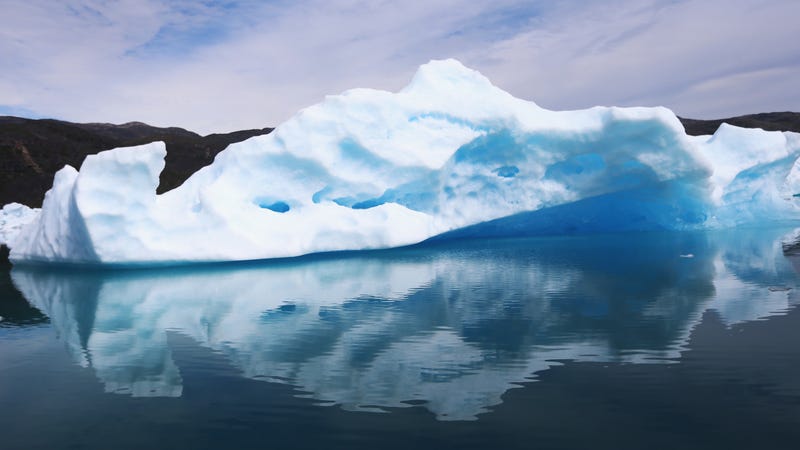
A new report from the United Nations shows that it’s basically game over for the Arctic as we know it.

Even if carbon pollution magically stopped tomorrow, the region’s winters would still warm an astonishing 5 degrees Celsius (9 degrees Fahrenheit) by century’s end. Meeting the Paris Agreement pledges—which do not get us to the two degree warming goal—would lead to that level of warming by midcentury and up to 9 degrees Celsius (16.2 degrees Fahrenheit) by 2100, along the way unraveling one of the most fragile ecosystems on the planet and displacing people who have done very little to cause the disruption.

The report was released on Tuesday at a meeting of the United Nations Environment Program. The synthesis pulls together recent research and puts it all in one terrifying graphic-driven document. The litany of changes that have already occurred is unsettling, but the real shock is in what could come next.

The Arctic is warming twice as fast as the rest of the globe, which translates to dramatic change. Sea ice extent, which has shrunk about 40 percent since regular satellite monitoring began in 1979, could reach zero percent in summer as early as the 2030s. Old, thick sea ice will likely be gone even sooner. Permafrost, frozen ground full of carbon, could thaw out and destroy a third of all the infrastructure in the Arctic (and also release deadly strains of anthrax). Rising temperatures could also unleash a host of other infectious diseases like Lyme disease, which is already on the rise in Canada.

“Insects like mosquitoes and ticks have the potential to connect the Arctic and tropics,” the authors write, which sounds like the sequel to Contagion.

The cruel irony of this is that like their small island counterparts, the 4 million people living the Arctic have contributed precious little to the carbon pollution causing those dramatic changes. In the case of permafrost, its thaw could also hasten climate change along by releasing methane and carbon dioxide in a vicious feedback loop.

And all these bleak findings don’t even get into other issues like plastic pollution, heavy metal contamination, or ocean acidification, all of which are and will continue to compound the region’s woes. The report concedes that the best way forward for the region with little sway on carbon pollution is adapting to whatever changes are coming its way.

“Challenges can no longer be managed in isolation: a holistic, ecosystem-based approach that considers multiple drivers and cumulative pressures is needed,” the report said. “In the years and decades to come, adaptation that integrates and respects local knowledge and Indigenous knowledge will be vital to help Arctic societies address the coming challenges.”

And there is sure to be no shortage of them.

Posted in Fun | Comments Off on Gizmodo: Arctic to Warm 15º by 2100

Get Girls Hiking

From High Country News — one of my favorite (weekly) newspapers <https://www.hcn.org/articles/hike-like-a-girl-to-close-outdoors-gender-gap?utm_source=wcn1&utm_medium=email>

———

TrailPosse

The outdoors gender gap needs to be closed

Women’s tax dollars help fund public land – yet that public asset isn’t seen as safe for all people to enjoy.

Liz Thomas Opinion Essay May 10, 2016 Like Tweet Email Print

Women often wonder whether it is safe for them to hike solo. For me, the answer clearly is yes: I’ve hiked 8,000 miles by myself, pioneered routes in Utah and the Columbia River Gorge, and set an Appalachian Trail speed record. But others argue that in the eyes of a good chunk of women – heck, in the eyes of many people in this country – what I do is an exception.

Which makes me wonder: Since no one questions female pilots, police officers or professional athletes these days, why should hikers be any different?

The truth is, as the daughter of two conservative, middle-class parents, I grew up internalizing the idea, rooted in historic and cultural sexism, that walking solo is unsafe for women, whether in nature or in urban settings. For centuries, unaccompanied women frequently were attacked because women, for religious or cultural reasons, aren’t “supposed” to be out. That’s still true in many countries. Even in supposedly safe places that don’t hold such religious or cultural norms, like U.S. cities, women walking alone experience high rates of street harassment. For women, going into the outdoors sometimes is a confidence issue— the fear of being alone, paired with just the plain, old fear that everyone has going outdoors, whether because of four-legged critters or just the two-legged.

Liz Thomas treks through a Seattle neighborhood on an “urban thru-hike.”
Glenn Nelson/TrailPosse

The perception of the outdoors as “not a woman’s place” even has been reinforced by institutions charged with managing public lands. At its inception in 1916, the National Park Service listed park ranger jobs as “men’s only.” Things hadn’t changed much by 1967. With a line straight out of Mad Men, then Secretary of the Interior Stewart Udall responded to a woman’s discrimination complaint by assuring the public that it was “our concern and affection for girls that prevents our saddling them with the full load of ranger duties.” Sporting airline-attendant inspired uniforms, so-called “rangerettes” were barred from law enforcement training and the ability to carry a gun until 1971. High Country News recently has published stories chronicling decades of sexual harassment and gender bias in the Park Service with a survey showing more than half of the female rangers and three-quarters of the female park police reporting on-the-job sexual harassment.

Despite the cultural taboos, I decided almost 10 years ago to backpack solo from Georgia to Maine on the Appalachian Trail. Those first few nights camping alone I was on such high alert that the U.S. Army Rangers, who use the trail to practice stealth travel skills, failed their mission. As they attempted to sneak past my lone hammock, I shined my headlamp on them. Dejected, the men disappeared into the woods, their training officer chastising them.

The more I hiked, the more I saw that, mile after mile, night after night, nothing bad happened. The vigilance that kept me up at night stirring with every sound quickly seemed unnecessary. My concerns about hiking solo were similar to those of a teenager learning to drive a car: Those first miles are exciting and scary, and then it becomes normal and routine. In fact, solo hiking and camping reinforced my sense that good things happen when going alone. I gained skills, bolstered my self-reliance, and observed and appreciated nature differently than when I hiked with men.

My story of discovery on the trail is not unique. Women have proven they can excel and can even surpass men in outdoor abilities, particularly during the past decade. Jennifer Pharr Davis was the National Geographic Adventurer of the Year in 2012. Heather Anderson is the thru-hike record holder for unsupported treks of both the Appalachian and Pacific Crest Trails. Kristin Gates was the first female to solo hike the 1,000-mile-long Brooks Range in Alaska. Female outdoor adventurers have let their love of the mountains be their reward; their stories rarely get the traction (or, like their sports-athlete sisters, the sponsorship and funding) that male adventure athletes receive.

Still, while elite women are pushing the limits and shattering the glass ceiling, the message that hiking is safe and fun still hasn’t filtered down to your average elementary school girl.

That’s why I urge all women – especially younger women – to get outdoors during Hike Like a Girl Weekend, May 14-15. Whether you hike solo or with other women, the weekend is not only supposed to be fun, it also is meant as an act of defiance against norms that seem 100 years old yet persist today. It’s standing against every stereotype or micro-aggression ever foisted our way – from the women who are told “be safe” instead of “have fun,” to every company that designs women’s gear by shrinking-and-pinking men’s models, to the ranger who asks the solo female hiker, “Are you doing this all by yourself?” Women’s tax dollars also go to fund public land – yet we still live in a world where that public asset isn’t perceived as safe for all people to enjoy. Trees, rivers and mountains should be spaces that feel welcoming to everyone.

Knock on wood, but I’ve never had a problem while hiking alone. I also try to be smart about making sure conditions are right, doing research, and keeping a rational head.

While I’d like to believe my anecdotal evidence – female adventurers like me sharing stories that hiking solo is safe – will inspire other women to get outdoors, either by themselves or with a friend, real change happens when women go out and take that first step in the woods. The real empowering education and confidence comes from showing yourself that you can do something that previously seemed impossible. The experience becomes proof more powerful than any athlete’s testimony that hiking is safe and not a strange thing for a woman to do.

Hike Like a Girl Weekend doesn’t require you to go out and buy fancy gear. A pair of running shoes, polyester gym clothes and a school backpack will do. Bring water, snacks, a flashlight, sun protection and some extra layers. Bring friends or family, too, if you’d like. For just one day or just one weekend, try something completely off your radar – something that seems outside your limits – whether it’s going beyond your routine run, visiting a new park or trail or hiking solo for the first time. You may be surprised by what you learn. Like me, you may find yourself coming back to hike again.

Note: “Hike Like a Girl,” organized by Teresa Baker of African American National Parks Event, encourages females of all ages to walk or hike this weekend, May 14-15, and post about their experiences on social media with the hashtag, #HikeLAG.

Liz “Snorkel” Thomas is a Japanese American fast, light and long-distance hiker who held the unsupported speed record for the Appalachian Trail from 2011-15. She has completed the so-called “Triple Crown” of thru-hiking (Appalachian, Pacific Crest and Continental Divide Trails), and is vice-president of the American Long Distance Hiking Association, an ambassador for the American Hiking Society, the instructor for Backpacker Magazine’s online course, Thru-hiking 101, and author of the newly released, The Best Hikes on the Continental Divide Trail: Colorado. She writes about her adventures at www.eathomas.com and tweets at @eathomas.

Posted in Fun | Comments Off on Get Girls Hiking

How Rising Seas Eat Home Values

The economic effects discussed here for mid-Atlantic coastal states in the continental USA also operate on housing and other coastal development in the Eastern Caribbean.

Rising Seas Soaked Home Owners for $16 Billion over 12 Years

The threat of flooding has driven some buyers away and caused losses in property values

Rising Seas Soaked Home Owners for $16 Billion over 12 Years
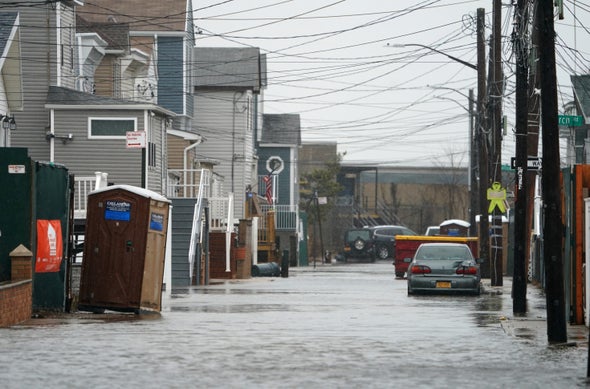
Flooded street in the Broad Channel section of Queens in New York on March 3, 2018. Credit: Don Emmert Getty Images

Sea-level rise has cost homeowners on the East and Gulf coasts nearly $16 billion in property value as floods and the threat of flooding drive some buyers away, according to a study released this week.

Analysts at the nonprofit First Street Foundation in Brooklyn studied millions of residential home sales in 17 states from Maine to Alabama and found that coastal property values were rising at a slower rate in flood-prone areas than in areas that did not flood.

“The market is already reacting,” First Street Executive Director Matthew Eby said. “There’s no longer a conversation of what sea-level rise will do in 2050 or 2100.”

Delaware Gov. John Carney said the study shows the need for “a serious, coordinated approach to confront the real threats posed by climate change. It’s clear that climate change already is having real effects in Delaware—the lowest lying state—and in states across our country.”

Carney, a Democrat, said Delaware has worked with a coalition of governors called the U.S. Climate Alliance to cut carbon emissions. “We cannot afford to delay action on this issue,” Carney said in an emailed comment.

The slower appreciation rates are affecting both expensive vacation properties in places such as the Hamptons in New York and middle-class homes in communities such as Norfolk, Va., Eby said. Although much of the $16 billion in eroded value occurred in pricey coastal communities, middle-class areas saw the largest percentage of loss, Eby said.

First Street has released a series of reports since June analyzing the effect of sea-level rise on property in various coastal regions from 2005 to 2017. The group issued its latest report yesterday covering Maryland, Delaware and Pennsylvania, which completes its analysis of all 17 coastal states.

The three mid-Atlantic states were affected moderately compared with their coastal neighbors, largely because they have less coastline than states like Florida and New Jersey. In Maryland, with a population of 6 million, 29,404 homes saw their property values depressed by sea-level rise, losing a total of $556 million in expected appreciation, the study found. Values were affected both on Maryland’s celebrated Atlantic shore and in inland communities along the Chesapeake Bay.

In Delaware, 9,552 homes were affected, and in Pennsylvania, 1,639 were affected, largely in the Philadelphia area along the Delaware River.

First Street says its study breaks ground by quantifying the effect of sea-level rise in the current real estate market and differs from other studies that have analyzed potential flood damage to homes in the future from climate change.

First Street analyzed 13.3 million real estate sales in the 17 states over 12 years and tried to assess the effect of flooding on sales prices. “We found that places that experience flooding are appreciating at a slower rate than places that don’t flood,” First Street data analyst Jeremy Porter said.

newsletter promo

Sign up for Scientific American’s free newsletters.

After determining the effect of flooding on properties that had been sold, First Street applied that measure to 26 million coastal properties and found that communities had lost a total of $15.8 billion in expected appreciation. Florida and New Jersey, with their long stretches of densely populated oceanfront communities, accounted for nearly $10 billion of the lost appreciation. They were followed by New York, South Carolina and Connecticut.

First Street seeks to quantify the effects of sea-level rise and has created an online interactive website that shows flood risks to individual properties.

Reprinted from Climatewire with permission from E&E News. E&E provides daily coverage of essential energy and environmental news at www.eenews.net.

Posted in Fun | Comments Off on How Rising Seas Eat Home Values

Most US coal plants are contaminating groundwater with toxins, analysis finds

Another nice piece of reporting from The Guardian <https://www.theguardian.com/environment/2019/mar/04/us-coal-plants-contaminating-groundwater-toxins-analysisutm_term=RWRpdG9yaWFsX0d1YXJkaWFuVG9kYXlVUy0xOTAzMDQ%3D&utm_source=esp&utm_medium=Email&utm_campaign=GuardianTodayUS&CMP=GTUS_email>

The Guardian Today US
Headlines
Most US coal plants are 'contaminating groundwater with toxins'
Environment / Most US coal plants are ‘contaminating groundwater with toxins’
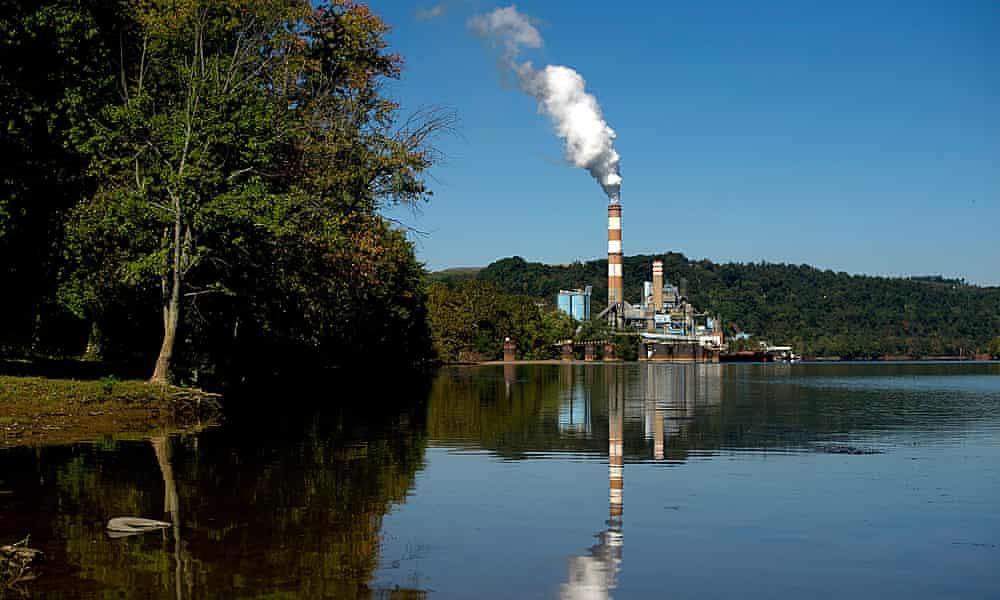
Of 265 US power plants that monitor groundwater, 242 report unsafe levels of at least one pollutant derived from coal ash
Thank you to all of you who have generously supported The Guardian’s journalism. Support from our readers helps protect our essential editorial independence, so if you value what we do, please support The Guardian today. Thank you.
Contribute
Subscribe
Manage your emails | Unsubscribe | Trouble viewing?
You are receiving this email because you are a subscriber to The Guardian Today US. Guardian News & Media Limited – a member of Guardian Media Group PLC. Registered Office: Kings Place, 90 York Way, London, N1 9GU. Registered in England No. 908396
Posted in Fun | Comments Off on Most US coal plants are contaminating groundwater with toxins, analysis finds

Blue Dolphin Cottages — 16 Feb 2019

Bruce Potter443-454-9044

Posted in Fun | Comments Off on Blue Dolphin Cottages — 16 Feb 2019

The Guardian Examines the US Empire in the 21st Century

From The Guardian — The long read: The United States likes to think of itself as a republic, but it holds territories all over the world – the map you always see doesn’t tell the whole story .

The long read

How the US has hidden its empire

The United States likes to think of itself as a republic, but it holds territories all over the world – the map you always see doesn’t tell the whole story. By Daniel Immerwahr

Fri 15 Feb 2019 01.00 EST Last modified on Fri 15 Feb 2019 08.28 EST

There aren’t many historical episodes more firmly lodged in the United States’s national memory than the attack on Pearl Harbor. It is one of only a few events that many people in the country can put a date to: 7 December 1941, the “date which will live in infamy,” as Franklin D Roosevelt put it. Hundreds of books have been written about it – the Library of Congress holds more than 350. And Hollywood has made movies, from the critically acclaimed From Here to Eternity, starring Burt Lancaster, to the critically derided Pearl Harbor, starring Ben Affleck.

But what those films don’t show is what happened next. Nine hours after Japan attacked the territory of Hawaii, another set of Japanese planes came into view over another US territory, the Philippines. As at Pearl Harbor, they dropped their bombs, hitting several air bases, to devastating effect.

The attack on Pearl Harbor was just that – an attack. Japan’s bombers struck, retreated and never returned. Not so in the Philippines. There, the initial air raids were followed by more raids, then by invasion and conquest. Sixteen million Filipinos – US nationals who saluted the stars and stripes and looked to FDR as their commander in chief – fell under a foreign power.

Contrary to popular memory, the event familiarly known as “Pearl Harbor” was in fact an all-out lightning strike on US and British holdings throughout the Pacific. On a single day, the Japanese attacked the US territories of Hawaii, the Philippines, Guam, Midway Island and Wake Island. They also attacked the British colonies of Malaya, Singapore and Hong Kong, and they invaded Thailand.

At first, “Pearl Harbor” was not the way most people referred to the bombings. “Japs bomb Manila, Hawaii” was the headline in one New Mexico paper; “Japanese Planes Bomb Honolulu, Island of Guam” in another in South Carolina. Sumner Welles, FDR’s undersecretary of state, described the event as “an attack upon Hawaii and upon the Philippines”. Eleanor Roosevelt used a similar formulation in her radio address on the night of 7 December, when she spoke of Japan “bombing our citizens in Hawaii and the Philippines”.

That was how the first draft of FDR’s speech went, too: it presented the event as a “bombing in Hawaii and the Philippines”. Yet Roosevelt toyed with that draft all day, adding things in pencil, crossing other bits out. At some point he deleted the prominent references to the Philippines.

Why did Roosevelt demote the Philippines? We don’t know, but it’s not hard to guess. Roosevelt was trying to tell a clear story: Japan had attacked the US. But he faced a problem. Were Japan’s targets considered “the United States”? Legally, they were indisputably US territory. But would the public see them that way? What if Roosevelt’s audience didn’t care that Japan had attacked the Philippines or Guam? Polls taken slightly before the attack show that few in the continental US supported a military defense of those remote territories.

Roosevelt no doubt noted that the Philippines and Guam, although technically part of the US, seemed foreign to many. Hawaii, by contrast, was more plausibly “American”. Although it was a territory rather than a state, it was closer to North America and significantly whiter than the others.

Yet even when it came to Hawaii, Roosevelt felt a need to massage the point. So, on the morning of his speech, he made another edit. He changed it so that the Japanese squadrons had bombed not the “island of Oahu”, but the “American island of Oahu”. Damage there, Roosevelt continued, had been done to “American naval and military forces”, and “very many American lives” had been lost.

An American island, where American lives were lost – that was the point he was trying to make. If the Philippines was being rounded down to foreign, Hawaii was being rounded up to “American”.

One reporter in the Philippines described the scene in Manila as the crowds listened to Roosevelt’s speech on the radio. The president spoke of Hawaii and the many lives lost there. Yet he only mentioned the Philippines, the reporter noted, “very much in passing”. Roosevelt made the war “seem to be something close to Washington and far from Manila”.

This was not how it looked from the Philippines, where air-raid sirens continued to wail. “To Manilans the war was here, now, happening to us,” the reporter wrote. “And we have no air-raid shelters.”

Hawaii, the Philippines, Guam – it wasn’t easy to know how to think about such places, or even what to call them. At the turn of the 20th century, when many were acquired (Puerto Rico, the Philippines, Guam, American Samoa, Hawaii, Wake), their status was clear. They were, as Theodore Roosevelt and Woodrow Wilson unabashedly called them, colonies.

That spirit of forthright imperialism didn’t last. Within a decade or two, after passions had cooled, the c-word became taboo. “The word colony must not be used to express the relationship which exists between our government and its dependent peoples,” an official admonished in 1914. Better to stick with a gentler term, used for them all: territories.

Yet a striking feature of the overseas territories was how rarely they were even discussed. The maps of the country that most people had in their heads didn’t include places such as the Philippines. Those mental maps imagined the US to be contiguous: a union of states bounded by the Atlantic, the Pacific, Mexico and Canada.

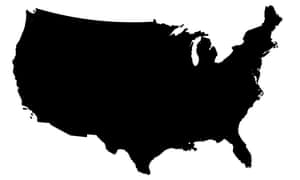
That is how most people envision the US today, possibly with the addition of Alaska and Hawaii. The political scientist Benedict Anderson called it the “logo map”, meaning that if the country had a logo, this shape would be it:

The US ‘logo map’

The problem with the logo map, however, is that it isn’t right. Its shape does not match the country’s legal borders. Most obviously, the logo map excludes Hawaii and Alaska, which became states in 1959 and now appear on virtually all published maps of the country. But it is also missing Puerto Rico, which, although not a state, has been part of the country since 1899. When have you ever seen a map of the US that had Puerto Rico on it? Or American Samoa, Guam, the US Virgin Islands, the Northern Marianas or any of the other smaller islands that the US has annexed over the years?

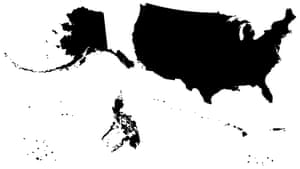
In 1941, the year Japan attacked, a more accurate picture would have been this:

The ‘Greater United States’ map
A map of the ‘Greater United States’ as it was in 1941

What this map shows is the country’s full territorial extent: the “Greater United States”, as some at the turn of the 20th century called it. In this view, the place normally referred to as the US – the logo map – forms only a part of the country. A large and privileged part, to be sure, yet still only a part. Residents of the territories often call it the “mainland”.

On this to-scale map, Alaska isn’t shrunken down to fit into a small inset, as it is on most maps. It is the right size – ie, huge. The Philippines, too, looms large, and the Hawaiian island chain – the whole chain, not just the eight main islands shown on most maps – if superimposed on the mainland would stretch almost from Florida to California.

This map also shows territory at the other end of the size scale. In the century before 1940, the US claimed nearly 100 uninhabited islands in the Caribbean and the Pacific. Some claims were forgotten in time – Washington could be surprisingly lax about keeping tabs. The 22 islands included here are the ones that appeared in official tallies (the census or other governmental reports) in the 1940s. I have represented them as clusters of dots in the bottom left and right corners, although they are so small that they would be invisible if they were drawn to scale.

The logo map is not only misleading because it excludes large colonies and pinprick islands alike. It also suggests that the US is a politically uniform space: a union, voluntarily entered into, of states standing on equal footing with one another. But that is not true, and it has never been true. From its founding until the present day, the US has contained a union of American states, as its name suggests. But it has also contained another part: not a union, not states and (for most of its history) not wholly in the Americas – its territories.

What is more, a lot of people have lived in that other part. According to the census count for the inhabited territories in 1940, the year before Pearl Harbor, nearly 19 million people lived in the colonies, the great bulk of them in the Philippines. That meant slightly more than one in eight of the people in the US lived outside of the states. For perspective, consider that only about one in 12 was African American. If you lived in the US on the eve of the second world war, in other words, you were more likely to be colonised than black.

My point here is not to weigh forms of oppression against one another. In fact, the histories of African Americans and colonised peoples are tightly connected (and sometimes overlapping, as for the African-Caribbeans in Puerto Rico and the US Virgin Islands). The racism that had pervaded the country since slavery also engulfed the territories. Like African Americans, colonial subjects were denied the vote, deprived of the rights of full citizens, called racial epithets, subjected to dangerous medical experiments and used as sacrificial pawns in war. They, too, had to make their way in a country where some lives mattered and others did not.

What getting the Greater United States in view reveals is that race has been even more central to US history than is usually supposed. It hasn’t just been about black and white, but about Filipino, Hawaiian, Samoan and Chamoru (from Guam), too, among other identities. Race has not only shaped lives, but also the country itself – where the borders went, who has counted as “American”. Once you look beyond the logo map, you see a whole new set of struggles over what it means to inhabit the US.


Looking beyond the logo map, however, could be hard for mainlanders. The national maps they used rarely showed the territories. Even the world atlases were confusing. During the second world war, Rand McNally’s Ready Reference Atlas of the World – like many other atlases at the time – listed Hawaii, Alaska, Puerto Rico and the Philippines as “foreign”.

A class of seventh-grade girls at the Western Michigan College Training School in Kalamazoo scratched their heads over this. They had been trying to follow the war on their maps. How, they wondered, could the attack on Pearl Harbor have been an attack on the US if Hawaii was foreign? They wrote to Rand McNally to inquire.

“Although Hawaii belongs to the United States, it is not an integral part of this country,” the publisher replied. “It is foreign to our continental shores, and therefore cannot logically be shown in the United States proper.”

The girls were not satisfied. Hawaii is not an integral part of this country? “We believe this statement is not true,” they wrote. It is “an alibi instead of an explanation”. Further, they continued, “we feel that the Rand McNally atlas is misleading and a good cause for the people of outlying possessions to be embarrassed and disturbed”. The girls forwarded the correspondence to the Department of the Interior and asked for adjudication. Of course, the seventh-graders were right. As an official clarified, Hawaii was, indeed, part of the US.

Yet the government could be just as misleading as Rand McNally on this score. Consider the census: according to the constitution, census takers were required to count only the states, but they had always counted the territories, too. Or, at least, they had counted the continental territories. The overseas territories were handled differently. Their populations were noted, but they were otherwise excluded from demographic calculations. Basic facts about how long people lived, how many children they had, what races they were – these were given for the mainland alone.

The maps and census reports that mainlanders saw presented them with a selectively cropped portrait of their country. The result was profound confusion. “Most people in this country, including educated people, know little or nothing about our overseas possessions,” concluded a governmental report written during the second world war. “As a matter of fact, a lot of people do not know that we have overseas possessions. They are convinced that only ‘foreigners’, such as the British, have an ‘empire’. Americans are sometimes amazed to hear that we, too, have an ‘empire’.”


The proposition that the US is an empire is less controversial today. The case can be made in a number of ways. The dispossession of Native Americans and relegation of many to reservations was pretty transparently imperialist. Then, in the 1840s, the US fought a war with Mexico and seized a third of it. Fifty years later, it fought a war with Spain and claimed the bulk of Spain’s overseas territories.

Empire isn’t just landgrabs, though. What do you call the subordination of African Americans? Starting in the interwar period, the celebrated US intellectual WEB Du Bois argued that black people in the US looked more like colonised subjects than like citizens. Many other black thinkers, including Malcolm X and the leaders of the Black Panthers, have agreed.

Or what about the spread of US economic power abroad? The US might not have physically conquered western Europe after the second world war, but that didn’t stop the French from complaining of “coca-colonisation”. Critics there felt swamped by US commerce. Today, with the world’s business denominated in dollars, and McDonald’s in more than 100 countries, you can see they might have had a point.

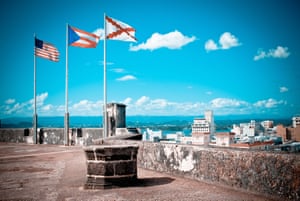
Flags on top of the fortress in Old San Juan in Puerto Rico.
Flags on top of the fortress in Old San Juan in Puerto Rico. Photograph: Anton Gorbov/Alamy

Then there are the military interventions. The years since the second world war have brought the US military to country after country. The big wars are well-known: Korea, Vietnam, Iraq, Afghanistan. But there has also been a constant stream of smaller engagements. Since 1945, US armed forces have been deployed abroad for conflicts or potential conflicts 211 times in 67 countries. Call it peacekeeping if you want, or call it imperialism. But clearly this is not a country that has kept its hands to itself.

Yet among all the talk of empire, one thing that often slips from view is actual territory. Yes, many would agree that the US is or has been an empire, for all the reasons above. But how much can most people say about the colonies themselves? Not, I would wager, very much.

It is not as if the information isn’t out there. Scholars, many working from the sites of empire themselves, have assiduously researched this topic for decades. The problem is that their works have been sidelined – filed, so to speak, on the wrong shelves. They are there, but as long as we have the logo map in our heads, they will seem irrelevant. They will seem like books about foreign countries. The confusion and shoulder-shrugging indifference that mainlanders displayed at the time of Pearl Harbor hasn’t changed much at all.


I will confess to having made this conceptual filing error myself. Although I studied US foreign relations as a doctoral student and read countless books about “American empire” – the wars, the coups, the meddling in foreign affairs – nobody ever expected me to know even the most elementary facts about the territories. They just didn’t feel important.

It wasn’t until I travelled to Manila, researching something else entirely, that it clicked. To get to the archives, I would travel by “jeepney”, a transit system originally based on repurposed US army jeeps. I boarded in a section of Metro Manila where the streets are named after US colleges (Yale, Columbia, Stanford, Notre Dame), states and cities (Chicago, Detroit, New York, Brooklyn, Denver), and presidents (Jefferson, Van Buren, Roosevelt, Eisenhower). When I would arrive at my destination, the Ateneo de Manila University, one of the country’s most prestigious schools, I would hear students speaking what sounded to my Pennsylvanian ears to be virtually unaccented English. Empire might be hard to make out from the mainland, but from the sites of colonial rule themselves, it is impossible to miss.

The Philippines is not a US territory any more; it got its independence after the second world war. Other territories, although they were not granted independence, received new statuses. Puerto Rico became a “commonwealth”, which ostensibly replaced a coercive relationship with a consenting one. Hawaii and Alaska, after some delay, became states, overcoming decades of racist determination to keep them out of the union.

Yet today, the US continues to hold overseas territory. Besides Guam, American Samoa, the Northern Mariana Islands, Puerto Rico, the US Virgin Islands and a handful of minor outlying islands, the US maintains roughly 800 overseas military bases around the world.

None of this, however – not the large colonies, small islands, or military bases – has made much of a dent on the mainland mind. One of the truly distinctive features of the US’s empire is how persistently ignored it has been. This is, it is worth emphasising, unique. The British weren’t confused as to whether there was a British empire. They had a holiday, Empire Day, to celebrate it. France didn’t forget that Algeria was French. It is only the US that has suffered from chronic confusion about its own borders.

The reason is not hard to guess. The country perceives itself to be a republic, not an empire. It was born in an anti-imperialist revolt and has fought empires ever since, from Hitler’s Thousand-Year Reich and the Japanese empire to the “evil empire” of the Soviet Union. It even fights empires in its dreams. Star Wars, a saga that started with a rebellion against the Galactic Empire, is one of the highest-grossing film franchises of all time.

This self-image of the US as a republic is consoling, but it is also costly. Most of the cost has been paid by those living in the colonies and around the military bases. The logo map has relegated them to the shadows, which are a dangerous place to live. At various times, the inhabitants of the US empire have been shot, shelled, starved, interned, dispossessed, tortured and experimented on. What they haven’t been, by and large, is seen.

The logo map carries a cost for mainlanders, too. It gives them a truncated view of their own history, one that excludes part of their country. It is an important part. The overseas parts of the US have triggered wars, brought forth inventions, raised up presidents and helped define what it means to be “American”. Only by including them in the picture do we see a full portrait of the country – not as it appears in its fantasies, but as it actually is.

How to Hide an Empire: A Short History of the Greater United States by Daniel Immerwahr will be published by Bodley Head on 28 February. Buy it at guardianbookshop.com

Follow the Long Read on Twitter at @gdnlongread, or sign up to the long read weekly email here.


Posted in Fun | Comments Off on The Guardian Examines the US Empire in the 21st Century

14 February, 2019 18:22

Posted in Fun | Comments Off on 14 February, 2019 18:22

“Heart Healthy” Means Healthy

From the Washington Post February 7th

Opinions

Americans have healthier hearts. We have a healthier budget, too.

597ffc08-3352-468f-9b22-a80c9ce45f21.jpg
By Catherine Rampell, Columnist

February 7

Thanks to preventive medicine, older Americans have healthier hearts. Which also means, incidentally, that federal budgets are healthier, too.

At the turn of the millennium, health spending growth was spiraling out of control. Economists projected that the already ginormous health-care sector would soon gobble up monster portions of the federal budget and the entire economy. But something strange happened over the past decade and a half.

Rather than rocketing upward at ludicrous speed, health spending growth slowed — dramatically so.

That’s true whether we’re talking about public- or private-sector health spending; for Medicare, Medicaid, private insurance and out-of-pocket spending, annual outlays have been way lower than the doomsday forecasters anticipated. Curiously, too, the sharpest slowdown has occurred with Medicare.

In fact, about three-quarters of the health spending slowdown nationwide was due to slow-as-an-(almost)-trickle growth in spending on the elderly. From 1992 to 2004, per-capita spending among Medicare beneficiaries grew by 3.8 percent each year, adjusted for economy-wide inflation; since 2005, the rate has been a mere 1.1 percent, according to a new Health Affairs study.

In plain English, that means total spending per elderly person hasn’t fallen, per se, but we’re spending thousands of dollars less today than was projected to be the case back in the early 2000s.

AQVXB7RMSAI6TMAR3BIAMRG4TA.png
(Catherine Rampell/The Washington Post)

So who gets credit?

Some have attributed the spending slowdown to lousy economic conditions, although in retrospect the timing isn’t exactly right. The deceleration appears to have begun before the Great Recession, and it continued long after it ended. What’s more, Medicare spending should be relatively shielded from the business cycle, at least relative to the private sector.

Some have credited structural changes to the health-care system, including some of Obamacare’s cost-control measures. Maybe bundled payments and accountable care organizations are responsible — though studies so far suggest their effects have been modest compared with the magnitude of the overall changes in health spending trends. What’s more, the slowdown pre-dates Obamacare.

That new study suggests a different cause: Americans taking better care of their hearts.

The study, from a team of researchers led by Harvard economics professor David M. Cutler, focuses specifically on medical spending for the elderly. The authors began by disaggregating spending into categories, based on the condition a patient was being treated for — cancer, dementia and so on.

They noticed something striking. The categories with far and away the biggest slowdown in spending were related to heart health. Spending on cardiovascular and cerebrovascular diseases (heart attack, cardiac arrest, stroke, etc.) declined by $827 per person, relative to earlier trends. Spending on a related category called cardiovascular risk factors (high blood pressure, high cholesterol, diabetes) also fell $802 per person below the trend line.

BDG5VGBMSAI6TMAR3BIAMRG4TA.png
(Catherine Rampell/The Washington Post)

Altogether, the researchers calculated that more than half of the elderly spending slowdown was because of slower spending on cardiovascular diseases and conditions. In dollar terms, this means the slowdown in cardiovascular spending growth effectively saved the Medicare program about $34 billion in 2012 (the most recent year of data available).

You can see similar results in other health stats. Elderly death rates for cardiovascular diseases, for instance, have plummeted, according to data from the Centers for Disease Control and Prevention.

JMC6T4RLGUI6TMX4OILRREB37Q.png
(Catherine Rampell/The Washington Post)

These are significant findings, with major policy implications.

The conventional wisdom among health policy experts has long been that preventive medicine does not save money. It has other virtues — including, well, making people healthier. That’s quite a good thing! But study after study has found that in dollar terms, at least, investing more in preventive care doesn’t pay off.

This new paper suggests that at least when it comes to heart health, that’s not the case.

Lower-than-expected cardiovascular spending appears to be primarily due to successful use of preventive measures, the authors find. Greater use of statins, anti-hypertensives, diabetes medications and aspirin has helped prevent lots of expensive health events and contributed to outright declines in hospital admissions for heart disease and stroke.

“We think that half of the reduction in cardiovascular cost growth is a result of more people taking medications and taking them more regularly,” Cutler said.

Why are people taking their meds more regularly? The authors don’t know for sure, but there are a few possibilities. There’s more awareness of the need for treatment, for one. But also, a bunch of existing drugs went off patent and got cheaper. And in 2006, we got Medicare Part D, which reduced out-of-pocket prescription costs for many older people and probably led to more compliance.

Whether policymakers can duplicate these results for other health conditions and preventive therapies remains to be seen. But as the country debates the fiscal and moral merits of expanding health coverage, these latest findings are useful — and heartening? — data points.

Posted in Health | Comments Off on “Heart Healthy” Means Healthy

Another good one to toast. . .

From the Washington Post 

When you make your list of heroes, save a spot for Ernest Fitzgerald: smart, fearless, witty. Makes James Comey (whom I like) look like sort of a doofus. He also gets bonus points for continuing to work to the end of his career, in spite of the leaders’ attempts to ostracize him.

Obituaries

A. Ernest Fitzgerald, Pentagon whistleblower fired by Nixon, dies at 92

ZWFDMCRLBMI6TEDOTVK3MRI6WQ.jpg

A. Ernest Fitzgerald was a senior financial management specialist in the Air Force and one of the Pentagon’s most prominent whistleblowers. (U.S. Air Force)

By Harrison Smith

February 7 at 7:10 PM

A. Ernest Fitzgerald, a Pentagon official tasked with analyzing project expenses, was summoned to Capitol Hill in 1968 to discuss a new fleet of Lockheed C-5A transport planes before the Joint Economic Committee.

He had been instructed to play dumb about the cost.

He did not.

Under oath, he said the C-5A was $2 billion over budget. In testifying, Mr. Fitzgerald later said, he was merely “committing truth.”

The revelation about the vast cost overruns made national headlines, stunning members of Congress as well as Mr. Fitzgerald’s superiors. Back at the Pentagon, he was met with a blunt question from his secretary: “Have you been fired yet?”

Mr. Fitzgerald lasted another two years in his position before President Richard M. Nixon ordered his dismissal. He went on to sue Nixon, an action that resulted in a landmark U.S. Supreme Court case on presidential immunity and helped make him “America’s best-known whistleblower,” The Washington Post wrote in 1987.

Through his more than 50 subsequent appearances on Capitol Hill, said Danielle Brian, executive director of the Project on Government Oversight (POGO), Mr. Fitzgerald all but single-handedly “created the concept of Pentagon waste and fraud. People didn’t even think about it. And now they very much understand it is happening,” even as policymakers have failed “to listen to his message,” she said.

Mr. Fitzgerald, alternately dubbed “the patron saint of government whistleblowers” and “the most hated man in the Air Force,” was 92 when he died Jan. 31, exactly 46 years after Nixon’s Oval Office taping system recorded the president discussing Mr. Fitzgerald’s ouster.

“This guy that was fired,” he told aide Charles W. Colson, “I’d marked it in the news summary. That’s how that happened. I said get rid of that son of a bitch.”

“The point was not that he was complaining about the overruns,” Nixon said in a separate conversation that day, “but that he was doing it in public. . . . And not, and frankly, not taking orders.”

The transcripts were made public as part of Mr. Fitzgerald’s effort to win $3.5 million in damages from Nixon and three of his aides — the final chapter in a legal saga that began soon after his C-5A testimony, when the Air Force inundated him with busy work, investigated his private life and launched a smear campaign against him, according to court documents.

In 1970, he was laid off from his position as a senior financial management specialist; he was told that it was part of a general staff reduction. Mr. Fitzgerald fought the dismissal with a lawsuit, and in 1973 the Civil Service Commission took his side, ordering his reinstatement with around $80,000 in back pay.

But while his job title was the same, the work was not.

“I’m completely excluded from the big weapons systems jobs,” Mr. Fitzgerald told The Post. “They keep me out of Boeing’s and Lockheed’s hair and all the big ones.” He was instead ordered to examine maintenance depots. As his daughter Nancy Fitzgerald-Greene said in an interview, the Air Force “put him in charge of inspecting bowling alleys in Thailand.”

In 1974, Mr. Fitzgerald sued again, this time targeting Nixon, in an action that went to the Supreme Court. In 1982, the justices ruled 5 to 4 that the president was “entitled to absolute immunity,” with Justice Lewis F. Powell Jr. explaining that “because of the singular importance of the president’s duties, diversion of his energies by concern with private lawsuits would raise unique risks to the effective functioning of government.”

By then, however, Mr. Fitzgerald had won a victory of sorts: One year earlier, Nixon had secretly paid him $144,000 to keep the case from going to trial. Previously, Newsweek reported, the former president had offered to contact President Jimmy Carter to see whether he might be able to arrange Mr. Fitzgerald’s appointment to director of the Office of Management and Budget.

The Pentagon, however, remained Mr. Fitzgerald’s home for decades. Poring over contracts and financial records, he testified dozens of times before Congress and forged close relationships with leaders of both parties. In a tribute to Mr. Fitzgerald given Wednesday on the Senate floor, Sen. Charles E. Grassley (R-Iowa) called him “a tenacious watchdog . . . a hero for taxpayers and a warrior against waste.” Years earlier, Proxmire told People magazine that Mr. Fitzgerald was “one of the very few people in government who has made a difference.”

In the early 1980s, as part of his battle against Pentagon waste and inefficiency, Mr. Fitzgerald developed the idea for the Project on Military Procurement, which evolved into POGO. The organization was designed to build on the findings of Pentagon insiders such as Mr. Fitzgerald, who uncovered inflated costs as well as evidence of falsified weapons tests, in which defense contractors were “cutting corners to get things out into the field,” Brian said.

Mr. Fitzgerald, who retired in 2006, also devised a novel strategy for explaining the extent of wasteful spending in the military, which he once estimated at $30 billion each year.

“An average person cannot relate to the overpricing of an airplane like the F-15 fighter or B-1 bomber or an M-1 tank, so first, we have to explain how the Pentagon’s overpricing scam works in terms of things they are familiar with, like toilet seats, hammers, screws, ashtrays, etc.,” he said, according to a remembrance by fellow military analyst Franklin C. “Chuck” Spinney. “Then, step 2 is simply to explain how an F-15 or B-1 bomber or M-1 is simply a bundle of overpriced spare parts flying in close formation.”

Among Mr. Fitzgerald’s findings: A plastic stool-leg cap that cost 34 cents, but was billed at $916.55; labor for a Boeing cruise missile, estimated at $14 an hour but paid at $114; and a six-inch airplane maintenance tool that, inexplicably, cost $11,492.

Separately, railing against unnecessary spending on large-scale defense projects, he cited a maxim he dubbed Fitzgerald’s First Law: “There are only two phases of a program. The first is, ‘It’s too early to tell.’ The second: ‘It’s too late to stop.’ ”

[A. Ernest Fitzgerald knows the price of exposing cost overruns]

The older of two children, Arthur Ernest Fitzgerald was born in Birmingham, Ala., on July 31, 1926. His father was a patternmaker, and his mother ran a small farm.

Mr. Fitzgerald served in the Navy during World War II and received a bachelor’s degree from the University of Alabama in 1951. He worked in the aerospace industry and formed a consulting firm before joining the Air Force as a civilian in 1965.

By then he had developed a specialty, cost-cutting, that helped him earn a nomination for the Defense Department’s Distinguished Civilian Service Award. But the praise stopped flowing after the C-5A hearings, and during the years he was out of work, he and his family “went to the rice and beans diet a lot,” Fitzgerald-Greene said.

Mr. Fitzgerald died at an assisted-living center in Falls Church, Va., she said. The cause was not immediately known. His wife of more than 50 years, the former Nell Burroughs, died in 2012. In addition to Fitzgerald-Greene, of Falls Church, survivors include two other children, Susan Fitzgerald of Vienna, Va., and John P. Fitzgerald of Marlow, Ala.; and four grandchildren.

The precise cause of death was not immediately known, his daughter said.

While Mr. Fitzgerald had some success in renegotiating Air Force contracts and eliminating inefficiencies, he said his efforts to spur broader changes were repeatedly blocked. He recalled Air Force Gen. John “Zeke” Zoeckler once telling him, “inefficiency is national policy.”

“Some of the Pentagon scams we once deplored are viewed as virtues,” Mr. Fitzgerald said in 1996, in a mournful acceptance speech for the Paul H. Douglas Ethics in Government Award. “The unit costs of defense are scandalously high, and going up. Porking-up contracts for political purposes, always present, but formerly stoutly denied, is now a good thing. It makes good jobs.”

Posted in Governance | Comments Off on Another good one to toast. . .